
 Worksheets
3l3ct120n 3n3126y l3v3l
Total questions: 30
Worksheet time: 32mins
What is an energy level in an atom?
The total number of protons in an atom.
A type of chemical bond between atoms.
An energy level in an atom is a quantized state that electrons can occupy, defined by specific energy values.
A measurement of an atom's size.
Describe the process of energy level transitions.
Energy level transitions occur only in molecules, not in atoms.
Electrons can only exist in a single energy level at a time.
Energy levels are fixed and do not change with temperature.
Energy level transitions involve electrons moving between different energy levels in an atom due to absorption or emission of energy.
What happens to an electron when it absorbs a photon?
The electron remains in the same energy level without any change.
The electron loses energy and falls to a lower energy level.
The electron gains energy and moves to a higher energy level or is ejected from the atom.
The electron is transformed into a neutron within the atom.
Explain the concept of photon emission.
Photon emission occurs when a photon is absorbed by an electron.
Photon emission is the release of energy in the form of a photon when an electron transitions between energy levels in an atom.
Photon emission is the process of converting light into sound.
Photon emission is the creation of photons from nuclear reactions.
What is the significance of the ground state in an atom?
The ground state is the highest energy state of an atom.
The ground state has no effect on an atom's stability.
The ground state is the lowest energy state of an atom, determining its stability and chemical properties.
The ground state is only relevant in ionic compounds.
Describe what occurs during a transition from a higher to a lower energy level.
An electron loses mass when moving to a lower energy level.
An electron remains stationary during the transition between energy levels.
An electron absorbs energy as a photon when transitioning to a lower energy level.
An electron releases energy as a photon when transitioning from a higher to a lower energy level.
How can energy level transitions be observed experimentally?
Energy level transitions can be observed using thermal imaging.
Energy level transitions can be observed through mechanical vibrations.
Energy level transitions can be observed with magnetic resonance imaging.
Energy level transitions can be observed using spectroscopy.
In the context of flame tests, why do different elements emit different colors when heated?
Because they all have the same number of electrons
Because of the differences in gravitational pull on the electrons
Because electrons jump to higher energy levels and then fall back down, releasing energy in the form of light
Because of the differences in the atomic mass of the elements
What is the principle behind the energy quantization in the Bohr model?
Electrons can only occupy certain orbits with specific energies.
Electrons can freely move between orbits without energy quantization.
The energy of electrons is continuous and not quantized.
Electrons in the outer orbits have less energy than those in inner orbits.
Why are energy levels in atoms quantized?
Because electrons can only exist in specific orbits with fixed energies.
Because electrons can move freely between any energy levels.
Because the nucleus allows only certain energy levels.
Because energy levels are continuous and not quantized.
What happens when an electron in an atom moves from a higher energy level to a lower energy level?
The atom absorbs a photon of light.
The atom remains in a stable state without releasing energy.
The atom releases a photon of light.
The electron's mass increases.
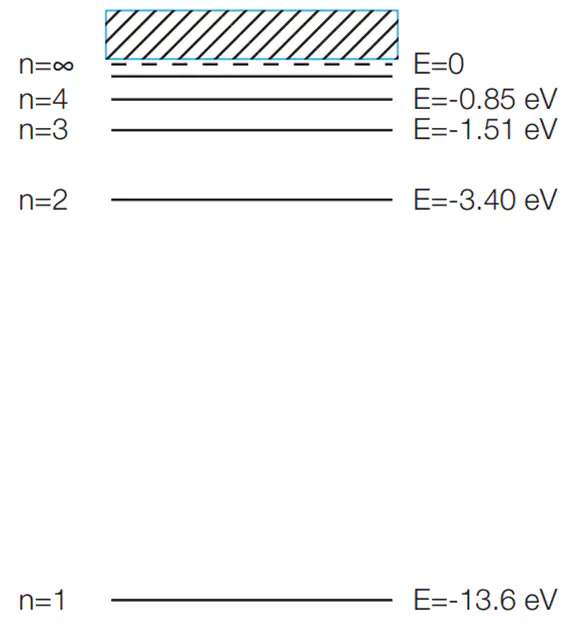
In an energy level diagram, the level "n = 3" refers to which energy state?
First excited state
Second excited state
Third excited state
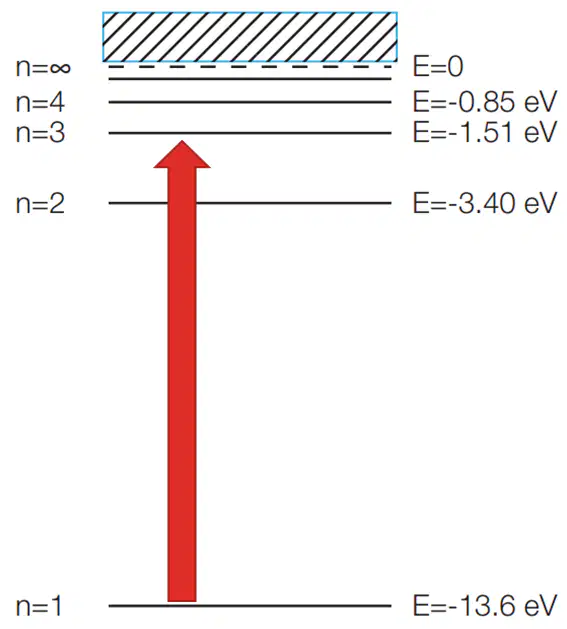
How does an electron transition to a higher energy state?
Absorbs energy
Releases energy
Magic
Incandescence
What energy is required to make the transition shown in the diagram?
13.6 eV
1.51 eV
12.09 eV
3.4 eV

When an electron in an atom is excited by a photon, what do we know about the energy of the photon?
Must exactly match the difference between energy levels
Must be greater than the difference between energy levels
Must be lesser than the difference between energy levels
Must have the same energy as the higher energy level
Which electron transition in the hydrogen atom has the LARGEST change in energy?
n=2 → n=1
n=1 → n=3
n=4 → n=1
n=1 → n=5
Which electron transition in the hydrogen atom EMITS a photon with the LONGEST wavelength?
n=2 → n=1
n=1 → n=2
n=3 → n=1
n=1 → n=3
Which electron transition in the hydrogen atom ABSORBS a photon with the SHORTEST wavelength?
n=2 → n=1
n=1 → n=2
n=3 → n=1
n=1 → n=3

Which are absorption arrows?
a, b, c, d
e, f, g, h
a, e, b
d, c, h
Which are emission arrows?
a, b, c, d
e, f, g, h
a, e, b
d, c, h
Which arrow indicates absorption of the LONGEST WAVELENGTH? (hint: how do energy and wavelength relate?)
h
e
a
d
Which arrow indicates Emission of the SHORTEST WAVELENGTH? (hint: how do energy and wavelength relate?)
h
e
a
d
Which arrow indicates Absorption of the SHORTEST WAVELENGTH? (hint: how do energy and wavelength relate?)
h
e
a
d
Which arrow indicates Emission of the LONGEST WAVELENGTH? (hint: how do energy and wavelength relate?)
h
e
a
d
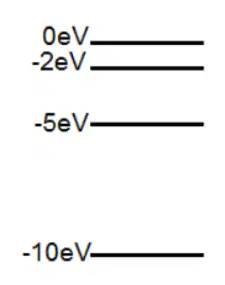

The diagram shows five energy levels in an atom. Electromagnetic radiation is incident on the atom. Which transition would be caused by the absorption of the lowest frequency of radiation?
1 → 5
1 → 2
4 → 5
5 → 4
An electron is accelerated through a large potential difference and gains a kinetic energy of 47 keV. This energy, expressed in joules, is equal to:
7.5 x 10⁻¹⁵ J
7.5 x 10⁻¹⁸ J
2.9 x 10²⁰ J
2.9 x 10²³ J
An electron is accelerated from rest through a potential difference of 5.0 kV. The kinetic energy gained by the electron is
8.0 x 10⁻¹⁶ J
8.0 x 10⁻¹⁹ J
3.2 x 10⁻²⁰ J
3.2 x 10⁻²³ J
The diagram shows some of the energy levels for a hydrogen atom. A free electron of kinetic energy 20.0 x 10⁻¹⁹ J collides with a hydrogen atom in its ground state. The hydrogen atom is excited from its ground state to the first excited state. Calculate the kinetic energy of the free electron after the collision.
1.8 x 10⁻¹⁹ J
3.6 x 10⁻¹⁹ J
5.4 x 10⁻¹⁹ J
16.4 x 10⁻¹⁹ J
Light of frequency 2.0×10¹⁵Hz is incident on a metal surface. The work function of the metal is 4.6×10⁻¹⁹J . Which statement is correct?
No photoelectrons are released.
Photoelectrons are released with a maximum kinetic energy of 3.1×10⁻¹⁹J
Photoelectrons are released with a maximum kinetic energy of 8.7×10⁻¹⁹J
Photoelectrons are released with a maximum kinetic energy of 18×10−19J

