
 Worksheets
Weather, Climate & Water Cycling CFA
Total questions: 30
Worksheet time: 15mins
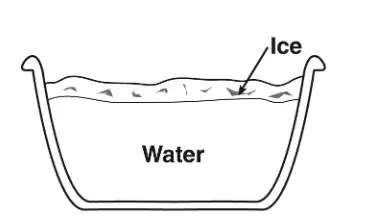
John fills a plastic bowl with water and puts it in a freezer. After an hour, he finds that a layer of ice has formed on the water. Which best explains why the ice formed?
The mass of the water changed.
Energy was released from the water.
A chemical reaction occurred at the surface of the water.
Molecules were exchanged between the environment and the water.
Which of these is an example of water changing from water vapor to liquid?
Moisture forming on a mirror when you breathe on it
Sweat forming on your body when you exercise
Ice cubes melting when you put them in a warm liquid
Rivers drying up during a very hot summer

An important step in the water cycle is evaporation. What energy changes occur when water evaporates?
Thermal energy causes the water molecules to move faster.
Potential energy in rain is used to convert liquid water to vapor.
Mechanical energy in the atmosphere separates water molecules.
Solar energy breaks down liquid water into hydrogen and oxygen.
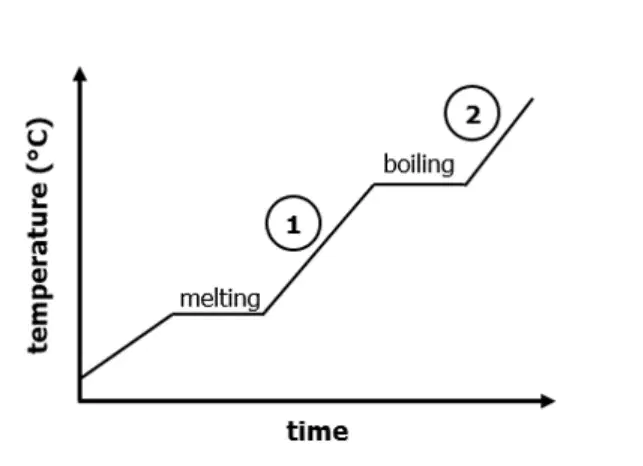
The graph shows how the temperature of a substance changes over time when heat is applied. Which particle diagram best represents the change in the substance from location 1 to location 2?

Diagram A

Diagram B

Diagram C

Diagram D
Water that evaporates from lakes and streams condenses into clouds and later falls as rain. The property of water that is demonstrated is the ability to
act as a universal solvent.
change from a liquid to a gas.
boil at a high temperature.
absorb large amounts of energy.
Which factor determines whether precipitation will be in the form of rain or snow?
wind
humidity
air pressure
temperature
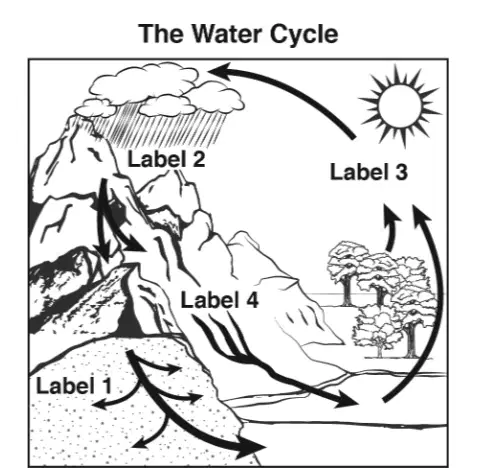
The diagram shows different processes that occur during the water cycle. Which label identifies the process of infiltration?
Label 1
Label 2
Label 3
Label 4
Ocean currents, prevailing wind patterns, and other atmospheric disturbances are initially caused by which of these?
Differences in the phases of the moon
Gravitational pull of the Sun
Incoming solar radiation
Ozone layer depletion
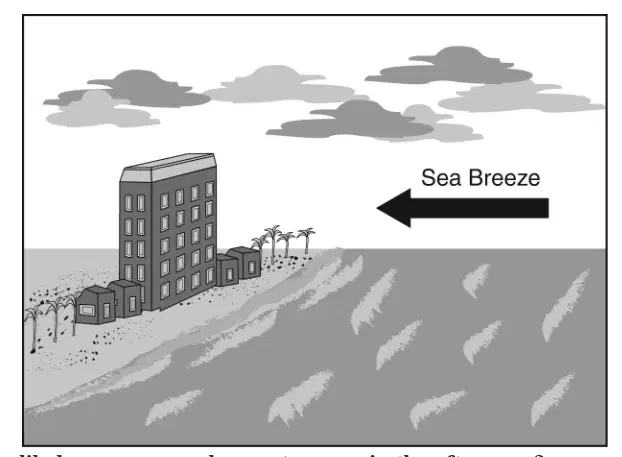
Which condition most likely causes a sea breeze to occur in the afternoon?
a thunderstorm forming over the land
a rise in pressure over the land and water
a cold front moving from the land toward the ocean
a temperature difference between the land and the water
How does the high moisture content from winds blowing inland from oceans affect the coastal area climate?
There is less condensation.
There are fewer hurricanes.
There is greater precipitation.
There are more smog-filled areas.
What is caused by prevailing winds and upper air currents?
flow of ocean currents
movement of air masses
the heights of clouds
sea and land breezes
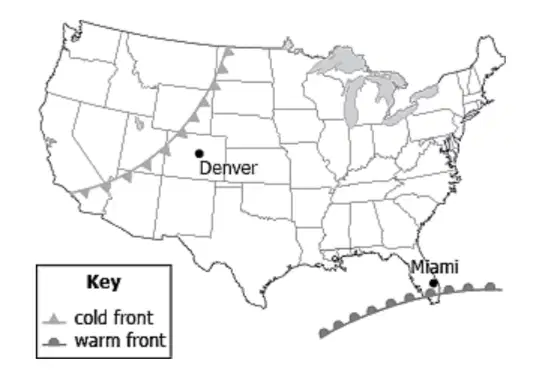
The map of the United States shows two fronts approaching Denver and Miami. What will likely happen to the air temperatures in Denver and Miami after the fronts pass?
Denver: Air temperature will increase. Miami: Air temperature will decrease.
Denver: Air temperature will decrease. Miami: Air temperature will increase.
Denver: Air temperature will increase. Miami: Air temperature will increase.
Denver: Air temperature will decrease. Miami: Air temperature will decrease.
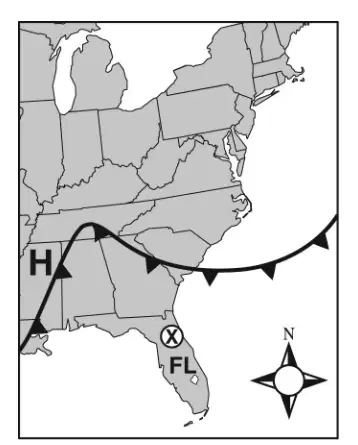
Based on the information, what is the best prediction for weather on the day after the system passes the point marked X?
Wet air with cooler temperatures
Drier air with cooler temperatures
Wet air with warmer temperatures
Drier air with warmer temperatures
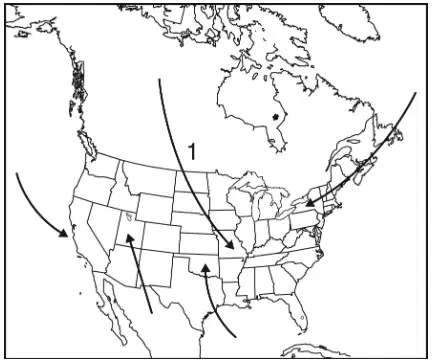
The arrows on the map represent the movement of air masses across North America. Air mass 1 would most likely bring which weather conditions to a region?
cool and dry
warm and dry
cool and humid
warm and humid
What happens to a moist air mass as it moves upward in the atmosphere?
It becomes warmer and forms clouds.
It becomes cooler and forms clouds.
Its temperature remains the same.
Its temperature varies greatly.
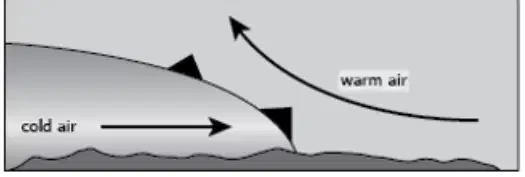
The diagram shows how a cold air mass collides with and slides under a warm air mass. Which weather condition will most likely result from this movement?
warmer temperatures and precipitation
warmer temperatures and clear skies
cooler temperatures and precipitation
cooler temperatures and clear skies

The motion of atoms is affected by temperature. The pictures show water at three different temperatures. Place the pictures in order of increasing motion of water atoms.
Picture 1 < Picture 3 < Picture 2
Picture 3 < Picture 1 < Picture 2
Picture 2 < Picture 3 < Picture 1
Picture 1 < Picture 2 < Picture 3
Which phase change in the atmosphere forms clouds?
evaporation
freezing
condensation
melting
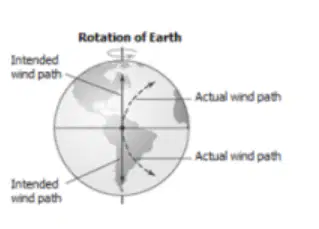
The diagram shows the global wind patterns on Earth in the Northern and Southern Hemispheres. Which factor explains the reason for the difference in intended and actual wind paths?
Coriolis effect
greenhouse effect
jet streams
trade winds
A student wants to make a model to show evaporation and condensation. How should the student make the model?
Fill a jar with water, and place it in an ice tray for 10 minutes.
Fill a pot with water, and place it over a flame for 10 minutes.
Fill a container with water, cover it with plastic film, and place it in sunlight.
Fill a tray with water, place a clay mound in the corner, and pour water over the mound.
An ice cube is placed in a glass, where it slowly begins to melt. What is true about the motion of the particles in the ice cube as it changes states?
The particle motion stops.
The particle motion increases.
The particle motion decreases.
The particle motion remains the same.
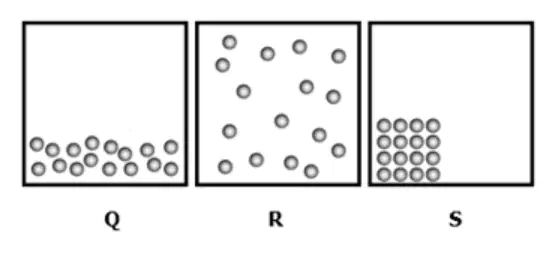
A student is examining three diagrams that show particle arrangements in a solid, liquid, and gas. Which sequence of particle diagrams represents decreasing kinetic energy of the particles?
Q → R → S
S → Q → R
R → S → Q
R → Q → S

The pie chart shows the distribution of the world’s available water. Based on the pie chart, which is the largest reservoir of freshwater?
glaciers
freshwater lakes
soil water
underground water
As part of the water cycle, water from Earth’s surface enters the clouds and finally falls back to the ground in the form of rain. What is the correct sequence of processes water undergoes?
evaporation → condensation → precipitation
precipitation → condensation → evaporation
condensation → evaporation → precipitation
evaporation → precipitation → condensation
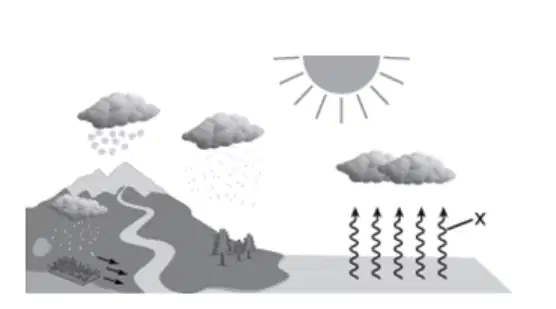
What are the next two stages in the water cycle that would immediately follow the stage marked X?
Condensation and precipitation
Transpiration and precipitation
Condensation and runoff
Precipitation and runoff
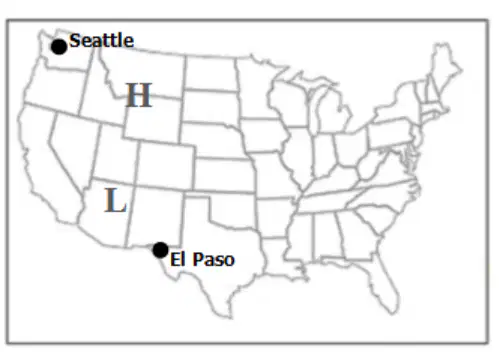
A low-pressure system is approaching El Paso. What kind of weather conditions are expected within the next day?
cloudy skies and rainy
cloudy skies and sunny
sunny and clear skies
sunny and rainy skies
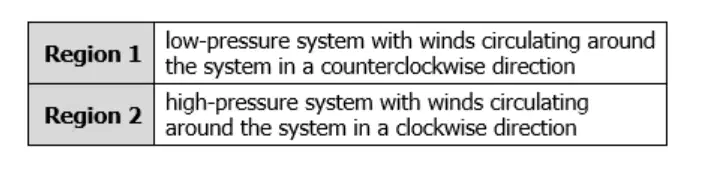
The image describes two pressure regions. Which weather conditions likely will exist in the two regions?
Regions 1 and 2 will have fair weather conditions.
Regions 1 and 2 will have stormy weather conditions.
Region 1 will have fair weather, and Region 2 will have stormy weather.
Region 1 will have stormy weather, and Region 2 will have fair weather.
A student conducts an investigation to study the impact of solar energy on land and water surfaces. What can the student conclude from his investigation?
Land heats up faster and releases heat faster than water.
Water heats up faster and releases heat faster than land.
Land heats up faster but releases heat slower than water.
Water heats up faster but releases heat slower than land.
Which statement correctly explains the formation of wind?
The rotation of Earth results in the creation of wind.
The Sun’s energy heats the air and influences its movement to create wind.
Warm ocean currents evaporate and condense into clouds to form wind.
The movement of objects such as trees all over Earth generates wind.
Which of these best explains the cause of convection currents in Earth’s atmosphere?
Heat from Earth’s core heats the land only at the equator.
Glaciers moving away from the poles cool Earth unevenly.
Sunlight is more concentrated in some places on Earth than others.
The light and heat reflected from the Moon varies as the Moon changes phases.

