
 Worksheets
Lesson 12 Assessment
Total questions: 54
Worksheet time: 38mins
As stated in his Farewell Address, which term best describes President Washington’s foreign policy?
aggression
isolationism
colonial expansion
alliance expansion

Which of these events challenged the foreign policy of President Adams?
attacks on U.S. ships
refusal of France to pay loans
Spanish invasion of the country
British policies toward African Americans
What did the Jay Treaty accomplish in 1796?
The United States bought land from Spain.
The British agreed to support the French Revolution.
The United States reserved land for American Indians.
The British removed their troops from the Ohio Valley.
Which slogan portrayed the U.S. response to the XYZ Affair?
Free trade and sailors' rights!
No taxation without representation!
Millions for defense, but not one cent for tribute!
First in war, first in peace, first in the hearts of his countrymen!
Which country was most responsible for the change in U.S. foreign policy at the end of the 18th century?
Spain
Mexico
Canada
Great Britain
Who was hurt most by Jefferson’s embargo on trade?
France
Great Britain
North African pirates
American sea workers
Which event led to the policies established by the Monroe Doctrine?
the pirating of ships in North Africa
the competition for trade between countries
the wars between Great Britain and France
the independence movement in Latin America
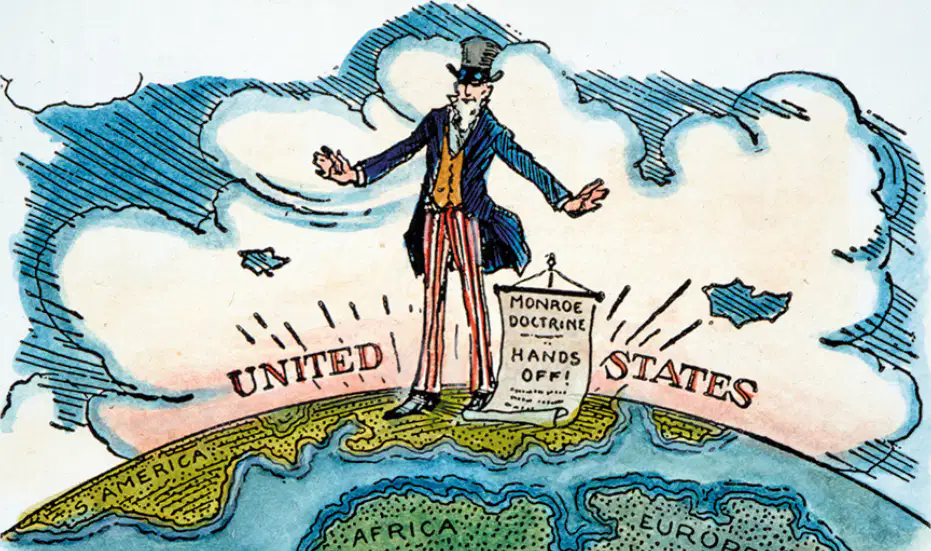
What was a goal of the Monroe Doctrine?
to put an end to attacks on U.S. ships
to warn against impressment of U.S. sailors
to encourage foreign trade with European merchants
to prevent European interference in North and South America
The banner bearing the Latin words E Pluribus Unum ("from many, one") symbolizes the creation of one nation
after many battles.
for many years to come.
out of many states.
Which symbols represent the original 13 states?
arrows and olive branch
stars and stripes
bald eagle and banner
The Monroe Doctrine warned European nations to
stop seizing American ships.
leave the Americas to the Americans.
end the impressment of U.S. sailors.
Britain justified its policy of impressing American seamen by arguing that these sailors
were needed to defeat France.
were deserters from the Royal Navy.
were poorly treated on U.S. ships.
In his Farewell Address, President Washington urged Americans to use a foreign policy based on
strong permanent alliances
isolationism and neutrality
involvement in world affairs
Why did France attack U.S. merchant ships after the Jay Treaty was signed in 1794?
France felt the Jay Treaty violated its own treaty with the United States.
France did not trust that the United States would follow the agreement.
France believed that Great Britain would break their side of the treaty.
France wanted the land that Great Britain had received in the treaty.
What is the name of the French military leader who took over the French government around the late 1700s?
Minister Talleyrand
Francis Scott Key
Oliver Hazard Perry
Napoleon Bonaparte
In 1800, France agreed to end their alliance with the United States. In return, the United States agreed to
cease all alliances and trade with Great Britain.
not ask France to pay for the ships it had seized.
get rid of isolationism as a form of foreign policy.
give up their land in Canada and Ohio Territory.
How did Great Britain affect the War of 1812 when it sent troops into Canada?
It allowed the United States to take Ohio Territory.
It ended the United States' plan to conquer Canada.
It caused the Indians to gain victory against Americans.
It forced Napoleon Bonaparte to lose European support.
What happened in Mexico in 1821 following a revolution inspired by Miguel Hidalgo?
Mexico joined forces with Great Britain.
Mexico went to war with the United States.
Mexico gained independence from Spain
Mexico became part of the Middle Colonies.
What was NOT true of the Battle of New Orleans?
A. It was the greatest American victory in the War of 1812.
B. It made a hero out of Andrew Jackson.
C. It left thousands of Americans dead and wounded
D. It helped Andrew Jackson eventually win the presidency
The Bombardment at Fort McHenry inspired what famous song?
God Bless America
Yankee Doodle
Star Spangled Banner
Canadian National Anthem
A closing off of an area to keep people or supplies from going in or out
blockade
embargo
isolationism
neutrality
A policy of not choosing sides in a dispute or war between other countries
blockade
embargo
isolationism
neutrality
A policy of avoiding political or military agreements with other countries
blockade
embargo
isolationism
neutrality
A government order that forbids trade with another country
blockade
embargo
isolationism
neutrality
What was NOT true of the Battle of New Orleans?
It was the greatest American victory in the War of 1812.
It made a hero out of Andrew Jackson.
It left thousands of Americans dead and wounded
It helped Andrew Jackson eventually win the presidency

John Adams, the second president of the United States, was a Federalist who wanted to
continue the policies of George Washington
go to a hair solon and have a good bath
start the XYZ affair
have lunch

During Adam's presidency, France and England were at war. This was a problem because
neither country wanted the United States to trade goods with the other.
he couldn't vacation in either France or England
his best friend was English
his best friend was French

The French Navy became aggressive and kidnapped our sailors, forcing them to fight, this is called....
impressment
forced fighting
french fries
french press

John Adams decided to keep out of the war..not to get involved with England (Britain) or France... this was following the policy of...
George Washington in his farewell address
his mother in law
Mr. Eling
the federalist party

To stop the French attack on our ships President Adams sent delegates to France, but the unnamed French Delegates named X, Y and Z ...
demanded a $250,000 bribe and a $10 million dollar loan for France before the U. S. Delegates could begin negotiations.
refused to talk
went on vacation
your mama


Washington's Secretary of The Treasury
Henry Knox
Alexander Hamilton
Thomas Jefferson
Edmund Randolph
In addition to British troops, who did the United States fight against in the War of 1812?
Native Americans
France
Barbary Pirates
Spain
Who led American troops at the Battle of New Orleans?
William Henry Harrison
James Madison
Andrew Jackson
George Washington
Native American who was forming a confederation of many diverse tribes against the US during the War of 1812
Chief Pontiac
Quanah Parker
Sitting Bull
Tecumseh

The practice of taking sailors from ships and forcing them into military service is known as___________________.
embargo
impressment
naval blockade
war hawks
In addition to defending America's honor, what did the War Hawks want from the War of 1812?
to help Napoleon
to take over Florida
to invade England
to take over Canada

In which city did the British burn several buildings?
Philadelphia
Boston
Washington D.C.
New York City
Why did the British seize American ships and impress sailors into service?
They were at war with France and wanted to prevent supplies from reaching their enemy.
They weren't actually seizing ships or sailors. It was a rumor spread by War Hawks.
They still considered America their colonies so they were just "taking what was theirs."
They were trying to push the Americans into a war.

Who wrote the National Anthem?
Francis Scott Key
Thomas Jefferson
James Madison
Dolly Madison
Even though it occurred after the official peace treaty was signed, why is the Battle of New Orleans important?
It encouraged a spirit of American nationalism and made Andrew Jackson a popular war hero.
It forced the British to give up all claims to land along the Mississippi River.
It convinced the Native American tribes to sign a peace treaty with the United States.
It demonstrated the United States' naval power and prompted France to request an alliance.

Which fort did the Americans defend in Baltimore?
Fort Necessity
Fort Bragg
Fort McHenry
Fort Knox

Who was President during the War of 1812?
Thomas Jefferson
James Madison
John Adams
George Washington
What town was the last hope for defending the US capitol at Washington?
Baltimore, Maryland
Bladensburg, Maryland
Yorktown, Virginia
Philadelphia, Pennsylvania
What specific fear was common in the southern states where slavery was widespread?
Slave rebellions
British stealing slaves
Disease epidemics
Slaves running away
Which of these was NOT a reason America declared war on Great Britain?
British impressment of Americans
To prove America had a superior navy
War Hawks desire to take Canada
British support of Native American attacks
British interference with American trade
Who lost the most in the War of 1812?
The British
The Americans
The Canadians
The Native Americans
Why did Americans admire Dolley Madison so much?
She served as a nurse to injured soldiers
She gave inspirational speeches
She showed bravery in saving Washington's portrait
She stood by her husband during war

