
 Worksheets
Asessment on Analytical Exposition Text
Total questions: 27
Worksheet time: 27mins
Name
Class
Date
1.
NAME (full name with capital letter)
4 lines
2.
CLASS OF 11
4 lines
3.
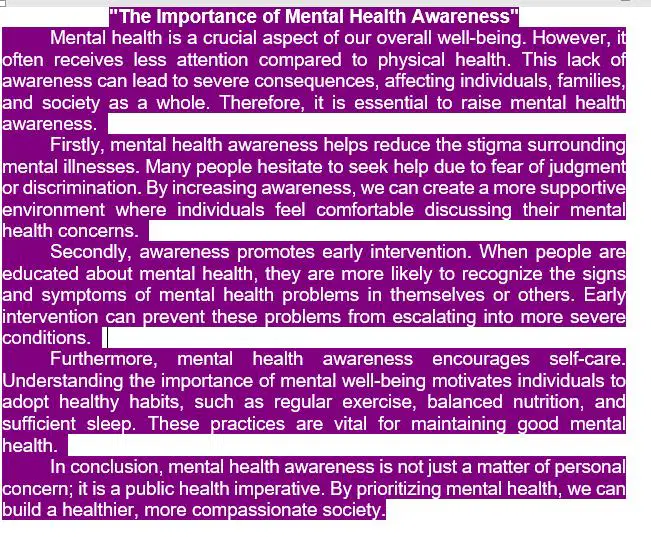
Which part of the passage serves as the writer's restatement of their position and a final thought?
a)
Mental health is a crucial aspect of our overall well-being...
b)
Firstly, mental health awareness helps reduce the stigma...
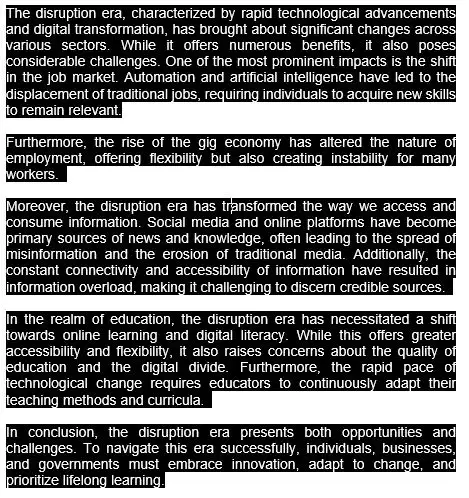
c)
Secondly, awareness promotes early intervention...
d)
Furthermore, mental health awareness encourages self-care...
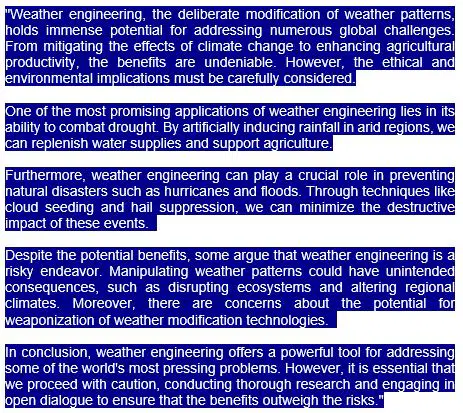
e)
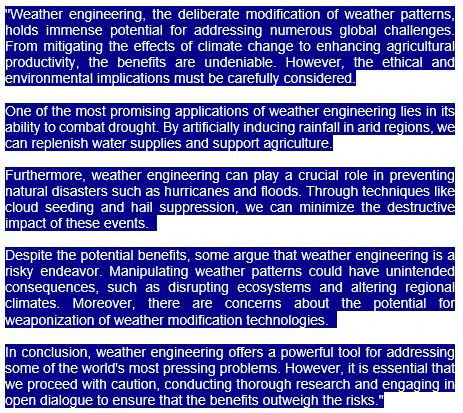
In conclusion, mental health awareness is not just a matter of personal
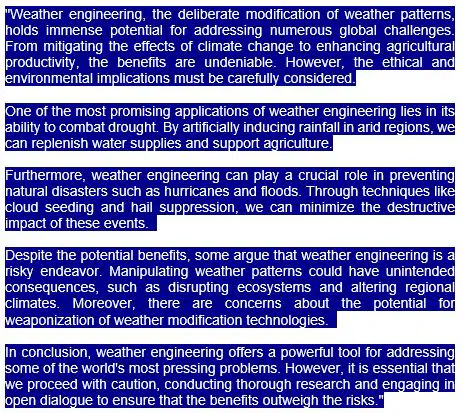
4.

What is the main idea of the second paragraph?
a)
The importance of physical health.
b)
The negative impact of mental health stigma.
c)
How to seek help for mental illnesses.
d)
The benefits of mental health awareness in reducing stigma.
e)
The danger of mental health concern.
5.
What is the writer's purpose in this text?
a)
To entertain readers with stories about mental health.
b)
To persuade readers that mental health awareness is important.
c)
To describe the symptoms of mental illnesses.
d)
To inform readers about the history of mental health.
e)
To explain the mental health treatment.
6.

Which of the following is an argument presented by the writer?
a)
Mental health is less important than physical health.
b)
Mental health awareness leads to early intervention.
c)
Only doctors can help with mental health problems.
d)
Mental illnesses are not real.
e)
Mental health is not public health imperative.
7.
Which of the following statements is an opinion?
a)
Mental health is a crucial aspect of our overall well-being.
b)
Lack of awareness can lead to severe consequences.
c)
Mental health awareness helps reduce stigma.
d)
Prioritizing mental health can build a healthier society.
e)
Regular exercise, balanced nutrition, and sufficient sleep are vital for maintaining good mental health.
8.
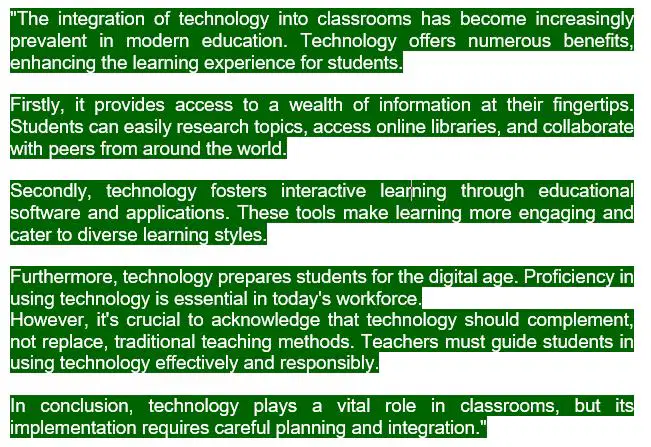
In the structure of an Analytical Exposition, what is the function of the paragraph that begins with "However, it's crucial to acknowledge..."?
a)
To introduce the thesis statement.
b)
To provide a counter-argument and rebuttal.
c)
To present the main arguments.
d)
To summarize the conclusion.
e)
To give a personal anecdote.
9.

What is the main idea of the text?
a)
Technology is the only solution to improve education.
b)
Technology should replace traditional teaching methods.
c)
Technology enhances learning but requires careful integration.
d)
Teachers should avoid using technology in classrooms.
e)
Technology is only beneficial for advanced students.
10.
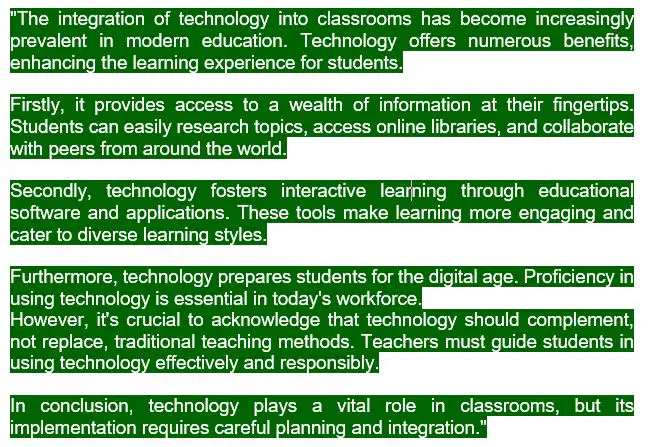
What is the writer's purpose in this text?
a)
To criticize the use of technology in classrooms.
b)
To persuade readers that technology is essential in education.
c)
To describe the history of technology in education.
d)
To compare traditional and modern teaching methods.
e)
To entertain readers with stories about technology in schools.
11.

Which of the following is an argument presented by the writer?
a)
Technology is expensive and difficult to implement.
b)
Technology distracts students from learning.
c)
Technology provides access to information and fosters interactive learning.
d)
Technology increases social isolation among students.
e)
Technology is only useful for science and technology subjects.
12.
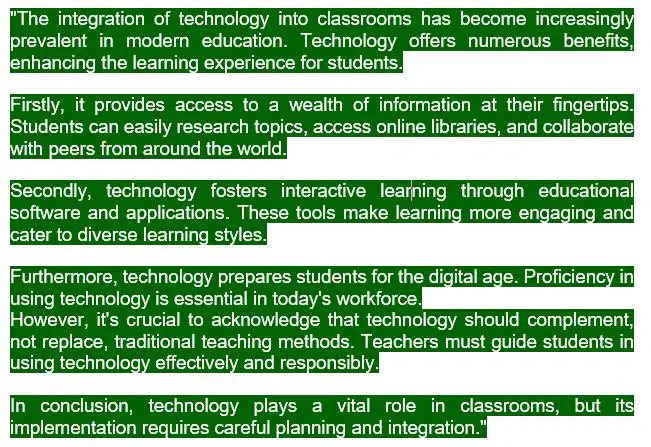
Which of the following statements is an opinion?
a)
Technology provides access to online libraries.
b)
Technology fosters interactive learning.
c)
Proficiency in using technology is essential in today's workforce.
d)
Technology enhances the learning experience for students.
e)
Teachers must guide students in using technology effectively.
13.
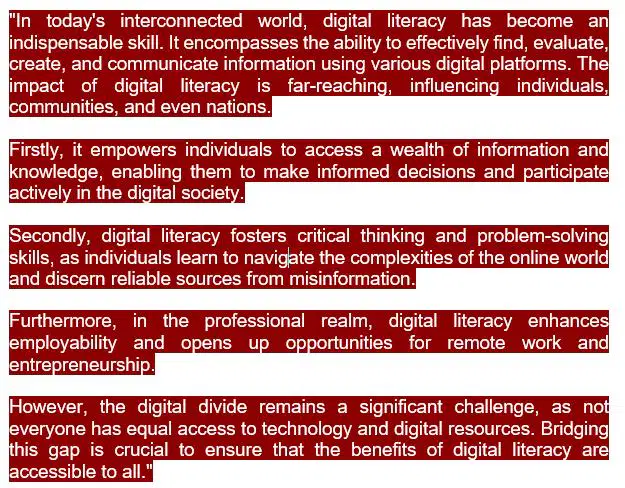
Which part of the passage provides the arguments supporting the writer's stance?
a)
"However, the digital divide remains a significant challenge..."
b)
"In today's interconnected world, digital literacy has become an indispensable skill..."
c)
"Firstly, it empowers individuals..." and "Secondly, digital literacy fosters critical thinking..." and "Furthermore, in the professional realm..."
d)
"Bridging this gap is crucial..."
e)
All sentences in the passage.
14.
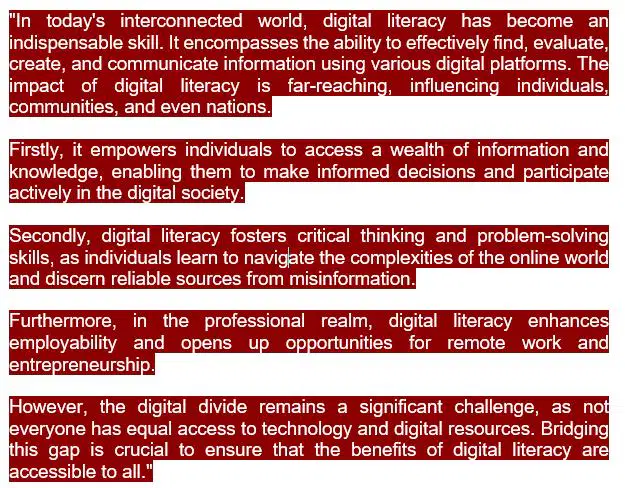
What is the main idea of this passage?
a)
The challenges of digital literacy.
b)
The importance and impact of digital literacy.
c)
The digital divide in modern society.
d)
How to improve digital literacy skills.
e)
The future of digital technology.
15.

What is the writer's primary purpose in this passage?
a)
To criticize the lack of digital literacy.
b)
To entertain readers with stories about digital technology.
c)
To inform and persuade readers about the significance of digital literacy.
d)
To compare different digital platforms.
e)
To describe the history of digital technology.
16.
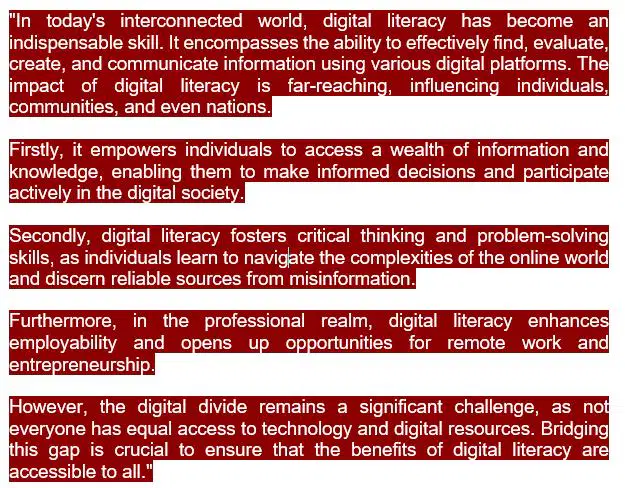
Which of the following is an argument presented by the writer?
a)
Digital literacy is only important for young people.
b)
Digital literacy can help individuals make informed decisions.
c)
All information found online is reliable.
d)
Digital technology is harmful to society.
e)
Digital literacy is a waste of time.
17.
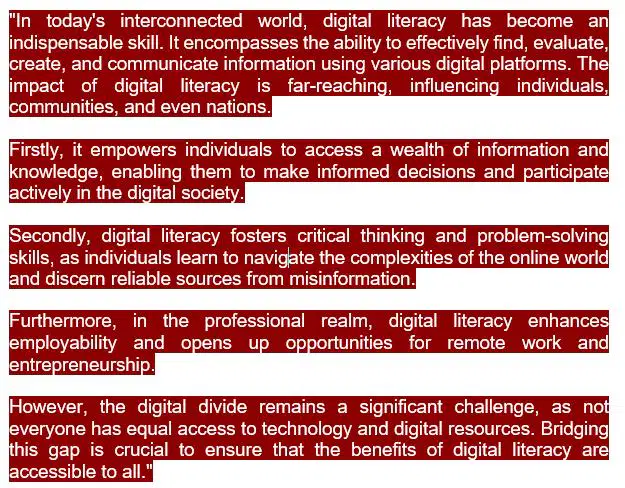
Which of the following statements is an opinion?
a)
Digital literacy enhances employability.
b)
The digital divide is a significant challenge.
c)
Digital literacy fosters critical thinking skills.
d)
Bridging the digital divide is crucial.
e)
Digital literacy includes the ability to evaluate information.
18.
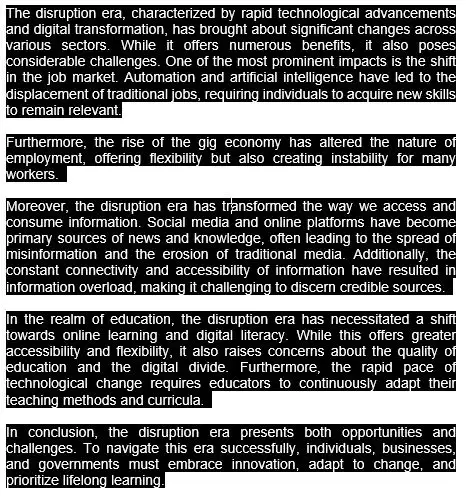
How does the conclusion in this passage relate to the thesis statement?
a)
It introduces a completely new idea.
b)
It contradicts the thesis statement.
c)
It restates the thesis and provides a summary of the arguments.
d)
It only focuses on the negative aspects.
e)
It only focuses on the positive aspects.
19.
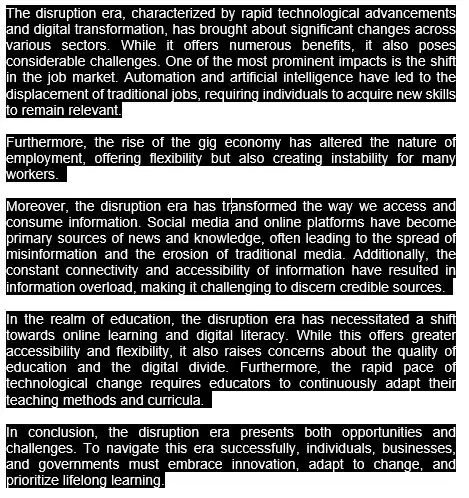
What is the main idea of the passage?
a)
The benefits of the disruption era outweigh the challenges.
b)
The disruption era has only negative impacts on society.
c)
The disruption era has brought about significant changes with both benefits and challenges.
d)
The disruption era has primarily affected the education sector.
e)
The disruption era is solely driven by technological advancements.
20.

What is the writer's purpose in this passage?
a)
To persuade readers to embrace the disruption era.
b)
To criticize the negative impacts of the disruption era.
c)
To inform readers about the various impacts of the disruption era.
d)
To entertain readers with stories about the disruption era.
e)
To compare the disruption era with previous eras.
21.

Which of the following is an argument presented by the writer?
a)
Traditional jobs are more stable than gig economy jobs.
b)
Social media is the most reliable source of information.
c)
Online learning is superior to traditional education.
d)
The disruption era requires continuous adaptation and learning.
e)
Technological advancements always lead to positive outcomes
22.
Which of the following statements is an opinion?
a)
Automation and AI have displaced traditional jobs.
b)
The gig economy offers flexibility but creates instability.
c)
Social media can lead to the spread of misinformation.
d)
The disruption era necessitates a shift towards online learning.
e)
The constant connectivity has resulted in information overload.
23.
How does the concluding paragraph relate to the thesis statement in terms of the generic structure of the analytical exposition?
a)
It contradicts the thesis statement.
b)
It restates and reinforces the thesis statement while adding a call for caution.
c)
It introduces a completely new topic.
d)
It only summarizes the counterarguments.
e)
It eliminates the thesis statement.
24.
What is the main idea of the passage?
a)
The dangers of weather engineering.
b)
The ethical implications of weather engineering.
c)
The potential benefits and risks of weather engineering.
d)
The history of weather engineering.
e)
The future of weather engineering.
25.
What is the writer's purpose in this passage?
a)
To persuade readers to support weather engineering.
b)
To inform readers about the benefits and risks of weather engineering.
c)
To entertain readers with stories about weather engineering.
d)
To criticize the use of weather engineering.
e)
To describe the process of weather engineering.
26.

Which of the following is an argument presented by the writer?
a)
Weather engineering is a proven technology.
b)
Weather engineering can solve all environmental problems.
c)
Weather engineering has the potential to mitigate drought and prevent natural disasters.
d)
Weather engineering is too expensive to implement.
e)
Weather engineering is only beneficial for developed countries.
27.
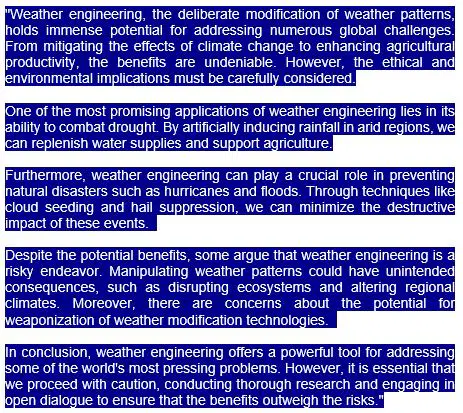
Which of the following statements is an opinion?
a)
Weather engineering is the deliberate modification of weather patterns.
b)
Weather engineering has ethical and environmental implications.
c)
Weather engineering can be used to combat drought.
d)
Weather engineering offers a powerful tool for addressing some of the world's most pressing problems.
e)
Weather engineering uses techniques like cloud seeding.
100 %

