
NEW
Font size
 Worksheets
Introduction to Landforms
Total questions: 26
Worksheet time: 4hrs 20mins


Which layer is composed mostly of iron?
Z
Y
V
X
Which layer of the Earth is the thinnest?
Crust
Mantle
Outer core
Inner core
Which of the following best describes Earth's asthenosphere?
Liquid rock that can reach the surface
Solid rock that is broken into plates
Dense molten rock that moves the crust
Metal rock at the center of the Earth

The diagram illustrates the movements of tectonic plates on Earth. Which statement best describes this diagram?
It shows the convection currents in the mantle.
It shows the convection currents in the outer core.
It shows the radiation of heat through the mantle.
It shows the conduction of heat in the mantle.
Which of the following statement best summarizes the Theory of Plate Tectonics?
The continents don't move and stay in their current locations.
There are convection currents in the mantle that move the Earth’s tectonic plates
The Earth’s lithosphere contains convection currents that move the mantle below.
The Earth is broken into sections that fit together into one super-continent.

Where does the heat come from that drives this convection current in the mantle?
The Crust
The Core
Mantle creates it's own heat
Convection currents move themselves
What is the shape of a magnetic field around the Earth?
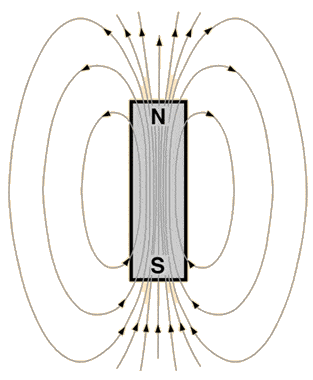
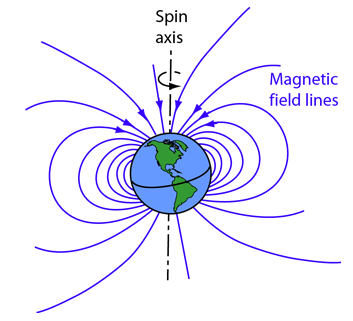
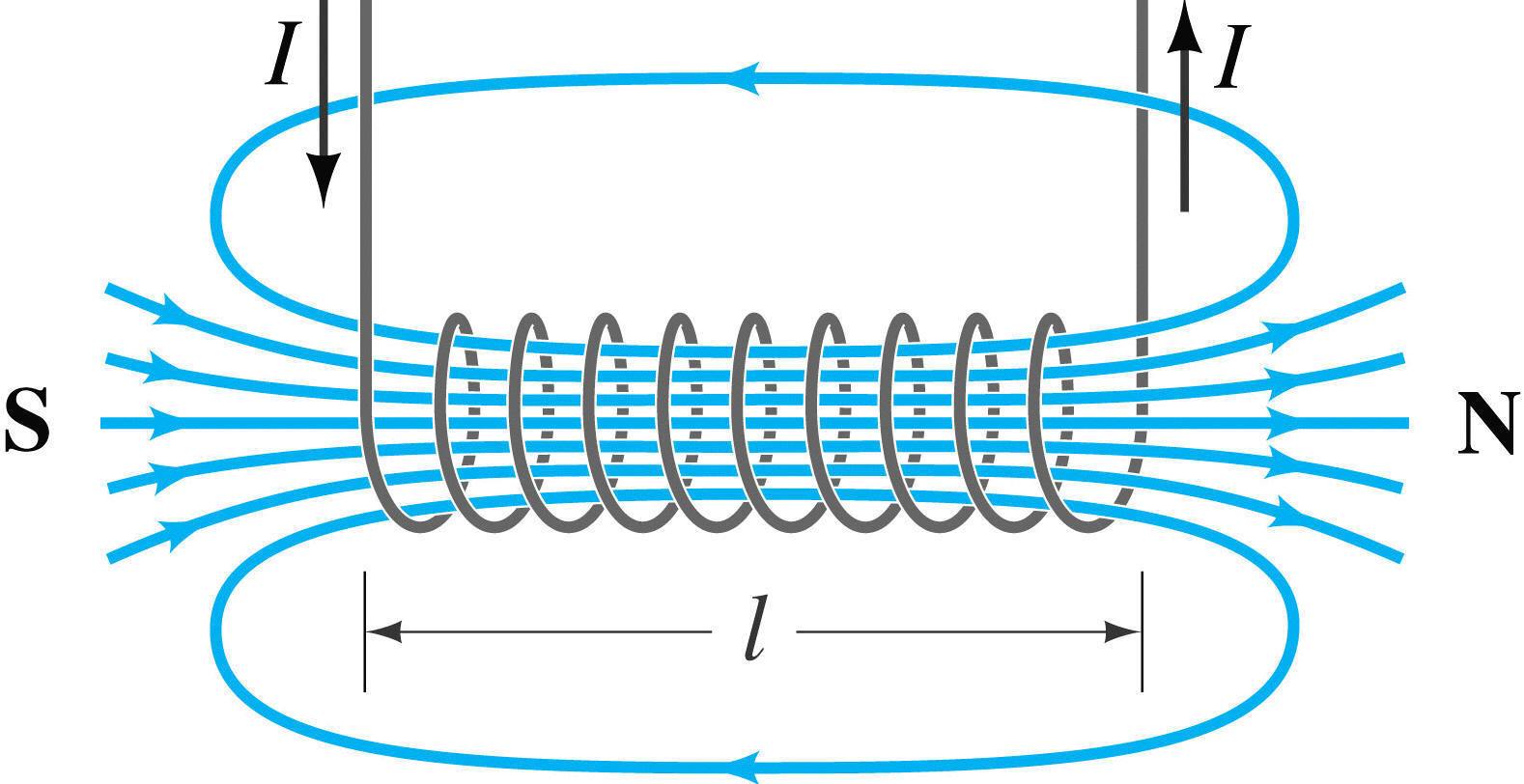
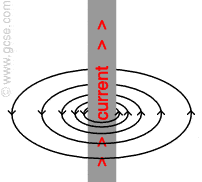
Earth is like a giant magnet due to....
its liquid iron core
the wind patterns of Coriolis Effect
the alignment of the continents
solar particles moving through the atmosphere
What is the main source of Earth's magnetic field?
Rotation of the Earth's crust
Movement of molten iron in the Earth's outer core
Gravity from the Moon
Heat from the Earth's core
What causes the Earth's magnetic field to flip?
Solar flares
Tectonic plate movements
Volcanic eruptions
Changes in the movement of molten iron in the outer core of the Earth
What is the role of Earth's magnetic field in protecting the planet?
Earth's magnetic field protects the planet from harmful solar radiation and charged particles.
Earth's magnetic field is used for navigation by animals and birds.
Earth's magnetic field is responsible for causing earthquakes and volcanic eruptions.
Earth's magnetic field helps in regulating the planet's temperature.
Differentiate between minerals and rocks
minerals are artificial occurring inorganic substances with definate chemical composition and physical properties found on or below the earth’s surface while rocks are an aggregate of mineral particles that form part of the earth crust.
minerals are found on the earths surface while rocks are found in the mantle
minerals are naturally occurring inorganic substances with definate chemical composition and physical properties found on or below the earth’s surface while rocks are an aggregate of mineral particles that form part of the earth crust.
rocks are naturally occurring inorganic substances with definate chemical composition and physical properties found on or below the earth’s surface while minerals are an aggregate of mineral particles that form part of the earth crust.
State three types of rocks
igneous,sedimentary and metamorphic rocks
Igneous ,gneis and metamorphosis
ignoous,sedimentary and metamorphic rocks
ignoous,sedimentary and metamorphic rocks
Alfred Wegener’s idea of continental drift was not complete because he didn’t know...
that the continents moved.
that the continents looked like puzzle pieces.
how the continents moved.
about Pangaea.
Why does oceanic crust subduct under continental crust when the two converge?
Oceanic crust subducts under continental crusts because they have the same density.
Oceanic crust subducts under continental crusts because oceanic crust is more dense than continental crust.
Oceanic crust subducts under continental crusts because oceanic crust is less dense than continental crust.
Oceanic crust does not subduct under continental crust.
Geological processes (like water or lava flowing) CAN change Earth's surface.
True
False

Which of the following is the correct definition for Lithosphere?
the rigid outer part of the Earth, consisting of the crust and upper mantle
the outermost region of the planet's atmosphere
the Earth's layer of silicate rock between the crust and outer core
the soft layer of the mantle on which tectonic plates move
What is the correct order of the earth's layers from inside to outside?
inner core, mantle, outer core, crust
outer core, inner core, mantle, crust
crust, mantle, outer core, inner core
inner core, outer core, mantle, crust

What causes convection currents?
Hot magma rises while cool magma sinks
The rotation of the Earth
Ocean currents pulling plates apart
The spinning of the Earth's core

What discontinuity in number 1 ?
Guttenberg discontinuity
Mohorovicic discontinuity
Lehmann discontinuity

