
 Worksheets
Stability Check
Total questions: 12
Worksheet time: 17mins
1-4.
Answer the questions below after watching the video
What is carrying capacity?
The maximum amount of organisms that an ecosystem can support
The minimum amount of organisms that an ecosystem can support
As a population nears the carrying capacity resources become
Increase
Limited
As the fish population continues to increase what happens?
They start to die from lack of food and water
They live long happy lives
Why does carrying capacity exist?
There are a limited amount of resources in an ecosystem
There is an infinite amount of resources in an ecosystem
Mice live in an ecosystem where they use berry bushes as their main food source. One day, a group of scientists released a second species of rabbit into the ecosystem that are much faster and better at obtaining the berry bushes than the mice.
How will this affect biodiversity and competitive exclusion? (select 2)
The new rabbit species will succeed in the competition for food over the mice
The mice will succeed in the competition for food over the new rabbits
The mice will be excluded from food and decrease in population size
The rabbits will be excluded from food and decrease in population size
English Ivy is an invasive plant species now found in North America. In an effort to control the
English Ivy, biologists tested and released three caterpillar species to feed on the plant.
Which result is an unintended negative consequence of releasing these caterpillar species into the environment?
There will be an increase in the available habitat for non-native plant species.
There will be an increase in the population numbers of native caterpillar species in the habitat.
There will be an increase in competition for food resources among the native caterpillars and the ones released by the scientists
There will be an increase in pollination of native plant species.
Wolves and Rabbits have a predator prey relationship. Wolves hunt down the rabbits for food. Which of the following are true about their relationship? (select 2)
In the absence of the wolves or other predators, the rabbit population could be at risk of exponential
growth.
The stability of the rabbit population is dependent on the stability of the wolf population.
There will always be more predators than prey in this ecosystem.
If the wolves got faster and better at hunting, the rabbit population would not be affected
An invasive plant was added to a lake's ecosystem. It grows quickly, covering large areas of the water's surface. When the plant dies and decomposes, the oxygen content in the water declines. How will this plant affect the rest of the ecosystem? (select 2)
It will prevent the growth of native plants
It will block sunlight from reaching plants lower in the lake
It produces waste products and energy for the other species to use
It increases the stability of the ecosystem
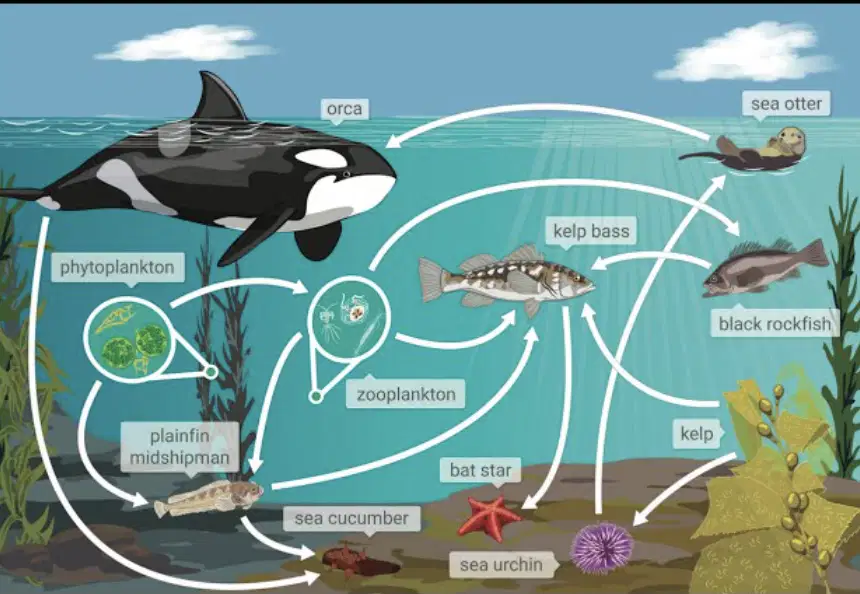
What would happen to ecosystem stability if the orcas began overhunting the sea otters nearing extinction? (select 3)
There would be more sea urchins (the otters prey)
There would be less kelp (the main producer)
Ecosystem stability would decrease due to the increase in sea urchins eating all the kelp
Ecosystem stability would increase due to the increase in kelp
There would be more kelp (the main producer)
A local lake has an overgrowth of algae from fertilizer runoff. This algae prevents sunlight and oxygen from entering the lake, harming the organisms in the lake. Oysters are a type of creature that are able to reduce the number of algae in the water.
How will releasing oysters into the water affect the ecosystem?
There will be an increase in biodiversity due to the oysters removing algae
There will be an decrease in biodiversity due to the oysters creating more algae
The ecosystem will become less stable
All of the organisms in the lake will die
A forest fire wipes out all of the producers in an ecosystem, including grass, trees, and berries. How would this affect biodiversity?
Biodiversity would decrease because producers support the whole ecosystem
Biodiversity would increase because consumers will be fine with no plants
The tertiary consumers won't be affected
Herbivores won't be affected
Human impact has led to an increase in carbon in the atmosphere. This has been linked to an increase in ocean temperatures. When ocean temperatures rise, more carbon is released to the atmosphere creating a cycle of temperatures continuing to rise.
How will this affect ecosystem stability and biodiversity?
There will be less biodiversity in the ocean ecosystems
There will be more biodiversity in the ocean ecosystems
Hints: An ecosystem is all of the living and nonliving parts in a geographic area. The living parts (plants, animals) are called biotic. The nonliving parts (water, soil) are called abiotic.
All of the living and non living parts in an area
Ecosystem
Living
Biotic
Nonliving
Abiotic
Max number of organisms and ecosystem can support
Carrying capacity
A species, that if removed, the rest of the ecosystem would be greatly affected
Keystone species
Drag and drop
Planting trees
Deforestation
Pollution
Burning fossil fuels
Recycling
Reducing waste
An invasive species is
Any kind of living organism that is not native to an ecosystem and causes harm.
It is a native species to the local area.
It is primary succession; where life starts from bare rock
It is a climax community; a mature forest

