
NEW
Font size
 Worksheets
Unit 3 Sedimentary Rocks Review Mod 2
Total questions: 39
Worksheet time: 20mins
Sedimentary rocks are often described as being of clastic or of chemical origin. For which of the following is both the rock type and the description CORRECT?
Conglomerate - clastic - made up of angular particles compacted together
Rock Salt - chemical - made up of sand-sized particles cemented together
Sandstone - chemical - made up of quartz, feldspar and mica cemented together
Shale - clastic - made up of clay-sized particles compacted together
On what basis are clastic (detrital) sedimentary rocks classified?
color
mineral composition
particle size
type of bedding
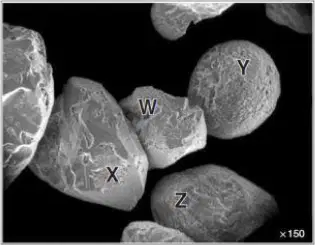
In the photomicrograph to the right, which sand grain has most likely traveled the greatest distance?
X
W
Y
Z
Which rock is properly matched with its classification?
Gypsum - Clastic
Rock Salt (Halite) - Chemical
Limestone - Clastic
Sandstone - Chemical
When a fast moving river slows, what sediment does it deposit first?
clay
gravel
sand
silt
What are the stages in the formation of coal, from the first material deposited to the type of coal formed under the greatest temperature/pressure conditions?
peat ➔ bituminous ➔ anthracite ➔ lignite
peat ➔ bituminous ➔ lignite ➔ anthracite
peat ➔ lignite ➔ anthracite ➔ bituminous
peat ➔ lignite ➔ bituminous ➔ anthracite
All of the following are related to sedimentary rocks EXCEPT ....
deposition.
cementation.
compression.
crystallization.
Which is an example of a chemical sedimentary rock formed by evaporation?
coal
gypsum
rhyolite
shale
Which process describes sediment undergoing compaction/cementation to form solid rock?
crystallization
lithification
sorting
segregation
Under which condition would a chemical sedimentary rock form?
cementing of sand and pebbles
compaction of sand and clay
precipitation of dissolved materials into solid form
erosion, changing mineral composition
The MOST likely sequence of events necessary to produce a sedimentary rock would be 1. COMPACTION 2. TRANSPORTATION 3. EROSION 4. DEPOSITION
1, 2, 3, 4
2, 3, 4, 1
4, 3, 1, 2
3, 2, 4, 1
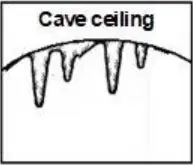
Which sedimentary feature is illustrated in the diagram to the right?
arêtes
stalactites
horns
stalagmites
When are sediments transported by a river deposited?
when the velocity of the river slows down
when the river is transporting too much sediment
when the discharge of a river is increased
when the river gains velocity
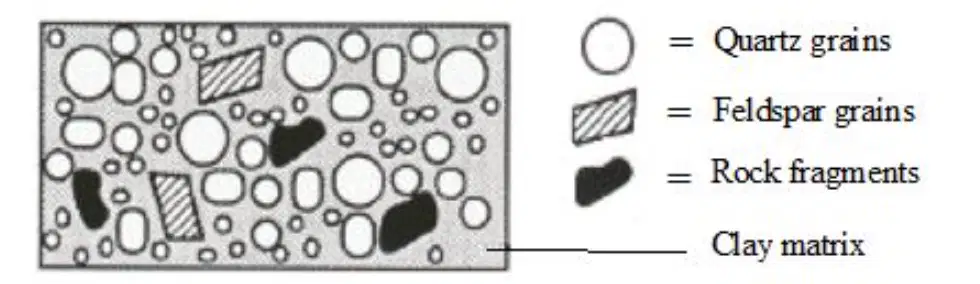
What would a geologist determine from the section of sedimentary rock below?
Feldspar grains are harder than other types of grains.
Feldspar grains have traveled a shorter distance than other types of grains.
Quartz grains are softer than other types of grains.
Quartz grains have traveled a shorter distance than other types of grains.
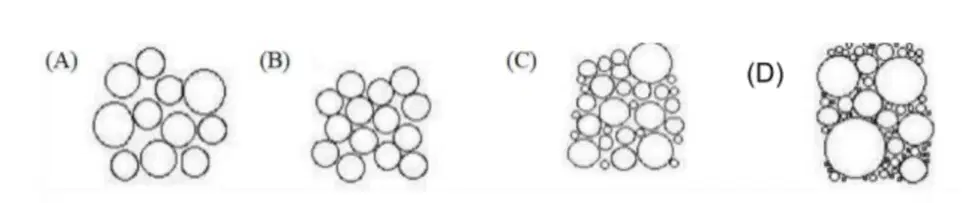
Which diagram shows a well-sorted sediment?
Diagram A
Diagram B
Diagram C
Diagram D
The process of breaking down rocks into smaller fragments is called
Deposition
Weathering
Lithification
Sedimentation
______________ is when a material is broken into pieces that still retain the characteristics of the original material.
Mechanical Weathering
Chemical Weathering
Erosion
Deposition
_______________ is when a rock is altered by chemical processes. The result is a new material which is chemically different from the original material.
Deposition
Mechanical Weathering
Chemical Weathering
Lithification
What are the three agents of erosion?
Water, ice, & wind
Water, Chemical & mechanical
Chemical, ice, & wind
Mechanical, ice, & chemical
The rock formation process is known as
Deposition
Weathering
Lithification
Sedimentation
The process of sedimentary rock formation involving the precipitation of minerals in the interstitial spaces between rock fragments is known as__________.
Deposition
Weathering
Compaction
Cementation
The process of sedimentary rock formation involving the compression of sedimentary layers sometimes resulting in the deformation of rock fragments is known as__________.
Deposition
Weathering
Compaction
Cementation
What type of sedimentary rock is formed from solid sediment that is deposited as a result of both chemical and mechanical weathering?
Clastic/Detrital
Chemical
Biochemical/Organic
What type of sedimentary rock is formed from dissolved sediment particles, produced by chemical weathering, subsequently carried in solution?
Clastic/Detrital
Chemical
Organic
Petrographic
These rocks form from an accumulation of once living material.
Clastic/Detrital
Chemical
Organic
Petrographic
These types of rocks consist of poorly sorted rounded fragments.
Sandstone
Mudstone
Conglomerate
Breccia
What are the factors that lead to the formation of sedimentary rock?
Erosion, Transportation, Deposition, Lithification
Mechanical Weathering, Transportation, Deposition, Lithification
Erosion, Transportation, Deposition, Cementation
Mechanical Weathering, Transportation, Deposition, Cementation
Chemical Weathering is the process which:
Material is broken into smaller pieces that still retain the characteristics of the original material
Material is weathered
Material is altered by chemical action and a new material is produced which is chemically different than the original materials
Mechanical weathering takes places
Which of the following is NOT an agent of transportation?
Water
Ice
Snowstorms
Glaciers
Compaction and Cementation are types of?
Erosion
Transportation
Deposition
Lithification
The three types of sedimentary rock are:
Clastic, Chemical & Organic
Clastic, Biogenic & Organic
Biogenic, Chemical & Organic
Clastic, Chemical, Igneous
What particle name matches the appropriate rock name that it would form?
Silt/clay --> Sandstone
Boulder/pebbles --> Sandstone
Boulder/pebbles --> Shale
Boulder/pebbles --> Conglomerate
Which of the following are ALL chemical sedimentary rock:
Sandstone, Limestone, & Rock Gypsum
Sandstone, Limestone, & Shale
Limestone, Rock Gypsum & Rock Salt
Limestone, Rock Gypsum, & Conglomerate
This rock has angular gravel sized particles that form with large particle sized clasts.
Breccia
Conglomerate
Sandstone
Shale
This rock consists of fine clay sized particles compacted to form thin layers.
Breccia
Conglomerate
Sandstone
Shale
Travertine, a type of this rock, can form stalactites and stalagmites in cave environments.
Sandstone
Limestone
Shale
Breccia
This rock results from the build-up, compaction and cementation of microscopic marine organisms such as foraminifera.
Chert
Coquina
Chaulk
Limestones
Sedimentary rocks often contain fossils because:
Lava flows trap the remains
They are formed near ocean ridges
Plant and animal remains are buried in sediment layers
They are exposed to high heat and pressure
What happens during deposition?
Rocks are turned into magma
Rock particles are glued together
Sediment settles and creates layers
Rocks break into smaller pieces

