wayground logo

Free Printable Worksheets

Font size

S
M
L
XL
Worksheets

GCSE Paper 1 Basics

Total questions: 45

Worksheet time: 44mins

Name
Class
Date
1.
What size resistor would produce a 3 Amp current flow with a 12 Volt battery
a)
1 Ohm
b)
3 Ohms
c)
4 Ohms
d)
12 Ohms
2.
What is current measured in?
a)
Ω (Ohms)
b)
V (Volts)
c)
A (Amps)
d)
W (Watts)
3.
What is resistance measured in?
a)
Ω (Ohms)
b)
V (Volts)
c)
A (Amps)
d)
W (Watts)
4.
What is Resistance?
a)
The flow of electrons
b)
Electric potential difference
c)
A battery
d)
The ability to reduce the flow of electrons
5.
What types of charges attract?
a)
Positive and Positive
b)
Positive and Neutral
c)
Negative and Neutral
d)
Positive and Negative
6.
What is the Voltage of a circuit that has a resistance of 5 Ω and a current of 2 A?
a)
25 V
b)
10 V
c)
2.5 V
d)
0.4 V
7.

Voltage divided by Resistance

(V / R)

a)

Current

b)

Power

c)

Ohms

d)

Watts

8.
If the Voltage is increased and the resistance stays the same, Current will
a)
Increase
b)
Decrease
c)
Stay the same
d)
X
9.
If the Voltage stays the same and Resistance is increased, Current will 
a)
Increase
b)
Decrease
c)
Stay the same
d)
X
10.
What characteristic do all renewable resources share?
a)
Produced by waste products
b)
Form underground from dead organisms.
c)
Replaced in a short period of time
d)
Allow energy to pass through them easily
11.
Which of the following is a fossil fuel?
a)
Wind
b)
Coal
c)
Solar
d)
Biomass
12.
Petroleum and natural gas form from...
a)
strong winds
b)
cooled magma
c)
radioactive materials
d)
remains of plants and animals 
13.
Hydroelectric power produces electricity using.....
a)
Wind
b)
Sunlight
c)
Moving water
d)
Dung
14.
 Energy from the sun is known as......... 
a)
hydroelectric energy
b)
geothermal energy
c)
solar energy
d)
wind energy
15.
Fossil fuels are classified as nonrenewable because they.......
a)
require expensive equipment
b)
take millions of years to replace
c)
can be found all over 
d)
provide all the energy we use
16.
What is biomass? 
a)
energy from the sun
b)
energy from water
c)
energy from wind
d)
energy from plant and animal waste
17.
What are two advantages of geothermal energy?
a)
cheap and a lot pollution
b)
expensive and a lot of pollution
c)
cheap and little pollution
d)
expensive and little pollution
18.
What is a disadvantage to Hydroelectricity?
a)
lots and lots of pollution
b)
Kills wild bird population
c)
Radioactive waste
d)
Increases potential for flooding 
19.
Wind energy 
a)
is less expensive than fossil fuels
b)
is difficult to utilize in areas with low wind availability
c)
is a renewable source of energy
d)
utilizes small or large areas of land not previously used
20.
Oil, Natural Gas, Nuclear, Coal - What do these items have in common?
a)
They are examples of inexhaustible energy resources.
b)
They are examples of renewable energy resources.
c)
They are examples of energy resources that do not cause pollution.
d)
They are examples of nonrenewable energy resources.
21.
Some power plants pump water down deep holes into hot rock. The hot rock heats the water, which turns the water into steam. The steam rushes back to Earth’s surface and is used to make electricity. This plant is generating which alternative energy resource?
a)
biomass
b)
wind
c)
solar energy
d)
geothermal energy
22.

Put the steps below in the correct order to describe how electrical energy is generated in an electrical power plant.

a)
  1. Fossil fuel is burned

b)
  1. Water is heated and changes to steam

c)
  1. Steam makes turbine spin

d)
  1. Magnet spins between wire coils

e)
  1. Electricity is generated

1)
2)
3)
4)
5)
23.
How do gases behave in a container?
a)
Cluster together
b)
form a solid
c)
They take the shape of their container
d)
leak out 
24.
Which states allow easy flow of particles
a)
Gas and Solid
b)
Gas and Liquid
c)
Solid and Liquid
d)
Gas only
25.
How do materials change from one state of matter to another?
a)
They gain or lose energy
b)
They break appart
c)

The particles get more attracted to each other
d)
They are magnetised to themselves
26.
Which of the following is a property of a liquid
a)
Can't be compressed
b)
Can be compressed
c)
Particles are far appart
d)
Particles hold the object's shape 
27.
Can Solids be compressed?
a)
No
b)
Yes
c)
Sometimes (it depends what it's made of)
d)
Generally no
28.
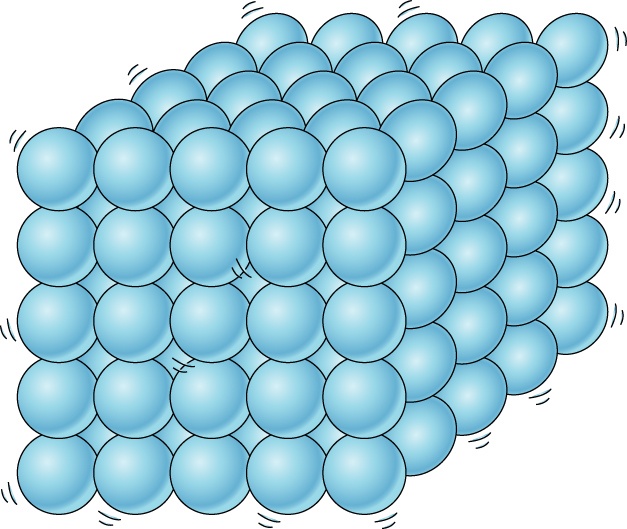
Which description best matches this particle model?
a)
Closely packed and can't move a lot. 
b)
Particles are close together but can move a little. 
c)
Particles have lots of energy and can move around. 
29.
Which description best matches this particle model?
a)
Closely packed and can't move a lot. 
b)
Particles are close together but can move a little. 
c)
Particles have lots of energy and can move around. 
30.

Describe the motion of particles in a gas

a)

Slow and Steady

b)

High speeds

c)

Range of speeds and random

d)

Unpredictable and constant speed

31.
The amount of energy required to raise the temperature 1ºC for every kilogram is called____?
a)
Thermal Energy
b)
Specific Heat
c)
Temperature
d)
Kinetic Energy
32.
What unit do you use to measure Thermal Energy?
a)
J/Kg ºC
b)
Kg
c)
ºC
d)
J
33.
What does temperature measure?
a)
Heat
b)
ºC
c)
Kinetic Energy
d)
Thermal Energy
34.

It's the amount of heat required to change the state (gas,liquid, solid) of a unit of material

a)

Latent Heat

b)

Specific Heat

c)

Temperature

d)

Q

35.
This particle determines what element you have - the elements identity.
a)
electron
b)
proton
c)
neutron
d)
valence shell
36.
Which particles make up the nucleus of an atom?
a)
protons and neutrons
b)
electrons and protons
c)
electrons, protons, and neutrons
d)
electrons and neutrons
37.

An isotope of an element has the same number of _________, but a different number of _________.

a)

Protons, electrons

b)

Protons, neutrons

c)

Electrons, neutrons

d)

Neutrons, protons

38.
What makes something radioactive?
a)
elements with an atomic number above 81
b)
an unstable nucleus
c)
contaminated sewage
d)
It decays over time
39.
In order of most to least penetrating radiation we have
a)
Alpha , Beta,  Gamma
b)
Beta , Gamma , Alpha
c)
Gamma, Beta, Alpha
d)
Gamma, Alpha, Beta
40.

Which type of radiation releases an electron?

a)

Alpha radiation

b)

Beta radiation

c)

Gamma radiation

d)

Theta radiation

41.
What type of radioactive decay is shown here?
a)
Alpha decay
b)
Beta decay
c)
Gamma decay
42.
What type of radiation can be stopped by clothing or a piece of paper?
a)
Alpha radiation
b)
Beta radiation
c)
gamma radiation
43.
What particle is released when an unstable isotope undergoes alpha radiation?
a)
an helium nucleus
b)
an electron
c)
a photon of light
44.
If the half life of a radioactive element is 100yrs, how long would it take for the radioactivity to reduce by one half?
a)
200yrs
b)
100yrs
c)
50yrs
d)
300yrs
45.

A certain radioactive sample has a half life of 2 years. After 6 years, how much of the sample is left?

a)

1/2

b)

1/3

c)

1/16

d)

1/8