
 Worksheets
Rocks and Minerals Test study game
Total questions: 25
Worksheet time: 13mins
Name
Class
Date
1.
1. Which of the following is true about rocks?
a)
Rocks are composed of only ONE mineral
b)
Rocks do NOT contain any mineral matter.
c)
Most rock are a mixture of minerals.
2.
2. Which of the following is NOT one of the three types of rock?
a)
igneous
b)
sedimentary
c)
magma
d)
metamorphic
3.
3. Metamorphic rock forms as a result of
a)
heat and pressure
b)
the cooling of magma
c)
compaction of sediments
d)
the melting of rock
4.
4. The rock cycle includes all of the following steps EXCEPT which of the following?
a)
magma or lava cools
b)
sedimentary rocks form from cooling magma
c)
extreme heat and pressure form metamorphic rocks
d)
rocks at Earth's surface are broken down into smaller pieces by wind and water
5.
5. Which of the following represents the correct order of the processes responsible for the formation of sedimentary rocks?
a)
erosion, weathering, compaction, cementation, deposition
b)
compaction, cementation, deposition, weathering, erosion
c)
deposition, cementation, compaction, erosion, weathering
d)
weathering, erosion, deposition, compaction, cementation
6.
6. Fossils are typically found in
a)
museums only
b)
extrusive igneous rock
c)
sedimentary rock
d)
metamorphic rock
7.
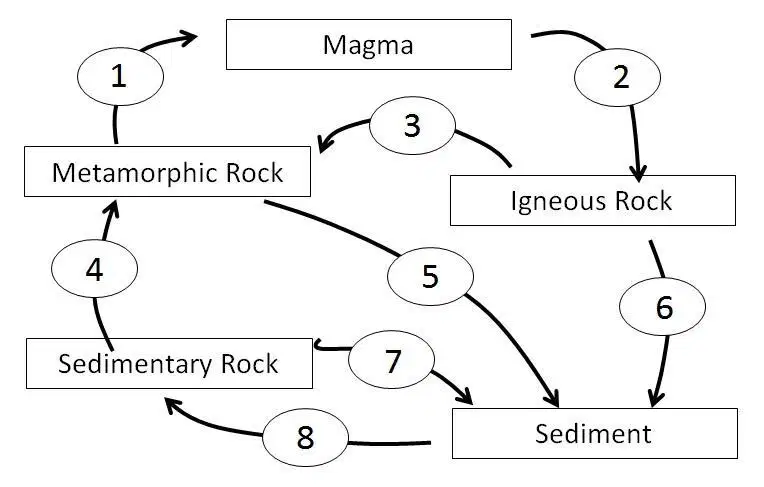
7. In the diagram above, what is happening at point 2 for the magma to be changed into igneous rock?
a)
the magma undergoes immense pressure
b)
the magma cools
c)
the magma heats up
d)
the magma is exposed to erosion
8.

8. In the diagram above, what is happening at point 8 for sediments to be changed into sedimentary rock?
a)
compaction and cementation
b)
cooling of magma
c)
weathering and erosion
d)
immense pressure and heat
9.
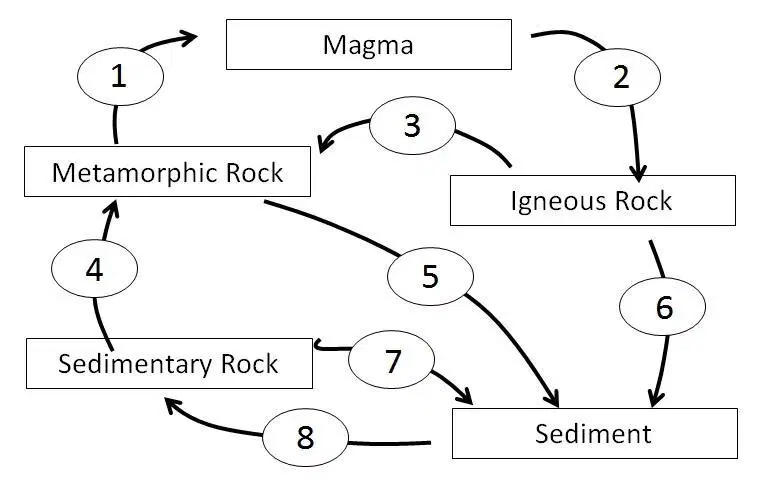
9. In the diagram above, what is happening at point 6 for igneous rock to be changed into sediments?
a)
compaction and cementation
b)
cooling of magma
c)
weathering and erosion
d)
immense pressure and heat
10.
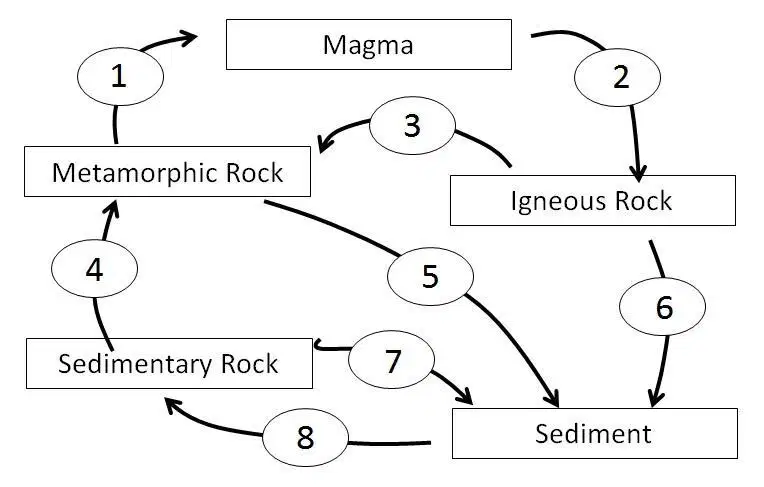
10. In the diagram above, what is happening at point 4 for sedimentary rock to be changed into metamorphic rock?
a)
compaction and cementation
b)
cooling of magma
c)
weathering and erosion
d)
immense pressure and heat
11.
11. Which of the following is NOT one of the 5 characteristics a substance must have to be considered a mineral?
a)
random arrangement of atoms
b)
solid
c)
naturally occurring
d)
crystalline structure
e)
definite chemical composition
12.
12. Minerals can form in many ways. One way is that water can evaporate from lakes and oceans, and the substances left behind can form minerals such as limestone and halides. These minerals are formed by
a)
crystallization from magma
b)
precipitation
c)
pressure and temperature
d)
hydrothermal solutions
13.
13. Minerals can form in many ways. As magma cools elements combine to form minerals containing iron (Fe), calcium (Ca), and magnesium (Mg). These minerals are formed by
a)
crystallization from magma
b)
precipitation
c)
pressure and temperature
d)
hydrothermal solutions
14.
14. Minerals can form in many ways. Hot water in the earth can come in contact with existing minerals and cause a chemical reaction. These minerals are formed by
a)
crystallization from magma
b)
precipitation
c)
pressure and temperature
d)
hydrothermal solutions
15.
15. Minerals are classified based on their
a)
composition
b)
where in the earth's crust they are found
c)
if it is a solid or a liquid
d)
if it is inorganic or organic
16.
16. The most common and the most abundant group of minerals is the
a)
carbonates
b)
silicates
c)
halides
d)
native elements
17.
17. Minerals that contain only one element from the periodic table such as gold and silver are known as the
a)
carbonates
b)
silicates
c)
halides
d)
native elements
18.
18. Minerals that contain an ion from the 7A group in the periodic table such as chlorine (Cl) are known as the
a)
carbonates
b)
silicates
c)
halides
d)
native elements
19.
19. Which of the following properties is used to identify minerals but is NOT always the best method?
a)
luster
b)
hardness
c)
streak
d)
color
20.
20. The color of a mineral in its powder form is known as its
a)
luster
b)
hardness
c)
streak
d)
color
21.
21. The Mohs scale is used to measure a mineral's
a)
cleavage
b)
luster
c)
density
d)
hardness
22.
22, The Mohs scale ranges between what numbers?
a)
1-5
b)
1-10
c)
1-50
d)
1-100
23.
23. The ratio of a mineral's mass to volume is known as its
a)
cleavage
b)
luster
c)
density
d)
hardness
24.
24. When a mineral does not show cleavage and it breaks unevenly, it is known as the mineral's
a)
density
b)
fracture
c)
crystalline structure
d)
density
25.
25. When a mineral breaks it in half evenly, the mineral shows
a)
cleavage
b)
luster
c)
density
d)
hardness
100 %

