
 Worksheets
Decision Making Vocabulary
Total questions: 65
Worksheet time: 35mins
What does the term 'Bias' mean in decision making?
A tendency to favor certain outcomes or perspectives
A method to ensure fairness in decisions
A random choice without any preference
A systematic approach to decision making

Explain the concept of 'Theory' in the context of decision making.
A systematic framework for understanding and analyzing decision-making processes.
A random guess made during decision making.
An unstructured approach to decision making.
A personal opinion about decision making.
What is 'Model' in decision making?
A representation of a system or process used to analyze and make decisions
A type of decision that is made without any data
A random choice made during decision making
An emotional response to a decision
Define 'Principle' as it relates to decision making.
A fundamental truth or proposition that serves as the foundation for a system of belief or behavior or for a chain of reasoning.
A detailed plan or procedure for achieving a specific goal.
A random choice made without any reasoning.
An unimportant rule that can be ignored.
What is meant by 'Effect' in decision making?
The outcome of a decision
The process of making a decision
The tools used in decision making
The people involved in decision making
Describe 'Information' in the context of decision making.
Information is data that has been processed to be useful in decision making.
Information is a random collection of data points.
Information is irrelevant to decision making.
Information is only useful in historical analysis.
Likelihood in decision making refers to:
The probability of an event occurring
The impact of a decision
The cost associated with a decision
The time taken to make a decision
Explain 'Commitment' in decision making.
Commitment in decision making refers to the dedication to a chosen course of action.
Commitment in decision making is the ability to change decisions frequently.
Commitment in decision making means avoiding any decision-making process.
Commitment in decision making is unrelated to the decision-making process.
What is 'Credibility' in decision making?
The quality of being trusted and believed in
The ability to make decisions quickly
The process of evaluating alternatives
The act of choosing the best option
Motivation as it pertains to decision making is defined as:
The process of making choices by identifying a decision, gathering information, and assessing alternative resolutions.
The reason or reasons one has for acting or behaving in a particular way.
A mental process resulting in the selection of a course of action among several alternatives.
The act of choosing between two or more possibilities.
The importance of arriving on time to class is:
It shows respect for the teacher and classmates.
It allows you to leave class early.
It means you can skip the first part of the class.
It helps you avoid homework.
How should you treat your classmates and teacher to be respectful?
By ignoring them
By being rude
By being polite and considerate
By interrupting them
Participating actively in class discussions is important because:
it helps in better understanding of the subject.
it wastes time.
it is not necessary for learning.
it distracts other students.
To avoid distractions during class, you should:
sit at the front of the class
turn off your phone
talk to your friends
daydream
How can you stay focused during class?
By taking regular breaks
By using a fidget spinner
By sitting at the back of the class
By paying attention and taking notes
It is important to follow the rules set by your teacher because:
it helps maintain order and discipline in the classroom.
it allows students to do whatever they want.
it makes the teacher happy.
it has no impact on learning.
Sustainability in business refers to:
the ability to maintain financial growth indefinitely.
practices that do not deplete resources or harm natural cycles.
the focus on short-term profits over long-term goals.
the exclusive use of renewable energy sources.
Sustainability in business generally addresses two main categories. What are they?
Environmental and Social
Economic and Environmental
Social and Economic
Technological and Economic

Which of the following is a benefit of being sustainable in business?
Attract and Retain Employees
Increase Costs
Reduce Employee Morale
Decrease Customer Loyalty
What are the three pillars of sustainability in business?

List the benefits of sustainable business practices as shown in the diagram.
Increased costs and reduced efficiency
Improved brand reputation and customer loyalty
Decreased employee satisfaction
Higher environmental impact
Balancing short-term profitability goals with long-term sustainability is important because:
it ensures immediate financial gains without considering future impacts.
it allows for a focus on long-term growth and environmental responsibility.
it prioritizes short-term success over long-term viability.
it disregards the importance of sustainable practices.
What are the cost-related benefits of adopting sustainable practices in business?
Reduced operational costs
Increased marketing expenses
Higher employee turnover
Decreased customer satisfaction
How can sustainability lead to increased revenue for businesses?
By reducing operational costs and attracting eco-conscious consumers
By increasing operational costs and reducing consumer interest
By focusing solely on profit without considering environmental impact
By ignoring sustainability trends and focusing on traditional methods
Sustainability helps in attracting and retaining talent according to IBM's research by:
Providing a competitive edge in the job market
Increasing operational costs
Reducing employee satisfaction
Limiting career growth opportunities
Company-wide sustainability commitments are:
Initiatives to reduce environmental impact
Efforts to increase profits
Strategies to expand market share
Plans to improve employee satisfaction
Which of the following is an example of a sustainability goal?
Carbon neutrality by 2030
Increase in fossil fuel usage
Deforestation for urban development
Increase in plastic production
Sustainability is integrated into corporate strategy by:
aligning with environmental regulations
ignoring stakeholder interests
focusing solely on short-term profits
disregarding social responsibilities
What are some procedures to reduce emissions?
Implementing renewable energy sources
Increasing fossil fuel usage
Deforestation
Ignoring environmental regulations
Renewable energy is used in manufacturing processes to:
reduce carbon emissions and increase energy efficiency
increase production costs and complexity
decrease product quality and reliability
eliminate the need for skilled labor
What are the benefits of waste management and recycling programs?
They reduce pollution and conserve natural resources.
They increase pollution and deplete natural resources.
They have no impact on the environment.
They are only beneficial for businesses.

Explain energy-efficient manufacturing processes.
Energy-efficient manufacturing processes reduce energy consumption and increase efficiency.
Energy-efficient manufacturing processes increase energy consumption and reduce efficiency.
Energy-efficient manufacturing processes have no impact on energy consumption.
Energy-efficient manufacturing processes are unrelated to energy consumption.
Water conservation strategies include:
Reducing water waste
Increasing water usage
Ignoring leaks
None of the above
The use of recycled and lightweight materials is important in modern construction because it:
reduces environmental impact and enhances sustainability.
increases the overall cost of construction.
complicates the construction process.
has no significant effect on construction.

What is the aim of the training provided to employees?
To improve employee skills
To increase company profits
To reduce employee turnover
To enhance workplace safety
Which of the following is a focus of the training programs?
Financial management
Sustainability practices
Marketing strategies
Customer service
Employees are encouraged to participate in sustainability initiatives by:
attending workshops
receiving bonuses
volunteering for projects
using public transport
What are the key components of Compliance and Reporting in sustainability?
Regulatory requirements, performance metrics, and transparency
Financial incentives, market trends, and consumer behavior
Technological advancements, innovation, and research
Cultural values, ethics, and social norms
Which of the following is included in Compliance and Reporting?
Adherence to environmental regulations and standards
Regular sustainability reporting
Transparency in sustainability performance
All of the above
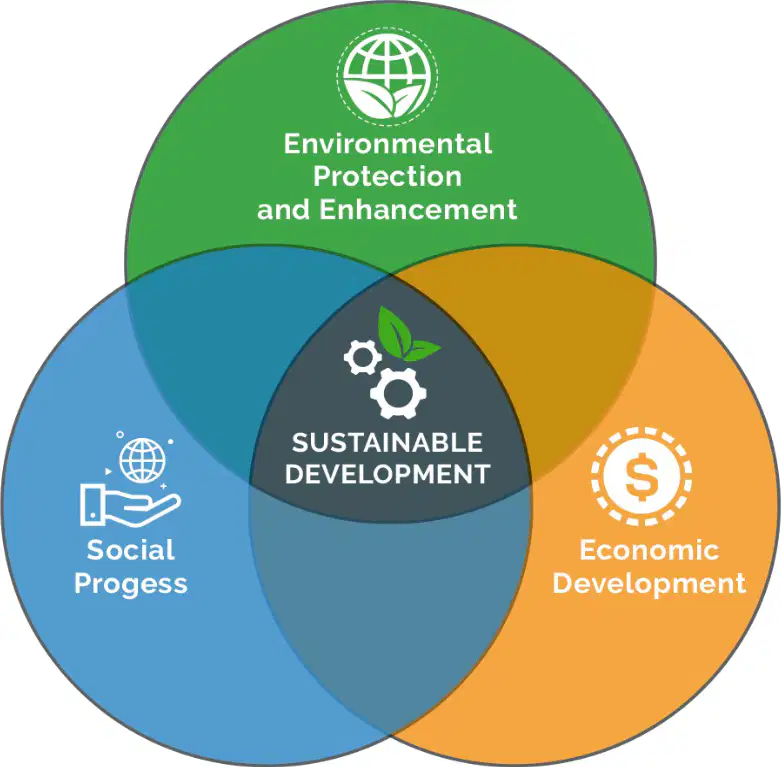
What does the Venn diagram in the image represent?
The relationship between different sets
The process of photosynthesis
The structure of an atom
The lifecycle of a butterfly

The role of partnerships with local communities in environmental projects is to:
provide financial support
ensure local engagement and sustainability
offer technical expertise
regulate project activities

Stakeholder consultations and feedback mechanisms contribute to community engagement by:
Providing a platform for dialogue and collaboration
Ensuring compliance with regulations
Increasing financial investment
Reducing the need for public relations efforts

What are corporate social responsibility initiatives according to Banerjee (2008)?
Initiatives that focus on maximizing profits for shareholders
Efforts to integrate social and environmental concerns in business operations
Strategies to reduce operational costs
Programs aimed at increasing employee productivity
Investigate a business problem and determine the most suitable solution.
Identify the problem, analyze data, and implement a solution
Brainstorm ideas without data analysis
Ignore the problem and continue as usual
Implement a solution without investigation
One purpose of sustainability questionnaires is to:
assess environmental impact
increase production costs
reduce employee benefits
promote consumerism
Sustainability questionnaires can help in assessing current practices by:
Identifying areas for improvement
Providing financial forecasts
Increasing production rates
Reducing employee turnover
Engaging stakeholders in sustainability initiatives is important because:
it ensures diverse perspectives and buy-in.
it complicates decision-making processes.
it increases costs without benefits.
it limits innovation and creativity.

What are the key elements of a good questionnaire?
Clarity, relevance, and brevity
Length and complexity
Ambiguity and vagueness
Irrelevance and redundancy

What types of questions should be included in a questionnaire?
Multiple choice questions
Open-ended questions
Both multiple choice and open-ended questions
None of the above
Ensuring anonymity and confidentiality in questionnaires is important because:
it protects respondents' privacy and encourages honest responses.
it makes data collection faster and more efficient.
it allows researchers to identify respondents easily.
it reduces the cost of conducting surveys.
What should be included in designing effective questionnaires?
Clear objectives and purpose
Complex language and jargon
Irrelevant questions
Ambiguous instructions

How do internal assessments help in evaluating energy usage and efficiency?
By providing detailed insights into energy consumption patterns
By offering financial incentives for energy savings
By mandating the use of renewable energy sources
By reducing the overall energy demand

Internal assessments play a role in assessing waste management practices by:
Identifying areas for improvement
Increasing waste production
Ignoring waste management issues
Promoting waste mismanagement

Internal assessments measure employee awareness and involvement in sustainability by:
Evaluating participation in sustainability programs
Assessing knowledge of sustainability policies
Measuring engagement in eco-friendly practices
All of the above

Why is community and stakeholder feedback useful for sustainability?
It helps identify potential issues and solutions.
It is not useful at all.
It only benefits the stakeholders.
It delays the process.

Which of the following is a way community and stakeholder feedback is used for sustainability?
Engaging with local communities on environmental impact
Increasing corporate profits
Reducing taxes
Building more factories
One of the purposes of gathering feedback from NGOs and advocacy groups is:
to improve public relations
to enhance policy development
to increase funding
to expand volunteer base
Methods for analyzing qualitative and quantitative data include:
Statistical analysis and thematic analysis
Only thematic analysis
Only statistical analysis
Neither statistical nor thematic analysis
Tools and software used for data analysis include:
Excel and Tableau
Photoshop and Illustrator
Word and PowerPoint
AutoCAD and SketchUp
Interpreting results can help identify trends and areas for improvement by:
Providing insights into data patterns
Offering no useful information
Complicating the analysis process
Ignoring key performance indicators
Employees are encouraged to provide feedback on:
Company policies
Work environment
Management decisions
All of the above
List the steps mentioned in the image for making changes based on feedback.
Step 1: Identify feedback, Step 2: Analyze feedback, Step 3: Implement changes
Step 1: Ignore feedback, Step 2: Continue as planned, Step 3: Review later
Step 1: Identify feedback, Step 2: Disregard feedback, Step 3: Implement changes
Step 1: Identify feedback, Step 2: Analyze feedback, Step 3: Ignore changes
What are some examples of feedback-driven initiatives mentioned in the image?
Initiative A, Initiative B, Initiative C
Initiative D, Initiative E, Initiative F
Initiative G, Initiative H, Initiative I
Initiative J, Initiative K, Initiative L
According to the image, what can enhance sustainability efforts?
Recycling and waste reduction
Increased fossil fuel usage
Deforestation
Ignoring climate change
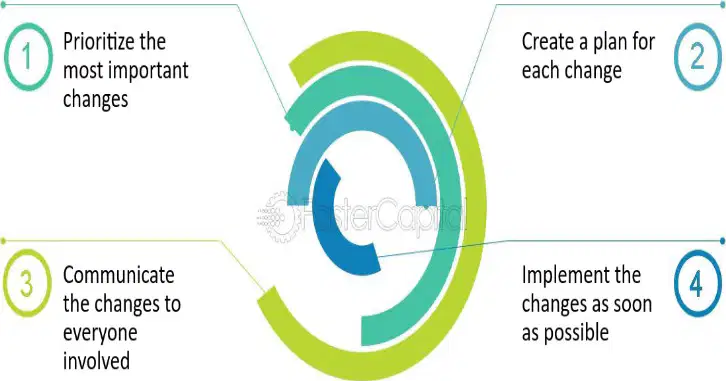
What are the three points listed under 'Implementing Changes' in the image?
Point 1, Point 2, Point 3
Step A, Step B, Step C
Action X, Action Y, Action Z
Measure 1, Measure 2, Measure 3

