
NEW
Font size
 Worksheets
Chapter 8 Quantitative chemistry
Total questions: 40
Worksheet time: 2hrs 53mins
Lithium hydroxide reacts with carbon dioxide as follows.
2LiOH + CO2 → Li2CO3 + H2O
What mass (in grams) of lithium hydroxide is needed to react with 11 g of carbon dioxide?
6
12
24
48
Which compound has the empirical formula with the greatest mass?
C2H6
C4H10
C5H10
C6H6
3.0 dm3 of sulfur dioxide is reacted with 2.0 dm3 of oxygen according to the equation below.
2SO2(g) + O2(g) → 2SO3(g)
What volume of sulfur trioxide (in dm3) is formed? (Assume the reaction goes to completion and all gases are measured at the same temperature and pressure.)
5.0
4.0
3.0
2.0
Q.
Complete the sentence.
During a chemical reaction, atoms ________.
can disappear
can appear
stop moving and vibrating
get rearranged
What is the right ratio of chemicals for the balanced chemical equation?
__CO + __Fe2O3--> __Fe + __CO2
3,2 --> 1,1
3,2 --> 2,4
3,1 --> 2,3
3,2 --> 2,1
What is the right ratio of chemicals for the balanced chemical equation?
__FeCl3 + __Ca(OH)2 --> __Fe(OH)3 + __CaCl2
4,3--> 2,1
3,2 --> 3,1
2,3 --> 2,2
2,3 --> 2,3
2.40 g of an explosive, J, contains 0.473 g of nitrogen. J also contains 33.8% carbon and 1.41% hydrogen by mass. The remainder of J is oxygen.
What is the empirical formula of J?
C4HNO2
CH2N2O
C2HNO2
CHNO
What is the molecular formula for a compound with the empirical formula: K2SO4 and a molecular mass of 696g.
K2SO4
K8SO16
K8S4O8
K8S4O16
Given the following: 42.07% Na, 18.89% P, and 39.04% O, and a molecular mass of 492 g/mole, what is the molecular formula?
Na6P3O7
Na9P3O12
Na3PO4
Na2PO4
Reactant and products might adhere to containers causing actual yield to be less than theoretical yield.
true
false
2 NaClO3 (s) --> 2NaCl (s) +3 O2 (g)
12.0 moles of NaClO3 will produce how many grams of O2?
256 g of O2
576 g of O2
288 g O2
How many liters of carbon dioxide are produced from 10L of carbon monoxide?
How many moles of aluminum would be needed to completely react with 45.0 grams of O2? (You'll need a balanced equation)
1.05 moles
3.75 moles
2.27 grams
1.88 moles
4NH3+6NO --> 5N2 + 6H2O
In a lab, a scientist calculate he should produce 12.3 grams of product in his experiment. When he is finished collecting his product it weighs 10.1 grams. What is his percent yield?
82.1 %
0.99 %
10.1 %
122 %

What is the reading on this burette?
24.00cm3
25.80cm3
24.20cm3
23.90cm3
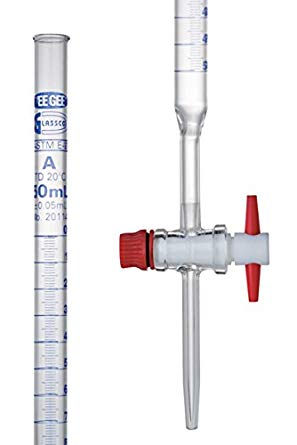
What is this piece of apparatus called
Pipette
Burette
Janette
Cuvette

What is this piece of apparatus called
Pipette
Burette
Janette
Cuvette

When the acid and alkali exactly neutralise each other
Where there is no acid left
When there is no alkali left
What allows us to know when the end point has been reached?
Bubbles
Feels warm
Indicator changes color
Turns to a solid

beaker

What is this apparatus used for titration called?
Burette
Volumetric Pipette
Pipette filler
Volumetric flask
What is placed under the conical flask during a titration
Heat proof mat
White tile

Is this burette tap open or closed?
open
closed
What is the concentration of citric acid if its volume is 25 ml and the titrated volume of the standard solution of 0.75 M is 12.4 ml
0.47
0.37
0.30
0.17
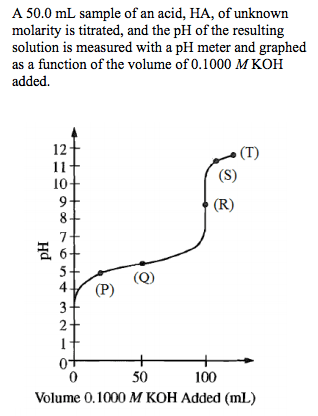
Which point on the titration curve corresponds to the point at which the moles of the added strong base are equal to the moles of the weak acid initially present?
Q
R
S
T
The number 6.02 x 10²³ is called...
Obama's number and it measures the amount of gases or liters in a mole
Bohr's number and it measures the amount of molecules or atoms in a sample
Avogadro's number and it measures the amount of gas in moles
Avogadro's number and it measures the amount of molecules or atoms in a sample
What is the molar volume of any gases at rtp?
32 dm3
24 dm3
101.3kPa
1 atm
Consider the following reaction:
4H₂(g) + Fe₃O₄(s) → 3Fe(s) + 4H₂O(l)
What is the minimum volume of H₂(g) in cm³ at r.t.p. needed to form 0.168 g of Fe(s)? (Molar volume of gas at r.t.p.= 24 dm³, Relative atomic mass of Fe = 55.8) DSE2020 Q25
24
48
96
192

