wayground logo

Free Printable Worksheets

Font size

S
M
L
XL
Worksheets

Chapter 14 Test

Total questions: 75

Worksheet time: 51mins

Name
Class
Date
1.
The particles of a gas move ____than the particles of the same substance in the liquid or solid state.
a)
faster
b)
slower
c)
same speed
2.

Particles in a __________ move quickly and the substance has no definite shape or volume.

a)

solid

b)

liquid

c)

gas

3.
__________ have a definite volume and tend to take the shape of their container. 
a)
solids
b)
liquids
c)
gases
4.
Which phrase best describes the particles in a solid?
a)
not moving
b)
very far apart
c)
vibrating in place
d)
able to slip past one another
5.

Kinetic Molecular Theory

a)

all matter is made of particles that are constantly moving

b)

the measure of average kinetic energy of a molecule

c)

energy of movement

d)

the total amount of kinetic energy in a substance

6.

Kinetic Energy

a)

all matter is made of particles that are constantly moving

b)

the measure of average kinetic energy of a molecule

c)

energy of movement

d)

the total amount of kinetic energy in a substance

7.

Temperature

a)

all matter is made of particles that are constantly moving

b)

the measure of average kinetic energy of a molecule

c)

energy of movement

d)

the total amount of kinetic energy in a substance

8.

Warm, less dense air _____

a)

rises

b)

sinks

c)

both

d)

neither

9.

Cool, more dense air _____

a)

rises

b)

sinks

c)

both

d)

neither

10.
The faster an object moves, the ________ kinetic energy it has. 
a)
more
b)
less
c)
none of the above
d)
all of the above 
11.
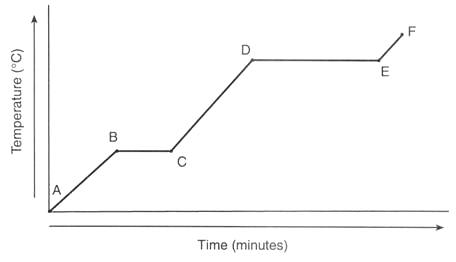
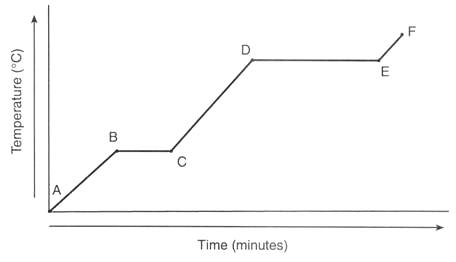
What line segment represents only the solid state?
a)
A-B
b)
B-C
c)
C-D
d)
D-E
12.
In which segment is the kinetic energy remaining constant?
a)
A-B
b)
B-C
c)
C-D
d)
E-F
13.
What state(s) of matter are present at D-E?
a)
Solid-liquid
b)
Liquid
c)
Liquid-gas
d)
Gas-Solid
14.
Between which points is the temperature of the substance remaining constant?
a)
A-B only. 
b)
A-B, C-D, E-F
c)
B-C only. 
d)
B-C, D-E
15.
Between which points is the temperature of the substance increasing?
a)
A-B only. 
b)
A-B, C-D, E-F
c)
B-C only. 
d)
B-C, D-E
16.
Between which points is the substance changing state?
a)
A-B only. 
b)
A-B, C-D, E-F
c)
B-C only. 
d)
B-C, D-E
17.
This type of graph is called a:
a)
Phase diagram
b)
Heating curve
c)
State of matter
d)
Temperature chart
18.

Between which two points is Heat of Vaporization?

a)

A <----> B

b)

B <----> C

c)

C <----> D

d)

D <----> E

e)

E <----> F

19.

Between which two points is the solid cooling?

a)

A <---- B

b)

B <----> C

c)

C <---- D

d)

D <----> E

e)

E <---- F

20.

Between which two points is the solid melting?

a)

A <---- B

b)

B <----> C

c)

C <---- D

d)

D <----> E

e)

E <---- F

21.

Between which two points is the gas condensing?

a)

A <---- B

b)

B <---- C

c)

C <---- D

d)

D <---- E

e)

E <---- F

22.

Between which two points is the water boiling?

a)

A <----> B

b)

B <----> C

c)

C <----> D

d)

D <----> E

e)

E <----> F

23.
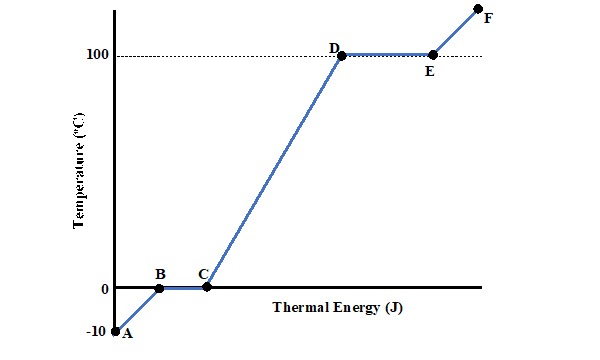
A substance's heating curve is shown in the graph.  What is its boiling point?
a)
100 C
b)
60 C
c)
80 C
d)
20 C
24.

The melting point of the sample is

a)

-60 ºC

b)

-100 ºC

c)

60 ºC

d)

100 ºC

25.

Given the heating curve of a solid being heated at a constant rate, how much total time was required to boil this substance after it reached its melting point?

a)

3 minutes

b)

4 minutes

c)

10 minutes

d)

14 minutes

26.

Given the heating curve for water, during which line segment could I find water in both the solid and liquid phase at the same time?

a)

AB

b)

BC

c)

CD

d)

DE

e)

EF

27.
At higher temperatures
a)
particles in an object have less energy
b)
particles in an object move faster
c)
a gas contracts
28.

The state of matter that has no definite size or shape is

a)

Solid

b)

Liquid

c)

Gas

29.

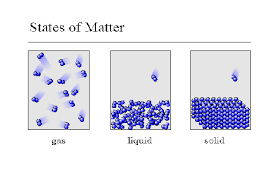
In which state of matter are the particles least able to move?

a)

A

b)

B

c)

C

30.

Matter is a substance that has ____________.

a)

mass and volume

b)

conductivity and buoyancy

c)

density and buoyancy

d)

solubility and conductivity

31.

While an object is melting, what happens to the temperature?

a)

increases

b)

decreases

c)

stays the same

32.
When Pressure increases then the Volume must...
a)
Increase
b)
decrease
33.
When Volume increases then Pressure must...
a)
Increase
b)
Decrease
34.

Is plasma the most important matter in the universe?

(a)  

35.
The liquid in a thermometer ______________ as the temperature increases.
a)
expands
b)
disappears
c)
freezes
d)
explodes
36.
An increase in the volume of a substance when the temperature increases is called ___________________________________.
a)
kinetic energy
b)
thermal expansion
c)
temperature
d)
heat
37.

The expanding of matter when it is heated is known as

a)

condensation

b)

evaporation

c)

thermal expansion

d)

vaporization

38.

What is buoyancy?

a)

The force exerted by gravity on a submerged object

b)

The force exerted by an object on a fluid

c)

Upward force exerted by a fluid on a submerged object

d)

The force exerted by a fluid on a floating object

39.

Who discovered the principle of buoyancy?

a)

Isaac Newton

b)

Albert Einstein

c)

Galileo Galilei

d)

Archimedes

40.

What is the formula to calculate buoyant force?

a)

Buoyant force = Weight of the fluid displaced

b)

Buoyant force = Mass of the object

c)

Buoyant force = Volume of the object

d)

Buoyant force = Density of the fluid

41.

What is the principle behind a hot air balloon?

a)

Friction

b)

Gravity

c)

Magnetism

d)

Buoyancy

42.
The buoyant force on floating objects equals the weight of the floating object 
a)
true
b)
false
43.
When the weight of an object is greater than the buoyant force, the object will ... 
a)
Sink
b)
Float 
c)
Expand
d)
Shrink
44.
What direction is the buoyant force in?
a)
Downward
b)
Left
c)
Right
d)
Upward
45.
The buoyant force on an object equals 250 N. What is the weight of the displaced water?
a)
250 N
b)
250 lbs
c)
250 N/9.8 m/sec2
d)
not enough information given
46.
If an object weighing 50.0 N displaces a volume of water with a weight of 10.0 N, what is the buoyant force on the object?
a)
10 N
b)
60 N
c)
40 N 
d)
20 N 
47.
The amount of force pushing on an area is the definition of....
a)
Fluid
b)
Viscosity
c)
Barometer
d)
Pressure
48.
What pressure does a 4000N horse exert on the ground if each foot is 10cm2?
a)
40 N/cm2
b)
100 N/cm2
c)
400 N/cm2
d)
10 N/cm2
49.
Look at the pressure triangle. How do we calculate the area?
a)
f ÷ a
b)
f x p
c)
p x f
d)
f ÷ p
50.
Pressure is measured in what units
a)
Newtons
b)
m/s
c)
Pascals
d)
Moles
51.
A force is applied in a closed container, the pressure increases the same amount. EX: squeezing a water bottle or toothpaste
a)
Archimede's Principle
b)
Pascal's Principle
c)
Bernoulli's Principle 
52.
Fluids can be...
a)
solids
b)
liquids
c)
gases
d)
liquids or gases
53.

Hydraulics use liquids as a force to do work.

a)

True

b)

False

54.

Viscosity can be described as...

a)

a physical property of liquids

b)

a physical property of solids

c)

a chemical property of liquids

55.

High viscosity can be described as...

a)

a liquid that flows quickly

b)

a liquid that flows slowly

56.

Peanut butter is an example of a...

a)

High viscosity liquid

b)

Low viscosity liquid

c)

Isnt a liquid at all! Don't be silly.

57.

Which of these are fluids?

a)

Sand

b)

Water

c)

Oxygen

d)

Rocks

58.

What is Viscosity?

a)

A fluids colour.

b)

A fluids temperature.

c)

A fluids resistance to flow.

59.

Which of these factors affects Viscosity?

a)

Temperature

b)

Colour

c)

Taste

60.
If a liquid has high viscosity, it probably has:
a)
strong resistance to flow
b)
weak resistance to flow
61.
Which material would have the greatest viscosity at normal temperatures?
a)
Peanut Butter
b)
Jelly
c)
Milk
d)
Marshmallow Fluff
62.

A substance that flows quickly has __________.

a)

low viscosity

b)

high viscosity

63.

Liquids with very low viscosity ,flow very _______________________.

a)

fast

b)

not at all

c)

slow

d)

whenever it wants

64.

The best example of a substance with low viscosity is?

a)

Honey

b)

Soap

c)

Marbles

d)

Water

65.

As temperature increases ,viscosity of liquid _______________.

a)

increases

b)

stays the same

c)

decreases

66.
When Pressure increases then the Volume must...
a)
Increase
b)
decrease
67.
When Volume increases then Pressure must...
a)
Increase
b)
Decrease
68.
The relationship of which two variables are compared in Boyle's Law?
a)
pressure & volume
b)
volume & temperature
c)
temperature & pressure
d)
volume & moles (amount of gas)
69.

What is the definition of Charles Law?

a)

At constant pressure, volume is directly proportional to temperature

b)

At constant pressure, volume is inversely proportional to temperature

70.

According to Charles Law, if Temperature of a gas increases Volume will also....

a)

Increases

b)

Decreases

c)

Stays the same

71.
If a balloon is cooled what will happen to the volume?
a)
Volume will increase
b)
Volume will decrease
c)
Volume will not change
72.

When Temperature of a gas increases, the Volume will ____________________

a)

Increase

b)

Decrease

c)

Stay the Same

73.

Charles's Law relates which 2 variables?

a)

pressure and volume

b)

temperature and pressure

c)

temperature and volume

d)

amount and volume

74.

The ratio of volume and temperature is constant only if which other variable remains constant?

a)

pressure

b)

moles

c)

distance

d)

time

75.
Sublimation is
a)
when solid turns into gas
b)
when gas turns into plasma
c)
when liquid turns into gas
d)
when gas turns into solid