
 Worksheets
Digital Tools and Presentation Tools Quiz 100 quiz
Total questions: 100
Worksheet time: 50mins
What are digital tools used for according to the learning material?
To create physical products
To present information, collaborate on projects, and organise meetings
To replace human interaction
To design clothing
What is the purpose of presentation tools as described in the document?
To create spreadsheets
To aid communication using graphics, text, audio, and video
To manage databases
To develop software applications
What are the three essential features that presentation software must provide?
A method for printing documents
A text editor with custom editing
A method for inserting, editing, and resizing graphics
A method to organise and display the slideshow sequentially
Which of the following is an example of presentation software that can be used through a web browser?
Microsoft PowerPoint
Prezi
Adobe Photoshop
CorelDRAW
What is the primary purpose of a product demo?
To train employees on new software
To promote a product to potential customers/clients
To conduct internal audits
To develop new software features
What is the main purpose of sales meetings within an organisation?
To conduct employee performance reviews
To discuss current sales, new products, and other information
To organise company events
To train new employees
What is the primary purpose of using presentations in training?
To entertain employees
To bring about change and improve behaviour
To increase sales figures
To reduce training costs
Which of the following is NOT mentioned as a component of effective promotional presentations?
Attractive colour schemes
Relevance to the audience
Complex technical details
Clear messages
What can be a consequence of not using good promotional techniques in presentations?
Increased production costs
Losing the audience's attention
Improved employee satisfaction
Enhanced product quality
What is a common feature of presentations used in both training and marketing?
Use of complex jargon
Inclusion of product packaging details
Use of images and videos
Focus on financial data
According to the Oxford English Dictionary, what is an infographic?
A visual representation of information or data
A detailed written report
A collection of audio recordings
A type of interactive software
What is a key characteristic of a digital infographic?
It contains a lot of text
It is a collection of images and charts with minimal text
It is primarily audio-based
It is a lengthy video presentation
What is the main difference between an infographic poster and an ordinary poster?
The size of the poster
The type of data they focus on
The colour scheme used
The material they are printed on
What does an infographic focus on compared to a poster?
Subjective storytelling
Quantifiable data
Personal opinions
Historical events
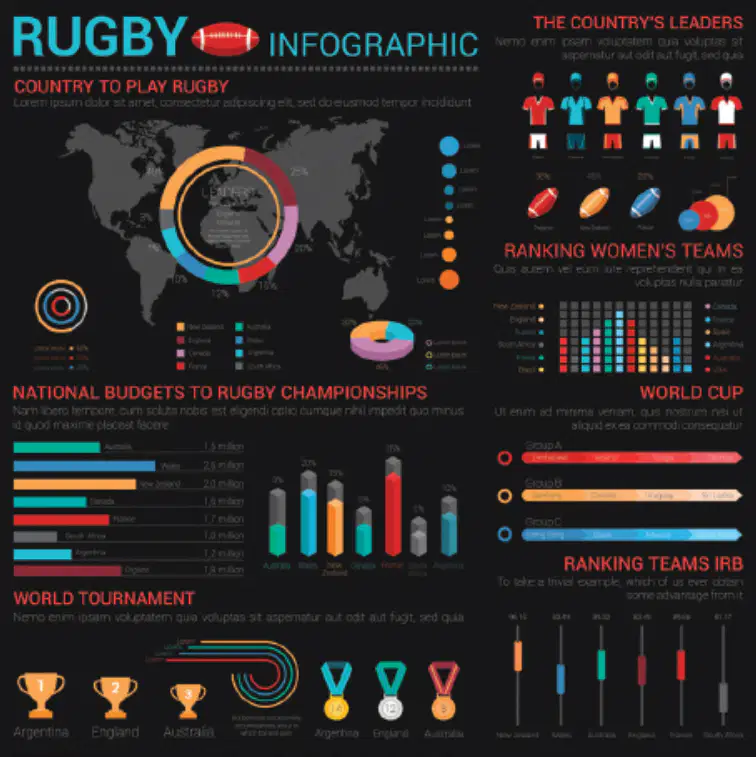
What is the main focus of an infographic poster?
To present quantifiable data in different ways
To tell a fictional story
To promote a product
To display artistic designs
What should you consider when researching different kinds of infographic posters?
The colour scheme used
The type of paper it's printed on
How they are different and the information they present
The size of the poster
What question should you ask to determine if a poster is an infographic poster?
Does the poster have a lot of text?
Does the poster promote the story about the data?
Is the poster colourful?
Does the poster have a famous person on it?
What defines an info poster according to the text?
It uses data to support a predetermined story or message
It is made of high-quality materials
It is larger than an infographic poster
It contains no data
What is the primary purpose of a leaflet?
To present a detailed report
To advertise products and/or services
To conduct surveys
To create a business plan
How can leaflets be distributed?
Through email only
By handing out face to face, posting, or placing in newspapers
By online advertisements
By television commercials
What is the main difference between graphs and charts?
Graphs are always more colourful than charts
Charts present information in written format, graphs do not
Graphs present the mathematical relationship between data sets
Charts are only used for financial data
Why are graphs particularly useful for sales teams?
They are cheaper to produce than written reports
They highlight trends and patterns of sales over time
They require less data to be effective
They are easier to print
What is the primary purpose of graphs in presenting complex information?
To provide entertainment
To communicate comparisons, composition, distribution, and relationships
To confuse the audience
To replace written reports
What are business dashboards primarily used for?
To play games
To track key performance indicators (KPIs) and metrics
To design websites
To write business reports
What does the term "composition" refer to in marketing?
The colour scheme of a product
The makeup of something, such as customer demographics
The price of a product
The location of a business
In marketing terms, what does "distribution" refer to?
The spread of a product/service within the marketplace
The relationship between customers and products
The evaluation of employee performance
The graphical representation of business data
What is the purpose of a Key Performance Indicator (KPI)?
To track the spread of products in the market
To evaluate the success of an organisation in meeting objectives
To establish customer relationships
To summarise complex data for strategic decisions
What is a management information dashboard used for?
To display the spread of products in the market
To summarise complex data for strategic decisions
To establish customer relationships
To evaluate employee performance
What does a business dashboard provide?
A graphical representation of KPIs, metrics, and measures
A method to spread products in the market
A way to establish customer relationships
A tool to evaluate employee performance
Identify three essential features for presentation software.
Animation, Templates, Collaboration
Sound effects, Background music, Transitions
Fonts, Colours, Images
Charts, Graphs, Videos
Describe how presentations can be used in sales meetings.
To entertain clients with music
To analyse sales data and trends
To replace face-to-face meetings
To create social media content
Explain the difference between an infographic poster and an info poster.
Infographic posters are only digital
Info posters contain more text
Infographic posters use more images and data visualisation
Info posters are interactive
Discuss how dashboards are utilised within a business context.
To play videos
To display real-time data and metrics
To create presentations
To design websites
Explain the difference between charts and graphs.
Charts are always circular
Graphs are used for text data
Charts are used for numerical data
Graphs represent data visually, charts can include text
What is the main purpose of a project scope?
To outline the budget of a project
To detail all aspects of a project, including activities, resources, timelines, and deliverables
To define the roles of team members
To list the software tools to be used
What is a key characteristic of Agile project management?
It uses a linear approach
It is a rigid methodology
It uses an iterative approach
It is only suitable for small projects
Which factor does NOT influence the selection of an Agile framework?
The size of the organisation
The structure of the team
The colour of the office
Resource availability
What is a characteristic of the Scrum framework?
It is a slow and rigid process
It is based on iterative and incremental processes
It does not involve stakeholders
It is only used for non-software projects
How long does a typical Scrum sprint last?
One day
One week
Two to four weeks
Six months
What is the primary responsibility of the product owner in a Scrum team?
Protecting the team from distractions
Defining and prioritising the work
Writing code for the project
Testing the final product
Who ensures that the Scrum team members can focus on their work without distractions?
The product owner
The development team
The scrum master
The stakeholders
How many people typically make up a Scrum development team?
Between two and four
Between five and nine
Between ten and fifteen
More than twenty
In addition to software development, which other teams are implementing Scrum?
Human resources teams
Sales and marketing teams
Legal teams
Manufacturing teams
What is the purpose of sprint planning in the Scrum process?
To define what can be delivered during the sprint and how it will be achieved.
To review the completed work at the end of the sprint.
To conduct a 15-minute daily meeting with the development team.
To refine the product backlog items.
How long is the daily scrum meeting in the Scrum process?
30 minutes
15 minutes
1 hour
45 minutes
Who describes the objective of the sprint during sprint planning?
Scrum master
Development team
Product owner
Stakeholders
What is the purpose of a Sprint review in Scrum?
To review completed work and determine necessary changes
To discuss what went well in the previous sprint
To outline deliverables for the sprint
To extract work from a backlog
What is discussed during a Sprint retrospective meeting?
What went well in the previous sprint and improvements for the next
The breakdown of deliverables for the sprint
The extraction of work from a backlog
The visual status of individual tasks
What does a Product backlog contain?
Items that can be completed by the Scrum team within one sprint cycle
A breakdown of deliverables to be completed during the sprint
A visual status of individual tasks
Steps in the workflow like design and testing
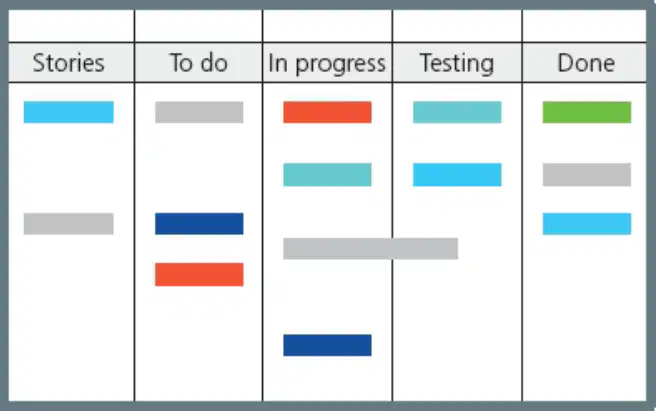
What is the main feature of a Kanban Board?
It consists of columns like 'To do', 'In progress', and 'Completed'
It outlines deliverables for the sprint
It reviews completed work and determines changes
It discusses improvements for the next sprint
What approach does the Kanban process use?
Just-in-Time
Sprint review
Product backlog
Sprint retro
What industry originally initiated Lean practices?
Automotive
Textile
Electronics
Food
What is the main purpose of lean project management?
To increase costs
To maximize value and minimize waste
To hire more employees
To extend project timelines
Which of the following is NOT one of the 3Ms identified in Lean?
Muda
Muri
Mura
Mito
What does 'Muda' refer to in Lean practices?
Overuse of equipment
Activities that consume resources but do not provide added value
Operational irregularities
Employee training
Which of the following is a benefit of applying lean development principles?
Increase in inventory costs
Reduction in overall costs
Decrease in customer satisfaction
Increase in lead times
What is the first principle of lean development?
Create flow by eliminating waste
Identify and map the value stream
Identify customers and specify value
Pursue perfection
Which principle involves creating a continuous flow of work processes by eliminating unnecessary activities?
Respond to customer pull
Identify and map the value stream
Create flow by eliminating waste
Pursue perfection
What does the principle of "respond to customer pull" imply in lean development?
Start work only when there is a demand
Deliver what the customer asked for
Continuous review and monitoring
Identify flaws in the process
Which principle focuses on continuous review and monitoring to ensure improvement?
Identify customers and specify value
Pursue perfection
Create flow by eliminating waste
Respond to customer pull
What is the first principle of the Lean framework?
Identify customers and specify value
Create flow by eliminating waste
Respond to customer pull
Pursue reflection
Which project management methodology is described as very rigid and structured, suitable for small projects with fixed requirements?
Waterfall
Agile
Scrum
Kanban
Why is the Waterfall methodology not suitable for large, complex projects?
It is too flexible
It has dynamic project needs
It is too rigid and structured
It lacks any structure
What is the main emphasis of the spiral methodology?
Risk analysis
Design
Implementation
Maintenance
During which phase of the spiral model are the project requirements gathered?
Planning
Risk analysis
Development
Evaluation
In the spiral model, what is typically created at the end of the risk analysis phase?
A prototype
A final product
A user manual
A marketing plan
What happens during the development phase of the spiral model?
The product is developed and tested
Risks are identified
Requirements are gathered
The project is evaluated
What is the purpose of the evaluation phase in the spiral model?
To evaluate the project at its current stage and format
To gather requirements
To develop the product
To identify risks
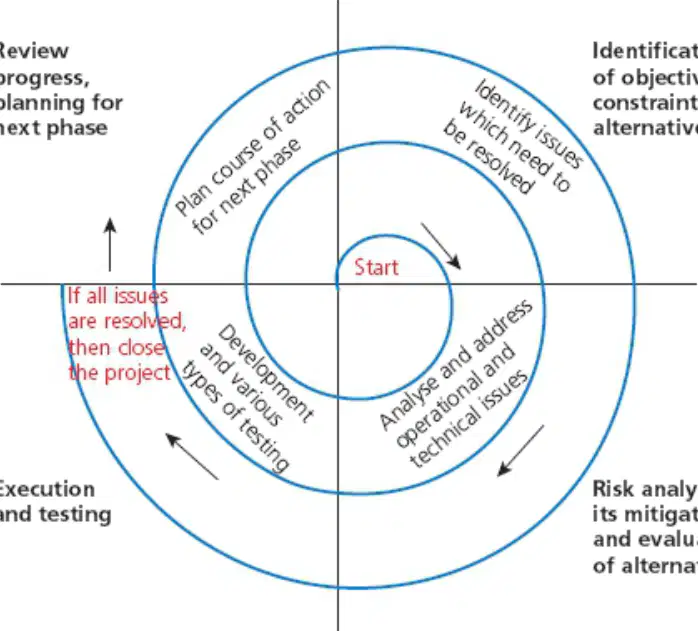
What is the main purpose of the spiral methodology in software development?
To complete projects in a single phase
To avoid any form of risk analysis
To work through phases in iterations
To eliminate the need for documentation
Which of the following is an advantage of the spiral methodology?
It is suitable for small projects only
It eliminates the need for testing
It allows for high-risk analysis and risk avoidance
It requires no expertise in risk analysis
What is a disadvantage of the spiral methodology?
It is not suitable for large projects
The risk analysis requires a lot of expertise
It does not allow for additional functionality
It lacks documentation control
What is a key benefit of using Rapid Application Development (RAD) in software development?
It is suitable for small projects.
It provides a fast project turnaround time.
It is a low-cost method.
It eliminates the need for stakeholder communication.
Which phase is critical for the overall success of a project in Rapid Application Development?
Testing
Deployment
Planning
Maintenance
What does the planning stage in Rapid Application Development involve?
Coding the final product
Analyzing the current problem
Marketing the product
Launching the product
Why is stakeholder approval important in the planning stage of a project?
To ensure the project is low-cost
To finalize project requirements
To avoid any form of communication
To skip the testing phase
What is emphasized in the design stage of development according to RAD?
Strict planning and requirements recording
Use of software and user feedback
Finalizing the product without iterations
Ignoring client input
What is the purpose of the rapid construction phase?
To finalize the product without client input
To convert the prototype into a working model quickly
To eliminate the need for testing
To avoid any changes or issues
Which of the following is NOT a step in the rapid construction phase?
Preparation for rapid construction
Program and application development
Marketing and sales strategy
Unit, integration, and system testing
Why is client input important during the rapid construction phase?
It helps in ignoring any problems that arise
It ensures the end product meets the clients’ objectives
It allows developers to avoid testing
It speeds up the coding process
Compare the agile frameworks, Scrum, Kanban, Lean and Sprints.
Scrum focuses on continuous delivery, Kanban on iterative development, Lean on waste reduction, and Sprints on time-boxed iterations.
Scrum focuses on waste reduction, Kanban on time-boxed iterations, Lean on continuous delivery, and Sprints on iterative development.
Scrum focuses on iterative development, Kanban on waste reduction, Lean on time-boxed iterations, and Sprints on continuous delivery.
Scrum focuses on time-boxed iterations, Kanban on continuous delivery, Lean on waste reduction, and Sprints on iterative development.
The Waterfall methodology is suitable for large and complex projects. True or false?
True
False
What framework has columns representing 'To do', 'In progress' and 'Completed' as a minimum?
Kanban
Scrum
Waterfall
Agile
Explain the spiral methodology.
A risk-driven process model generator for software projects
A linear sequential model
A method focusing on rapid prototyping
A framework for managing iterative work
The stages of the RAD methodology are:
Requirements planning, user design, construction, cutover
Planning, analysis, design, implementation
Initiation, planning, execution, closure
Concept, development, testing, deployment
What is a flowchart primarily used for?
To display geometric shapes without connections
To represent processes, workflows, systems, or algorithms
To create artistic designs
To write lengthy essays
Which of the following is a benefit of using flowcharts?
They make processes more complex
They are only useful for artistic purposes
They provide visual clarification of complex processes
They are used to write novels
How do flowcharts help in communication?
They make communication more difficult
They simplify communication by documenting how a process works
They are not used for communication
They only confuse the reader
What is one way flowcharts contribute to efficient coordination of events?
By hiding the sequence of events
By showing the sequence of events to prevent unnecessary steps
By making the sequence of events more complicated
By ignoring the sequence of events
What does effective analysis in flowcharts help to highlight?
The most obvious flaws
The step-by-step sequence of a process and less obvious flaws
Only the positive aspects of a process
The artistic elements of a process
What are the two variables that can impact a project according to the text?
Time and cost
Power and interest
Resources and budget
Quality and scope
What does 'power' refer to in the context of project stakeholders?
The financial contribution of the stakeholder
The ability of the stakeholder to stop or change the project
The stakeholder's level of expertise
The stakeholder's communication skills
What does 'interest' refer to in the context of project stakeholders?
The stakeholder's financial gain from the project
The stakeholder's personal interest in the project topic
The size of the overlap between a stakeholder’s goals and the project’s goals
The stakeholder's influence over the project team
What is the first step in the initiation phase of the project life cycle according to the flowchart?
Approval
Initiation
Project cancelled
Adjust or cancel

In the flowchart, what happens if the project does not receive approval?
Continue with planning processes
Initiation
Project cancelled
Project initiation form
According to the text, which axis represents interest in the stakeholder analysis graph?
x axis
y axis
z axis
w axis
Who are considered key stakeholders in a project?
Stakeholders with low power and low interest
Stakeholders with high power and low interest
Stakeholders with high power and high interest
Stakeholders with low power and high interest
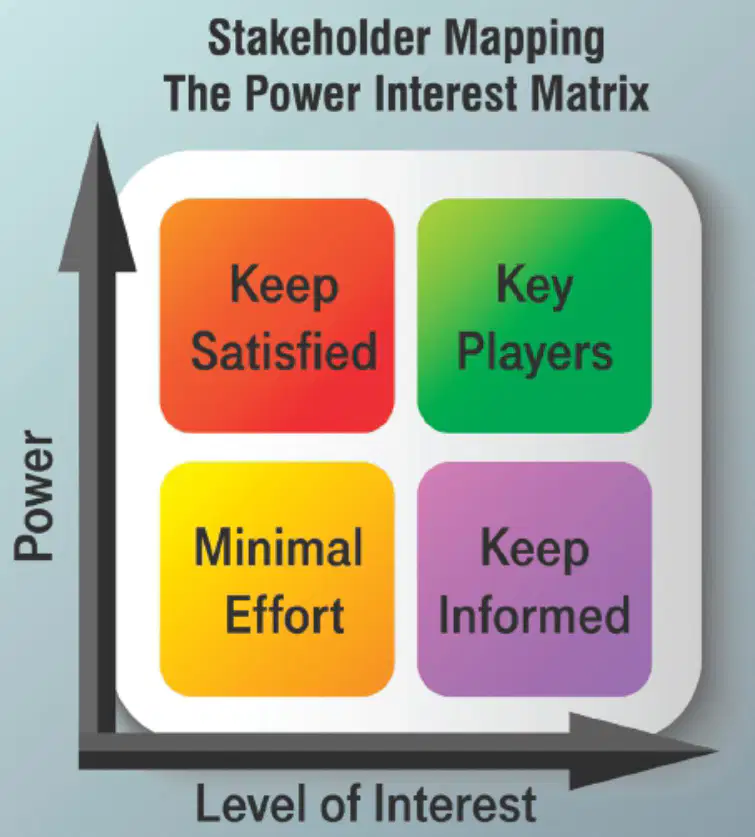
How should stakeholders with high power and low interest be managed?
Keep Satisfied
Keep Informed
Minimal Effort
Key Players
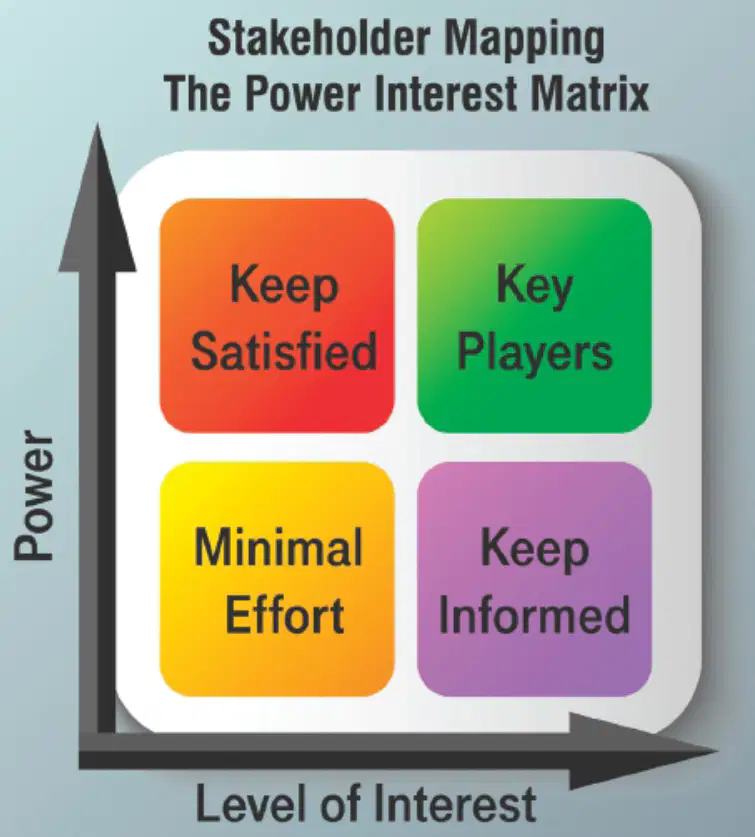
What is the recommended approach for stakeholders with low power and high interest?
Keep Satisfied
Keep Informed
Minimal Effort
Key Players
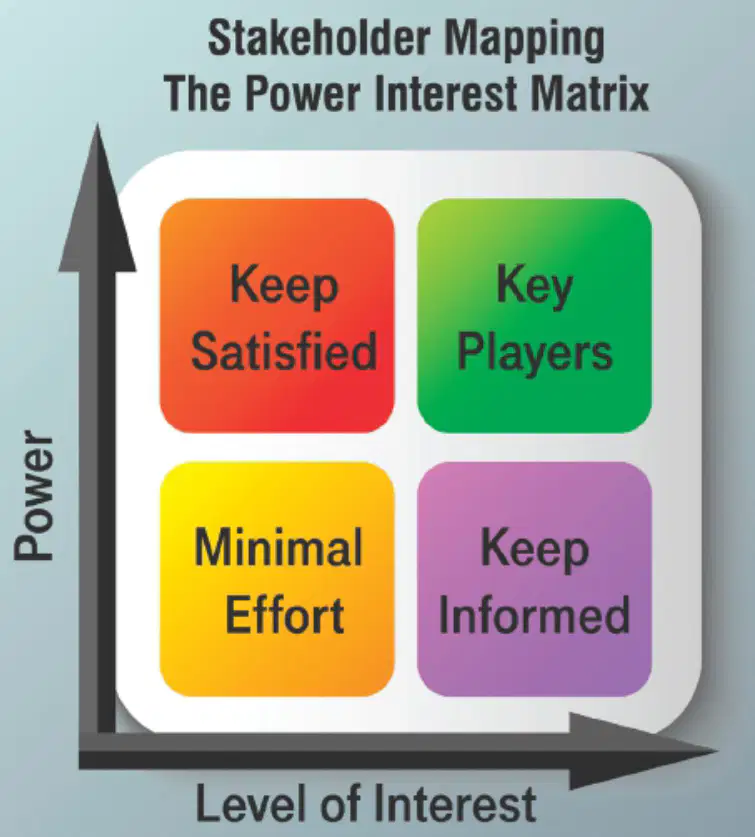
How should stakeholders with low power and low interest be managed?
Keep Satisfied
Keep Informed
Minimal Effort
Key Players
Why is a budget essential for starting a project?
It provides a detailed timeline for the project.
It helps in securing project funding.
It ensures the project is completed on time.
It guarantees project success.

