
 Worksheets
Radiation Biology
Total questions: 63
Worksheet time: 32mins
Radiation Biology is concerned with:
the study of radiation effects on living organisms
the development of nuclear weapons
the use of radiation in medical imaging
the production of radioactive materials
What sequence of events does Radiation Biology include after the absorption of energy from ionizing radiation?
Absorption, Ionization, Excitation, Chemical Changes, Biological Effects
Ionization, Absorption, Excitation, Biological Effects, Chemical Changes
Excitation, Absorption, Ionization, Chemical Changes, Biological Effects
Chemical Changes, Absorption, Ionization, Excitation, Biological Effects
What actions does the living system take to make up for the consequences of energy assimilation in Radiation Biology?
The living system repairs damaged DNA.
The living system increases energy intake.
The living system reduces metabolic rate.
The living system enhances cell division.
What is the effect of ionizing radiation on living systems?
Damage to DNA
Improved cellular function
Increased energy levels
Enhanced immune response
Which of the following is a type of radiation that causes ionization?
Ultraviolet rays
X-rays
Infrared rays
Microwaves
Fill in the blank: Ionized atoms will not bond properly in _______.
molecules
crystals
metals
gases
Linear Energy Transfer (LET) is a measure of the energy transferred by radiation to the material it passes through. Which of the following best describes LET?
The amount of energy lost by radiation per unit distance traveled in a material.
The total energy absorbed by a material from radiation.
The speed at which radiation travels through a material.
The time taken for radiation to pass through a material.
What is meant by Relative Biologic Effectiveness in radiation energy transfer?
A measure of the biological damage caused by radiation
A type of radiation therapy
A unit of radiation measurement
A method of radiation shielding
The Oxygen Enhancement Ratio (OER) is significant in radiation energy transfer because it:
increases the effectiveness of radiation therapy by enhancing the damage to cancer cells in the presence of oxygen.
decreases the effectiveness of radiation therapy by reducing the damage to cancer cells in the presence of oxygen.
has no effect on the effectiveness of radiation therapy.
is only relevant in non-oxygenated environments.
What does LET stand for in the context of radiation?
LET stands for Linear Energy Transfer.
LET stands for Light Emission Technology.
LET stands for Low Energy Transmission.
LET stands for Laser Energy Transfer.
In what units is Linear Energy Transfer (LET) described?
Linear Energy Transfer (LET) is typically described in units of keV/μm (kiloelectronvolts per micrometer).
MeV/cm (megaelectronvolts per centimeter)
J/m (joules per meter)
eV/nm (electronvolts per nanometer)
Which of the following is a category of radiation according to LET?
Low-linear energy transfer radiation
High-linear energy transfer radiation
Both A and B
None of the above
Why is Linear Energy Transfer (LET) important in assessing radiation exposure?
LET helps in understanding the potential damage to biological tissues.
LET is used to measure the speed of radiation particles.
LET determines the color of radiation.
LET is used to calculate the distance radiation travels.
Explain the concept of Linear Energy Transfer (LET) as described in the passage.
Linear Energy Transfer (LET) is the amount of energy that an ionizing particle transfers to the material traversed per unit distance.
Linear Energy Transfer (LET) is the speed at which an ionizing particle moves through a material.
Linear Energy Transfer (LET) is the total energy lost by an ionizing particle in a material.
Linear Energy Transfer (LET) is the distance an ionizing particle travels in a material before stopping.
What are the types of Low-LET Radiation?
Gamma rays
Alpha particles
Beta particles
Neutrons
Which of the following is a type of High-LET Radiation?
Gamma rays
X-rays
Alpha particles
None of the above.
As LET increases, the quality factor for a given form of radiation will ________.
increase
decrease
remain the same
fluctuate
What does Relative Biologic Effectiveness (RBE) describe?
The absolute capabilities of radiation with similar LETs to produce a particular biologic reaction
The relative capabilities of radiation with differing LETs to produce a particular biologic reaction
The capabilities of radiation to produce any biologic reaction
The effectiveness of radiation in producing non-biologic reactions
What is the formula for calculating Relative Biologic Effectiveness (RBE)?
RBE = Dose of reference radiation / Dose of test radiation
RBE = Dose of test radiation / Dose of reference radiation
RBE = Dose of radiation / Dose of control
RBE = Dose of control / Dose of radiation
What is the RBE of the test radiation?
5
2
10
15
What is the Oxygen Enhancement Ratio (OER)?
1.5
2.0
2.5
3.0
In general, what is the OER for x-rays and gamma rays when the radiation dose is high?
1.0
2.0
3.0
4.0
What happens to the OER when radiation doses are below 2 Gyₜ?
It increases
It decreases
It remains the same
It becomes zero
Fill in the blank: The formula for Oxygen Enhancement Ratio (OER) is OER = Radiation dose required to cause biologic response without O2 / Radiation dose required to cause biologic response with O2.
OER = Radiation dose required to cause biologic response without O2 / Radiation dose required to cause biologic response with O2.
OER = Radiation dose required to cause biologic response with O2 / Radiation dose required to cause biologic response without O2.
OER = Radiation dose required to cause biologic response with O2 + Radiation dose required to cause biologic response without O2.
OER = Radiation dose required to cause biologic response without O2 - Radiation dose required to cause biologic response with O2.
In living systems, biologic damage from exposure to ionizing radiation may be observed on which three levels?
Molecular, Cellular, Organic systems
Atomic, Molecular, Cellular
Cellular, Organic systems, Atomic
Molecular, Atomic, Organic systems
Any visible radiation-induced injuries of living systems at the cellular or organic level always begin with damage at the _______ level.
molecular
atomic
cellular
tissue
Molecular damage results in the formation of structurally changed molecules that may impair what?
Cellular functioning
Atomic structure
Genetic coding
Chemical bonding
Ionizing radiation affects a human cell's chemical balance and operation by:
causing mutations in DNA
increasing cell metabolism
decreasing cell membrane permeability
enhancing protein synthesis
What happens if a sufficient quantity of somatic cells are affected by radiation?
The organism may develop cancer.
The organism will become immune to radiation.
The organism will gain superpowers.
The organism will not be affected at all.
The potential genetic impact if radiation damages germ cells is:
Mutations in offspring
Immediate health effects
No impact
Increased lifespan
What are the two classifications of ionizing radiation interaction on a cell?
A) Direct action and Indirect action
B) Chemical action and Physical action
C) Thermal action and Electrical action
D) Biological action and Mechanical action
Fill in the blank: Because the human body is 80% water and less than 1% DNA, essentially all effects of low-LET irradiation in a living cell result from ________ action.
indirect
direct
chemical
nuclear
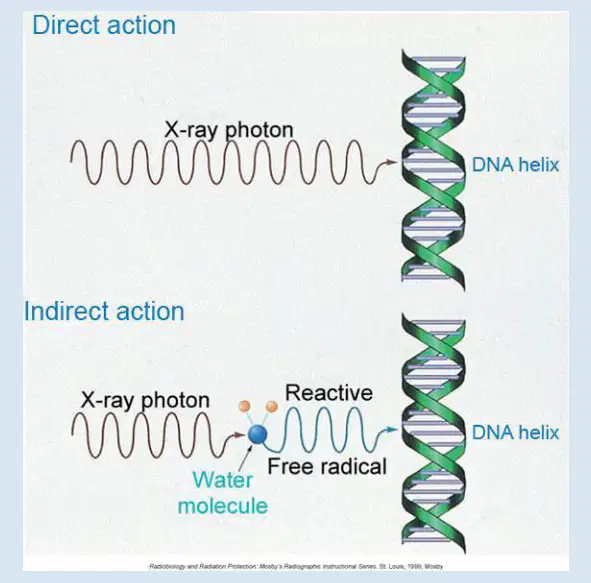
The difference between direct and indirect action of ionizing radiation on cells is:
Direct action involves ionizing radiation interacting directly with DNA, while indirect action involves radiation interacting with water molecules to produce free radicals that damage DNA.
Direct action involves radiation interacting with water molecules to produce free radicals that damage DNA, while indirect action involves ionizing radiation interacting directly with DNA.
Direct action and indirect action both involve ionizing radiation interacting directly with DNA.
There is no difference between direct and indirect action of ionizing radiation on cells.
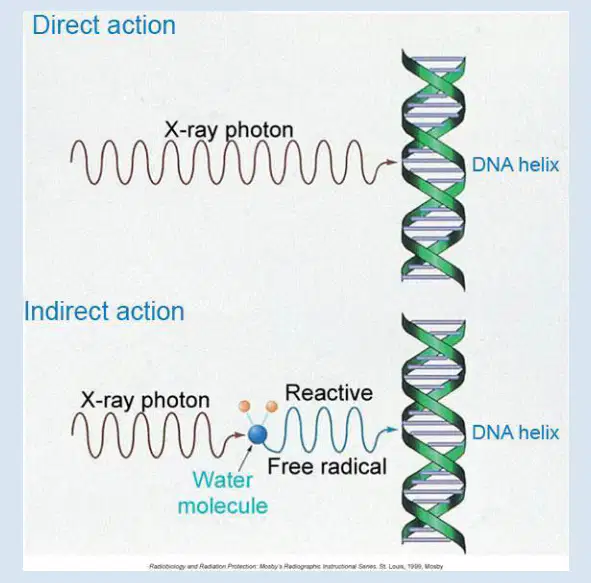
In the context of ionizing radiation, what happens during indirect action?
A) Ionizing particles interact directly with DNA
B) Ionizing particles interact with a water molecule
C) No interaction occurs
D) DNA is unaffected.
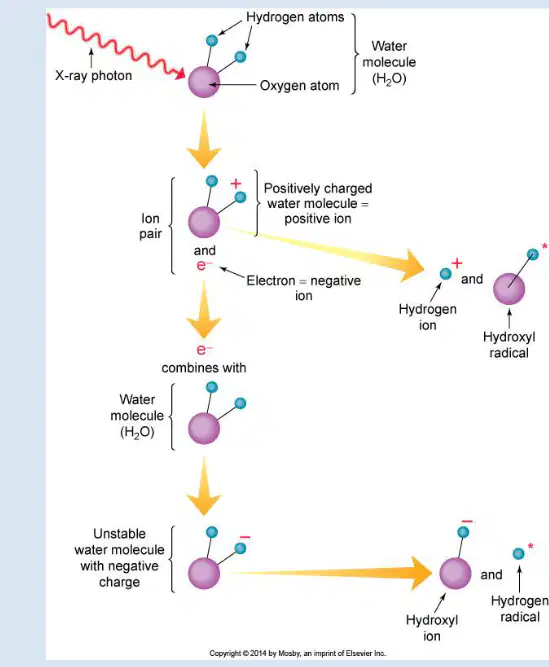
What is the process called where water molecules are ionized and free radicals are produced?
Electrolysis
Photolysis
Radiolysis
Hydrolysis
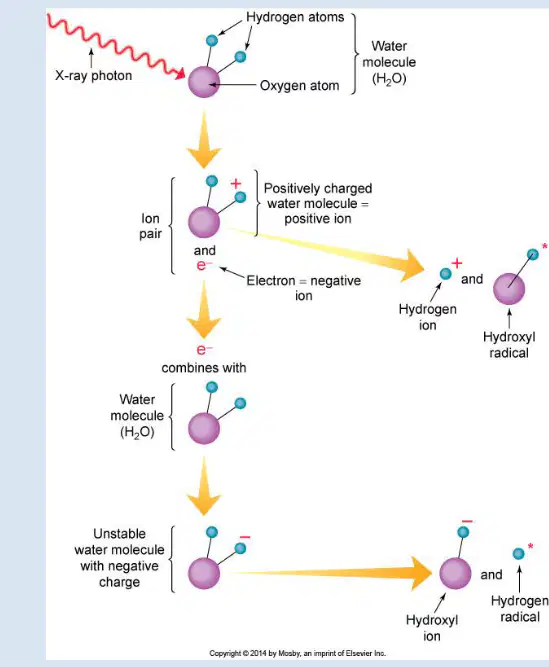
Which of the following is a highly reactive and unstable substance produced during the radiolysis of water?
Oxygen
Free radicals
Hydrogen
Water
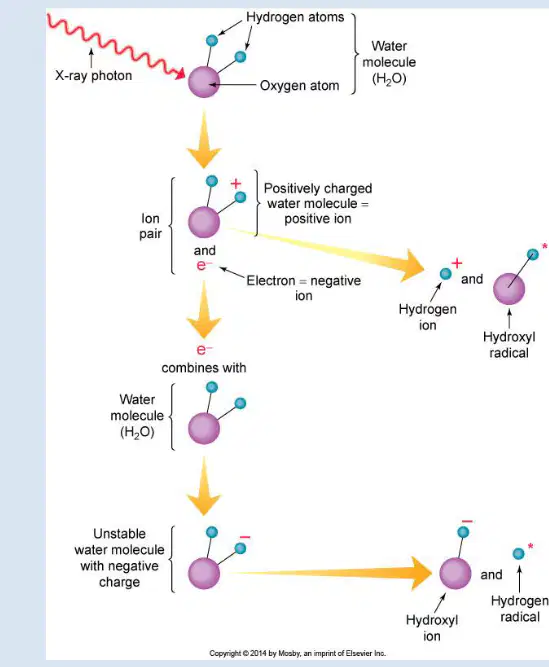
Explain how a free electron can combine with a normal water molecule during radiolysis.
By forming a covalent bond with the hydrogen atom
By forming a covalent bond with the oxygen atom
By forming a hydrogen bond with the water molecule
By forming an ionic bond with the water molecule
Fill in the blank: Free radicals can combine to form toxic substances such as hydrogen peroxide, represented by the equation OH + OH = _______.
H2O2
H2O
O2
OH2
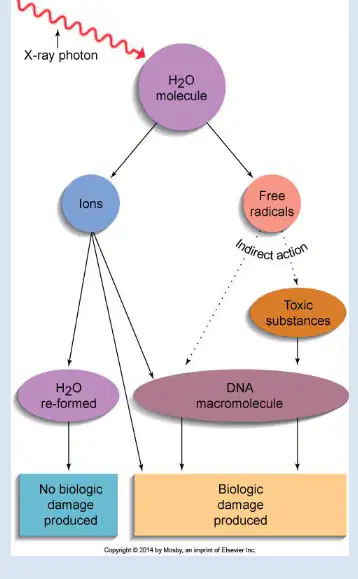
Explain how free radicals can cause biologic damage according to the diagram and description.
Free radicals can cause biologic damage by stealing electrons from other molecules, leading to a chain reaction of damage.
Free radicals cause biologic damage by donating electrons to other molecules, stabilizing them.
Free radicals have no effect on biologic systems as they are neutralized immediately.
Free radicals enhance cellular function by increasing energy production.
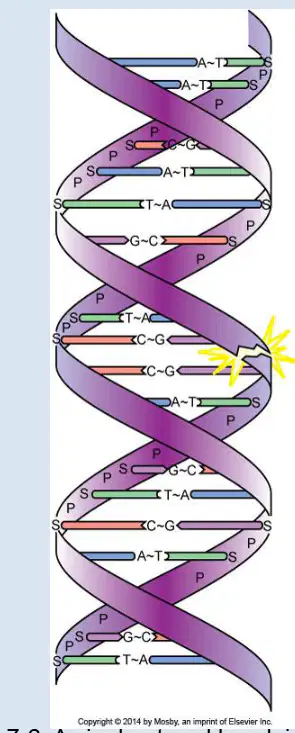
What is the effect of ionizing radiation on DNA macromolecules?
It strengthens the chemical bonds
It ruptures one of the molecule’s chemical bonds
It has no effect
It doubles the DNA strands.
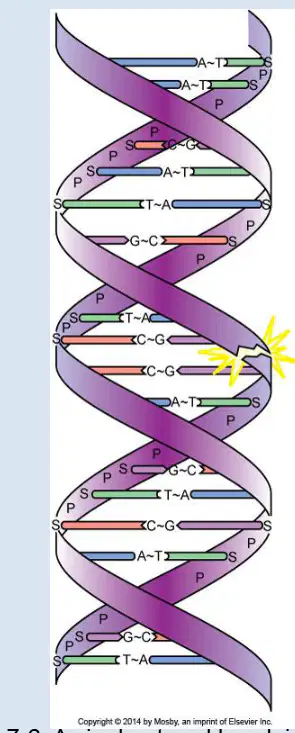
Repair enzymes interact with single-strand breaks caused by ionizing radiation by:
binding to the break site and facilitating repair
ignoring the break and continuing replication
causing further damage to the DNA
removing the damaged strand entirely
What can further exposure of the affected DNA macromolecule to ionizing radiation lead to?
Repair of DNA
Additional breaks in the sugar-phosphate molecular chain(s)
No effect
Strengthening of DNA
Breaks in DNA are more easily repaired as:
Single-strand breaks
Double-strand breaks
What may occur if repair does not take place in the DNA chains?
Mutations may occur
DNA will remain unchanged
Cells will function normally
Proteins will be synthesized correctly
Double-strand breaks occur more commonly with which type of radiation?
Low-LET radiation
High-LET radiation
Non-ionizing radiation
Ultraviolet radiation
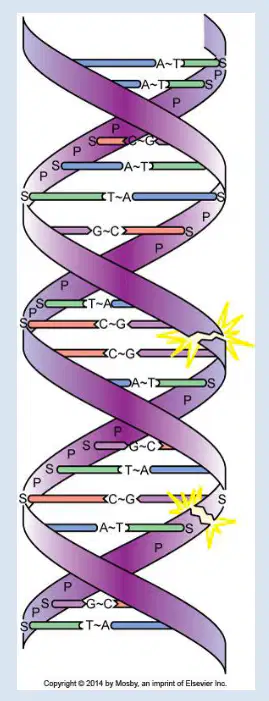
Explain the effects of ionizing radiation on DNA as shown in the diagram.
Ionizing radiation causes DNA strand breaks.
Ionizing radiation has no effect on DNA.
Ionizing radiation repairs DNA.
Ionizing radiation only affects RNA.
The result of a double-strand break in DNA is:
Cell death
DNA repair
Mutation
All of the above
What happens if a damaged chromosome divides?
The cell repairs the chromosome before division.
The damaged chromosome is passed on to daughter cells.
The cell undergoes apoptosis to prevent damage.
The cell cycle is halted until the damage is repaired.
What does a double-strand break in the DNA molecular structure cause?
Complete chromosome breakage
No effect
Partial chromosome breakage
What is a possible effect of ionizing radiation on DNA molecules?
It strengthens the DNA chain.
It may cause the loss of or change in a nitrogenous base in the DNA chain.
It has no effect on DNA.
It repairs damaged DNA.
What is a direct consequence of damage caused by ionizing radiation to DNA?
Mutation
Cell death
DNA repair
Cancer
True or False: The effects of ionizing radiation on DNA may not be reversible and may cause acute consequences for the cell.
True
False
What happens if a cell remains viable after being affected by ionizing radiation?
The cell dies immediately
The cell repairs itself and continues to function
The cell becomes cancerous
The cell becomes immune to further radiation
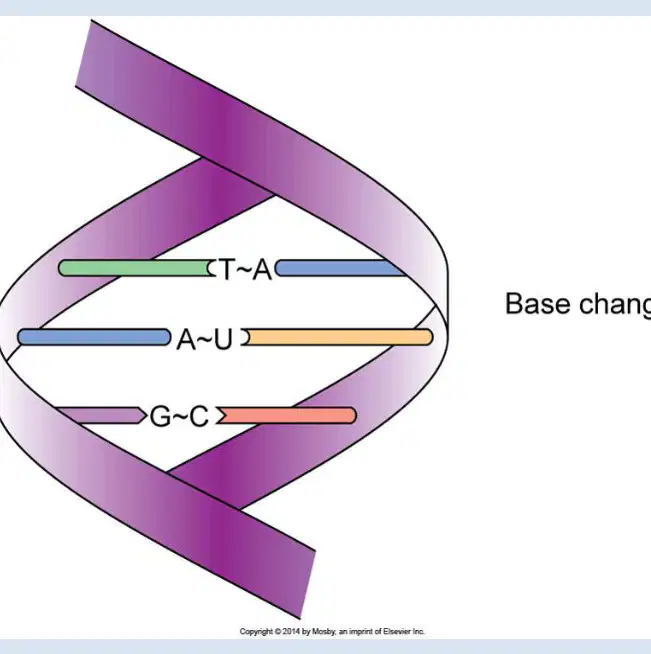
What is the effect of ionizing radiation on the nitrogen base sequence of DNA as shown in the diagram?
It causes base changes such as T~A, A~U, G~C.
It strengthens the DNA structure.
It has no effect on DNA.
It causes DNA to replicate faster.
What are covalent cross-links?
Chemical unions created by the sharing of electrons
Chemical unions created by the transfer of electrons
Chemical unions created by the sharing of protons
Chemical unions created by the transfer of protons
Covalent cross-links are initiated by _________.
high-energy radiation
low-energy radiation
thermal energy
mechanical stress
What can happen to molecules following irradiation?
They can fragment or change into small, spurlike molecules
They become less interactive
They lose their ability to attach to other macromolecules
They become non-sticky
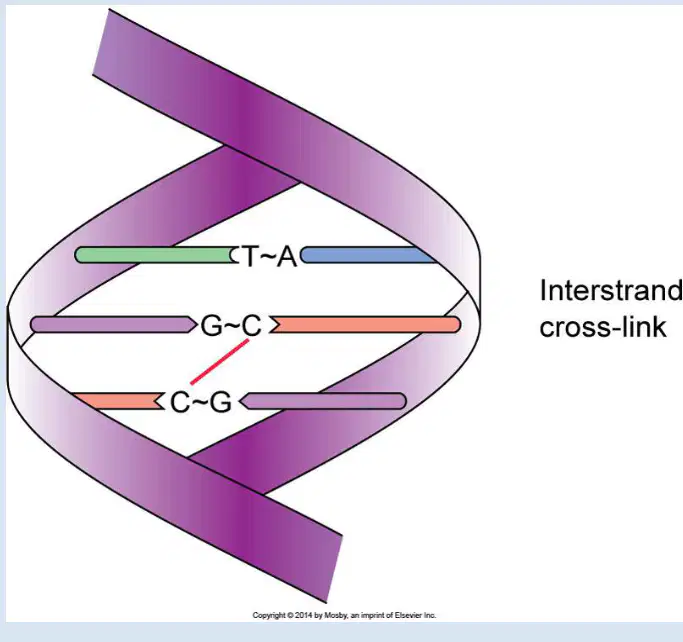
Explain the effects of ionizing radiation on DNA as shown in the diagram.
Ionizing radiation causes DNA strand breaks.
Ionizing radiation has no effect on DNA.
Ionizing radiation repairs DNA.
Ionizing radiation only affects RNA.
The effects of ionizing radiation on chromosomes include:
chromosomal aberrations such as breaks and translocations
enhanced chromosomal stability
no effect on chromosomes
improved DNA repair mechanisms
Which of the following is a result of radiation-induced chromosome breaks?
A) Chromosomal fragments
B) Chromosome anomalies
C) Structural changes in biologic tissue
D) All of the above
True or False: Large-scale structural changes in a chromosome produced by ionizing radiation may be as grave for the cell as radiation-induced changes in DNA.
True
False
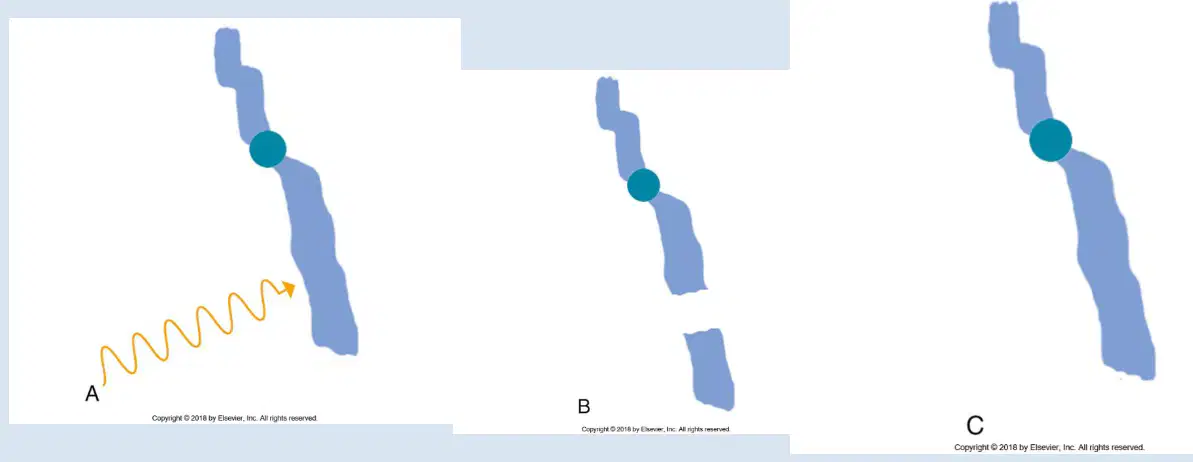
Explain the process of restitution as it relates to structural changes within the nucleus.
Restitution involves the repair of DNA double-strand breaks.
Restitution is the process of cell division.
Restitution refers to the synthesis of new proteins.
Restitution is the degradation of nuclear membrane.
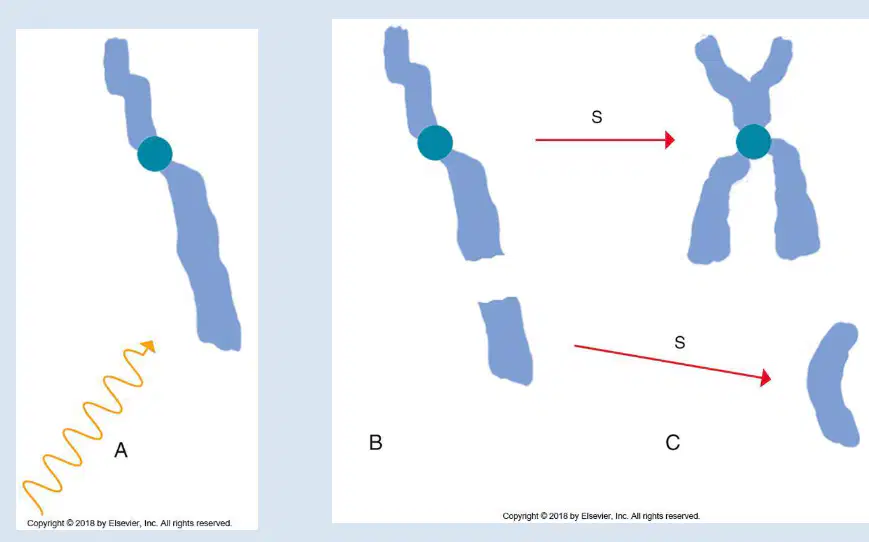
The process of deletion in chromosomes as shown in the diagram includes the steps labeled A, B, and C. Which of the following best explains these steps?
A involves the removal of a segment, B involves the joining of the remaining parts, and C involves the stabilization of the chromosome.
A involves the duplication of a segment, B involves the inversion of the segment, and C involves the insertion of the segment.
A involves the translocation of a segment, B involves the deletion of the segment, and C involves the duplication of the segment.
A involves the inversion of a segment, B involves the translocation of the segment, and C involves the deletion of the segment.

