
Font size
 Worksheets
Stoichiometry Practice Test
Total questions: 100
Worksheet time: 6hrs 46mins
How many moles of water will be produced from 6.5 moles of octane?
Solid zinc oxide (ZnO) is added to hydrochloric acid (HCl) to form zinc chloride (ZnCl2) in water. How many moles of zinc chloride will be produced when 112 grams of zinc oxide is used?
ZnO + 2HCl --> ZnCl2 + H2O
1.38 moles
3.07 moles
56.0 moles
112 moles
A student burns 1.50 mol C3H8 according to the following reaction:
C3H8 + 5O2 → 3CO2 + 4H2O
How many grams of carbon dioxide are produced?
44 g
66 g
132 g
198 g
Antimony is burned in oxygen to form antimony oxide.
4 Sb + 3 O2→2Sb2O3
How many moles of Sb2O3 will be formed when you have 20.0 moles of oxygen gas?
10 moles
13.3 moles
15.5 moles
40.8 moles
Potassium chlorate decomposed into potassium chloride and oxygen gas.
2KClO3 → 2 KCl + 3O2
How many grams of oxygen gas will be given off from 50.0 grams of potassium chlorate?
9.84 g
19.7 g
33.3 g
75.0 g
Nitrogen and hydrogen react to produce ammonia.
N2(g) + 3H2(g) → 2NH3(g)
How many grams of hydrogen are needed to produce 15.0 mol of ammonia if the reaction goes to completion?
15.0 g
22.5 g
45.0 g
90.0 g
In 1860, Robert Boyle was the first to use phosphorus to ignite sulfur-tipped wooden splints that gave rise to our modern matches. One of the ways it can be made involves the chemical reaction of calcium phosphate with carbon and silicon dioxide in a furnace:
2Ca3(PO4)2 + 6SiO2 + 10C → 6CaSiO3 + P4 + 10CO
If you use 100.0 grams of calcium phosphate and an excess of silicon dioxide and carbon, how many moles of phosphorus will be produced?
0.1612 moles
0.3224 moles
15510 moles
1.551 moles
3Cl2 + 6NaOH --> 5NaCl + NaClO3 + 3H2O
What is the mole ratio of chlorine (Cl2) to sodium hydroxide (NaOH)?
1:2
1:3
2:3
6:3
A tank contains 2.46 moles of propane gas. If the whole amount of gas reacts with a sufficient amount of oxygen gas, how many grams of water will be produced?
C3H8 + 5O2 --> 3CO2 + 4H2O
9.84 g
12.3 g
177 g
221 g
How many moles of sodium oxide (Na2O) would be produced from 174 g of sodium?
What would be the mass of aluminum aluminum sulfide (Al2S3) produced from 8 moles of aluminum?
16Al + 3S8 --> 8 Al2S3
How many moles of carbon dioxide would be produced from 156 g of benzene?
2C6H6 + 15O2 --> 12CO2 + 6H2O
2C2H2 + 5O2 --> 4CO2 + 2H2O
How many moles of acetylene will be required to produce 200 L of carbon dioxide (CO2)?
When sulfur dioxide reacts with oxygen, sulfur trioxide is formed.
2SO2 + O2 → 2SO3
How many grams of sulfur trioxide will be produced from 64.0 grams of sulfur dioxide?
256 g
160 g
128 g
80.0 g
Ammonia is synthesized from nitrogen and hydrogen gases.
N2 + 3H2 → 2NH3
If 10.0 moles of nitrogen are used, how many moles of ammonia will be produced?
40.0 moles
30.0 moles
20.0 moles
10.0 moles
Calcium carbonate decomposes into calcium oxide and carbon dioxide.
CaCO3 → CaO + CO2
How many grams of calcium oxide will be produced from 200.0 grams of calcium carbonate?
168 g
56.0 g
112 g
200 g
Determine the volume of carbon dioxide gas produced at STP when 2.5 g of nitroglycerin (C3H5N3) decomposes by this balanced equation. Round your answer to two decimal points.
4C3H5N3O9(l) → 12CO2(g) + 10H2O(g) + 6N2(g) + O2(g)
Use the reaction to answer these stoichiometry questions.
3Cl2 + 6NaOH --> 5NaCl + NaClO3 + 3H2O
What is the mole ratio of chlorine to sodium hydroxide?
1:1
1:2
2:1
2:3
C3H8 + 5O2 --> 3CO2 + 4H2O
A tank containing 55 L of propane gas contains 2.46 moles of the gas. If the whole amount of gas reacts with a sufficient amount of oxygen gas, how many grams of water will be produced?
9.84 g
12.3 g
177 g
221 g
Suppose we have the following pizza recipe:
1 crust + 5 ounces tomato sauce + 2 cups cheese → 1 pizza
Let's assume that we currently have 4 crusts and 10 cups of cheese. What is the minimum number of ounces of tomato sauce would you need in order to make 3 pizzas?
10
15
20
25
Predict the mass of iron filings required to completely react with 2.5 g of yellow sulfur solid, S8(s), to yield iron (III) sulfide.
3S8 + 16Fe --> 8Fe2S3
0.54 g Fe
1.5 g Fe
2.9 g Fe
4.3 g Fe
What is the volume of 1.0 mole of hydrogen gas at standard temperature and pressure?
5.5 L
11 L
22 L
44 L
Chocolate Chip Cookie Recipe:
1 cup of flour
100 chocolate chips
1 cup sugar
1/2 cup milk
Yields 10 cookies
You and your sister want to bake chocolate chip cookies. You go to the store and buy 5 cups of flour, three bags of chips, each containing 100 chocolate chips, 6 cups of sugar, and 10 cups of milk. You want to make as many cookies as possible. What is your limiting reactant, the ingredient that would run out first?
milk
flour
sugar
chocolate chips
4Al + 3O2 → 2Al2O3
How many grams of aluminum are required to produce 3.5 moles Al2O3 in the presence of excess O2?
94.5 g
108 g
189 g
378 g
The reaction between solid white phosphorous and oxygen produces solid tetraphosphorous decaoxide (P4O10). The balanced equation is given below:
P4 + 5O2 → P4O10
What is the limiting reactant if you are using 25.0 grams of phosphorus and 50.0 grams of oxygen?
O2
P4
P4O10
P4O2
In the chemical reaction NaHCO3 + CH3COOH → CH3COONa + H2O +CO2, 83 g of sodium bicarbonate reacts with 70 g of acetic acid. Which of these is correct?
Amount of NaHCO3 is in excess.
Amount of CH3COOH is in excess.
CH3COOH is the limiting reagent.
Amount of CH3COONa is in excess.
In a reaction 4 NH3 + 5 O2 → 4 NO + 6 H2O, 1 mole of ammonia reacts with 2 moles of oxygen. Which of these is correct after the reaction is complete?
All the oxygen is consumed.
All the ammonia is consumed.
1 mole of oxygen remains.
1 mole of water is produced.
Hydrogen gas (H2) reacts with oxygen gas (O2) and produces water. If one mol of hydrogen reacts with one mol of oxygen, what is the limiting reactant?
oxygen gas
water vapor
hydrogen gas
liquid water
4Al + 3O2 → 2Al2O3
How many grams of aluminum are required to produce 3.5 moles Al2O3 in the presence of excess O2? Round your answer to the whole number.
Hydrazine (N2H4), a rocket fuel , reacts with oxygen to form nitrogen gas and water vapor. The reaction is represented with the equation:
N2H4(l) + O2(g) → N2(g) + 2H2O(g)
How many grams of hydrazine (N2H4) are needed to produce 96.0g water?
Round your answer to one decimal point.
Zn + 2HCl → ZnCl2 + H2
At conditions of Standard Temperature and Pressure, determine how many liters of hydrogen gas are produced by placing a zinc nail with a mass of 2.2g into an excess of hydrochloric acid.
6.42 L
1.33 L
0.75 L
0.0015 L
C3H8 + 5O2 → 3CO2 + 4H2O
In the chemical reaction for the combustion of propane, determine, at standard temperature and pressure, how many liters of carbon dioxide gas are produced if 15 liters of oxygen gas are completely consumed.
3
5
6
9

What is the total number of moles of Na2S produced when 8.0 moles of Na were completely consumed?
What mass of O2 will be needed to burn 36.1 g of B2H6?

The Reactant that is NOT used up is called the ..............
Limiting Reactant
Excess Reactant
How many grams of hydrogen are produced if 120 g of Na are available?
B2H6 + 3O2 -->2 HBO2 + 2 H2O
What mass of O2 will be needed to burn 20.0 g of B2H6 ?

Identify the limiting and excess reactants in the reaction shown.
N2 is limiting and H2 is excess.
H2 is limiting and N2 is excess.
NH3 is both limiting and excess.
There is no limiting reactant.

This reactant determines the maximum amount of product you could produce.
Limiting Reactant
Excess Reactant

Identify the limiting and excess reactants in the reaction shown.
O2 is limiting and H2 is excess.
H2 is limiting and O2 is excess.
O2 is both limiting and excess.
There is no limiting reactant.

If 23 g KCl are obtained,
what is the percent yield for the reaction?
44%
102%
98%
43%
Fe2O3(s) + 3H2(g) → 2Fe(s) + 3H2O(l)
How many moles of iron can be made from 6 moles H2?
How many moles of hydrogen are needed to react with 2 moles of nitrogen?
6 mol H
2 mol H
3 mol H
1 mol H
How many moles of water can be produced if 8 moles H2 are used?
12.00 moles of NaClO3 will produce how many grams of O2?
How many grams of aluminum sulfate would be formed if 250g H2SO4 completely reacted with aluminum?
How many moles of HCl are consumed in the production of 7.5 moles of MgCl₂?
how many grams of Ca(OH)₂ would be formed with 3.20 moles of CaC₂?
NaIO3(aq) + 6HI(aq) --> 3I2(s) + NaI(aq) + 3H2O(l)
How many moles of iodine can be made from 6.55 moles of NaIO3?
4NH3(g) + 5O2(g) --> 4NO(g) + 6H2O(l)
How many grams of oxygen gas are needed to react with 56.8 grams of ammonia?
How many moles of oxygen are produced when 6.7 moles of KClO3 decompose completely?
How many grams of hydrogen are produced if 120 g of Na are available?
In the formation of CO2 from CO and oxygen, how many Liters of CO2 are produced by the reaction of 8 mols of O2 with an excess of carbon monoxide?
How many grams of potassium chloride can be produced from 356 g of chlorine and 356 g of potassium bromide?
How many moles of carbon dioxide are produced from the combustion of 110 g of CH4?
In the experiment above, 7.62 g of Fe are allowed to react with 8.67 g of S.
How much FeS is formed?
How many moles of hydrogen are needed to react with 2 moles of nitrogen?
How many moles of water can be produced if 8 moles H2 are used?
How many grams of potassium chloride (KCl) can be produced from 356 g of potassium bromide (KBr)?
Mg + 2HCl --> MgCl2 + H2
Mg + 2HCl --> MgCl2 + H2
Fe2O3(s) + 3H2(g) → 2Fe(s) + 3H2O(l)
How many moles of iron can be made from 6 moles H2?
What is the total number of moles of water needed to make 2.5 moles of C6H12O6?
When magnesium reacts with nitrogen gas, magnesium nitride is formed.
3Mg + N2 → Mg3N2
How many grams of magnesium nitride will be produced from 48.6 grams of magnesium?
100.0 g
74.6 g
162.0 g
200.0 g
In the reaction of aluminum with chlorine gas, aluminum chloride is formed.
2Al + 3Cl2 → 2AlCl3
If 5.0 moles of aluminum are used, how many moles of aluminum chloride will be produced?
10.0 moles
7.5 moles
5.0 moles
15.0 moles
Calcium carbonate decomposes into calcium oxide and carbon dioxide gas.
CaCO3 → CaO + CO2
How many grams of calcium oxide will be produced from 200 grams of calcium carbonate?
200.0 g
168.0 g
112.0 g
56.0 g
What is the formula for percent yield?
TheoreticalActual×100
ActualTheoretical×100
100Actual×Theoretical
Actual×Theoretical100
Actual yield = 62g
Calculate the percent yield.
When reacting Na with Cl2, we calculated that the theoretical yield should be 13 grams. Our actual yield was 12.5 grams. What is the percent yield?
90.4%
104%
96.15%
1.04%
The theoretical yield of a reaction is 237 grams, but the reaction actually yields 26 less grams than expected. What is the percent yield?
17.6%
82.4%
89.0%
121.3%
Which of the following reactions has the lowest percent yield?
Theoretical yield 25.7 g; actual yield 23.2 g
Theoretical yield 42.1 g; actual yield 39.9 g
Theoretical yield 18.2 g; actual yield 15.6 g
Theoretical yield 93.4 g; actual yield 87.9 g
24 grams of CH4 was added to the above reaction. Calculate the theoretical yield of CO2.
The reaction of 75.0g P4 with excess chlorine gas produces 110g PCl3 in lab. Find the theoretical yield and calculate percent yield for the reaction.
2Fe2O3 + C → Fe + 3CO2
You add 28 grams of carbon. You find the actual yield to be 181.2 grams of CO2. What is the percent yield of CO2? (Hint: calculate theoretical yield of CO2 first)
58.83%
308%
6435%
15.5
3FeCl2 + 2Na3PO4 → Fe3(PO4)2 + 6NaCl
If 23 grams of iron (II) chloride reacts with 41 grams of sodium phosphate. Determine the limiting reactant
Fe3(PO4)2
Na3PO4
FeCl2
NaCl
Cu + 2AgNO3 → 2Ag + Cu(NO3)2
When 160 g of copper reacts with 200 g of silver nitrate according to the equation above, the limiting reactant of copper (II) nitrate is (a) and the theoretical yield is (b)
Cu(NO3)2
110.4 g
Using the following equation:
Fe2O3(s) + 3 H2(g) → 2 Fe(s) + 3 H2O(l)
How many grams of iron can be made from 6.00 grams of H2 and excess Fe2O3?
(a)
2 Al + 3 Cl2 ---> 2 AlCl3.
If 2 moles of aluminum and 2 moles of chlorine are reacted,
identify the limiting reactant (a)
Identify the excess reactant (b)
P4 + 3 O2 --> P4O6
How many grams of product is made when 12 grams of P4 react with 15 grams of O2?
(a)
Use the equation 2 Al + 3 Cl2 ---> 2 AlCl3.
If 2.00 moles of aluminum and 3.00 moles of chlorine are reacted, how much ,in grams, AlCl3 can be made?
133
0.00750
9.88
267
Actual yield = 62g
Calculate the percent yield.
24 grams of CH4 was added to the above reaction. Calculate the theoretical yield of CO2.
The reaction of 25.0 g benzene, C6H6, with excess HNO3 resulted in 21.4 g C6H5NO2. What is the percentage yield?
C6H6 + HNO3 → C6H5NO2 + H2O
100%
27.39%
54.29%
85.62%
When reacting Na with Cl2, we calculated that the theoretical yield should be 13 grams. Our actual yield was 12.5 grams. What is the percent yield?
90.4%
104%
96.15%
1.04%
1 Mg + 2 HCl --> 1 MgCl2 + 1 H2
The balanced chemical equation for the reaction of sodium with iron (III) oxide is:
6Na + Fe2O3 → 3Na2O + 2Fe
If 80.0g of sodium (Na) reacts with 72.0g of iron (III) oxide (Fe2O3) , what is the limiting reactant?
Na
Fe2O3
Na2O
Fe
The balanced chemical equation for the reaction of sodium with iron (III) oxide is:
6Na + Fe2O3 → 3Na2O + 2Fe
If 80.0g of sodium (Na) reacts with 72.0g of iron (III) oxide (Fe2O3) , what is the theoretical yield of iron (Fe)?
50.4 g Fe
64.9 g
8.0 g
44.2 g
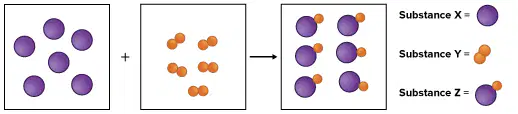
Which is true of the reaction shown here?
two molecules of Substance Y will be left over when this reaction goes to completion
Substance Y is the limiting reactant in this reaction
the mole ratio of this reaction is 6:5:6
adding more molecules of Substance X will not affect the amount of Substance Z produced
Nitrogen acts as a(n) (a) reactant when 2 mol of nitrogen and 5 mol of hydrogen react in the production of ammonia.
N2 + 3H2 --> 2NH3
In this chemical reaction, 6 moles of each of the reactants is combined.
3Mg + N2 → Mg3N2
Which is the limiting reagent?
Mg
N2
In this chemical reaction, 6 moles of each of the reactants is combined.
3Mg + N2 → Mg3N2
Which is the excess reagent?
Mg
N2
In this chemical reaction, 6 moles of each of the reactants is combined.
3Mg + N2 → Mg3N2
What is the theoretical yield?
600 g
200 g
400 g
800 g
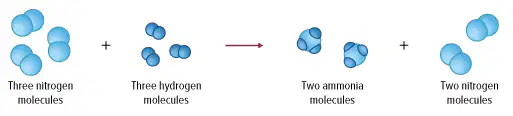
Which molecule is the excess reactant?
hydrogen
nitrogen
ammonia

