
 Worksheets
Great Depression Quiz
Total questions: 68
Worksheet time: 34mins

What time period does the image refer to?
1920 - 1930
1930 - 1940
1929 - 1945
1945 - 1960
What era is known for its cultural and economic prosperity in America after WW1?
The Great Depression
The Roaring Twenties
The Industrial Revolution
The Civil Rights Movement
Which of the following was a popular form of entertainment during the Roaring Twenties?
Watching television
Listening to the radio and gramophones
Playing video games
Surfing the internet
What significant change occurred in American cities during the Roaring Twenties?
Decrease in population
Increase in industrialization and urbanization
Decline in cultural activities
Reduction in automobile usage
What was a significant economic event that occurred on October 29, 1929?
The beginning of World War II
The signing of the Treaty of Versailles
The Stock Market Crash
The discovery of penicillin
During the Roaring Twenties, what did people rely on to spend their wealth in luxury?
Gold reserves
Credit
Barter system
Cryptocurrency
What was a common practice among investors before the Stock Market Crash of 1929?
Buying stocks with cash only
Investing in real estate
Buying on margin using borrowed money
Trading in foreign currencies
What was one of the effects of the Stock Market Crash of 1929?
Increase in bank savings
Economic growth
Banks failed and the economy declined
Rise in stock prices
What was a major economic issue during the Great Depression?
High employment
Low poverty
High unemployment
Business growth
How did the Dust Bowl affect Texas during the Great Depression?
It improved crop prices
It worsened the economic situation
It had no impact
It led to industrial growth
What was the purpose of the New Deal introduced by President Franklin D. Roosevelt?
To increase taxes
To provide relief, recovery, and reform
To reduce government intervention
To promote international trade
What long-term effect did the Great Depression have on the role of government?
Reduced government intervention
No change in government role
Reshaped the role of government in the economy
Decreased expectations for government intervention

What is the main message of the billboard in the image?
The American lifestyle is the best.
People are waiting for a bus.
The line is for a concert.
It's an advertisement for a new car.

What is happening in the image below the billboard?
People are in a parade.
People are standing in line.
People are playing a game.
People are dancing.

What does the image suggest about the contrast between the billboard and the people in line?
The billboard and the people are unrelated.
The billboard shows prosperity, while the people seem to be in need.
The people are happy and prosperous like the billboard suggests.
The people are advertising the billboard.
What was one of the main causes of the Dust Bowl in the Great Plains during the 1930s?
Heavy rainfall
Severe drought
Earthquakes
Volcanic eruptions
How did high winds contribute to the Dust Bowl?
By cooling the region
By picking up loose soil and creating dust storms
By increasing rainfall
By preventing soil erosion
What effect did extreme heat have on the soil during the Dust Bowl?
It increased soil moisture
It contributed to the drying of the soil
It caused the soil to freeze
It made the soil fertile
Why was soil erosion a significant problem during the Dust Bowl?
Because it increased plant growth
Because it made the soil too wet
Because without plant roots, the dry, loose topsoil was easily blown away
Because it prevented dust storms
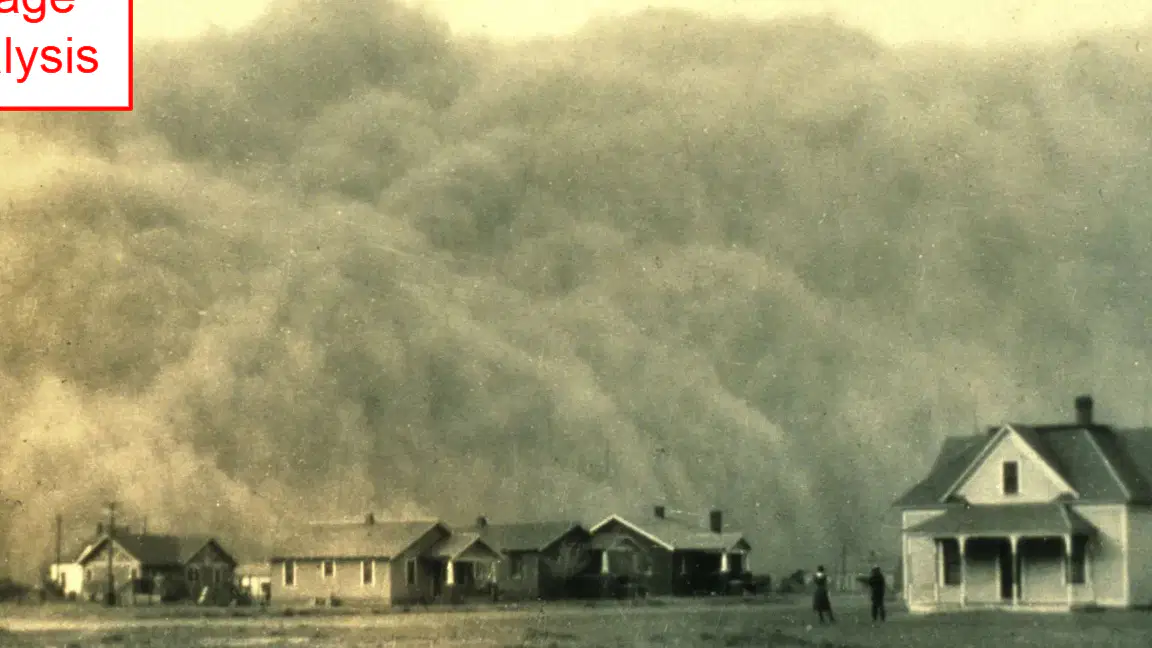
What natural phenomenon is depicted in the image?
Tornado
Earthquake
Dust storm
Flood
What was one of the main crops grown by farmers that contributed to the Dust Bowl?
Corn
Wheat
Rice
Barley
What practice involves the continuous planting of the same crop, leading to soil depletion?
Crop Rotation
Monoculture Cropping
Contour Plowing
Land Speculation
Which of the following was NOT a technique used by farmers that contributed to the Dust Bowl?
Crop Rotation
Contour Plowing
Windbreaks
Over-Farming
What belief led to the overuse of marginal lands during the Dust Bowl?
Land Speculation
Soil Conservation
Crop Diversification
Sustainable Farming
What was a major reason for the migration of families during the Dust Bowl?
Seeking better education
Searching for work
Escaping war
Looking for a warmer climate
What economic hardship did many farmers face during the Dust Bowl?
Increased crop production
Land loss due to crop failures
Higher market prices
Abundance of resources
What health problems were caused by dust storms during the Dust Bowl?
Skin rashes
Respiratory illnesses
Hearing loss
Vision problems
What was the government's response to the Dust Bowl under FDR?
Encouraging urban development
Promoting industrial growth
Encouraging soil conservation practices
Increasing military spending
How did the Dust Bowl impact farmers?
It increased crop yields significantly.
It caused many farmers to lose their land.
It led to a boom in agricultural exports.
It improved soil fertility.
How did the Dust Bowl influence the landscape of the Great Plains?
It made the region more fertile.
It caused widespread desertification.
It led to the growth of forests.
It improved water availability.
How did government influence farming practices?
By encouraging deforestation.
By promoting sustainable farming techniques.
By banning all agricultural activities.
By increasing taxes on farmers.
What lessons can we learn from the Dust Bowl and its impacts on humans?
The importance of ignoring environmental changes.
The need for better urban planning.
The significance of sustainable agriculture.
The benefits of industrial pollution.
What was Herbert Hoover's belief about the economy during the early years of the Great Depression?
It would recover on its own.
It needed immediate government intervention.
It required international aid.
It was beyond recovery.
What did Herbert Hoover emphasize with his idea of "Rugged Individualism"?
Reliance on government aid.
Reliance on international support.
Reliance on oneself and local communities.
Reliance on technological advancements.
How did Herbert Hoover respond to large-scale federal aid programs during the Great Depression?
He supported them fully.
He resisted them.
He expanded them.
He ignored them.
What was a result of public discontent with Hoover's policies during the Great Depression?
Increased support for Hoover.
Decreased unemployment rates.
Protests like the "Bonus Army" march.
Economic recovery.
In what year was Franklin D. Roosevelt elected, promising bold action to combat the Great Depression?
1932
1929
1945
1939
What was the main goal of the New Deal launched by FDR?
To provide relief for the unemployed and promote economic recovery
To increase taxes on the wealthy
To reduce government spending
To expand the military
Which programs provided jobs for millions of Americans during the Great Depression?
Civilian Conservation Corps (CCC) and Works Progress Administration (WPA)
Social Security Administration
Federal Reserve System
Environmental Protection Agency
What year was the Social Security Act established, providing financial support for the elderly, unemployed, and disabled?
1935
1925
1940
1930
What type of government approach did Hoover support?
Limited government
Strong government action
Social Security
New Deal Plan
Which president is associated with the New Deal Plan?
Hoover
FDR
Lincoln
Washington
What major construction project is associated with Hoover?
Hoover Dam
Golden Gate Bridge
Empire State Building
Mount Rushmore
Which of the following was a focus of FDR's presidency?
Encouraged volunteerism
Smoot-Hawley Tariff
Social Security
Reconstruction Finance Corp
What did both Hoover and FDR aim to address during their presidencies?
World War I
The Great Depression
The Cold War
The Civil Rights Movement
During which decade did the Great Depression continue with high unemployment and widespread poverty?
1920s
1930s
1940s
1950s
What impact did the Great Depression have on Texas agriculture?
Increased crop prices
Improved weather conditions
Falling crop prices and drought
Abundant rainfall
What was a major consequence of bank failures during the Great Depression?
Increased savings for families
Wiping out savings for families and businesses
More banks opening
Higher interest rates
When did the economy fully recover from the Great Depression?
During World War I
During World War II
In the 1920s
In the 1950s
Who served as Vice President under Franklin D. Roosevelt and helped shape early New Deal policies?
Miriam "Ma" Ferguson
Sam Rayburn
John Nance "Cactus Jack" Garner
Lyndon B. Johnson
Which Texas leader was elected as governor during the Great Depression and worked to address economic issues?
Sam Rayburn
Miriam "Ma" Ferguson
Lyndon B. Johnson
John Nance "Cactus Jack" Garner
Who played a key role in supporting New Deal legislation and helped pass the Social Security Act?
Lyndon B. Johnson
John Nance "Cactus Jack" Garner
Sam Rayburn
Miriam "Ma" Ferguson
Which young politician from Texas supported New Deal programs and advocated for rural electrification?
Miriam "Ma" Ferguson
Sam Rayburn
Lyndon B. Johnson
John Nance "Cactus Jack" Garner
What was the purpose of Roosevelt's work-relief program?
To increase taxes
To employ more than 8.5 million people
To reduce government spending
To promote international trade
What does WPA stand for in the context of Roosevelt's program?
World Peace Association
Work Progress Administration
Workers' Protection Agency
World Power Alliance

Which of the following slogans is associated with the WPA?
Save Your Eyes
Work Pays America
Ready to Serve
New Deal
In what year did Adolf Hitler rise to power in Germany?
1929
1933
1945
1918
Which country did Benito Mussolini invade in 1935?
China
Poland
Ethiopia
France
Hideki Tojo was a military leader from which country?
Germany
Italy
Japan
Russia
What type of rule did these dictators use to control their nations?
Democratic Rule
Totalitarian Rule
Monarchical Rule
Anarchic Rule
What event marked the start of World War II?
The bombing of Pearl Harbor
The invasion of Poland
The formation of the United Nations
The signing of the Treaty of Versailles
Which countries formed the Axis Powers during World War II?
Germany, Italy, and Japan
Germany, France, and the UK
Italy, Japan, and the USA
Japan, China, and Russia
What strategy did Germany use to quickly overwhelm countries like Poland and France?
Trench warfare
Naval blockade
Blitzkrieg tactics
Guerrilla warfare
What event led the United States to enter World War II?
The invasion of Poland
The bombing of Pearl Harbor
The fall of France
The signing of the Munich Agreement
What shift did Texas industries make during World War II?
Producing consumer goods
Producing war materials like aircraft, ships, and weapons
Producing agricultural products
Producing electronics
How did Texans support the war effort through rationing?
By increasing food production
By conserving food, gasoline, and other resources
By exporting more goods
By reducing taxes
What new roles did women in Texas take on during World War II?
Working in agriculture
Working in factories and offices
Serving in the police force
Teaching in schools
What were victory gardens used for during World War II in Texas?
To grow flowers for decoration
To supplement food supplies
To create public parks
To grow medicinal plants

