
 Worksheets
TERM 3 SUMMATIVE POE
Total questions: 35
Worksheet time: 18mins
Which of the following is a characteristic of an open-loop system?
Uses feedback
Self-correcting
Operates without feedback
Requires sensors to adjust
A washing machine that stops at a preset time regardless of load weight is an example of:
Open-loop system
Closed-loop system
Feedback-controlled system
Sensor-driven system
A thermostat that adjusts room temperature by turning the heater on or off based on the current temperature is an example of:
Open-loop system
Closed-loop system
Manual control system
Relay control system
In a closed-loop system, feedback is used to:
Ignore external disturbances
Improve system accuracy
Remove the need for actuator
Eliminate the need for input
A factory conveyor belt automatically stops when a sensor detects that an item is at the correct position for packaging. This system is an example of:
Open-loop control
Manual control
Closed-loop control
Manual control
Which of the following is NOT a VEX structural component?
C-Channels
Wheels
Gears
Microcontroller
The VEX V5 Brain serves as:
A power source
A structural component
The central processing unit
A sensor module
A student is designing a VEX robot to pick up small objects. Which component should they use to grasp the objects?
C-Channels
Gears
Claw mechanism
Omni wheels
What is the benefit of adding comments to your code?
Increases execution speed
Helps with debugging and readability
Prevents compilation errors
Reduces file size
A programmer wants to ensure their VEX robot stops moving when it detects an obstacle. Which programming concept should they use?
Loop condition
Hardcoded movement
Conditional statements
Random number generator
A resistor is used in a circuit to:
Increase current
Store electrical charge
Limit current flow
Convert AC to DC
Which component is used to measure voltage?
Resistor
Multimeter
Breadboard
Diode
In a series circuit, if one component fails, the rest:
Continue working
Stop working
Increase voltage
Reduce resistance
A parallel circuit has:
Only one path for current
Multiple paths for current
No resistance
Decreasing current
If a student builds a circuit with three resistors in series, how does the total resistance compare to individual resistances?
It is the same as the smallest resistor
It is the sum of all resistances
It is lower than the smallest resistor
It remains constant
Ohm’s Law states that voltage equals:
Current × Resistance
Resistance / Current
Current / Resistance
Power × Resistance
Ohm’s Law states that current equals:
Current × Resistance
Voltage / Resistance
Current / Resistance
Power × Resistance
What happens to the current if resistance increases while voltage remains constant?
It increases
It decreases
It stays the same
It doubles
A multimeter can measure:
Only voltage
Voltage, current, and resistance
Only current
Only resistance
What is the primary function of a breadboard?
To permanently connect electrical components
To temporarily build and test circuits
To increase voltage in a circuit
To measure current flow
A student is troubleshooting a circuit on a breadboard and notices that an LED isn’t turning on. Which of the following is a likely reason?
The LED is connected in reverse polarity
The circuit is using too much current
The breadboard is only for DC circuits
The LED needs more than 50V to function
The long leg or leg with the bend of an LED is called the:
Anode
Cathode
Base
Collector
When connecting a resistor in a circuit, the resistance value is determined by:
The color bands on the resistor
The number of turns in the coil
The type of battery used
The position of the resistor in the circuit
What is the purpose of a schematic diagram?
To show a circuit’s physical layout
To display an artistic drawing of components
To provide a symbolic representation of a circuit
To identify the manufacturer of each component
If a circuit has 0.5A of current and a resistance of 10Ω, what is the voltage?
5V
10V
15V
20V
A student accidentally replaces a 100Ω resistor with a 10Ω resistor in a circuit with a 12V power source. What will happen to the current?
It will increase
It will decrease
It will stay the same
It will reach zero
A student is working on a circuit with a 24V power supply and a 12Ω resistor. What is the current flowing through the circuit?
1A
2A
3A
4A
A small fan motor operates at 0.5A and has a resistance of 40Ω. What is the voltage required to run the motor?
10V
20V
30V
40V
A student builds a circuit with a 5Ω resistor and connects it to a 10V battery. How much power is consumed by the resistor?
5W
10W
20W
50W
A student is testing a resistor and finds that it allows 0.25A of current when connected to a 50V source. What is the resistor’s value?
100Ω
150Ω
200Ω
250Ω
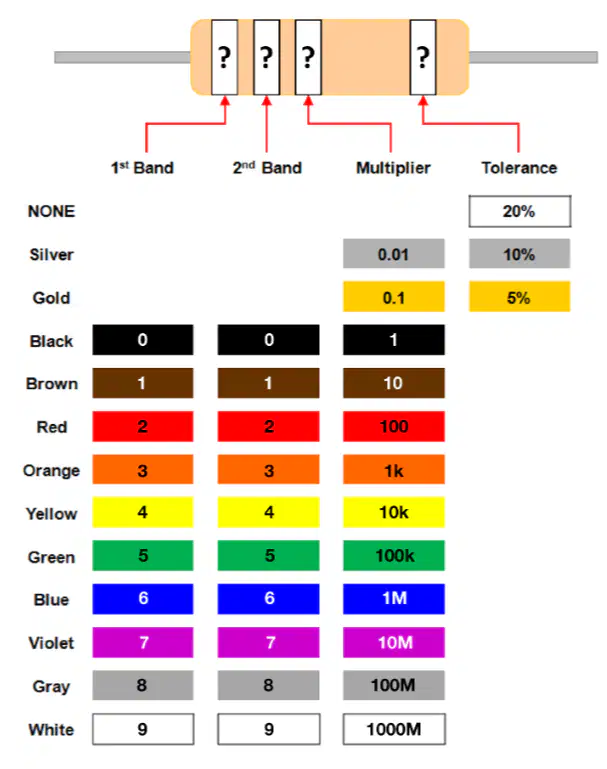
What is the resistance value of a resistor with the color bands: Brown, Black, Red, Gold?
10Ω ±5%
1000Ω ±5%
100Ω ±5%
10kΩ ±5%
What is the resistance of a resistor with the color bands: Red, Red, Brown, Gold?
2.2Ω ±5%
220Ω ±5%
2.2kΩ ±5%
22Ω ±5%
A student needs a resistor with a value of approximately 1kΩ. Which of the following resistor color codes is the best choice?
Brown, Black, Red, Gold
Red, Red, Brown, Gold
Yellow, Violet, Brown, Gold
Green, Blue, Black, Gold
A resistor labeled 10kΩ ±10% is used in a circuit. What is the possible range of resistance?
9.5kΩ – 10.5kΩ
9kΩ – 11kΩ
8kΩ – 12kΩ
10kΩ – 12kΩ
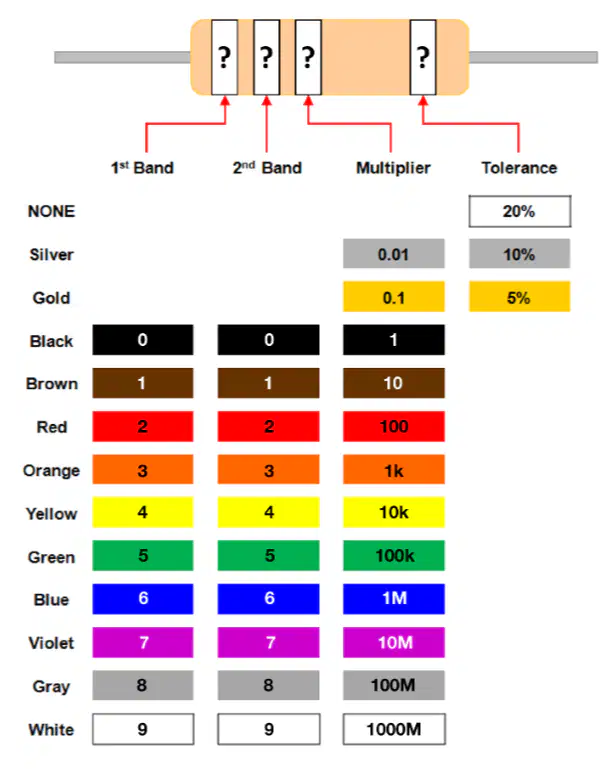
A student measures the resistance of an unknown resistor using a multimeter and finds it to be approximately 4.7kΩ. Which of the following color codes is most likely on the resistor?
Yellow, Violet, Red, Gold
Orange, Orange, Brown, Gold
Yellow, Violet, Orange, Gold
Brown, Black, Red, Gold

