
 Worksheets
Bio 206 CH:12
Total questions: 98
Worksheet time: 49mins
Who formulated the central dogma of molecular genetics in 1958?
James Watson
Francis Crick
Rosalind Franklin
Gregor Mendel
What is the role of transcription in molecular genetics?
Produces a DNA copy of a gene
Produces an RNA copy of a gene
Produces a polypeptide using mRNA
Stores information in units called genes
What does messenger RNA (mRNA) do?
Stores information in units called genes
Becomes part of a functional protein
A temporary copy of a gene that contains information to make a polypeptide
Produces a polypeptide using mRNA
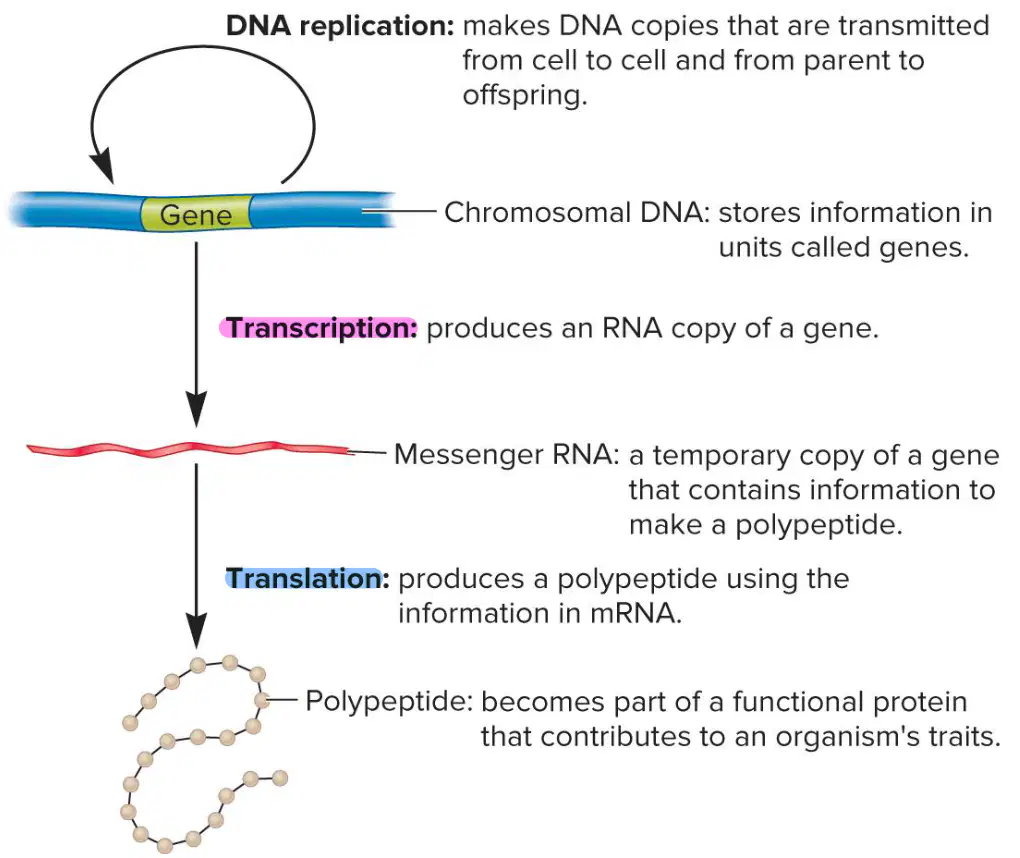
What is the function of translation in the central dogma?
Produces a DNA copy of a gene
Produces an RNA copy of a gene
Produces a polypeptide using the information in mRNA
Stores information in units called genes
What is the primary function of Messenger RNA (mRNA)?
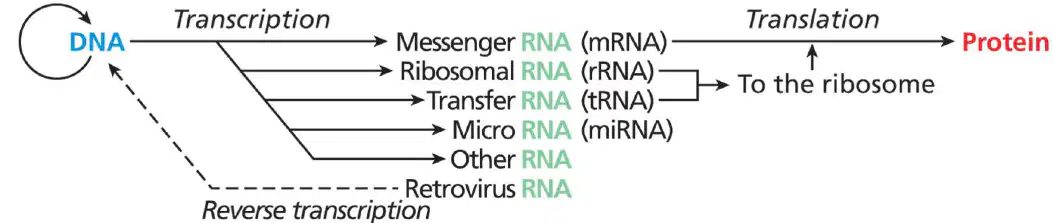
To carry amino acids to ribosomes
To encode the sequence of amino acids in a polypeptide
To form the large and small ribosomal subunits
To regulate mRNA stability and translation
Which type of RNA helps form the large and small ribosomal subunits?
Messenger RNA (mRNA)
Transfer RNA (tRNA)
Ribosomal RNA (rRNA)
MicroRNA (miRNA)
What is the role of Transfer RNA (tRNA) in protein synthesis?
To encode the sequence of amino acids in a polypeptide
To carry amino acids to ribosomes and bind them to mRNA
To form the large and small ribosomal subunits
To regulate mRNA stability and translation
Which type of RNA is involved in regulating mRNA stability and translation?
Small nuclear RNA (snRNA)
MicroRNA (miRNA)
Ribosomal RNA (rRNA)
Transfer RNA (tRNA)
Where is Telomerase RNA located and what is its function?
In the ribosome, forming subunits
In the nucleoprotein complex, maintaining telomere length
In the cytoplasm, carrying amino acids
In the nucleus, encoding polypeptides
What does a gene code for?
Proteins
DNA
RNA
Lipids
What is the function of a structural gene?
Codes for lipids
Codes for mRNA
Codes for DNA
Codes for carbohydrates
What does a nonstructural gene code for?
mRNA
Proteins
Non-mRNA, such as rRNA
Lipids

What is the role of constitutive genes?
Only active during cell division
Always active
Active only when needed
Inactive in all cells
What is the role of regulated genes?
Always active
Active only when needed
Never active
Active during cell death
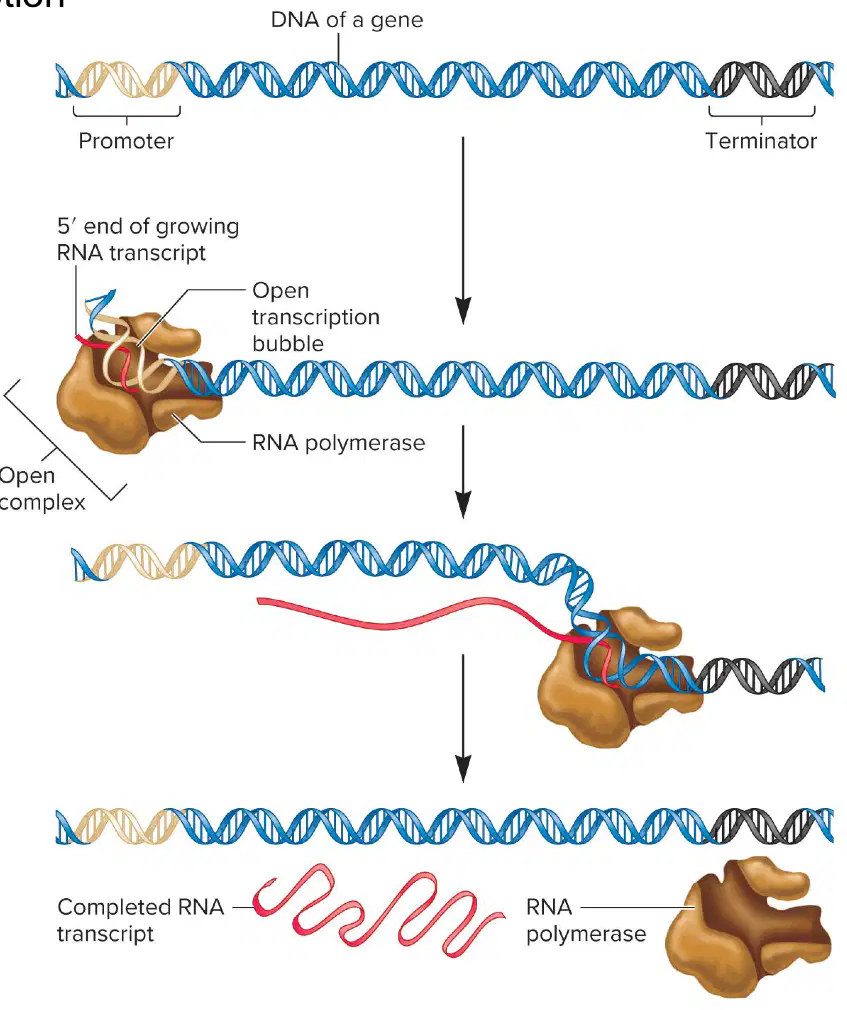
What is the role of RNA polymerase during transcription?
It unwinds the DNA double helix.
It synthesizes RNA from a DNA template.
It adds nucleotides to the 3' end of the DNA.
It terminates the transcription process.
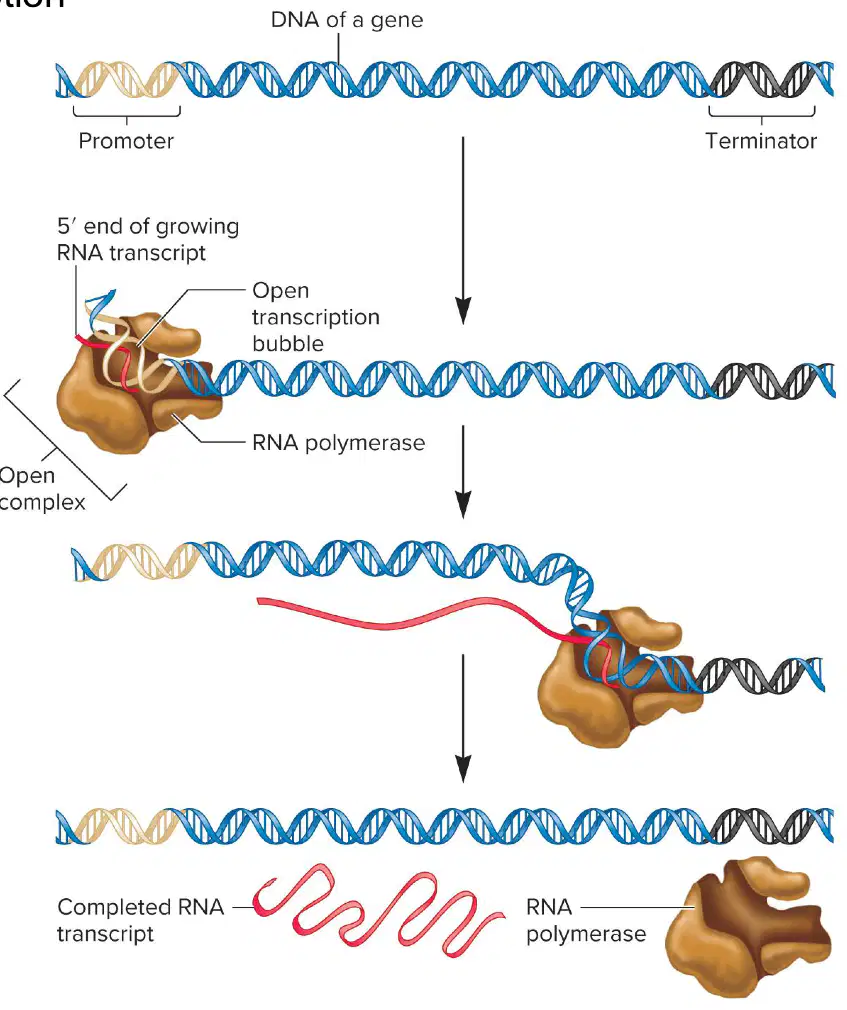
Where does the transcription process begin on the DNA strand?
At the terminator.
At the open complex.
At the promoter.
At the transcription bubble.

What is formed at the end of the transcription process?
A new DNA strand.
A completed RNA transcript.
A protein molecule.
A transcription bubble.
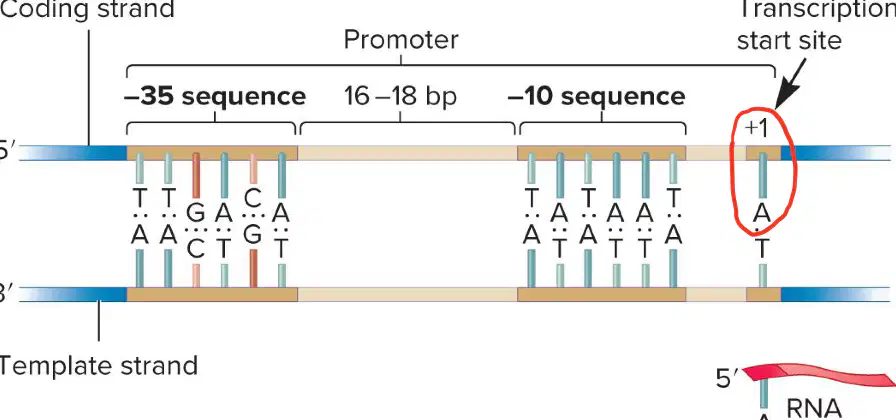
What is the sequence of the -10 promoter region in bacterial transcription?
5’-TTGACA-3’
5’-TATAAT-3’
5’-ACAGTT-3’
5’-GCCCAA-3’
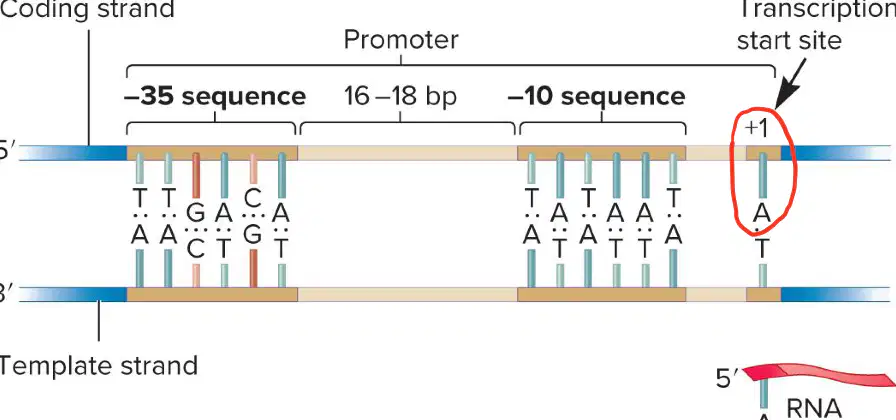
What is the sequence of the -35 promoter region in bacterial transcription?
5’-TATAAT-3’
5’-ACAGTT-3’
5’-TTGACA-3’
5’-GCCCAA-3’
What are the components of the core enzyme of RNA Polymerase in bacteria?
α, β, β', ω
α, β, γ, δ
α, β, β', σ
α, β, δ, ω
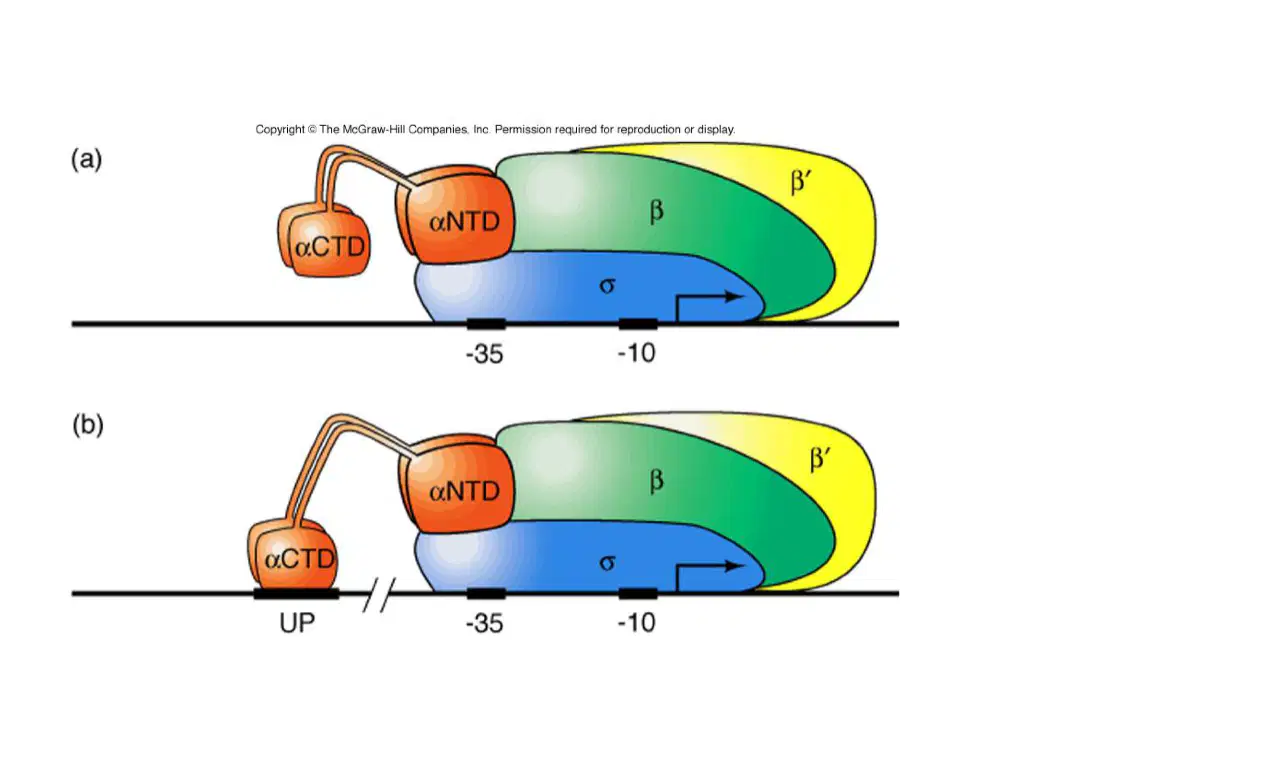
What additional component is required to form the holoenzyme from the core enzyme in bacterial transcription?
δ (Delta)
σ (Sigma)
γ (Gamma)
ε (Epsilon)
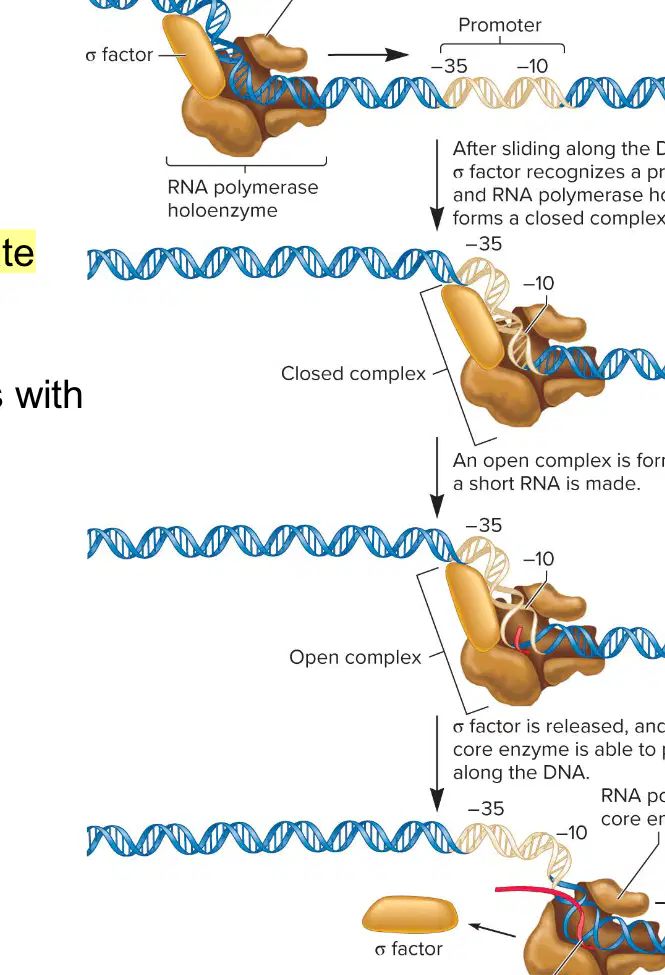
What is the role of the σ factor in the initiation of transcription in bacteria?
It binds to the promoter and forms a closed promoter complex.
It separates the AT base-pairs of the -10 sequence.
It synthesizes the RNA strand.
It terminates the transcription process.
What happens after the AT base-pairs of the -10 sequence separate during transcription initiation?
The σ factor binds to the promoter.
A short RNA strand is made.
The transcription process is terminated.
The RNA polymerase detaches from the DNA.
What occurs when the σ factor is released during transcription initiation?
The RNA polymerase forms a closed complex.
The transcription process is terminated.
Elongation begins with the RNA Pol core enzyme.
The DNA strands re-anneal.

What is the role of RNA polymerase during the elongation phase of transcription in bacteria?
It unwinds DNA and uses the template strand to make the RNA transcript.
It synthesizes proteins directly from DNA.
It replicates the entire DNA strand.
It degrades the RNA transcript.
What happens to the DNA after RNA polymerase has passed during transcription?
DNA rewinds behind RNA polymerase.
DNA remains unwound permanently.
DNA is degraded.
DNA forms a double helix with RNA.

What is the direction of chain growth during RNA transcription in bacteria?
3' to 5'
5' to 3'
2' to 4'
1' to 3'

Which enzyme is responsible for synthesizing RNA during transcription in bacteria?
DNA polymerase
RNA polymerase
Ligase
Helicase

During RNA transcription in bacteria, which nucleotide pairs with adenine (A) on the DNA template strand?
Thymine (T)
Cytosine (C)
Uracil (U)
Guanine (G)

What role does a promoter play in bacterial transcription?
It specifies the direction of transcription.
It terminates the transcription process.
It translates RNA into proteins.
It replicates DNA strands.

In bacterial transcription, what can some promoters do with regard to adjacent genes along a chromosome?
Direct transcription in one direction or the opposite direction.
Terminate transcription immediately.
Translate RNA into proteins.
Replicate DNA strands.
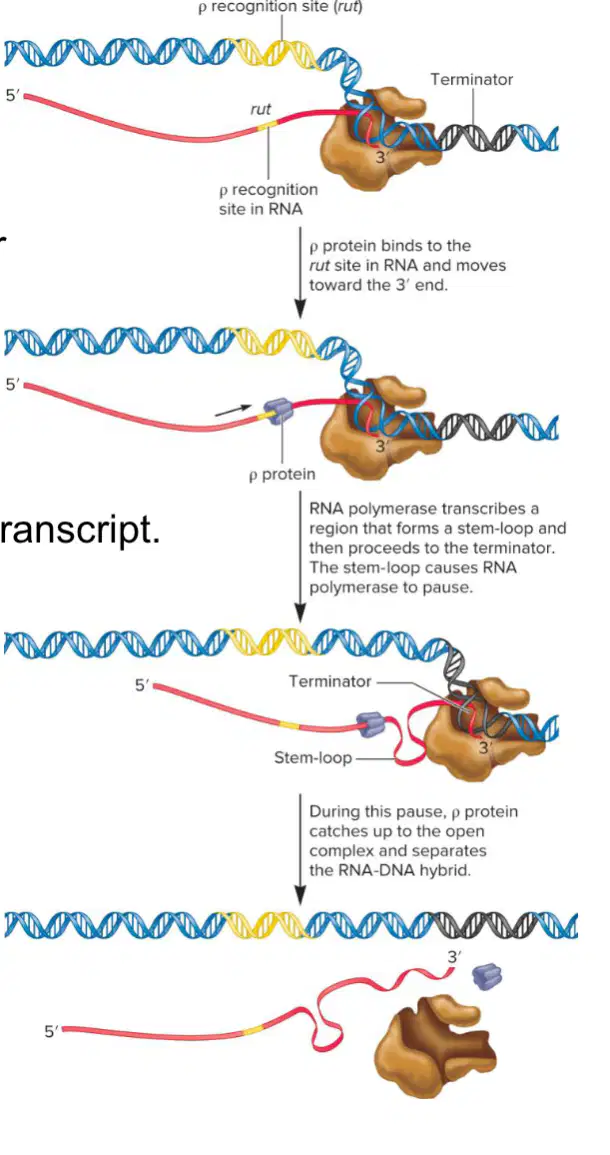
What is the role of the ρ protein in the rho-dependent termination mechanism of transcription in bacteria?
It initiates transcription.
It binds to the rho utilization (rut) sequence and moves toward the 3' end of RNA.
It synthesizes RNA.
It degrades RNA.
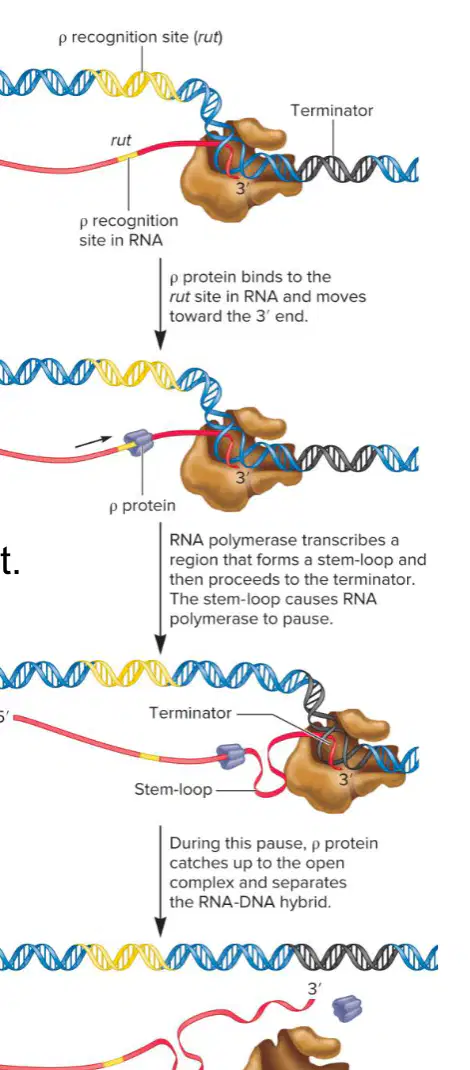
What causes RNA polymerase to pause during rho-dependent termination?
The presence of a terminator protein.
The formation of a stem-loop due to inverted repeats.
The binding of a repressor protein.
The degradation of RNA.
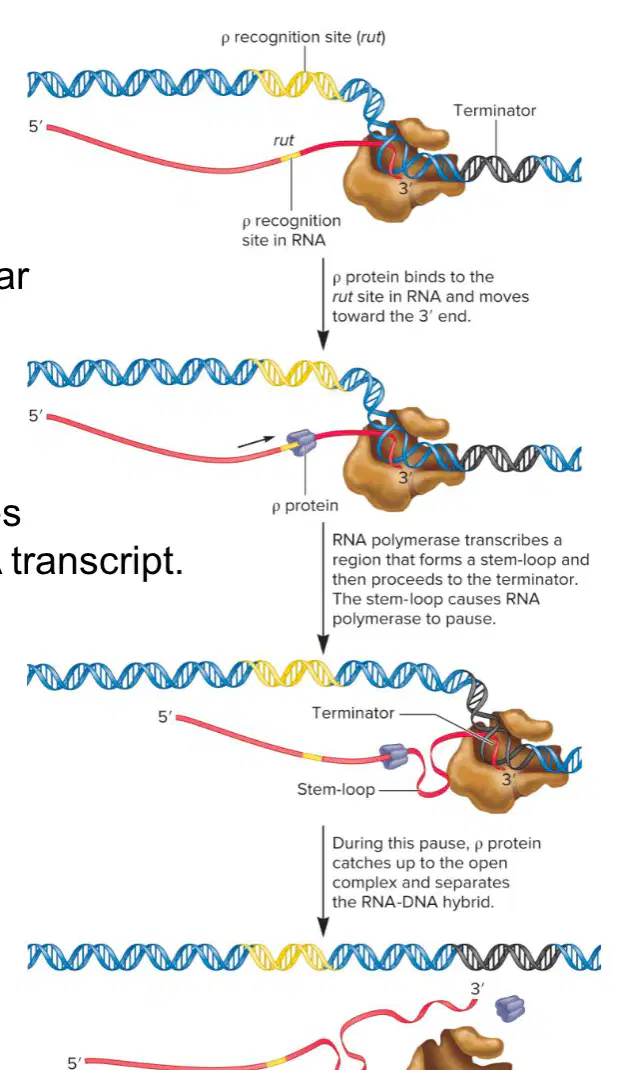
How does the ρ protein facilitate the release of the RNA transcript in rho-dependent termination?
By synthesizing new RNA.
By binding to the promoter region.
By its helicase activity, separating the RNA-DNA hybrid.
By degrading the DNA template.
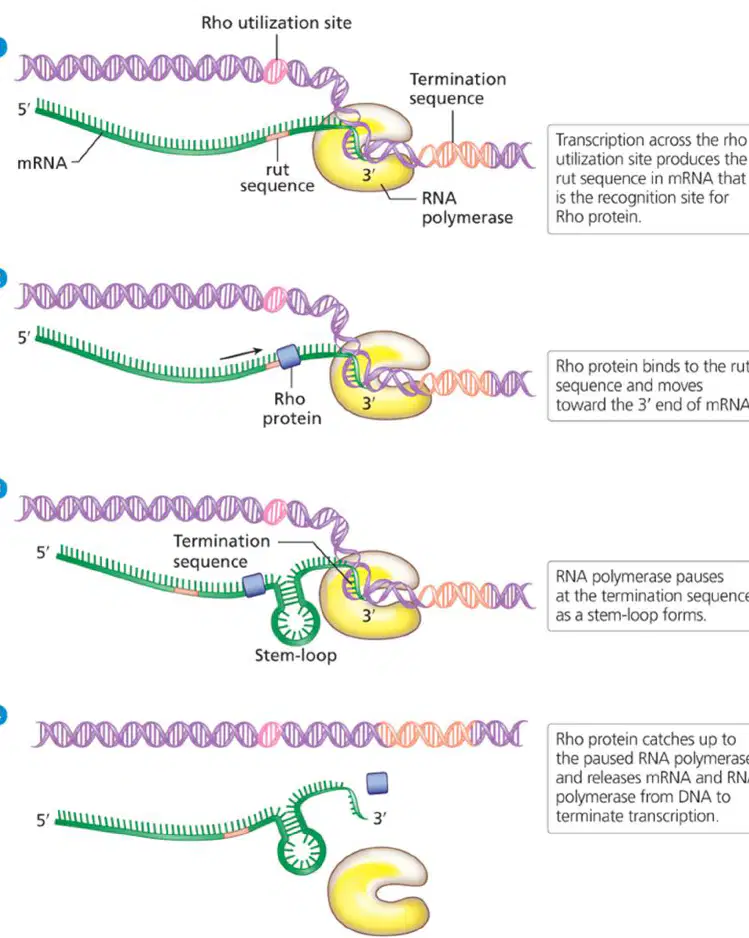
What is the role of the rut sequence in mRNA during the Rho-dependent termination of transcription in bacteria?
It serves as the recognition site for Rho protein.
It initiates the transcription process.
It binds to the DNA polymerase.
It terminates the translation process.
What happens when the Rho protein binds to the rut sequence in mRNA?
It moves toward the 3' end of mRNA.
It initiates DNA replication.
It binds to the ribosome.
It starts protein synthesis.
What occurs when RNA polymerase pauses at the termination sequence during Rho-dependent termination?
A stem-loop forms.
DNA unwinds.
Protein synthesis begins.
mRNA is degraded.
What is the final step in the Rho-dependent termination of transcription?
Rho protein releases mRNA and RNA polymerase from DNA.
DNA replication is initiated.
mRNA is translated into protein.
Rho protein binds to the ribosome.
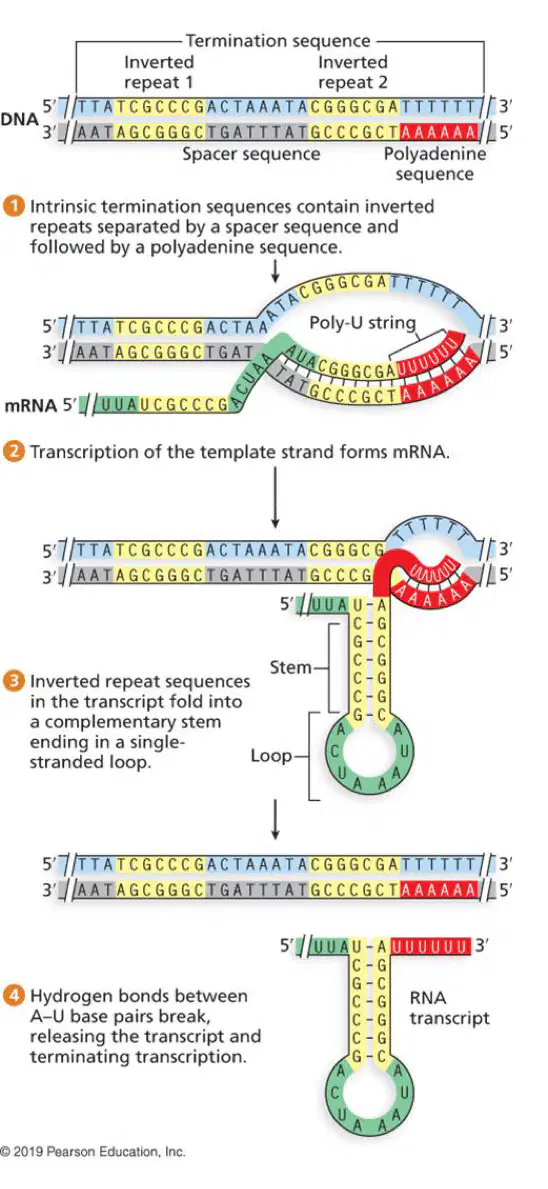
What causes RNA polymerase to pause during the rho-independent termination mechanism in bacteria?
A-U base pairs
Stem-loop region
Poly-A tail
Spacer sequence
What happens to the A-U base pairs during the rho-independent termination mechanism?
They strengthen the RNA-DNA hybrid
They form a double helix
They break, releasing the RNA transcript
They cause the RNA polymerase to bind more tightly
What is the role of the U-rich RNA sequence in the rho-independent termination mechanism?
It strengthens the RNA-DNA hybrid
It causes the RNA polymerase to pause
It is unable to hold the RNA-DNA hybrid together, leading to termination
It forms a double helix with the DNA
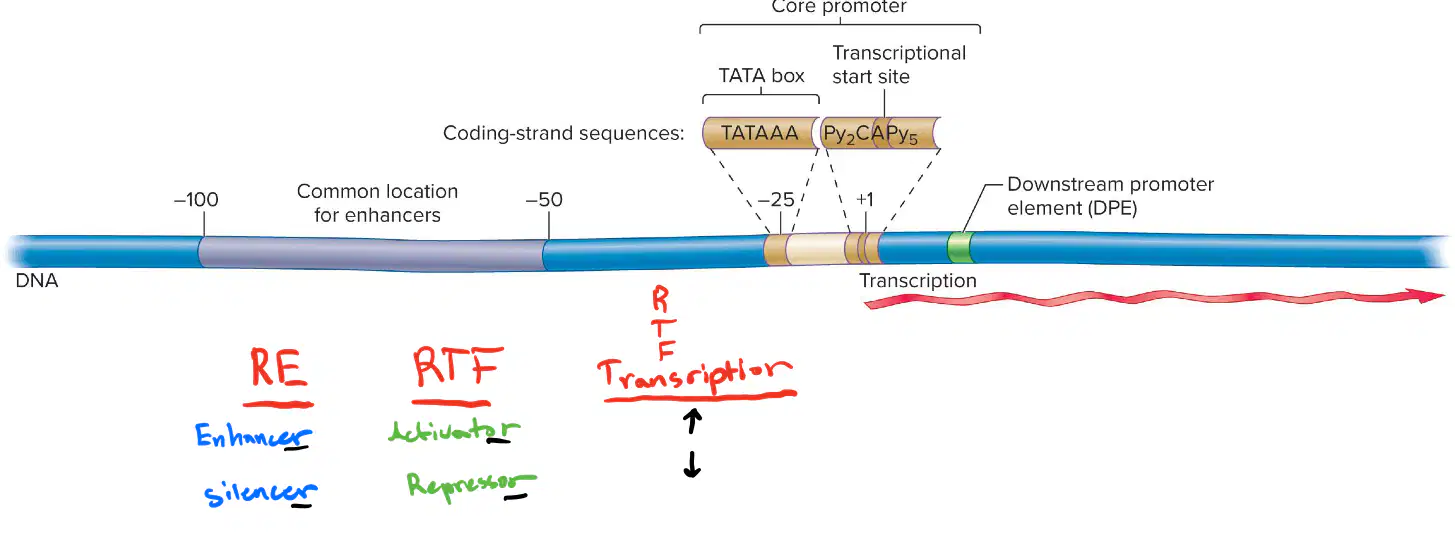
What is the sequence found at the +1 position in the promoter region during transcription initiation in eukaryotes?
TATA box
Py₂CAPy₅
DPE
Enhancer
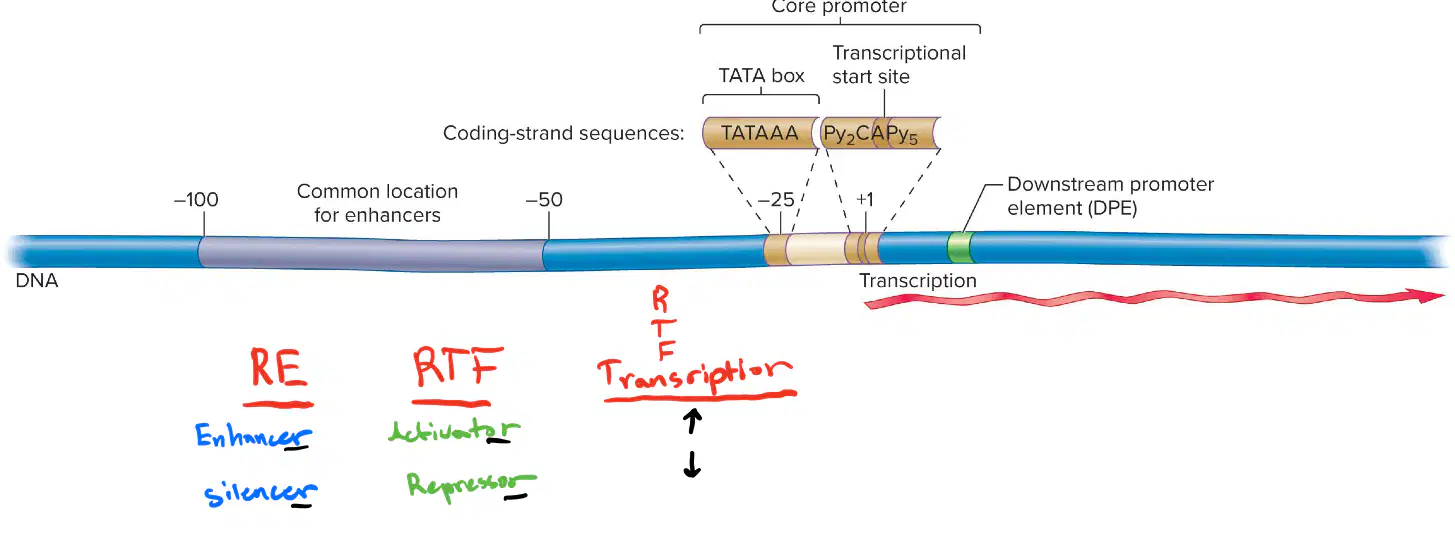
What is the name of the sequence located at the -25 position in the promoter region?
Py₂CAPy₅
DPE
TATA box
Silencer

Which RNA polymerase is responsible for synthesizing mRNA, snRNA, miRNA, and telomerase RNA?
RNA Polymerase I
RNA Polymerase II
RNA Polymerase III
RNA Polymerase IV
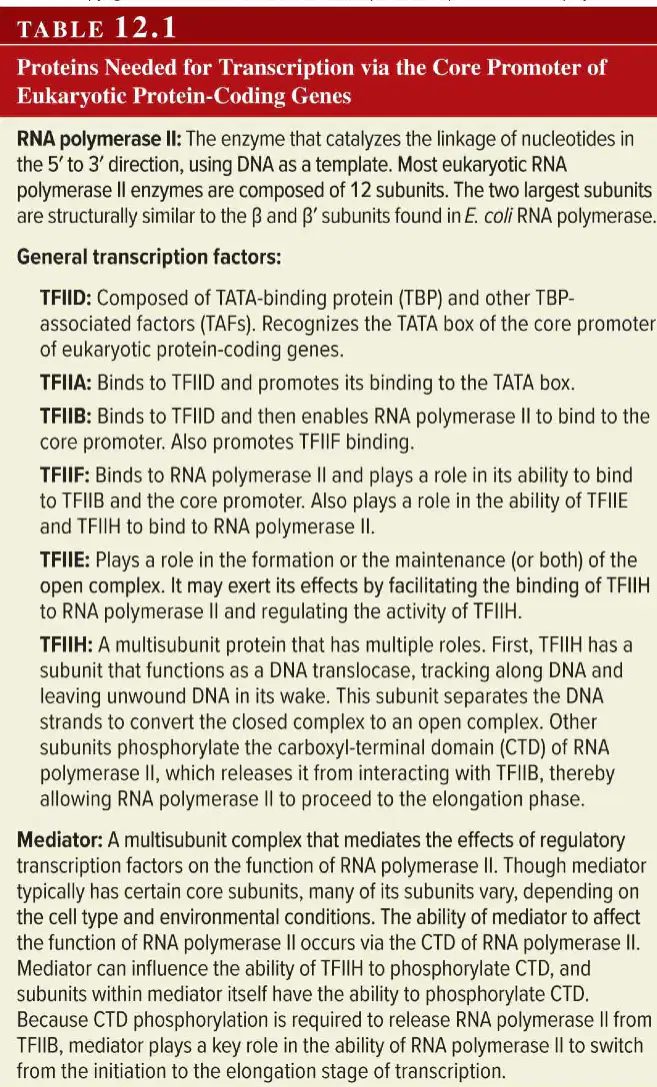
What is the role of TFIID in transcription?
Binds to RNA polymerase I
Binds to the TATA box and promotes its binding
Acts as a DNA translocase
Phosphorylates the CTD of RNA polymerase II
Which transcription factor is involved in the formation or maintenance of the open complex?
TFIID
TFIIA
TFIIF
TFIIE
What is the function of the mediator complex in transcription?
Binds to the TATA box
Phosphorylates RNA polymerase I
Mediates the effects of regulatory transcription factors
Acts as a DNA translocase
Which RNA polymerase is associated with the production of tRNA, 5S rRNA, snRNA, miRNA, and siRNA?
RNA Polymerase I
RNA Polymerase II
RNA Polymerase III
RNA Polymerase IV
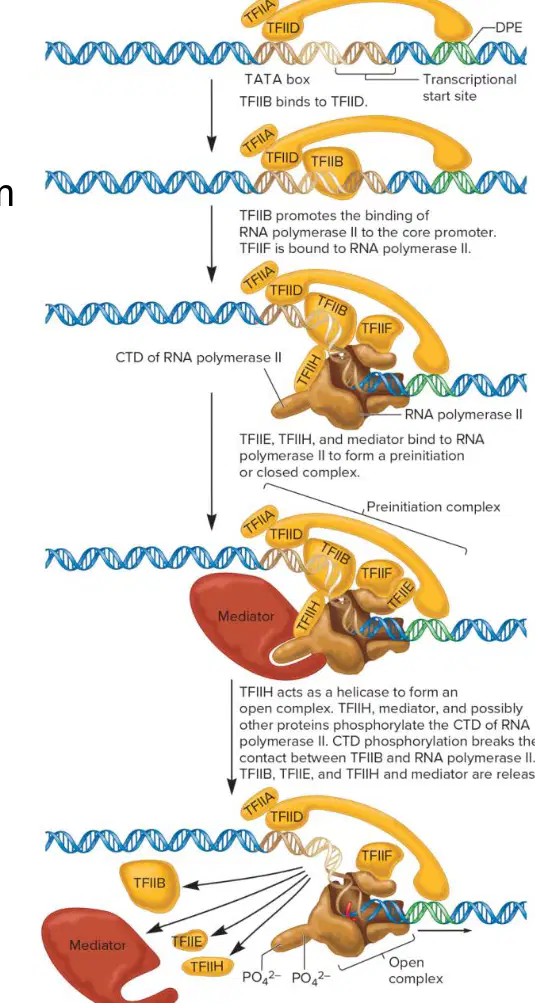
What is the first step in the initiation of transcription in eukaryotes?
RNA Pol II binds to the core promoter.
TFIID binds to the TATA box and DPE.
TFIIH acts as a helicase to form an open complex.
Transcription begins.
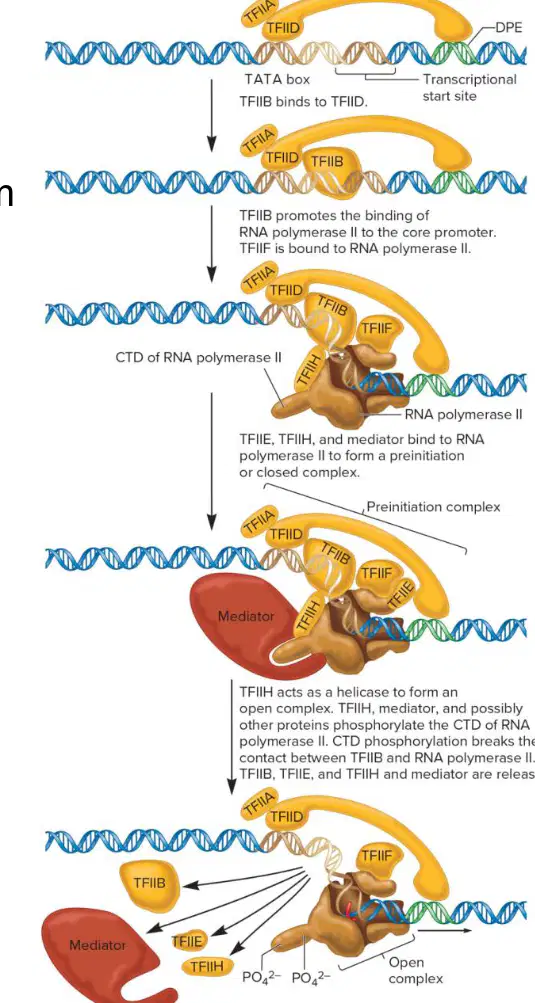
Which factor acts as a helicase to form an open complex during transcription initiation?
TFIID
RNA Pol II
TFIIH
GTFs
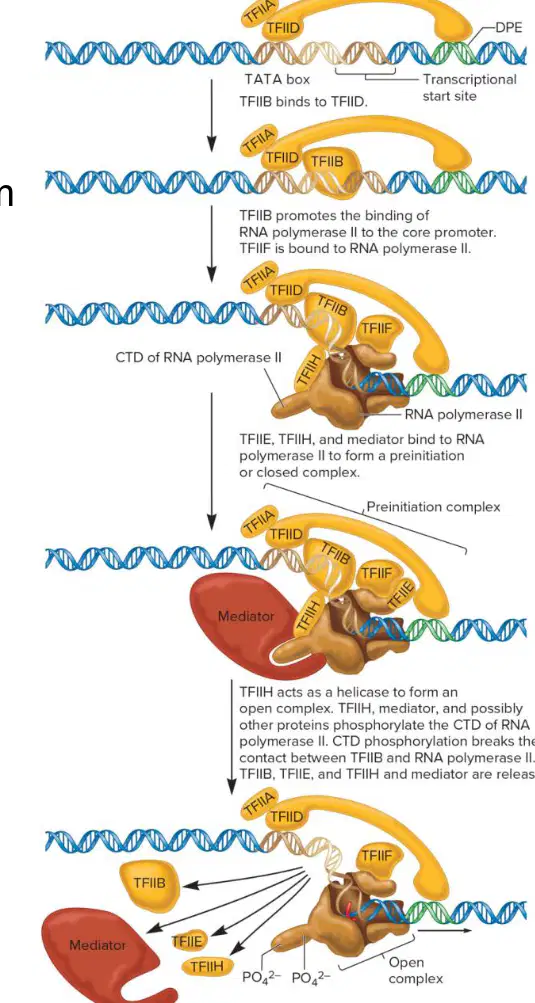
What happens to the CTD of RNA Pol II during transcription initiation?
It binds to the TATA box.
It gets phosphorylated.
It releases GTFs.
It forms a closed complex.
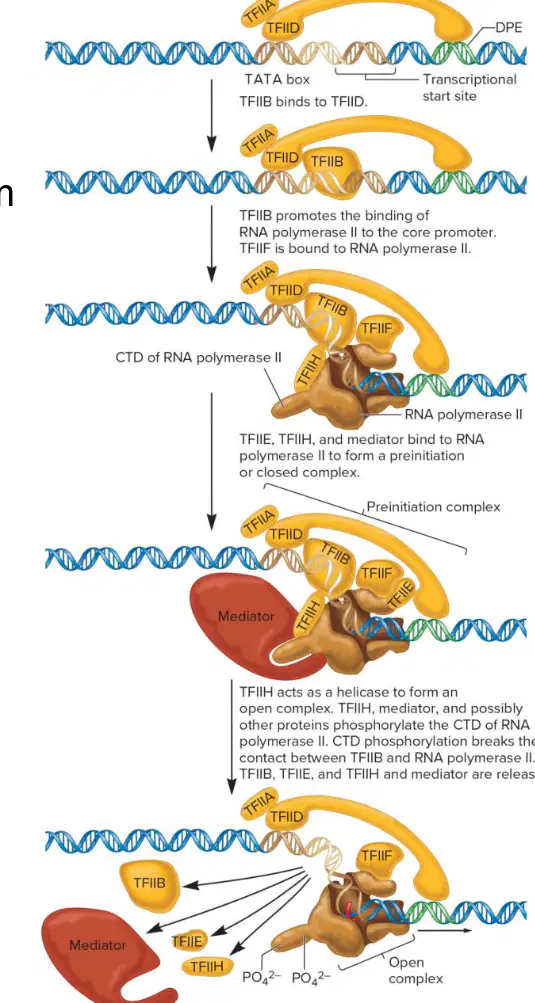
What is released after the CTD of RNA Pol II gets phosphorylated?
TFIID
RNA Pol II
Mediator and GTFs
TFIIH

What is the role of RNA polymerase II in the transcription termination process in eukaryotes?
It initiates transcription by binding to the promoter.
It stabilizes the DNA double helix.
It transcribes a gene past the polyadenylation signal sequence.
It degrades RNA in a 3' to 5' direction.
In the allosteric model of transcription termination, what causes RNA polymerase II to dissociate from the DNA?
Binding of an exonuclease.
Release of elongation factors or binding of termination factors.
Cleavage of RNA at the promoter.
Stabilization of the DNA double helix.
What is the function of an exonuclease in the torpedo model of transcription termination?
It binds to the 3' end of the DNA.
It stabilizes RNA polymerase II.
It degrades RNA in a 5' to 3' direction.
It initiates transcription by binding to the promoter.
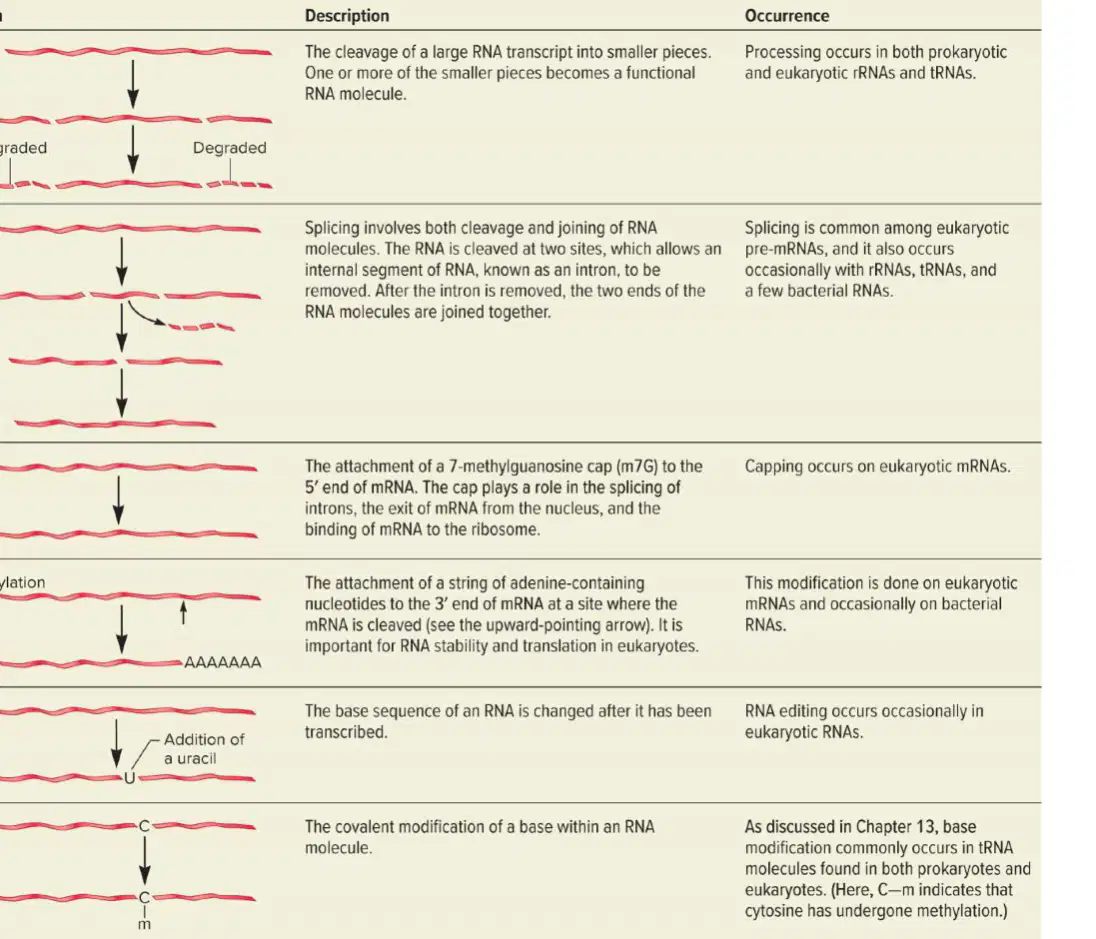
What is the process called where a large RNA transcript is cleaved into smaller pieces, with one or more pieces becoming a functional RNA molecule?
Splicing
5' capping
Processing
Base modification

Which RNA modification involves the cleavage and joining of RNA molecules, allowing an internal segment known as an intron to be removed?
3' polyadenylation
Splicing
RNA editing
Base modification

What is the purpose of attaching a 7-methylguanosine cap (m7G) to the 5' end of mRNA?
To increase RNA stability
To assist in RNA splicing and ribosome binding
To remove introns
To add adenine nucleotides

Which modification involves the addition of adenine-containing nucleotides to the 3' end of mRNA?
5' capping
Splicing
3' polyadenylation
RNA editing

What is RNA editing?
The addition of a methyl group to cytosine
The change of the base sequence of an RNA after it has been transcribed
The removal of introns
The addition of a poly-A tail
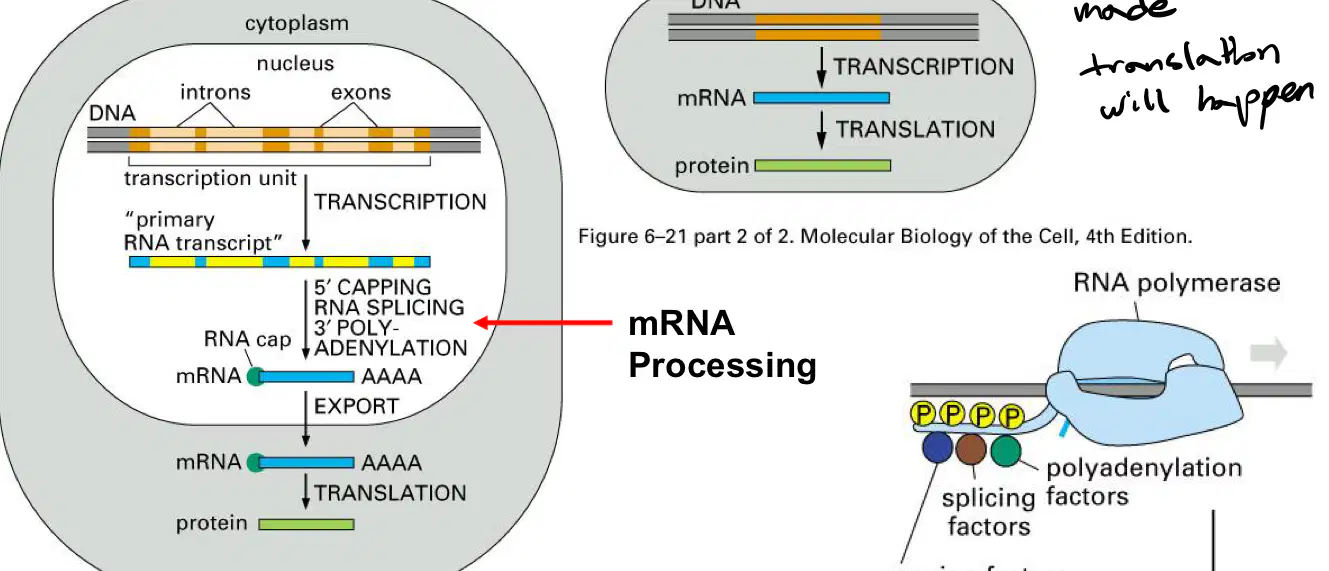
What are the three main processes involved in converting pre-mRNA to mature mRNA in eukaryotes?
5' capping, RNA splicing, 3' polyadenylation
Transcription, translation, replication
DNA replication, RNA splicing, protein synthesis
RNA editing, DNA repair, protein folding
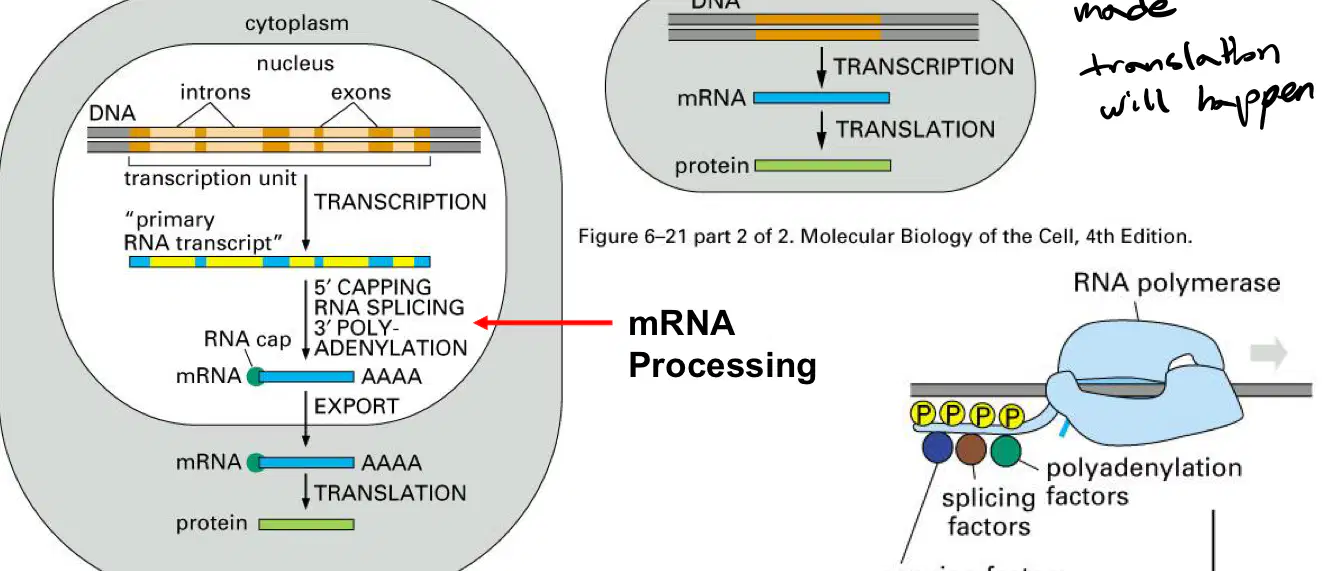
In prokaryotes, what process follows transcription?
Translation
RNA splicing
DNA replication
5' capping
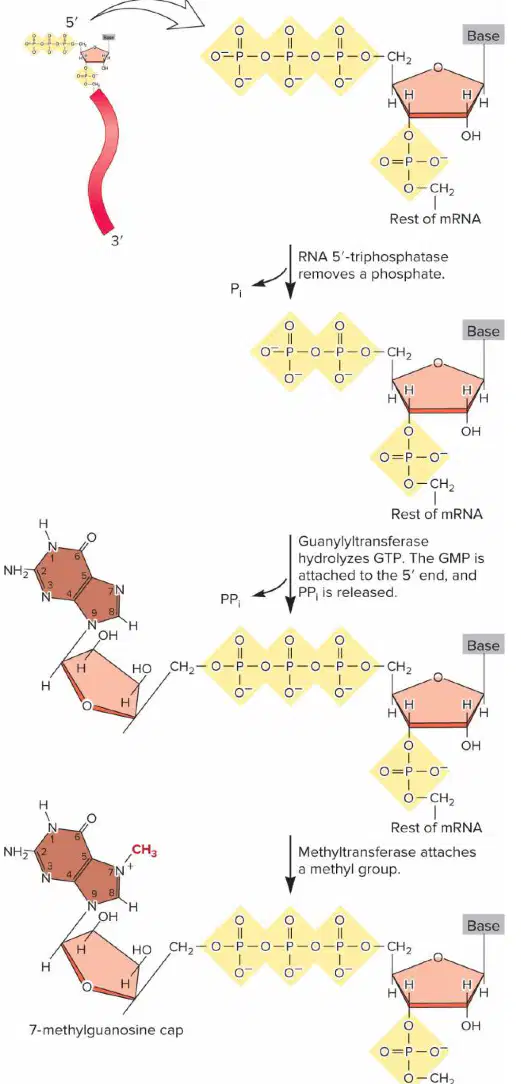
What is added to the 5' end of mRNA during 5' capping?
7-methylguanosine
Adenine
Thymine
Cytosine
What is one of the functions of 5' capping in mRNA processing?
Export to the cytoplasm
DNA replication
Protein degradation
Lipid synthesis
What is the role of exons in RNA splicing?
Expressed sequence
Intervening sequence
Non-coding sequence
Regulatory sequence

What is the process called that involves the removal of introns and joining of exons?
Transcription
Translation
Splicing
Replication
What is the role of snRNPs in RNA modification?
DNA replication
Protein synthesis
Splicing
RNA degradation
During the first transesterification in RNA splicing, which part of the branch point A attacks the 5' splice site?
3' oxygen of exon 1
2' oxygen of branch point A
3' oxygen of intron
5' oxygen of exon 2
What structure is formed after the second transesterification in RNA splicing?
Double helix
Lariat
Codon
Anticodon
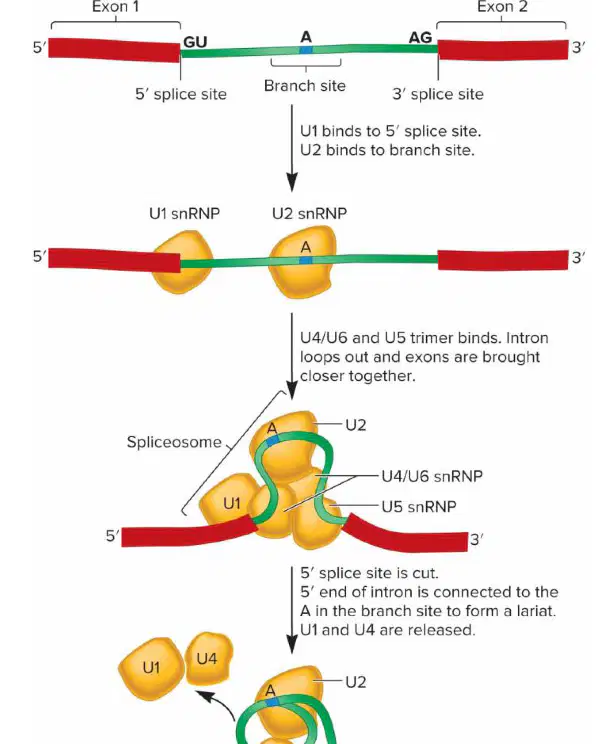
What is the role of U1 snRNP in RNA splicing?
Binds to the 5' splice site
Binds to the branch site
Binds to the 3' splice site
Binds to exon 2
Which snRNP binds to the branch site during RNA splicing?
U1
U2
U4/U6
U5
What forms a lariat structure during RNA splicing?
Exon 1
Exon 2
The intron
U1 snRNP
Which snRNPs are released after the 5' splice site is cut?
U1 and U2
U1 and U4
U4 and U5
U2 and U5
What happens to the intron after splicing is complete?
It is connected to exon 1
It is connected to exon 2
It forms a lariat and is degraded
It remains in the RNA
What is alternative splicing?
The process of translating mRNA into proteins.
The ability to produce different proteins from the same mRNA by splicing together different combinations of exons.
The replication of DNA into RNA.
The synthesis of RNA from a DNA template.
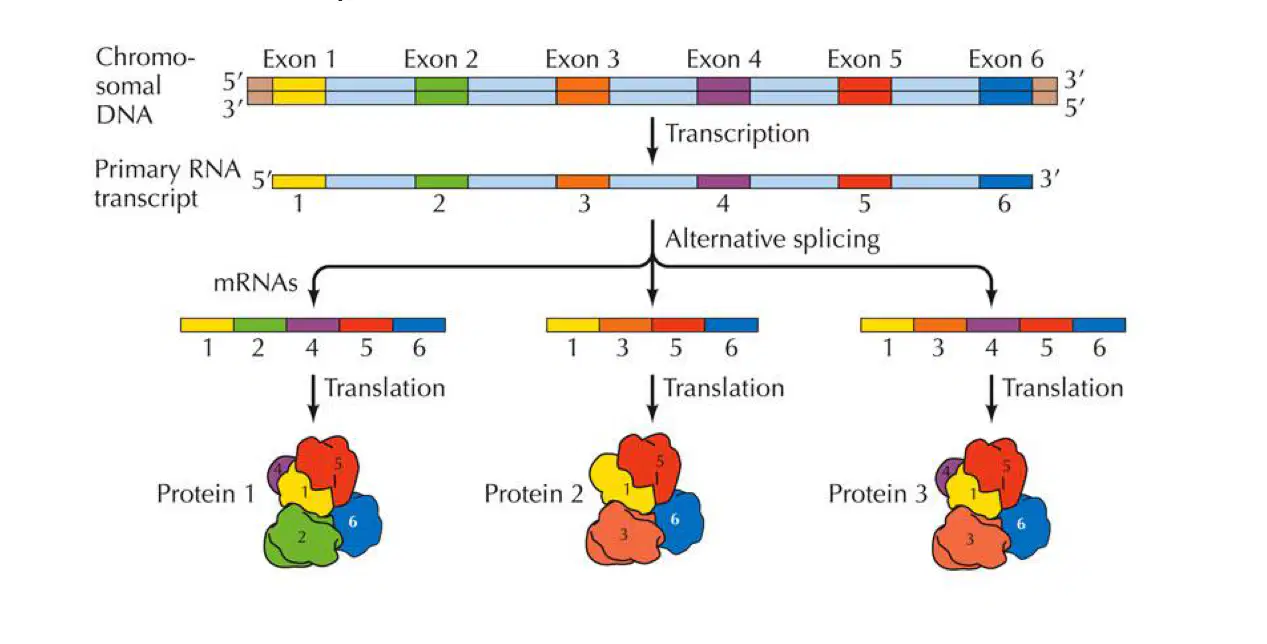
What does the process of alternative splicing allow?
Production of identical proteins from different mRNAs.
Production of different proteins from the same mRNA.
Conversion of proteins back into mRNA.
Replication of mRNA into DNA.

What is the process called that allows a single gene to code for multiple proteins by including or excluding certain exons?
Transcription
Translation
Alternative Splicing
Replication

In the context of RNA modification, what are the segments called that are retained in the final mRNA after splicing?
Introns
Exons
Codons
Anticodons
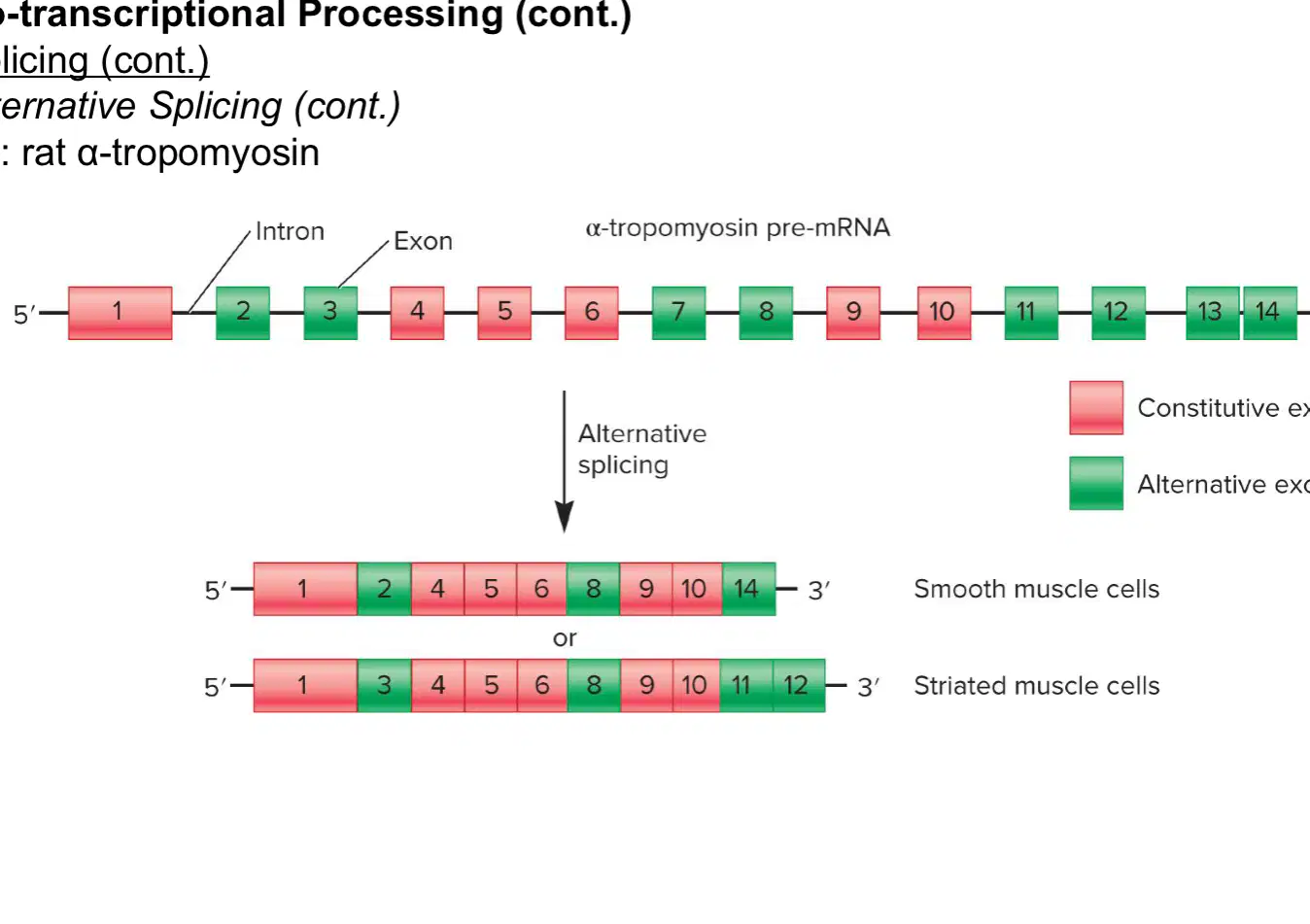
Which type of exons are always included in the final mRNA regardless of the cell type?
Constitutive exons
Alternative exons
Introns
Codons

What is the process called that allows a single gene to code for multiple proteins by including or excluding certain exons?
Transcription
Translation
Alternative Splicing
Replication

In the context of IgM, what does the presence of Exon 5 in mRNA indicate?
It codes for a secreted form of IgM
It codes for a membrane-bound form of IgM
It is not involved in IgM production
It codes for a light chain of IgM

Which part of the mRNA is responsible for coding the transmembrane anchor in IgM?
Exon 3
Exon 4
Exon 5
Exon 6
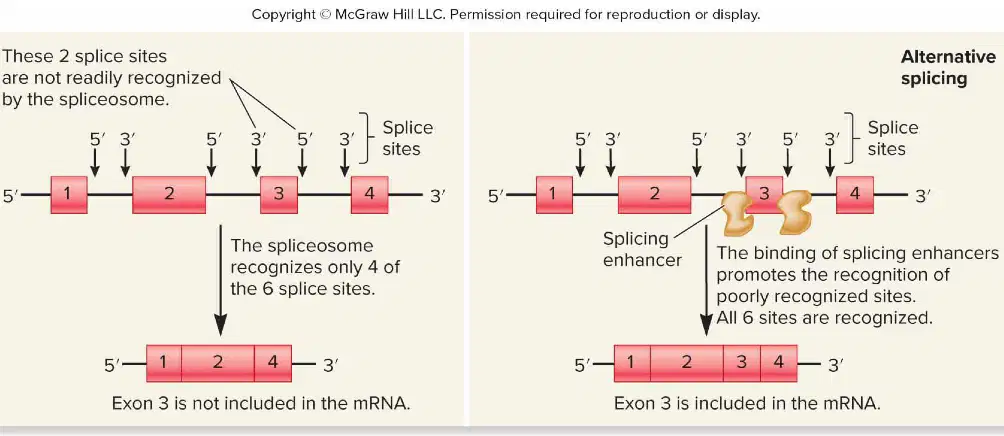
What is the role of splicing factors in alternative splicing?
They always increase the ability of the spliceosome to recognize splice sites.
They may increase or decrease the ability of the spliceosome to recognize splice sites.
They only decrease the ability of the spliceosome to recognize splice sites.
They have no effect on the spliceosome's ability to recognize splice sites.
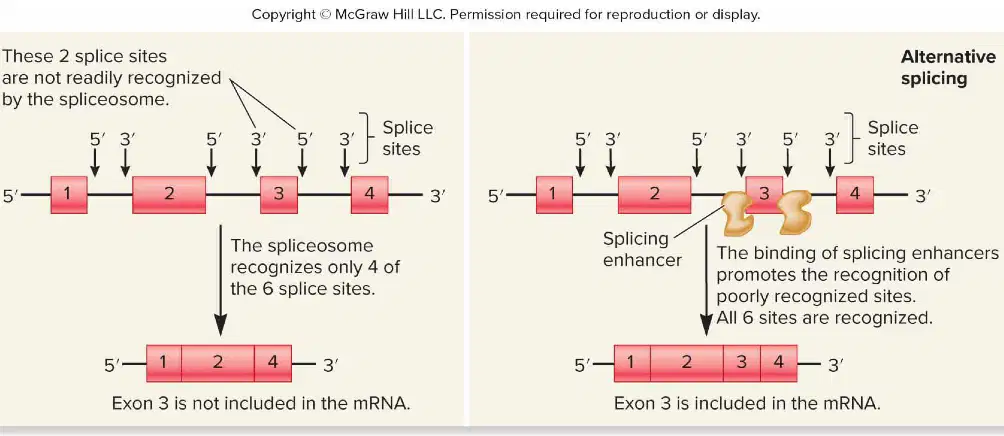
What do splicing repressors bind to in RNA splicing?
5' splice sites
3' splice sites (exon included)
3' splice sites (exon excluded)
Both 5' and 3' splice sites
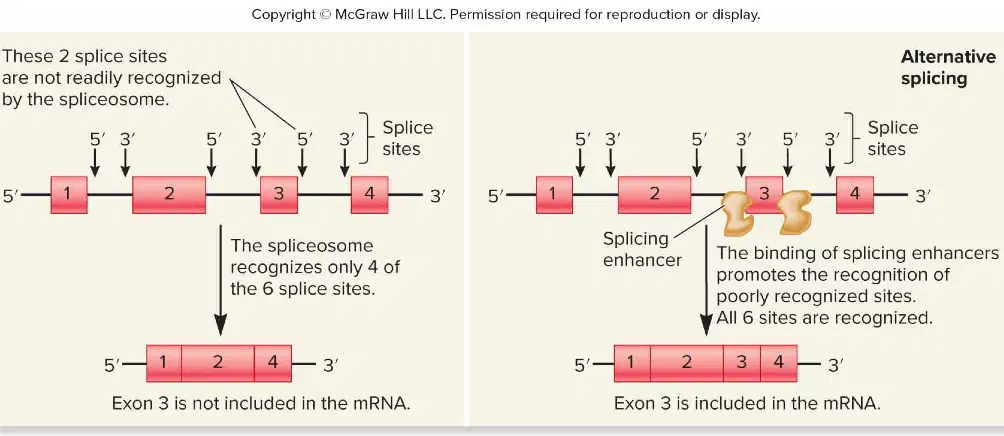
What is the effect of splicing enhancers on splice sites?
They bind to 3' splice sites only.
They bind to 5' splice sites only.
They bind to both 3' and 5' splice sites (exon included).
They prevent the recognition of splice sites.
What is the function of the polyA tail in RNA processing?
It initiates transcription.
It protects RNA from exonucleases.
It degrades RNA.
It removes introns.
How many adenine nucleotides are typically added to form a polyA tail?
≤ 100
≤ 150
≤ 200
≤ 250

Where does endonuclease cleavage occur in relation to the AAUAAA sequence?
10 nucleotides upstream
20 nucleotides downstream
30 nucleotides upstream
40 nucleotides downstream
What is the role of the sigma (σ) factor in bacterial transcription initiation?
It is needed for promoter recognition.
It is involved in RNA splicing.
It adds a 7-methyl-guanosine cap.
It converts cytosine to uracil.
Which component is involved in the elongation phase of transcription in archaea?
Sigma (σ) factor
TFE protein
RNA polymerase III
Spliceosome
In eukaryotes, what is the function of the mediator during transcription?
It adds a PolyA tail.
It controls the switch to the elongation phase.
It is needed for promoter recognition.
It converts cytosine to uracil.
What is a common feature of RNA splicing in eukaryotes?
It is rare and self-splicing.
It occurs in protein-coding pre-mRNAs using a spliceosome.
It does not occur.
It involves the release of σ factor.
How does termination of transcription occur in bacteria?
Through the allosteric or torpedo model.
By the release of σ factor.
It is ρ-dependent or ρ-independent.
By adding a 7-methyl-guanosine cap.
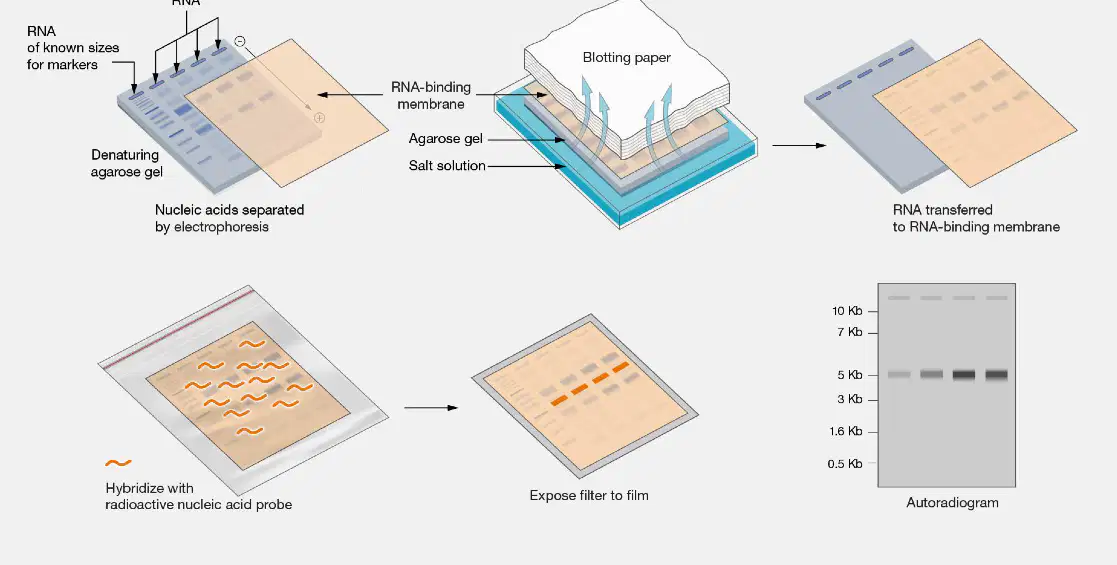
What is the primary purpose of a Northern Blot?
To detect specific DNA sequences
To detect specific RNA sequences
To detect specific protein sequences
To detect specific lipid sequences
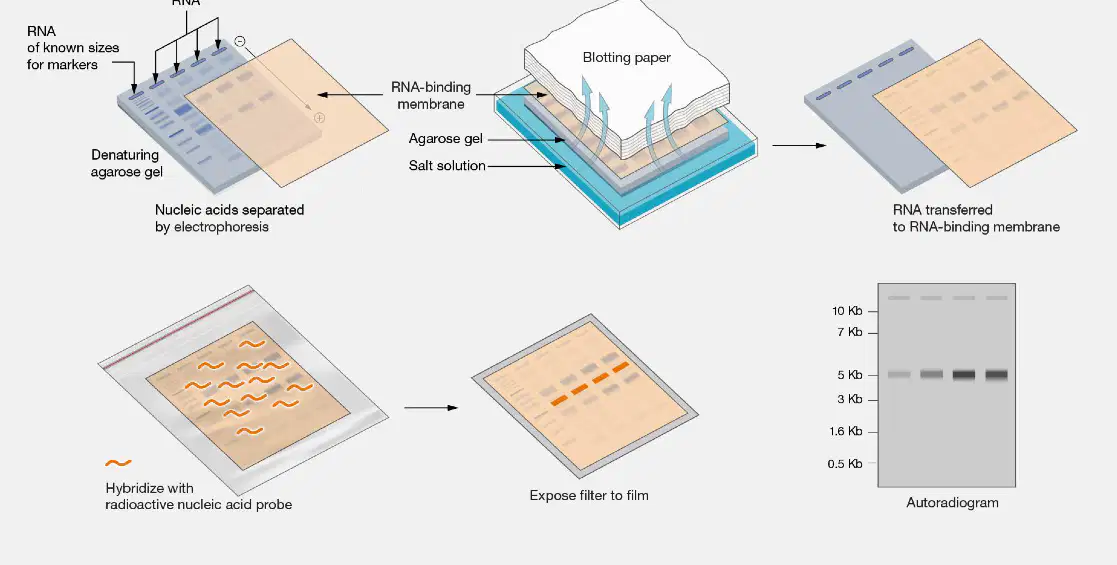
In a Northern Blot, what is used to hybridize with the RNA on the membrane?
A radioactive protein probe
A radioactive lipid probe
A radioactive nucleic acid probe
A radioactive carbohydrate probe
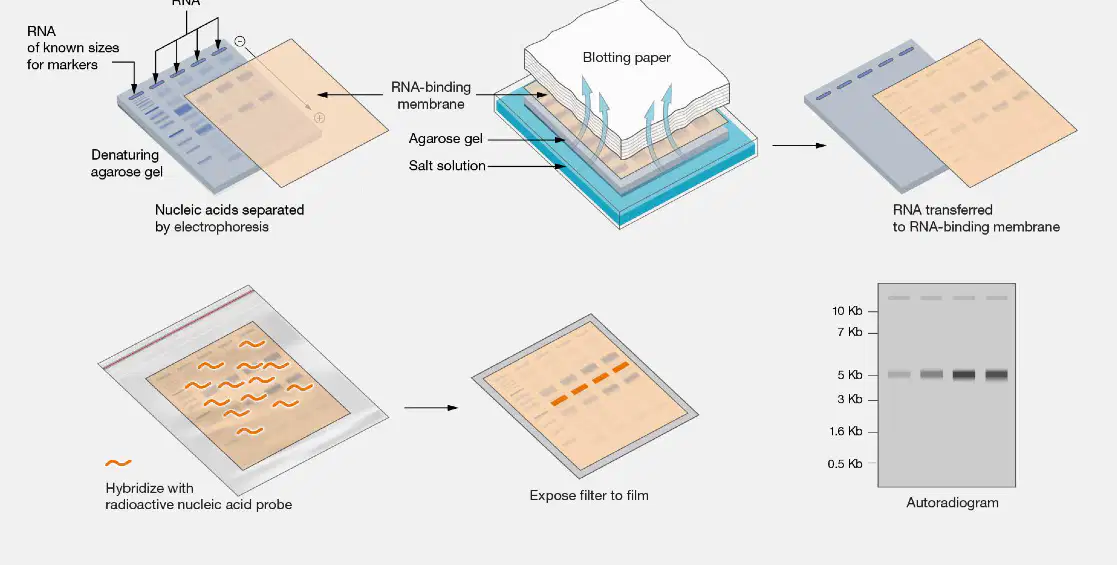
What type of gel is used in the initial separation of nucleic acids in a Northern Blot?
Polyacrylamide gel
Denaturing agarose gel
Non-denaturing agarose gel
Starch gel
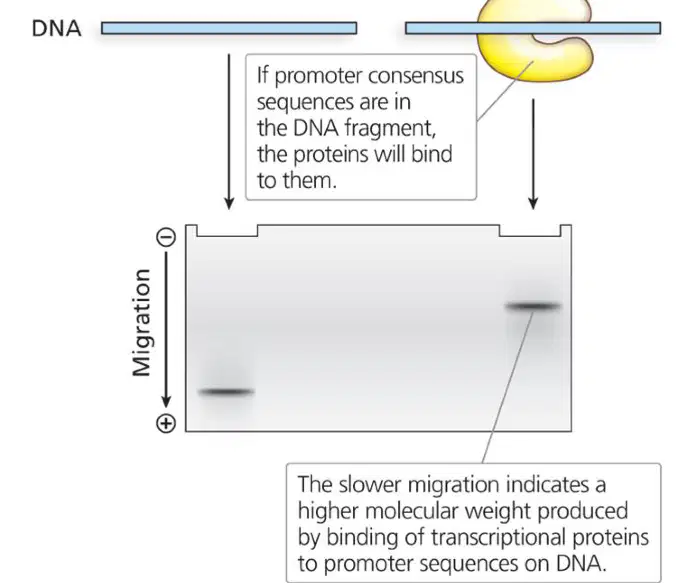
What is the purpose of adding transcriptional proteins to DNA in a band shift assay?
To increase the length of the DNA
To bind to promoter sequences and form a complex
To degrade the DNA
To change the DNA sequence
What does slower migration in a band shift assay indicate?
Lower molecular weight
Higher molecular weight due to protein binding
No change in molecular weight
DNA degradation

