
 Worksheets
ECON Unit 1: Fundamental Economic Concepts
Total questions: 115
Worksheet time: 58mins
Name
Class
Date
1.
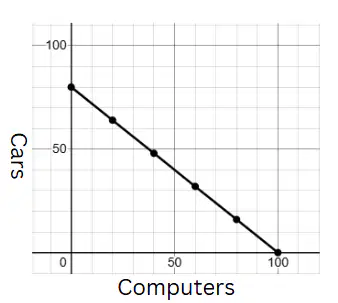
What does the curve represent?
a)
Unemployment
b)
Efficient production
c)
Economic growth
d)
Price levels
2.
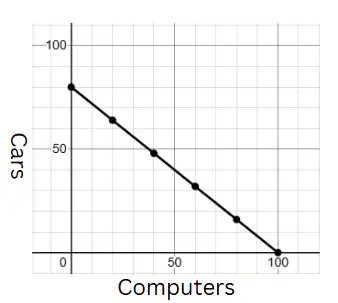
If the economy is producing at a point inside the curve, it indicates:
a)
Full efficiency
b)
Underutilization of resources
c)
Overutilization of resources
d)
Economic growth
3.
What is marginal analysis primarily used for in economic decision-making?
a)
Calculating total profits and losses
b)
Examining the additional benefits or costs of one more unit
c)
Determining long-term market trends
d)
Analyzing historical economic data
4.
Which of the following best describes a characteristic of effective short-term goals?
a)
They should be vague and flexible
b)
They must span multiple years
c)
They should be specific and measurable
d)
They can be unrealistic but inspiring
5.
At what point should an economic activity stop, according to the rational decision rule?
a)
When total benefits exceed total costs
b)
When marginal costs exceed marginal benefits
c)
When marginal benefits equal marginal costs
d)
When total costs equal zero
6.
What is a marginal benefit?
a)
The total satisfaction gained from all units
b)
The additional satisfaction from one more unit
c)
The average satisfaction of multiple units
d)
The fixed benefit of production
7.
Which of the following is NOT a common decision-making pitfall?
a)
Making emotional decisions
b)
Comparing marginal benefits to marginal costs
c)
Focusing only on total costs/benefits
d)
Setting unrealistic short-term goals
8.
How long is a short-term goal typically defined to be?
a)
Under one year
b)
2-3 years
c)
5 years
d)
10 years or more
9.
In rational decision-making, what should be done after identifying marginal benefits?
a)
Implement the decision immediately
b)
Calculate marginal costs
c)
Review long-term goals
d)
Seek peer approval
10.
Which personal decision would benefit from marginal analysis?
a)
Choosing a career path
b)
Deciding whether to study one more hour
c)
Selecting a college major
d)
Picking a permanent residence
11.
What type of goals should short-term objectives align with?
a)
Peer group goals
b)
Industry standards
c)
Long-term objectives
d)
Market trends
12.
What is a key aspect of marginal cost?
a)
The total expense of all units produced
b)
The average cost per unit
c)
The additional cost of one more unit
d)
The fixed costs of production
13.
How often should goals be reviewed according to the material?
a)
Only when they're not met
b)
Once per year
c)
Regularly
d)
Never once set
14.
Which element is essential for making rational economic decisions?
a)
Emotional investment
b)
Comparison of marginal benefits and costs
c)
Following market trends
d)
Copying competitors' decisions
15.
What should be the first step in rational decision-making?
a)
Calculate costs
b)
Analyze benefits
c)
Set clear short-term goals
d)
Review past decisions
16.
Which of the following represents a proper application of marginal analysis?
a)
Determining lifetime earnings
b)
Deciding whether to work one more hour at a part-time job
c)
Choosing a company name
d)
Selecting a business location
17.
What role does feedback play in goal-setting?
a)
It should be ignored to maintain consistency
b)
It should be used to adjust goals as needed
c)
It only matters for long-term goals
d)
It's irrelevant to decision-making
18.
How should marginal benefits and costs be compared?
a)
Benefits should always exceed costs
b)
Costs should always exceed benefits
c)
They should be compared one unit at a time
d)
They should be compared in total only
19.
What type of decisions can marginal analysis be applied to?
a)
Only business decisions
b)
Only personal decisions
c)
Both individual and business decisions
d)
Neither individual nor business decisions
20.
Which approach to decision-making is most rational?
a)
Following intuition only
b)
Copying successful people's choices
c)
Using systematic analysis of benefits and costs
d)
Making quick decisions without analysis
21.
What makes a short-term goal "measurable"?
a)
It must be approved by others
b)
It can be quantified or tracked
c)
It takes a long time to achieve
d)
It requires multiple steps
22.
When is marginal analysis MOST useful?
a)
When making one-time decisions
b)
When dealing with continuous choices
c)
When planning for retirement
d)
When setting company policy
23.
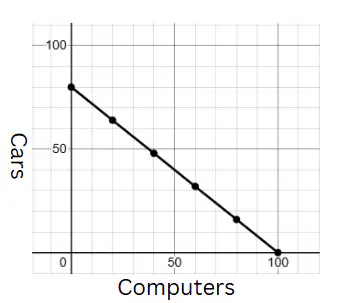
Moving from point A (0, 80) to point B (20, 65) on the curve indicates:
a)
Decrease in production of Computers
b)
Increase in production of Computers
c)
Increase in production of Cars
d)
Decrease in production of Cars
24.
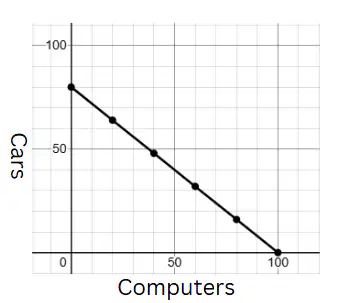
The opportunity cost of increasing the production of Computers is:
a)
The amount of Cars that must be sacrificed
b)
The amount of resources used
c)
The same as the production of Computers
d)
Not relevant
25.
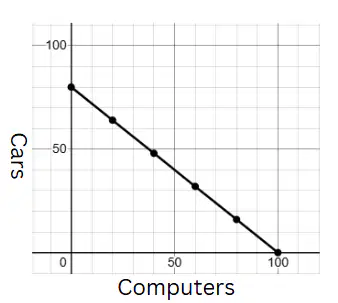
If technological advancements improve the production of Computers, what happens to the PPC?
a)
It shifts inward
b)
It shifts outward
c)
It remains unchanged
d)
It becomes a straight line
26.
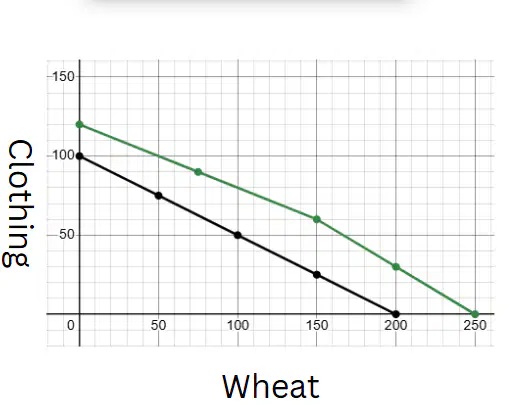
What does the outward shift of the curve indicate?
a)
Decrease in resources
b)
Increase in efficiency
c)
Economic growth
d)
No change in production capacity
27.
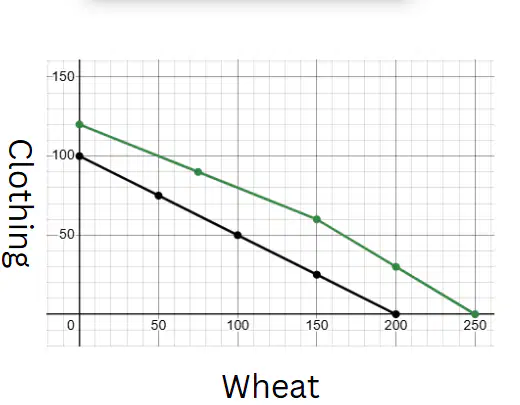
If the economy is producing at a point on the new curve, it signifies:
a)
Inefficient production
b)
Maximum efficiency
c)
Underemployment
d)
Resource scarcity
28.
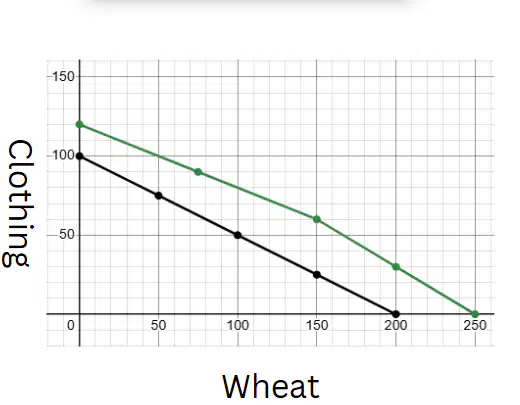
When the economy moves from the old curve to the new curve, it represents:
a)
A decrease in production potential
b)
An increase in opportunity cost
c)
A technological advancement
d)
A recession
29.
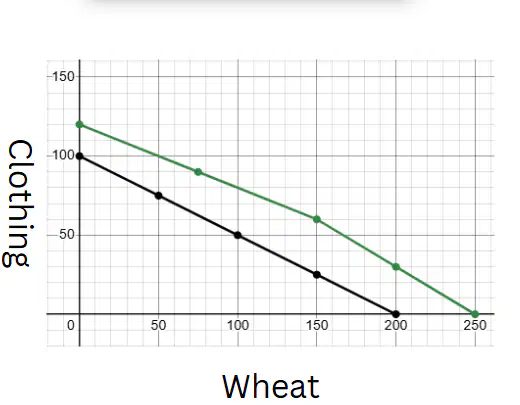
If resources are reallocated to produce more of Wheat, the production of Clothing will:
a)
Increase
b)
Decrease
c)
Remain the same
d)
Become more efficient
30.
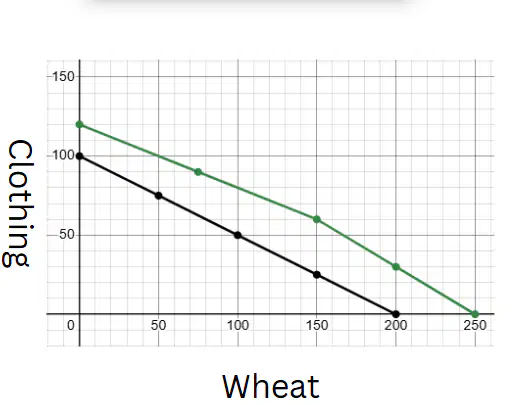
The concept of opportunity cost in this graph refers to:
a)
The total cost of production
b)
The benefits lost from not producing more of clothing
c)
The fixed costs of production
d)
The variable costs of production
31.
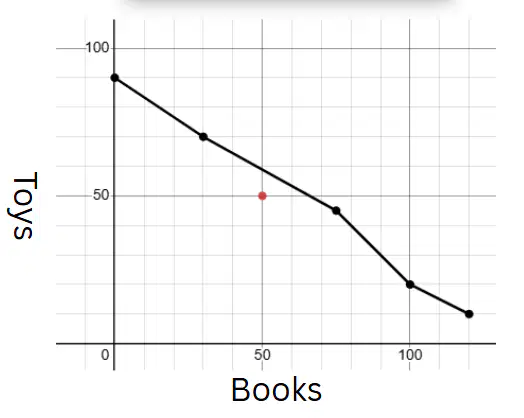
What does a point below the curve indicate?
a)
Full efficiency
b)
Inefficient production
c)
Economic growth
d)
Resource scarcity
32.
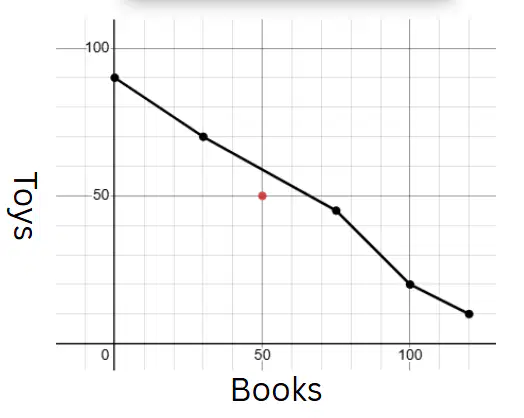
If a country is producing at a point on the curve, it is:
a)
Underutilizing resources
b)
Maximizing output
c)
Experiencing economic downturn
d)
Facing resource limitations
33.
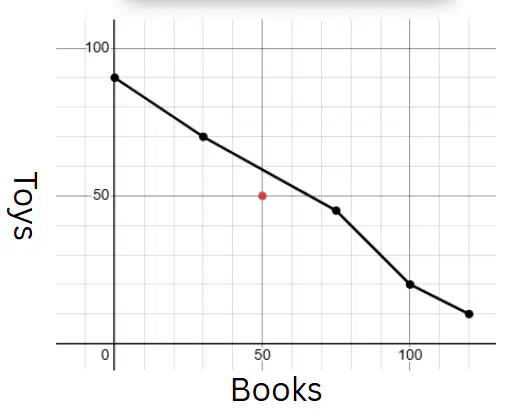
The opportunity cost of moving from point C (55, 75) to point D (100, 30) on the curve is:
a)
The amount of books given up
b)
The amount of toys gained
c)
The total resources used
d)
Not applicable
34.
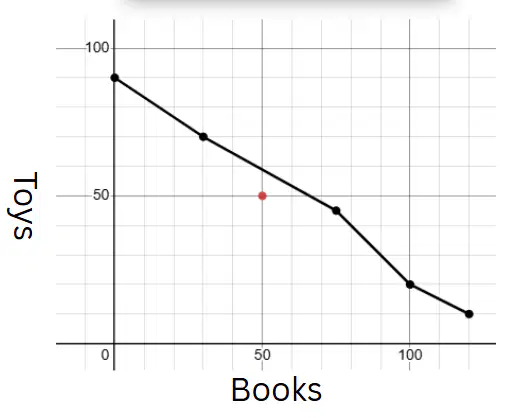
If the production is increased beyond the curve, it would represent:
a)
A feasible situation
b)
An impossible production level
c)
A new technological efficiency
d)
A point of maximum efficiency
35.
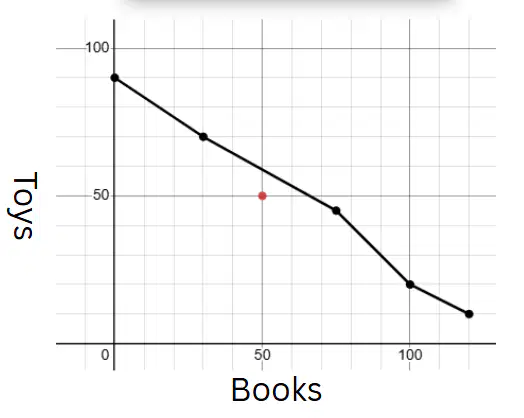
Which factor can cause the PPC to shift inwards?
a)
Increase in population
b)
Natural disasters affecting resources
c)
Improved technology
d)
Government subsidies
36.
What is a Production Possibility Curve (PPC) primarily used to show?
a)
The minimum production levels of an economy
b)
The maximum possible production combinations of two goods
c)
The actual production levels in current markets
d)
The desired production goals of a company
37.
The shape of a typical PPC is:
a)
A straight diagonal line
b)
A perfect circle
c)
Bowed outward (concave)
d)
Bowed inward (convex)
38.
Points inside the PPC curve represent:
a)
Optimal production levels
b)
Unattainable production combinations
c)
Inefficient use of resources
d)
Maximum economic growth
39.
What causes an outward shift of the PPC?
a)
Natural disasters
b)
Economic recession
c)
Resource depletion
d)
Economic growth
40.
The Law of Increasing Opportunity Cost explains why:
a)
All resources are equally efficient
b)
The PPC is curved rather than straight
c)
Production always increases over time
d)
Resources are unlimited
41.
What assumption is made about resources in the PPC model?
a)
Resources are unlimited
b)
Resources are variable
c)
Resources are fixed
d)
Resources are growing
42.
Which statement about points on the PPC is correct?
a)
They represent inefficient production
b)
They are impossible to achieve
c)
They represent maximum efficiency
d)
They represent minimum production
43.
What happens to the PPC after a natural disaster?
a)
It shifts outward
b)
It shifts inward
c)
It becomes straight
d)
It disappears completely
44.
The concept of opportunity cost in PPC means:
a)
The monetary cost of production
b)
The profit gained from production
c)
What must be given up to produce something else
d)
The cost of importing goods
45.
How does technological advancement affect the PPC?
a)
Causes inward shift
b)
Has no effect
c)
Causes outward shift
d)
Makes it more linear
46.
Which is NOT a practical application of PPC?
a)
Business decision making
b)
Government resource allocation
c)
Predicting stock market trends
d)
Environmental protection decisions
47.
What does a point outside the PPC represent?
a)
Current production capability
b)
Efficient production
c)
Inefficient production
d)
Unattainable production level
48.
How does improved education and training affect the PPC?
a)
No effect
b)
Shifts it inward
c)
Makes it more linear
d)
Shifts it outward
49.
Which factor is considered constant in a basic PPC model?
a)
Technology level
b)
Production costs
c)
Consumer demand
d)
Market prices
50.
What does scarcity mean in the context of PPC?
a)
Lack of money
b)
Limited resources prevent unlimited production
c)
Shortage of labor only
d)
Temporary production problems
51.
The Production Possibility Frontier (PPF) is:
a)
Different from the PPC
b)
Another name for the PPC
c)
Only used in international trade
d)
Only applicable to developing economies
52.
When resources are better suited for specific products, this explains:
a)
Economic growth
b)
Market equilibrium
c)
Increasing opportunity cost
d)
Perfect competition
53.
Which is a common misconception about PPC?
a)
It shows trade-offs
b)
It demonstrates scarcity
c)
All points inside the curve are equally inefficient
d)
It shows maximum production possibilities
54.
Population growth typically affects the PPC by:
a)
Making it more linear
b)
Shifting it outward
c)
Shifting it inward
d)
Having no effect
55.
The primary purpose of studying PPC in economics is to understand:
a)
Stock market fluctuations
b)
International trade only
c)
Economic trade-offs and resource allocation
d)
Currency exchange rates
56.
What are the three basic economic questions that every society must answer?
a)
Who produces, where to produce, when to produce
b)
What to produce, how to produce it, for whom to produce
c)
Why produce, which resources to use, how to distribute
d)
Where to produce, when to produce, how much to produce
57.
In a traditional economic system, how are resources primarily allocated?
a)
Through government planning and control
b)
Based on supply and demand
c)
Through inheritance and social customs
d)
By technological innovation
58.
Which characteristic best describes a command economic system?
a)
Free market competition
b)
Government control of production means
c)
Inheritance-based resource allocation
d)
Consumer-driven decision making
59.
What is a key advantage of a command economic system?
a)
Maximum individual choice
b)
High production efficiency
c)
Rapid mobilization for national goals
d)
Technological innovation
60.
In a market economic system, what determines prices?
a)
Government regulations
b)
Traditional customs
c)
Central planning
d)
Supply and demand
61.
Which economic system is considered the oldest form of economic organization?
a)
Market economy
b)
Mixed economy
c)
Traditional economy
d)
Command economy
62.
What is a primary characteristic of mixed economic systems?
a)
Complete government control
b)
No government intervention
c)
Combination of market and command elements
d)
Purely traditional methods
63.
The Scandinavian Model is best characterized by:
a)
Minimal government involvement
b)
No welfare programs
c)
Strong market economy with comprehensive welfare
d)
Pure command economy structure
64.
What drives innovation in a mixed economic system?
a)
Government control
b)
The private sector
c)
Traditional customs
d)
Central planning
65.
Which feature is NOT typically associated with a market economic system?
a)
Consumer choice
b)
Price controls by government
c)
Free enterprise
d)
Competition
66.
What is a primary goal of traditional economic systems?
a)
Technological advancement
b)
Self-sufficiency
c)
Global trade
d)
Rapid industrialization
67.
In the United States' mixed economy, what is the government's primary role?
a)
Controlling all production
b)
Providing regulation and social programs
c)
Eliminating private enterprise
d)
Setting all prices
68.
What drives production decisions in a market economy?
a)
Government quotas
b)
Traditional practices
c)
Consumer choice
d)
Social customs
69.
Which economic system typically features price controls?
a)
Market economy
b)
Traditional economy
c)
Command economy
d)
Pure capitalism
70.
What is a key characteristic of resource distribution in a market economy?
a)
Central planning
b)
Price mechanism
c)
Social customs
d)
Government quotas
71.
Which is a disadvantage of command economic systems?
a)
Too much competition
b)
Limited individual choice
c)
Excessive technological change
d)
Low government control
72.
What role does the government play in providing public goods in a mixed economy?
a)
No role at all
b)
Minimal involvement
c)
Direct provider
d)
Only advisory role
73.
How does a market economy promote efficiency?
a)
Through government control
b)
Through competition
c)
Through tradition
d)
Through central planning
74.
What distinguishes a mixed economy from a pure market economy?
a)
Complete absence of private property
b)
No government intervention
c)
Government provision of social safety nets
d)
Lack of competition
75.
Which factor is most important in determining production in a command economy?
a)
Market forces
b)
Individual choices
c)
Central planning
d)
Traditional customs
76.
In a mixed economy, how does government intervention in market failures demonstrate the balance between free enterprise and regulation?
a)
By completely controlling all economic decisions
b)
By selectively addressing externalities while preserving market autonomy
c)
By eliminating all private sector involvement
d)
By maintaining a purely laissez-faire approach
77.
How does the concept of marginal analysis explain why a restaurant might close despite having a full dining room?
a)
The restaurant's total revenue exceeds total costs
b)
Fixed costs are too high to consider
c)
The marginal cost of serving additional customers exceeds the marginal benefit
d)
Customer satisfaction is the only relevant factor
78.
How does the shape of a Production Possibilities Curve reflect the law of increasing opportunity costs?
a)
The curve is perfectly linear
b)
The curve is concave to the origin due to resource specialization
c)
The curve shows only one production possibility
d)
The curve is convex to the origin
79.
What economic principle explains why a country with abundant skilled labor might specialize in technology services rather than agricultural production, even if it can produce both efficiently?
a)
Absolute advantage
b)
Comparative advantage
c)
Economy of scale
d)
Diminishing returns
80.
How does scarcity influence the development of different economic systems across societies?
a)
It forces all societies to adopt the same economic system
b)
It creates a universal solution to resource allocation
c)
It leads to varying approaches based on cultural and resource factors
d)
It eliminates the need for economic systems
81.
In what way does technological advancement affect both the Production Possibilities Curve and opportunity costs?
a)
It only shifts the curve inward
b)
It shifts the curve outward and may alter the slope of the curve
c)
It has no effect on opportunity costs
d)
It only affects current production levels
82.
How do traditional economies address the challenge of resource allocation differently from market economies?
a)
They rely solely on government planning
b)
They use only modern technology
c)
They base decisions on customs and historical practices
d)
They ignore scarcity completely
83.
What complex relationship exists between command economies and market innovation?
a)
Command economies always produce more innovation
b)
Innovation is impossible in command economies
c)
Central planning can target specific innovations but may stifle spontaneous innovation
d)
Innovation only occurs in mixed economies
84.
How does the concept of marginal net benefit apply to a student's decision about study time?
a)
More study time always yields better results
b)
Study time has no relationship to academic performance
c)
The optimal study time occurs where marginal benefit equals marginal cost
d)
Students should minimize study time to maximize efficiency
85.
What economic principle explains why some regions within a country might specialize in certain industries while trading with other regions?
a)
Random resource distribution
b)
Regional comparative advantage and opportunity costs
c)
Government mandate
d)
Consumer preferences only
86.
How do changes in resource availability affect both the Production Possibilities Curve and economic decision-making?
a)
Only current production is affected
b)
Only future possibilities are affected
c)
Both current production and future possibilities shift, requiring strategic reallocation
d)
Neither current nor future production is affected
87.
What role does opportunity cost play in understanding international trade patterns?
a)
It has no impact on trade decisions
b)
It only affects domestic production
c)
It helps explain why countries trade even when they can produce all goods themselves
d)
It only applies to developing economies
88.
How does the scarcity of time influence economic decision-making differently from other scarce resources?
a)
Time scarcity affects only individual decisions
b)
Time can be stored for future use
c)
Time's non-renewable nature makes it uniquely constraining in all decisions
d)
Time scarcity only affects businesses
89.
What economic principle explains why mixed economies tend to be more adaptable than pure command or market economies?
a)
They eliminate all economic problems
b)
They combine the flexibility of markets with strategic government intervention
c)
They function without any government oversight
d)
They eliminate private property rights
90.
How does specialization affect a country's Production Possibilities Curve over time?
a)
It has no effect on productive capacity
b)
It only affects current production
c)
It can lead to increased efficiency and an outward shift of the curve
d)
It always decreases productive capacity
91.
What relationship exists between market economies and income inequality?
a)
Market economies eliminate inequality
b)
Income inequality is impossible in market economies
c)
Market efficiency can lead to wealth concentration
d)
Only command economies experience inequality
92.
How do economic systems address the challenge of allocating resources between current consumption and investment in future production?
a)
By focusing only on current needs
b)
By ignoring future possibilities
c)
Through various mechanisms that balance present and future needs
d)
By eliminating the need for investment
93.
What role does marginal analysis play in government policy decisions about public goods?
a)
It is irrelevant to public policy
b)
It helps determine optimal provision levels by comparing social benefits and costs
c)
It only considers monetary costs
d)
It only applies to private goods
94.
How does the concept of opportunity cost apply to environmental resource management?
a)
It only considers monetary values
b)
It has no relevance to environmental decisions
c)
It helps evaluate trade-offs between conservation and development
d)
It only applies to renewable resources
95.
What economic principle explains why different societies might choose different points along their Production Possibilities Curve?
a)
All societies choose the same point
b)
Social values and priorities influence resource allocation decisions
c)
The choice is always random
d)
Only efficiency matters in the decision
96.
What is the fundamental economic problem that all societies face?
a)
Technological advancement
b)
Government regulation
c)
Scarcity of resources
d)
Market competition
97.
Which economic system is characterized by goods, services, and work following established traditions?
a)
Command economy
b)
Traditional economy
c)
Market economy
d)
Mixed economy
98.
In a command economy, who typically controls the allocation of resources?
a)
Private businesses
b)
Individual consumers
c)
The central government
d)
Traditional leaders
99.
What type of economic system does the United States primarily use?
a)
Pure market economy
b)
Traditional economy
c)
Command economy
d)
Mixed economy
100.
What is the definition of opportunity cost?
a)
The actual monetary cost of a purchase
b)
The total benefit received from an action
c)
What must be given up to obtain something else
d)
The government's regulation of resources
101.
Which resource is considered the most scarce and can never be replenished?
a)
Money
b)
Time
c)
Natural resources
d)
Labor
102.
What is marginal analysis?
a)
The total cost of production
b)
The examination of additional benefits compared to additional costs
c)
The study of economic traditions
d)
The analysis of government spending
103.
What does a Production Possibilities Curve (PPC) demonstrate?
a)
Government spending patterns
b)
Consumer preferences
c)
Maximum possible output combinations given available resources
d)
Historical economic trends
104.
What can cause an outward shift in the Production Possibilities Curve?
a)
Decrease in resources
b)
Economic recession
c)
Technological advancement
d)
Resource depletion
105.
In a market economy, what primarily determines the allocation of resources?
a)
Government planning
b)
Traditional customs
c)
Supply and demand
d)
Central authority
106.
What is the primary characteristic of laissez-faire capitalism?
a)
Heavy government regulation
b)
Minimal government interference
c)
Equal distribution of wealth
d)
Central planning
107.
What is cost-benefit analysis?
a)
A comparison of costs with benefits received from an action
b)
The study of government spending
c)
Analysis of traditional economic systems
d)
Calculation of profit margins
108.
What best describes the relationship between specialization and trade?
a)
Specialization eliminates the need for trade
b)
Countries that specialize must be completely self-sufficient
c)
Specialization encourages trade between countries based on their strengths
d)
Trade reduces a country's ability to specialize
109.
What is marginal benefit?
a)
Total profit from all activities
b)
Additional benefits gained from one more unit of activity
c)
The cost of producing one more unit
d)
The average benefit of all units
110.
How does geography impact a country's economic capabilities?
a)
It has no significant impact
b)
It only affects transportation
c)
It affects access to resources and trade routes
d)
It only impacts agriculture
111.
What is specialization in economics?
a)
Having a variety of industries
b)
Focusing on producing what a country does best
c)
Importing all goods
d)
Avoiding international trade
112.
In a mixed economic system, which statement is most accurate?
a)
All industries are government-controlled
b)
Traditional customs determine production
c)
Most industries are private with some public oversight
d)
There is no government involvement
113.
What is the primary purpose of studying economics?
a)
To understand stock markets only
b)
To make informed decisions about limited resources
c)
To maximize government control
d)
To eliminate scarcity
114.
What happens at any point along the Production Possibilities Curve?
a)
Resources are being underutilized
b)
Resources are being wasted
c)
Resources are being used inefficiently
d)
Resources are being used at maximum efficiency
115.
How do economic systems address scarcity?
a)
By eliminating all wants and needs
b)
By creating unlimited resources
c)
By making choices about resource allocation
d)
By ignoring the problem
100 %

