
 Worksheets
F3 Learning Target
Total questions: 15
Worksheet time: 8mins
Name
Class
Date
1.
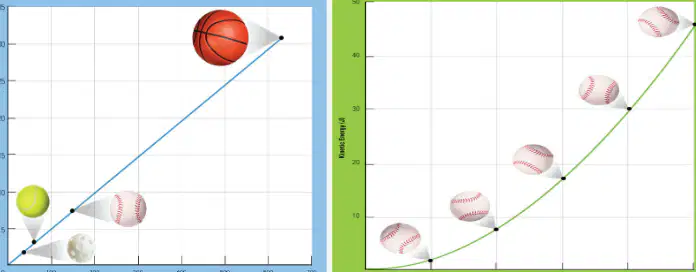
What is the effect of doubling the speed of an object on its kinetic energy? Given that Speed and KE have an Exponetial Relationship.
a)
Kinetic energy remains the same
b)
Kinetic energy doubles
c)
Kinetic energy quadruples
d)
Kinetic energy halves
2.
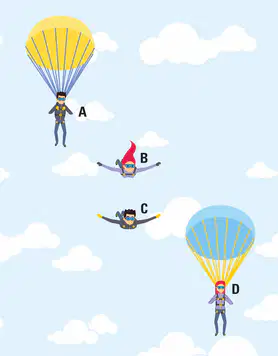
Four skydivers are descending from the same altitude. Two have deployed their parachutes, and two are still in free fall. Based on the image, which skydiver has the LEAST gravitational potential energy?
a)
skydiver A
b)
skydiver B
c)
skydiver C
d)
skydiver D
3.
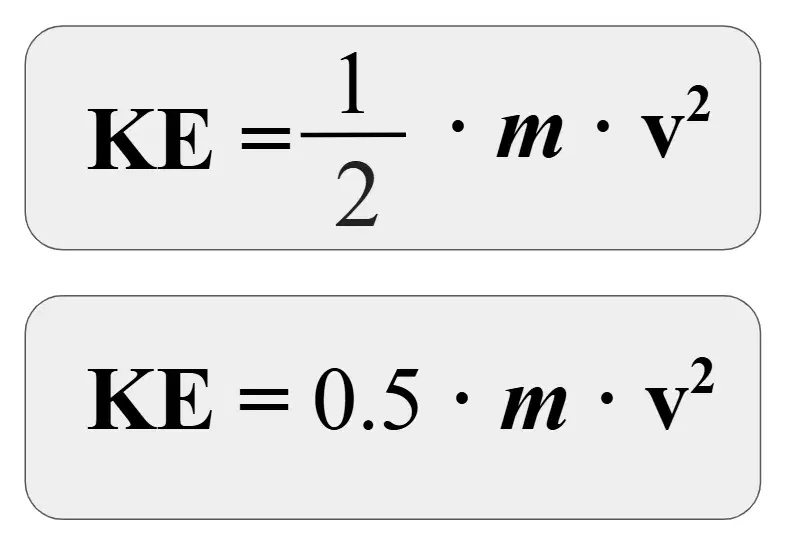
Marcus is observing a boulder rolling down a hill near his home. If the boulder has a mass of 8kg and is moving at a speed of 1.2 m/s, what is its Kinetic Energy?
a)
5.76 Joules
b)
7.2 Joules
c)
9.6 Joules
d)
11.52 Joules
4.
What type of energy is stored in a stretched rubber band?
a)
Kinetic Energy
b)
Potential Energy
c)
Sound Energy
d)
Nuclear Energy
5.
What factors affect the amount of gravitational potential energy an object has?
a)
Height from the ground and Weight
b)
Velocity and Acceleration
c)
Mass and Speed
d)
Speed and Direction
6.
Which factors determine the amount of kinetic energy an object possesses?
a)
Mass and velocity
b)
Temperature and mass
c)
Density and weight
d)
Volume and mass
7.

When considering the law of conservation of energy, which of the following statements is true?
a)
Energy can be created out of nothing
b)
Energy can be destroyed
c)
Energy can change forms, but the total amount of energy stays the same. It cannot be created nor destroyed
d)
Energy only applies to mechanical systems
8.

In an open system, how does the total energy change over time due to friction?
a)
Total energy gradually decreases due to friction
b)
Total energy rapidly increases
c)
Total energy remains constant
d)
Total energy fluctuates
9.
In a closed system with no external forces, what happens to the total energy over time according to the law of conservation of energy?
a)
Total energy gradually decreases
b)
Total energy rapidly increases
c)
Total energy remains constant
d)
Total energy fluctuates
10.
Which of the following is an example of potential energy?
a)
A moving car
b)
A sandwich
c)
Sunlight
d)
Sound waves
11.
What is the scientific definition of energy?
a)
A feeling
b)
A drink from the gas station
c)
The ability to cause motion or change
d)
Caffeine that makes your body use food faster
12.

What type of energy transformation occurs in an Electric Generator like those found in a wind turbine?
a)
Electrical energy → Heat energy
b)
Kinetic energy → Electrical energy
c)
Chemical energy → Electrical energy
d)
Nuclear energy → Thermal energy
13.
Friction converts kinetic energy predominantly into which form of energy?
a)
Light energy
b)
Nuclear energy
c)
Thermal energy
d)
Chemical energy
14.

After the first drop on a roller coaster, it starts to go up the next loop. As it does this, it converts...
a)
All of its kinetic energy into gravitational potential energy.
b)
Some of its kinetic energy back into gravitational potential energy, some into thermal energy, and some stays as kinetic energy
c)
Gravitational potential energy into kinetic energy.
d)
Kinetic energy into chemical energy.
e)
None of its energy— all of it stays kinetic until the end of the ride
15.
What type of energy transformation occurs during photosynthesis?
a)
Chemical energy → Light energy
b)
Thermal energy → Chemical energy
c)
Light energy → Chemical energy
d)
Mechanical energy → Electrical energy
100 %

