
 Worksheets
Self-Assessment PPD1 WEEK 11
Total questions: 69
Worksheet time: 40mins
The definition of self-assessment is:
A process of evaluating one's own performance or abilities.
A method of assessing others' performance.
A technique for improving communication skills.
A strategy for managing time effectively.
What are the key components of effective self-assessment?
Goal setting, reflection, and feedback
Time management and organization
Creativity and innovation
Collaboration and teamwork
One benefit of self-assessment according to Panadero et al., 2017 is:
Improved academic performance
Increased stress levels
Decreased motivation
Reduced learning outcomes
Active engagement is promoted through self-assessment by:
encouraging reflection and personal responsibility
providing external feedback
focusing on rote memorization
relying on teacher-led instruction
Self-assessment helps in developing critical thinking skills by:
Encouraging reflection and self-awareness
Providing immediate feedback
Offering external validation
Focusing on rote memorization
The role of self-assessment in fostering independence is to:
Encourage reliance on others
Promote self-awareness and responsibility
Limit personal growth
Discourage self-reflection
According to Brown and Harris (2013), self-assessment has what impact on performance?
Positive impact
Negative impact
No impact
Varied impact
Reflective Journaling helps in self-assessment by:
Providing a structured way to reflect on experiences and learn from them.
Offering a platform to share thoughts with others.
Allowing for the recording of daily events without analysis.
Serving as a tool for creative writing.
Self-Grading is important in evaluating one's work because it allows individuals to:
Identify areas of improvement and enhance learning.
Rely solely on external feedback for validation.
Ignore personal biases and focus on others' opinions.
Avoid self-reflection and maintain status quo.
Peer Feedback contributes to gaining new perspectives in self-assessment by:
providing diverse viewpoints
limiting personal biases
enhancing self-awareness
all of the above
Describe the role of Goal-Setting in tracking progress and achieving targets.
Goal-setting helps in tracking progress and achieving targets by providing clear objectives and milestones.
Goal-setting is irrelevant to tracking progress and achieving targets.
Goal-setting complicates the process of tracking progress and achieving targets.
Goal-setting only helps in achieving targets but not in tracking progress.
Knowledge Gap Identification in medical education is the process of:
assessing the difference between current knowledge and required knowledge
teaching new medical procedures
evaluating medical students' performance
conducting medical research
Clinical Skills Improvement benefits patient care by:
Enhancing diagnostic accuracy
Reducing treatment time
Improving patient satisfaction
All of the above
The Mini-CEX Application is used in medical education for:
assessing clinical skills through direct observation
providing online medical courses
conducting medical research
managing patient records
The purpose of filling out a brief self-assessment form about recent performance is to:
Evaluate personal progress and identify areas for improvement.
Provide feedback to peers.
Document achievements for future reference.
Fulfill a mandatory requirement.
Personal Reflection: Why is it important to take time to consider academic growth and challenges faced?
To understand personal development and areas for improvement
To ignore past experiences
To avoid future challenges
To focus solely on academic success

Partner Discussion: How can sharing insights with a classmate help in exploring improvement strategies together?
By fostering collaboration and diverse perspectives
By creating competition among classmates
By limiting individual thinking
By focusing only on personal goals
The concept of Growth Mindset was developed by:
Carol Dweck
Albert Bandura
Jean Piaget
Lev Vygotsky
Growth Mindset contrasts with:
Fixed Mindset
Open Mindset
Creative Mindset
Flexible Mindset
The core belief of Growth Mindset is:
Intelligence and abilities can be developed through effort and learning.
Intelligence and abilities are fixed traits that cannot be changed.
Success is determined by innate talent alone.
Failure is a reflection of one's unchangeable abilities.

What is the perspective of a fixed mindset?

What is the perspective of a growth mindset?
How do these mindsets affect learning impact according to Dweck (2006)?
They enhance learning by promoting a growth mindset.
They have no effect on learning.
They hinder learning by promoting a fixed mindset.
They are irrelevant to learning.

Embracing challenges in the context of a growth mindset means:
avoiding difficult tasks to prevent failure
welcoming difficult tasks as opportunities to learn and grow
ignoring challenges and focusing on strengths
seeking only tasks that guarantee success

Persisting through setbacks contributes to a growth mindset by:
Building resilience and adaptability
Encouraging fixed mindset
Avoiding challenges
Focusing on innate talent

Valuing effort is important in developing a growth mindset because:
it leads to fixed mindset.
it encourages learning and resilience.
it guarantees success.
it is not necessary.

Learning from criticism can enhance a growth mindset by:
improving self-awareness and adaptability
decreasing motivation and confidence
encouraging a fixed mindset
promoting avoidance of challenges

Being inspired by others' success can foster a growth mindset by:
Encouraging imitation of others' actions
Promoting a fixed mindset
Motivating personal development and learning
Focusing on others' achievements only
Brain Plasticity supports the idea that our brains can change throughout life because it refers to the brain's ability to:
remain static and unchanging
adapt and reorganize itself
deteriorate over time
grow in size indefinitely

Learning activities create new pathways between neurons in the brain by:
strengthening existing connections
creating entirely new neurons
removing old neurons
decreasing synaptic activity
Effort and practice reinforce neural pathways over time, as explained in Strengthening Connections.
True
False
Scenario Recognition: How can students identify fixed vs growth mindset responses in common situations?
By observing the language used in responses
By analyzing the tone of voice
By considering the context of the situation
By evaluating the emotional response
Group Discussion: What are some different mindset approaches that teams can debate when faced with challenges?
Growth mindset vs. Fixed mindset
Optimistic vs. Pessimistic
Collaborative vs. Competitive
All of the above
Reframing Practice: How can fixed mindset statements be transformed into growth-oriented perspectives?
By ignoring challenges
By embracing challenges and learning from them
By avoiding feedback
By sticking to what you know
Recognizing fixed thinking in the context of developing a growth mindset means:
Identifying and challenging limiting beliefs
Accepting all thoughts as they are
Ignoring negative thoughts
Focusing only on positive outcomes
Embracing challenges can contribute to developing a growth mindset by:
Avoiding difficult situations
Encouraging learning and resilience
Maintaining a fixed mindset
Focusing on immediate success
Focusing on the process is important in developing a growth mindset because:
it helps in understanding the steps needed for improvement.
it guarantees success without effort.
it allows one to ignore failures.
it ensures immediate results.
Cultivating learning passion plays a role in developing a growth mindset by:
Encouraging continuous improvement and resilience
Limiting the ability to adapt to new challenges
Focusing solely on innate talent
Discouraging risk-taking and experimentation
What is the fixed statement mentioned in 'The Power of Yet'?
The statement is about embracing challenges.
The statement is about fixed mindset.
The statement is about growth mindset.
The statement is about learning from mistakes.
How does the growth transformation change the fixed statement in 'The Power of Yet'?
It adds a sense of possibility and progress.
It reinforces the fixed mindset.
It has no effect on the statement.
It makes the statement more negative.
What perspective shift is described in 'The Power of Yet'?
A shift from a fixed mindset to a growth mindset
A shift from optimism to pessimism
A shift from individualism to collectivism
A shift from realism to idealism
The outcome of applying 'The Power of Yet' is:
Increased motivation and resilience
Decreased confidence
Immediate success
Lack of progress
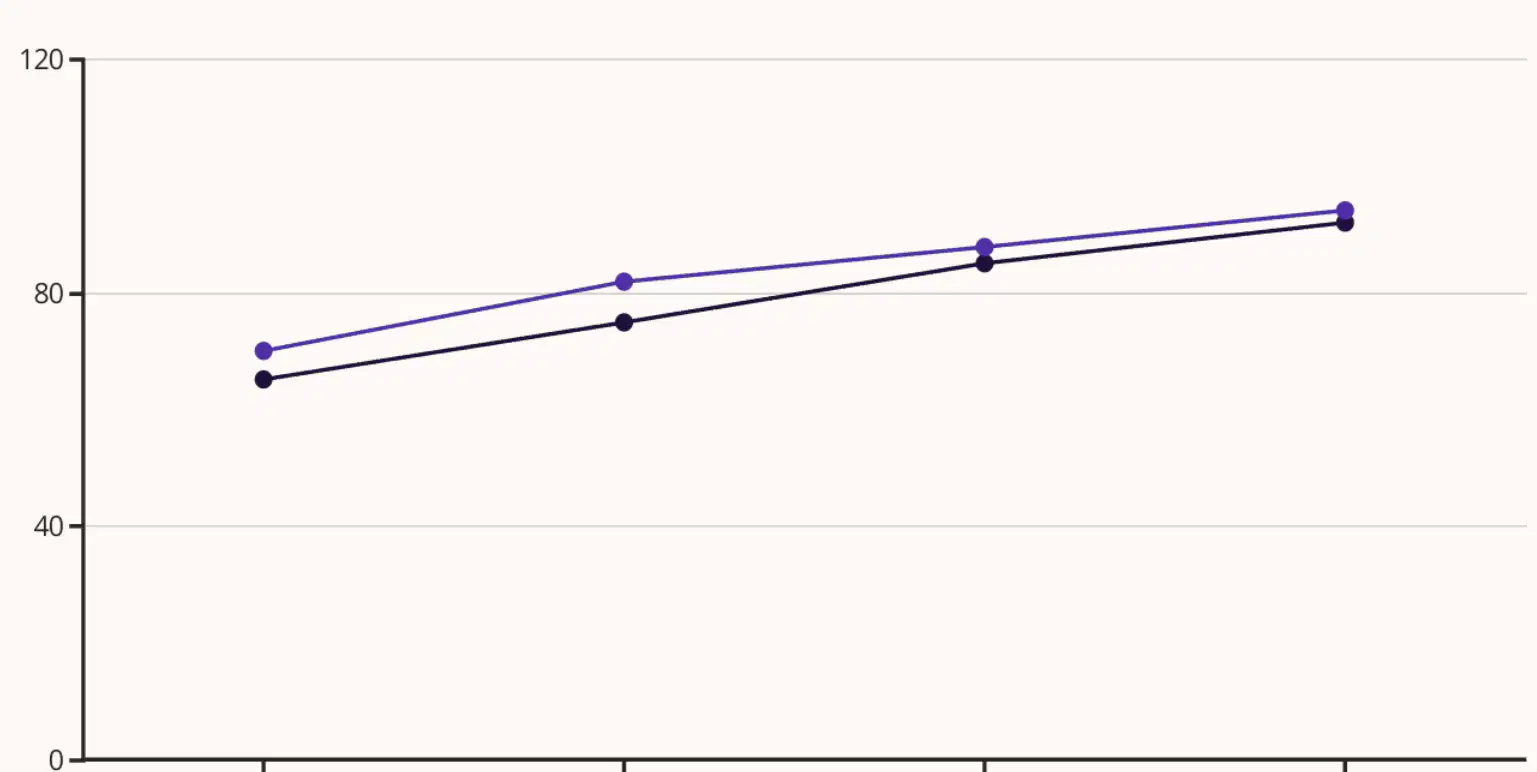
What does the graph in the image represent?
The graph represents sales data over time.
The graph represents temperature changes throughout the year.
The graph represents population growth over decades.
The graph represents stock market trends.
According to the image, who transformed Microsoft by encouraging employees to be 'learn-it-alls' instead of 'know-it-alls'?
Bill Gates
Steve Ballmer
Satya Nadella
Paul Allen
What is the first step in the Personal Growth Plan class activity?
Identify personal goals
Create an action plan
Reflect on past achievements
Discuss with a mentor
Setting SMART Goals in the Personal Growth Plan involves:
Specific, Measurable, Achievable, Relevant, Time-bound objectives
General, Vague, Unmeasurable, Irrelevant, Open-ended goals
Random, Unplanned, Unachievable, Irrelevant, Time-wasting tasks
Specific, Measurable, Achievable, Irrelevant, Time-bound objectives
How can students develop strategies in the Personal Growth Plan?
By setting clear goals and objectives
By ignoring feedback
By procrastinating
By avoiding challenges
The purpose of tracking progress in the Personal Growth Plan is to:
Evaluate personal development over time
Identify areas for improvement
Set new personal goals
All of the above
A Self-Assessment Tool helps in recognizing growth opportunities by:
Providing feedback on current performance
Identifying areas for improvement
Offering a structured approach to self-evaluation
All of the above
How does Challenge Embracing contribute to persistence?
By avoiding challenges
By giving up easily
By facing and overcoming challenges
By ignoring challenges
The importance of Strength Identification in tackling challenges is:
It helps in recognizing personal abilities to overcome obstacles.
It is not relevant to overcoming challenges.
It only focuses on weaknesses.
It is a theoretical concept with no practical application.
Why are Improvement Areas considered opportunities rather than judgments?
Because they focus on growth and development
Because they are critical evaluations
Because they are final assessments
Because they are negative criticisms

How does Goal Setting enhance motivation from a growth perspective?
By providing a clear direction and measurable objectives
By increasing stress and pressure to perform
By focusing solely on outcomes rather than processes
By discouraging risk-taking and innovation
The importance of addressing bias in self-assessment is:
To ensure accurate self-evaluation and personal growth
To maintain a positive self-image
To avoid criticism from others
To enhance social interactions
External validation can improve self-assessment by:
Providing objective feedback
Increasing self-doubt
Encouraging overconfidence
Reducing motivation
Self-awareness development is crucial for accurate self-assessment because it allows individuals to:
Understand their strengths and weaknesses
Ignore external feedback
Rely solely on intuition
Avoid self-reflection
Continuous improvement plays a role in self-assessment by:
Enhancing personal growth and development
Providing entertainment
Reducing the need for feedback
Eliminating the need for self-reflection
What are the future directions and applications for Professional Development?
Increased focus on digital skills and online learning platforms
Decreased emphasis on continuous learning
Elimination of professional development programs
Focus solely on traditional classroom training
Technology Enhancement is expected to evolve in the future by:
increasing automation and AI integration
decreasing reliance on digital platforms
eliminating the need for cybersecurity
reducing the use of renewable energy
What skills are emphasized in Lifelong Learning for future career landscapes?
Technical skills
Soft skills
Both technical and soft skills
Neither technical nor soft skills
Educational Policy is expected to integrate growth mindset principles by:
focusing solely on academic achievements
encouraging a fixed mindset
promoting resilience and adaptability
eliminating challenges in learning
What is the focus of Cross-Cultural Applications in future educational systems?
Integration of technology in classrooms
Emphasis on cultural diversity and inclusion
Standardization of global curricula
Development of language proficiency programs
What is the title of the article written by Brown, G.T.L. and Harris, L.R. in 2013?
The article written by Brown, G.T.L. and Harris, L.R. in 2013 is titled 'The Impact of Feedback on Learning'.
The article written by Brown, G.T.L. and Harris, L.R. in 2013 is titled 'Assessment and Learning'.
The article written by Brown, G.T.L. and Harris, L.R. in 2013 is titled 'Student Engagement in Learning'.
The article written by Brown, G.T.L. and Harris, L.R. in 2013 is titled 'Effective Teaching Strategies'.
The article written by Brown, G.T.L. and Harris, L.R. in 2013 is titled 'The Role of Assessment in Learning'.
Who is the author of 'Mindset: The new psychology of success' published in 2006?
Carol S. Dweck
Malcolm Gladwell
Daniel Kahneman
Angela Duckworth
The article by Dweck, C.S. was published in 2014 in which journal?
Journal of Personality and Social Psychology
Psychological Science
Science
Nature
Who co-authored the article with Dweck, C. in the Harvard Business Review in 2016?
John Doe
Jane Smith
Mark Johnson
Susan Lee
What is the volume and issue number of the Educational Psychology Review where Ng, B.'s article was published in 2018?
Volume 30, Issue 2
Volume 29, Issue 3
Volume 28, Issue 1
Volume 27, Issue 4
In which year was the article by Norcini, J.J. et al. published in Medical Teacher?
2005
2010
2015
2020
The authors of the article published in the Educational Research Review in 2017 are:
Smith and Johnson
Brown and Taylor
Williams and Jones
Davis and Wilson

