
 Worksheets
Genetic Code Review
Total questions: 54
Worksheet time: 54mins
Which shows the correct complementary DNA strand of ATG?
ATG
TAC
TAG
CGC


Which enzyme is responsible for building nucleotides?
Helicase


Name this structure
double helix
nucleotide
amino acid
protein
You are given the DNA strand 5'ATGCTCAGCTGA3'. What is the corresponding DNA strand?
5'UACGAGUCGACU3'
5'TACGAGTCGACT3'
3'UACGAGUCGACU5'
3'TACGAGTCGACT5'

Which letter in the picture below depicts the leading strand in DNA replication?
A
C
B
None of the above
Which letter in the picture below depicts the lagging strand in DNA replication?
Letter A since it is copied from 5' to 3'
Letter A since it is copied from 3' to 5'
Letter B since it is copied from 3' to 5
Letter B since it is copied from 5' to 3'
DNA replication puts down nucleotides ______' to _____' and is said to be ______________________
5, 3, antiparallel
3, 5, antiparallel
5, 3, parallel
3, 5, parallel
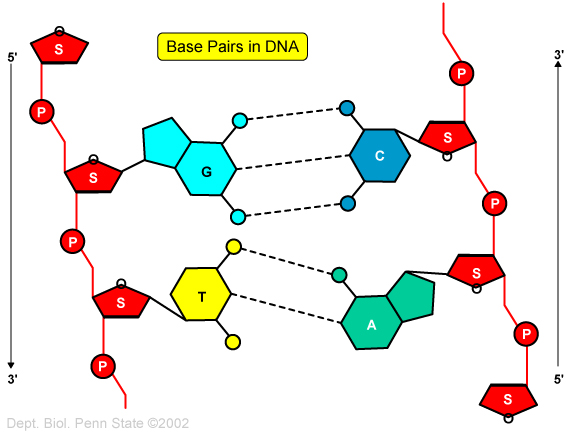
What are the components of a DNA nucleotide? (Mark all that apply)
Deoxyribose
Ligase
Nitrogen Base
Phosphate group
Ribose
What enzyme "glues" the Okazaki fragments together?
Helicase
Ligase
Primase
DNA Polymerase
___ is a double-stranded helix of nucleotides which carries the genetic information of a cell.
RNA (Ribonucleic Acid)
DNA (Deoxyribonucleic acid)
Chromosomes
Centrioles
Where does mRNA transcription occur?
In the cytoplasm
On a ribosome
In the nucleus where the DNA is
In the Golgi Apparatus?
RNA has information to create...
DNA
Proteins
Elements
Atoms
Which of the mRNA strands below is the complement to this DNA strand: AACCGGTT
UUAACCGG
TTGGCCAA
UUGGCCAA
None of the Above
What does RNA stand for?
Ribonucleic acid
Ricenucleic acid
Ribouncenucleic acid
Rinucleic acid
What are the 4 RNA nitrogen bases?
adenine, thymine, cytoplasm, and guanine
adenine, thymine cytosine, and guanine
adenine, uracil, cytoplasm, and guanine
adenine, uracil, cytosine, and guanine
DNA contains the template to make RNA
True
False

Which statement is true about RNA?
RNA is usually single stranded and contains the base uracil
RNA is usually double stranded and contains the base thymine
RNA is made in the nucleus and stays there to carry out its function
All of the above are true.
Which of the following structures carries the DNA information from the nucleus, out to a ribosome
DAN
mRNA
tRNA
rRNA
Which of the following correctly describes transcription
DNA replicating its self
MRNA is made from a DNA template
An anticodon is formed
proteins are made from amino acids
A strand of mRNA carries the code to specific amino acids that will construct specific proteins. what are these codes called?
codons
anticodons
genes
histones
Transcribe this DNA sequence to an mRNA:
3' TAGCATG 5'
3' ATCGTAC 5'
5' AUCGUAC 3'
3' AUCGUAC 5'
5' ATCGTAC 3'
Transcribe this DNA sequence into an mRNA:
5' ATGGCTGA 3'
(a)
mRNA sequences are typically written in the (a) direction
What best explains the interaction between tRNA and mRNA during translation?
anticodons on the mRNA line up with complementary codons on the tRNA
anticodons on the tRNA line up with complementary codons on the mRNA
tRNA attach amino acids to the complementary mRNA sequence
mRNA attach amino acids to the complementary tRNA sequence
What does tRNA "transfer"?
amino acids
nucleic acids
nucleotides
AUG
anti-codons are located on __________
mRNA
tRNA
rRNA
snRNA
codons are located on __________
mRNA
tRNA
rRNA
snRNA
How many nucleotides make up a single codon?
3
5
4
1

The following codon is translated into which amino acid?
AUU
Methionine
Isoleucine
Histidine
Arginine

The following codon is translated into which amino acid?
CAU
Methionine
Isoleucine
Histidine
Arginine

The following codon is translated into which amino acid?
UAA
STOP
Phenylalanine
Valine
Aspartic acid


3'-GCT-5'

Deletion
A
B
C
What mutation has occurred here?
T-G-A-C-C-A
T-G-A-G-C-A
Substitution
Deletion
Insertion
Frameshift
DNA molecule segment is : TTACGCAAG
The mutated DNA segment is TTCGCAAG. This is an example of ___ mutation.
Substitution
Deletion
Insertion
Inversion
A mutation is defined as:
A change in the cell's structure
Anything that changes in an embryo
Any change in the physical features of a human
A change in the DNA sequence
Why are insertion and deletion (frameshift) mutations so harmful?
They change all of the codons from the mutation on down the line, which changes the amino acid sequence
They insert things that an organism doesn't need.
They often delete things that organisms need.
Insertion and deletions are not any more harmful than substitution mutations.

