
 Worksheets
Magnetism/Electricity Review
Total questions: 46
Worksheet time: 23mins
Name
Class
Date
1.
1) What would happen if you brought the south pole of a magnet next to the north pole of another magnet?
a)
They would attract.
b)
They would repel.
c)
They would neither attract or repel.
2.
2) Which statement is correct about magnetic fields?
a)
The field lines criss cross each other near the poles.
b)
The field lines get closer the farther away you go from the magnet.
c)
The field loses strength farther from the magnet and the field lines go from the north to south pole.
d)
The field loses strength farther from the magnet and goes from south to south pole.
3.
3) What is a device that changes kinetic energy into electrical energy?
a)
electric motor
b)
generator
c)
transformer
d)
galvanometer
4.
4) Which of the following would have the strongest magnetic field?
a)
An electromagnet with a high current and 15 coils.
b)
An electromagnet with a low current and 15 coils.
c)
An electromagnet with a high current and 25 coils.
d)
An electromagnet with a low current and 25 coils.
5.
5) Which statement best describes electromagnetic induction?
a)
Wrapping wires with electricity in them around a nail creates a magnetic field.
b)
Moving magnets near a coil of wire creates electrical current in the wire.
c)
A magnet's atoms and domains line up to create a magnetic field.
6.
6) Where is the magnetic field the strongest on a magnet?
a)
furthest from the magnet
b)
between the magnets
c)
at the poles
7.
7) Which of these metals cannot become magnetized?
a)
cobalt
b)
copper
c)
iron
d)
nickel
8.
8) Which statement best describes what happens inside of a magnet when it becomes magnetized.
a)
The atoms and domains line up.
b)
The atoms and domains become randomized.
c)
The atoms and domains attract and repel.
9.
9) Which instrument makes use of the Earth's magnetic field?
a)
magnetron
b)
electromagnet
c)
compass
d)
maglev
10.
10) How could you use a string to determine the north pole of a magnet?
a)
Tie two magnets to a string and see which one points north.
b)
Hang a magnet from a string. The north pole will point north.
c)
Hang a magnet from a string. The north pole will point south.
d)
Tie two magnets to a string and see which one points south.
11.
11) What is a device called that increases or decreases electrical voltage?
a)
electric motor
b)
generator
c)
transformer
d)
galvanometer
12.
12) In the electromagnet lab, how did you measure the strength of the magnet?
a)
by the current level in the wires
b)
by the number of paperclips held
c)
by the temperature of the wire
d)
by the voltage on the power supply
13.
13) Which statement best describes the magnetic field lines around two magnets with OPPOSITE poles facing each other?
a)
They go from north to south pole on each magnet in half circle shapes, and the field lines connect between the opposite poles.
b)
They go from north to south pole on each magnet in half circle shapes, and the field lines don't connect between the opposite poles.
c)
They go around both magnets in one larger half circle shape moving from the north pole of one magnet to the north pole of the other magnet.
14.
14) Which statement best describes how lightning is formed?
a)
Negative charges build up in the cloud, and opposite charges build up in the ground. Then an electric discharge occurs.
b)
Negative charges build up in the cloud, and the same charges build up in the ground. Then an electric discharge occurs.
c)
Negative charges build up in the cloud and then create a continuous flowing circuit with positive charges in the ground.
15.
15) Which of the following does NOT correctly explain why bulbs in a series circuit are dimmer than in a parallel circuit?
a)
The current in the series circuit is lower than the current in the parallel circuit.
b)
The resistance in the series circuit is higher than the resistance in the parallel circuit.
c)
The bulbs in the series circuit must share the electricity from the power supply.
d)
The voltage in the series circuit is lower than in the parallel circuit.
16.
16) What is different between a fuse and a circuit breaker?
a)
A fuse must be replaced, and a circuit breaker can be reset.
b)
A fuse can be reset, and a circuit breaker must be replaced.
c)
A fuse shuts off electrical power, but a circuit breaker increases it.
d)
A fuse increases electrical power, but a circuit breaker shuts it off.
17.
17) If you RUBBED (wiped) a balloon on your head and stuck it to the wall, this would be an example of charging by _____________
a)
induction
b)
friction
c)
conduction
d)
current
18.
18) An electric charge that is fixed in one place (at rest) is called ___________ electricity.
a)
current
b)
alternating
c)
fuse
d)
static
19.
19) The closed, continuous path through which electrons can flow is a(n) _____________
a)
battery
b)
circuit
c)
circuit breaker
d)
switch
20.
20) A certain circuit has bulbs wired so that when one goes out the other bulbs still work. What type of circuit is it?
a)
simple
b)
series
c)
parallel
21.
21) Current that flows in one direction like a battery is called ___________ current.
a)
alternating
b)
direct
c)
free flowing
d)
positive
22.
22) Which direction does electricity flow in a circuit?
a)
negative to positive
b)
positive to negative
c)
negative to negative
d)
positive to positive
23.
23) Which description best fits with a series circuit?
a)
All of the bulbs are connected in one path for electricity.
b)
Each bulb has its own path for electricity.
c)
There is one switch and one bulb on the circuit path.
24.
24) You place a negatively charged object near an object of unknown charge. They attract. What is the charge of the unknown object?
a)
positive
b)
negative
c)
no charge
25.
25) A good conductor would .........
a)
resist the flow of electrons (electrons cannot flow easily through it)
b)
allow electrons to flow through easily.
c)
keep electrons held tightly in the atoms
26.
26) A(n) __________ circuit is one in which NO CHARGES CAN FLOW through any load (resistor) connected in a circuit.
a)
closed
b)
open
c)
inductive
d)
alternating
27.
27) Electrons have a positive charge
a)
True
b)
False
28.
28) The shock you felt when you brought your hand NEAR a generator (without direct contact) is charging by ___________.
a)
induction
b)
friction
c)
conduction
d)
current
29.
29) If you put two objects with LIKE CHARGES near each other, they would ____________.
a)
fuse together
b)
attract
c)
repel
d)
remain in the same place
30.
30) The rate of flow of electric charges in a circuit is current.
a)
True
b)
False
31.

31) Using Ohm's Law, if a circuit has a voltage of 9 V and a resistance of 5 Ω, the current would be _______.
a)
45 A
b)
1.8 A
c)
0.56 A
d)
14 A
32.
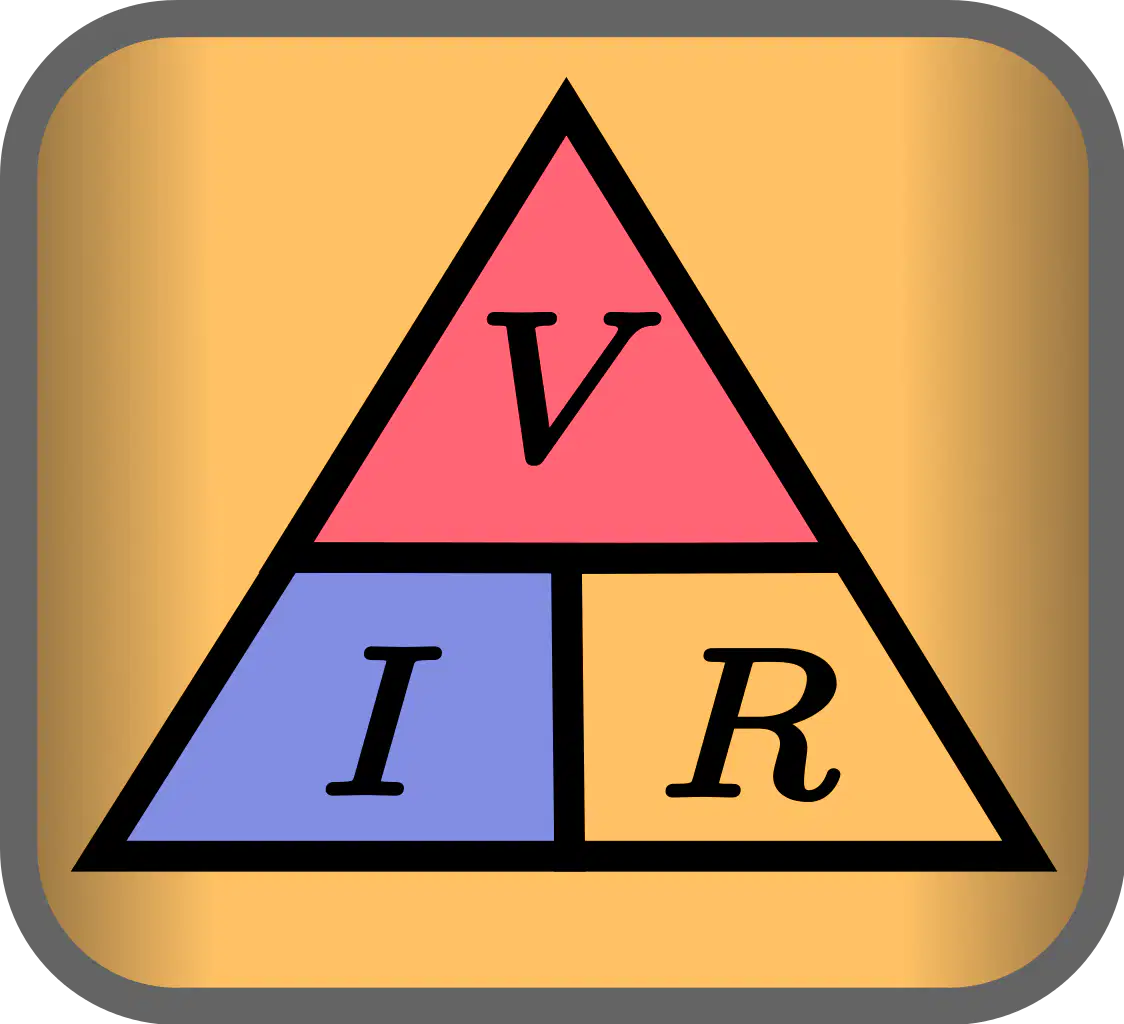
32) Brianna has a lamp connected to a 120 V series circuit and the current in the lamp is 0.4 A. Using Ohm's Law, what is the RESISTANCE in the lighted lamp?
a)
300 Ω
b)
48 Ω
c)
120.4 Ω
d)
119.6 Ω
33.

33) Use Ohm's Law: what would the resistance be in a circuit with a voltage of 10V and a current of 4 A?
a)
40 ohms
b)
2.5 ohms
c)
40 watt hours
d)
2.5 watt hours
34.
34) Sophia has a lamp connected to a 120 V series circuit and the current in the lamp is 0.4 A. How much POWER is used by the lamp? (P = VI)
a)
300 W
b)
48 W
c)
120.4 W
d)
119.6 W
35.
35) A 60 W light bulb, shining down on your pet iguana, was left on while you were at school (for 8 hours). How much ENERGY was wasted? (E=Pt)
a)
480 Whrs
b)
7.5 Whrs
c)
60.8 Whrs
d)
59.2 Whrs
36.
36) The law of electric charges states that ........
a)
for every action, there is an equal and opposite reaction.
b)
charged objects that move produce electric current.
c)
the energy of charges and mass are interchangeable.
d)
like charges repel and opposite charges attract.
37.
37) What type of current flows through the wires in our homes?
a)
alternating
b)
direct
c)
fluctuating
d)
amps
38.
38) Which statement best describes the "Balloon Demonstration"?
a)
When both balloons were rubbed with a piece of fur, they were charged by friction and repelled from each other since they had the same charge.
b)
When both balloons were rubbed with a piece of fur, they were charged by conduction and repelled because they had opposite charges.
c)
When both balloons were shocked with the Tessla Coil, they were charged by induction and repelled because they had the same charge.
d)
When both balloons were touched to a doorknob, there was a spark because the opposite charges attracted.
39.
39) A student is doing a lab, and creates a circuit with 2 bulbs and a switch in series. If the switch is closed and one of the bulbs is unscrewed, what would happen?
a)
The bulb that is unscrewed would go out, but the other bulb would stay on.
b)
Both of the bulbs would go out.
c)
Both of the bulbs would stay lit.
d)
The bulb that is unscrewed would stay lit, but the other bulb would go out.
40.
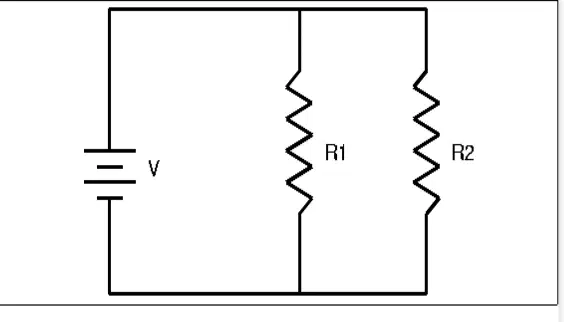
40) In the circuit pictured below, if R1 and R2 are light bulbs, which of the following statements would be true?
a)
If R1 went out, R2 would also go out because they are both connected to the same battery.
b)
If R1 went out, R2 would still light up because each bulb has its own connection to the same battery.
c)
R1 and R2 could go on or off depending upon the switch position in this diagram.
d)
R1 and R2 should always stay lit up because they are in a circuit.
41.
41) Which of the following is NOT true about parallel circuits?
a)
They have more than one path for current to travel.
b)
Each bulb uses the same voltage.
c)
Each bulb glows at full brightness.
d)
The switch on a parallel circuit is always closed.
42.
42) A circuit has 3.5 A of current and a resistance of 7 ohms. How much voltage does it have?
a)
2 V
b)
0.5 V
c)
24.5 V
d)
10.5 V
43.
43) A simple circuit diagram typically has what 3 items?
a)
a bulb and two batteries
b)
a battery and 2 bulbs
c)
a battery and 2 switches
d)
a battery, a switch, and a bulb
44.
44) The light bulbs in a circuit should be off if the switch is in the _____________ position.
a)
closed
b)
open
c)
full
d)
connected
45.
45) Circuit A has a voltage of 10 V and 2 ohms of resistance. Circuit B has a voltage of 10V and 4 ohms of resistance. Which circuit has the highest current flowing? Which circuit would have the brightest bulbs?
a)
Circuit A has the highest current as well as the brightest bulbs.
b)
Circuit B has the highest current as well as the brightest bulbs.
c)
Circuit A has the highest current, but circuit B has the brightest bulbs.
d)
Circuit B has the highest current, but circuit A has the brightest bulbs.
46.
46) If a magnetic levitation track had north poles facing up on its left side and south poles facing up on its right side, how would you want to have the magnets in your vehicle?
a)
You would want north poles facing down on the left side of the vehicle and north poles facing down on the right side of the vehicle.
b)
You would want south poles facing down on the left side of the vehicle and north poles facing down on the right side of the vehicle.
c)
You would want south poles facing down on the left side of the vehicle and south poles facing down on the right side of the vehicle.
d)
You would want north poles facing down on the left side of the vehicle and south poles facing down on the right side of the vehicle.
100 %

