
 Worksheets
IG Magnetism and Electricity
Total questions: 85
Worksheet time: 56mins

X
Y
Z
They all have the same reading

A
B
C
D

A
B
C
D

Less than 4 ohm
50 ohm
Between 60 ohm and 100 ohm
100 ohm

Less than 3 ohm
3.0 ohm
4.5 ohm
more than 6 ohm

4.0 V
6.0 V
8.0 V
12.0 V
Which circuit shows a voltmeter measuring the p.d. across a rasistor


A
B
C
D

A
B
C
D

A
B
C
D
An electromagnet is used to separate magnetic metals from non-magnetic metals.
Why is steel not suitable as the core of the electromagnet?
It forms a permanent magnet
It has a high density
It has a high thermal capacity
It is a good conductor of electricity
How can a permanent magnet be demagnetised?
Cool the magnet for a long time
hit the magnet repeatedly with a hammer
Leave the magnet in a coil which is connected to a batteray
Shine bright light onto the magnet

A
B
C
D
Some resistors aare made using one type of wire. two different lenghts of wire are available. Each lenght is available in two different diameters.
Which wire has the highest resistance?
the wire with the greater lenght and the larger diameter
the wire with the greater lenght and the smaller diameter
the wire with the smaller lenght and the larger diameter
the wire with the smaller lenght and the smaller diameter

A
B
C
D

A
B
C
D

A
B
C
D
A resistor of resistance R is connected to a batteray of e.m.f. V.
There is a current in the resistor.
Power P is dissipated by the resistor, and in time t the energy transferred is E.
Which expression is correct ?
E = I V t
E = P I t
P = V I R
P = V / R

2.4 J
14.4 J
240 J
1440 J
The resistance of a wire depends on its length L and on its cross-sectional area A.
The resistance is?
directly proportional to L and directly proportional to A
directly proportional to L and inversely proportional to A
inversely proportional to L and directly proportional to A
inversely proportional to L and inversely proportional to A
Atoms that have a positive charge will be ATTRACTED to atoms with a ___________ charge.
positive
negative
neutral
Which of these forces works only by combining electric and magnetic forces?
Magnetic
Electric
Electromagnetism
This force occurs when ions/atoms create attractive and repulsive forces.
Magnetic
Electric
Electromagnetism
This force occurs when there is an attractive and repulsive force between two poles.
Magnetic
Electric
Electromagnetism
In a magnet the opposite poles will ___________.
attract
repel
The magnetic field of a magnet is ____________ further away from the magnet.
stronger
weaker
Electric charges that DO NOT move through a current are known as
Magnetic
Electric
Electromagnetism
Static Electricity
What makes an electromagnet stronger?
greater number of loops
smaller number of loops
decreasing the current
decreasing the voltage
An example of an electromagnet
water bottle
paper
motor
glass
current flowing through a wire is surrounded by a/an
force field
magnetic force
nothing
two type of charges in electric and magnetic forces are
north and south
east and west
positive and negative
beyonce
when electrons all spin in the same direction, they create an invisible force known as
electricity
magnetism
motor
electrons
this force is the attractive and repulsive force between two poles.
electric
magnetic
electromagnetic
this force occurs when ions/atoms create attractive and repulsive forces.
electric
magnetic
electromagnetic
electrons have this type of charge
positive
negative
neutral
protons have this type of charge
positive
negative
neutral
when the number of electrons matches the number of protons, the atom's charge is...
positive
negative
neutral
When your hair stands on end, each strand repelling the other, you are experiencing
magnetism
ghosts
static electricity
Complete the sentence: An ammeter is a device that measures
voltage.
charge.
current.
resistance.
Which is the unit of measure for current?
amp
volt
coulomb
joule
Which of the following materials is not a conductor?
wire wool
ionic solution
steel
plastic
Complete the following sentence: A current is defined as
stationary electrons.
the energy in a cell.
a net flow of charge.
electrons.
Which of the following statements about conventional current is correct?
The electrons do not move.
The electrons flow in all directions.
Electrons flow from negative to positive.
Electrons flow from positive to negative.
A voltmeter measures the voltage across a component. Where should it be positioned in a circuit in order to measure voltage correctly?
in series with the component
in parallel with the component
over the cell
anywhere in the circuit
Where would you place an ammeter in a series circuit to get a reading?
next to the cell only
in parallel with the component
in parallel with the cell
anywhere in the circuit
Which of the following represents the definition of an amp?
Cs
s/C
C/s
J/C
Which of the following represents the relationship between charge, current and time?
Q = I × t
Q = I/t
Q = t/I
Q = V × t
A kettle requires a current of 2.1 A and takes 3 minutes to boil a litre of water. Calculate the charge through the wire in this time?
6.3 C
378 C
0.7 C
6.3 Q
Calculate the number of electrons passing through a wire in 5 seconds if the current through it is 2 A.
6 × 10^19
1.7 × 10^-18
10
2
Which of the following represents the definition of a volt?
C/s
J/C
JC
J
Which of the following represents the relationship between energy, voltage and charge?
E/V = Q
E = V/Q
E = V × I
E = V/I
The voltage across a kettle is 230 V. Calculate the energy supplied if 100 C of charge pass through the kettle’s wires.
0.44 J
2.3 J
440 kJ
23 kJ
The voltage across a cooker is 230 V. There is a current of 12 A for 10 minutes. Calculate the total amount of energy.
28 kJ
1.7 kJ
1.7 MJ
2 kJ

What does this circuit symbol represent?
resistor
diode
variable resistor
light dependent resistor

What does this circuit symbol represent?
Lamp/bulb
Cell
Motor
Voltmeter

What does this circuit symbol represent?
Lamp
Resistor
Fuse
Light-dependent resistor

What does this circuit symbol represent?
Variable resistor
Light emitting diode (LED)
Bulb/lamp
Diode

What does this circuit symbol represent?
Motor
Generator
Electric bell
Bulb/lamp

What does this circuit symbol represent?
Bulb/lamp
Battery
Resistor
Cell
Which component would you use to indicate that a current may be flowing?
voltmeter
buzzer
cell
resistor
In a parallel circuit, 0.8 A arrives at a junction between two wires. It splits with 0.2 A going down the first wire. What would the ammeter reading on the second wire be?
0.8 A
0.6 A
0.2 A
It will depend on the resistance of the components down that wire.
Which of the following statements about a parallel circuit that has bulbs on each wire is not correct?
If one bulb filament breaks the other bulbs will remain on.
Switches can be placed throughout the circuit so that different bulbs can be turned on and off.
The current around the circuit will be the same at all points.
Parallel circuits are used in the home for lighting.
Which of the following statements about a series circuit is not correct?
The current is the same throughout the circuit.
The voltage is shared across components.
Different bulbs can be turned on and off depending on where you place a switch.
When one bulb is broken the circuit will no longer work.
In which circuit does ammeter measuring the charge through the lamp?


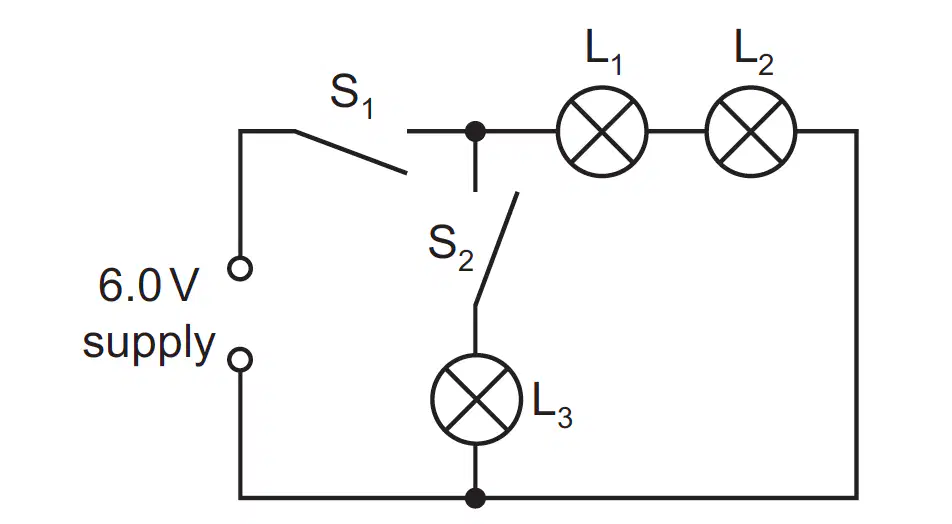
Which lamps light when switch S1 is closed and S2 is open?
L1 only
L3 only
L1 and L2 only
L1, L2 and L3
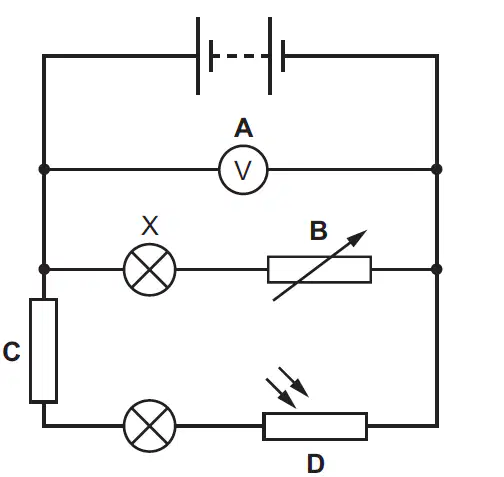
Which labelled component in the circuit shown controls the brightness of lamp X?
A
B
C
D
In which circuit do both lamps light?


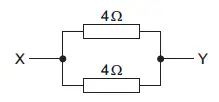
What is combined resistance between XY?
2 Ω
4 Ω
8 Ω
16 Ω
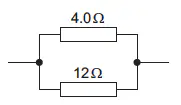
A 4.0 Ω resistor and a 12 Ω resistor are connected in parallel.
What is the effective resistance of this combination of resistors?
0.33 Ω
3.0 Ω
8.0 Ω
16 Ω
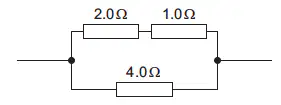
The diagram shows part of a circuit.
What is the combined resistance of the resistors?
0.14 Ω
0.57 Ω
1.7 Ω
7.0 Ω
Which statement about identical lamps in a parallel circuit is NOT CORRECT?
If one lamp blows, the others remain switched on.
The current in each lamp is different.
The lamps can be switched on and off separately.
The lamps have the same voltage across each of them.
A resistor and a battery are connected in series.
The value of the resistor is 20 Ω.
The potential difference (p.d.) of the battery is 4.0 V.
What is the current in the resistor?
0.20 A
4.0 A
5.0 A
80 A

The figure shows a graph of current against potential difference (p.d.) for a filament lamp. At normal brightness, the p.d. across the lamp is 5.0 V.
What is resistance of the lamp at normal brightness?
0.12 A
0.83 A
1.2 A
8.3 A
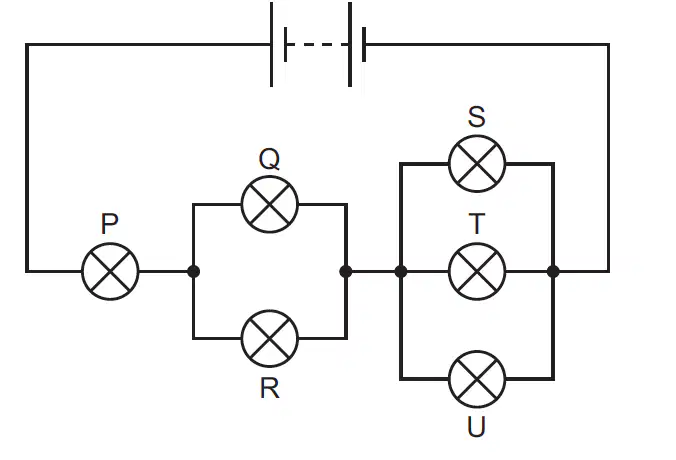
The diagram shows a circuit of six identical lamps connected to a battery.
Which lamps are brightest?
P only
Q and R only
S, T and U only
P, Q, R, S, T and U are equally bright
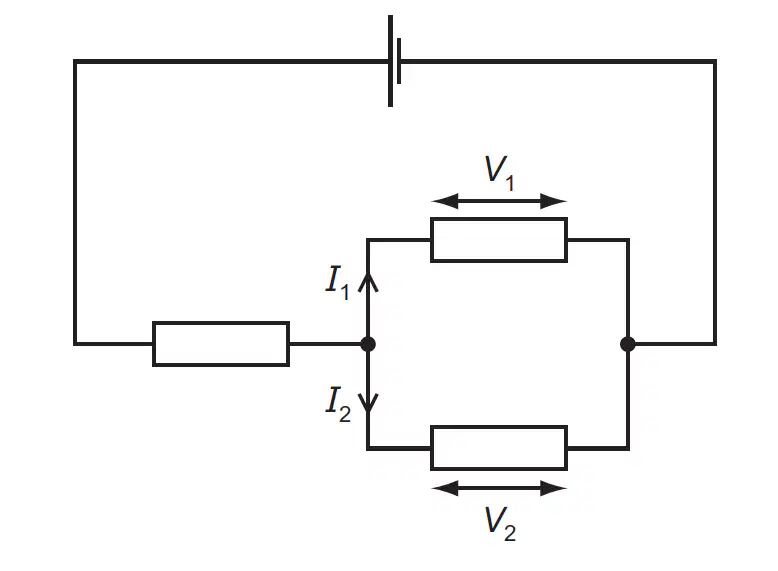
The circuit shows three resistors connected to a cell.
The resistors have DIFFERENT values of resistance.
V1 and V2 are potential differences and I1 and I2 are currents as shown.
Which pair of relationships is correct?


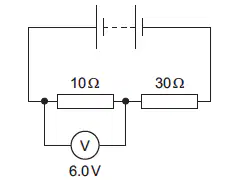
The diagram shows a circuit which includes two resistors and a battery.
The voltmeter reads 6.0 V.
What is the potential difference across the 30 Ω resistor?
2.0 V
6.0V
18 V
24 V
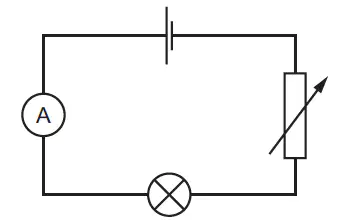
The diagram shows a circuit containing a cell, an ammeter, a lamp and a variable resistor.
The resistance of the variable resistor is INCREASED.
What happens to the ammeter reading and what happens to the brightness of the lamp?


Four lamps are each labelled '60 W 230 V'.
In which circuit are the lamps connected so that they operate at normal brightness?


In which circuit does the ammeter read 2.0 A?


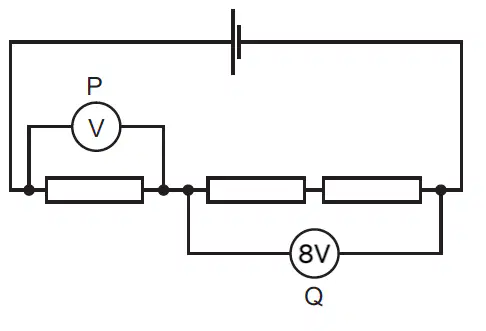
Three identical resistors are joined in series to a cell.
Voltmeter Q reads 8.0 V.
What is the reading on voltmeter P and what is the e.m.f. of the cell?


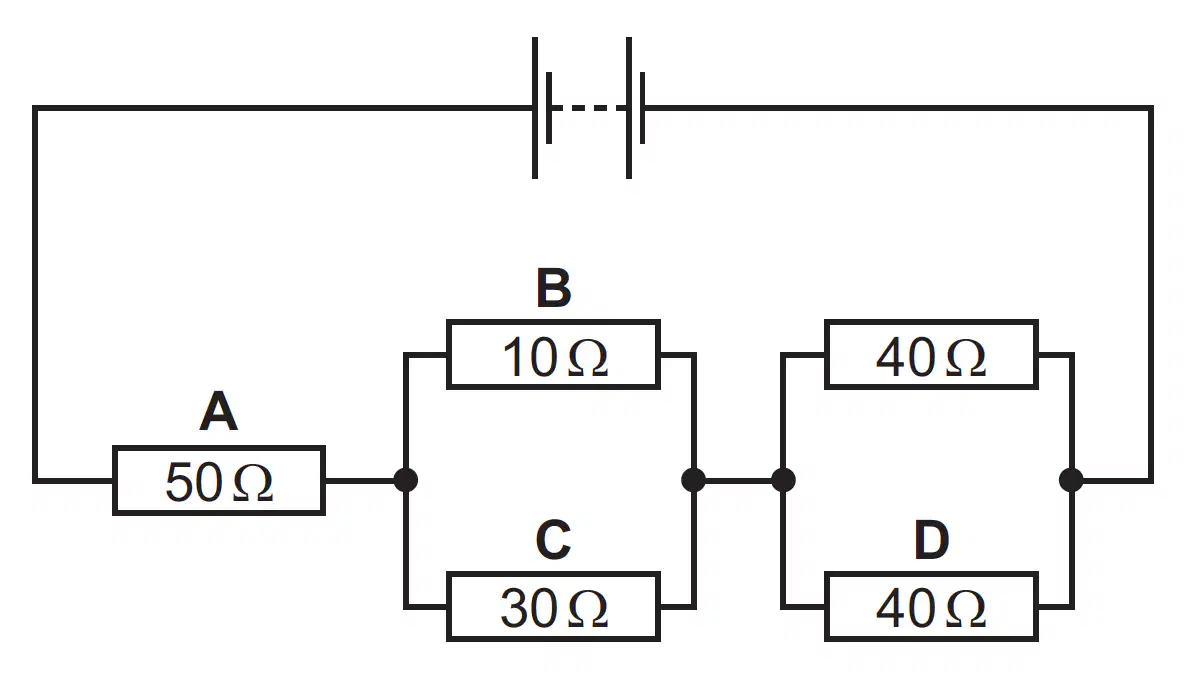
The diagram shows a circuit containing five resistors connected to a battery.
In which resistor is the current the smallest?
A
B
C
D
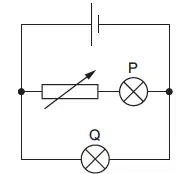
The diagram shows a circuit containing a cell, a variable resistor and two bulbs, P and Q.
The resistance of the variable resistor is increased.
What happens to the brightness of each bulb?


A power supply of 18 V is connected to three resistors, as shown.
What is the potential difference across the 2.0 Ω resistor?
2.0 V
3.6 V
6.0 V
12 V
Answer question:

Answer question:


