
 Worksheets
Copy of US History Unit 1 Test - Western Frontier
Total questions: 25
Worksheet time: 13mins
Name
Class
Date
1.

1.
a)
Native Americans easily adapted to white western settlement in the late nineteenth century.
b)
Native Americans experienced firsthand the clash of two very different cultures in the late nineteenth century.
c)
White settlers encouraged Native Americans to continue their native traditions into the twentieth century.
d)
White settlers encouraged the U.S. government to promote Native American civil rights in the twentieth century.
2.
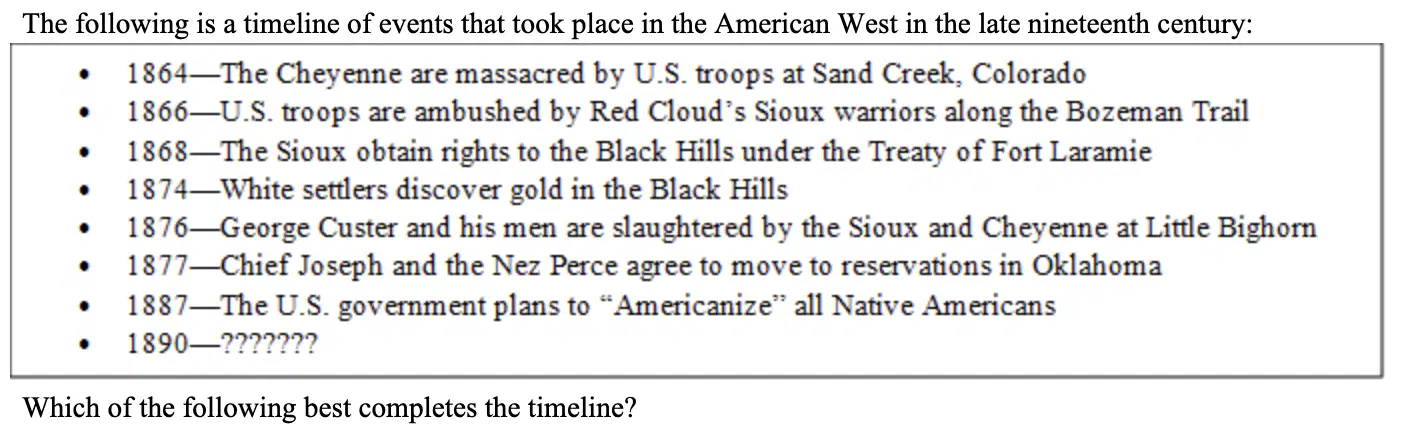
2.
a)
The Sioux are massacred at Wounded Knee, South Dakota ending the Frontier Wars.
b)
The U.S. government allows Native American tribes to continue their traditional way of life.
c)
All Native American tribes were moved to reservations located in the eastern part of the United States.
d)
Native American tribes continue to lead successful raids on white settlements.
3.
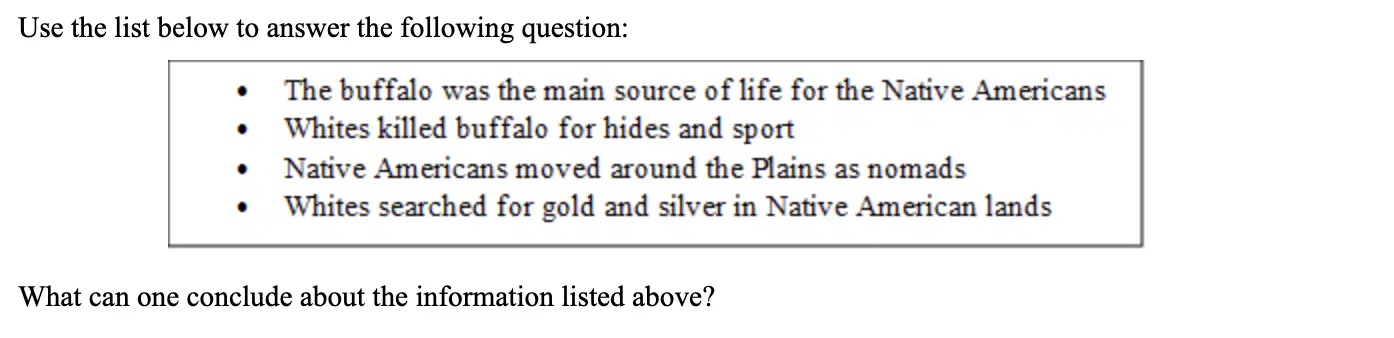
3.
a)
Native Americans and whites coexisted peacefully on the Great Plains.
b)
Native Americans and whites adapted to each other’s customs and needs.
c)
Native Americans and whites worked together in the mining and cattle industries.
d)
Native American and white culture differed in the West.
4.
4. Which of the following became the best crop of the Great Plains?
a)
Cotton
b)
Rice
c)
Wheat
d)
Corn
5.

5.
a)
Native Americans achieved voting rights and equal protection by law.
b)
Native Americans were forced to assimilate under the Dawes Act.
c)
Native Americans decided to leave the Great Plains and move to eastern cities.
d)
Native Americans achieved equal rights under the Civil Rights Act.
6.

6.
a)
The discovery of gold and silver lured many settlers to the West.
b)
Americans migrated from the east for industrial opportunities.
c)
Government policies encouraged settlement of the American West.
d)
Native Americans voluntarily granted land to white settlers.
7.
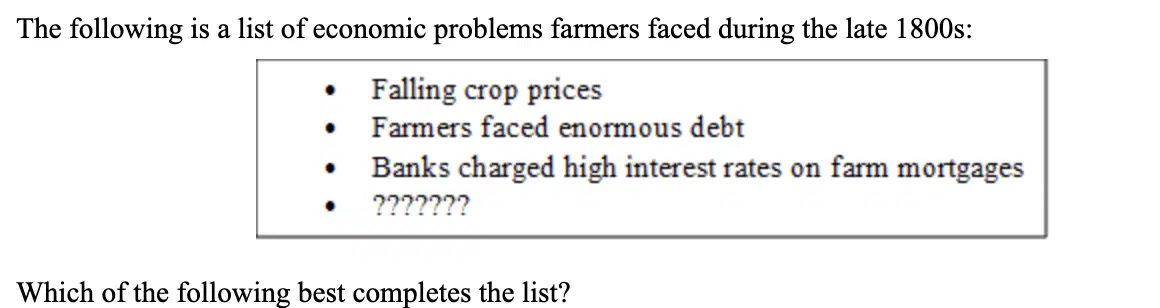
7.
a)
The U.S. government began to regulate farmland.
b)
Poor environmental conditions forced farmers to stop planting.
c)
Farmers suffered heavily from inflation.
d)
Railroads charged farmers extremely high shipping rates.
8.
8. Which of the following was the first national farmers’ organization to be established in 1867?
a)
The Greenback Party
b)
The Grange
c)
The Colored Farmers’ National Alliance
d)
The Northern Farmers’ Alliance
9.

9.
a)
The U.S. government protected settlers from organized Native American attacks.
b)
The U.S. government protected tribal authority over Indian lands.
c)
The U.S. government attempted to achieve cultural assimilation of Native Americans.
d)
The U.S. government attempted to achieve international recognition for Native Americans.
10.

10.
a)
The Supreme Court urged Congress to pass laws that would protect African Americans from prejudice.
b)
The philosophy that African Americans have equality before the law was rejected by this court case.
c)
The Supreme Court was helpless to intervene and protect African Americans from social injustice.
d)
The reasoning behind this decision left African Americans with no protection from racial discrimination.
11.

11.
a)
Native American Indians were granted full rights to their tribal lands.
b)
Native American Indians migrated to Mexico to find new ways to earn a living.
c)
Native American Indians left for industrial cities and found work in factories.
d)
Native American Indians’ food source was lost, and they were forced to live on reservations.
12.
12. In 1890, a Sioux religious leader named Wovoka began the Ghost Dance ritual. It had been banned by federal authorities and deemed as too dangerous. The Sioux continued the ritual in the hopes it would bring back the buffalo and their autonomous way of life. What were the consequences of the conflict?
a)
The Battle of Little Bighorn took place, resulting in the deaths of hundreds of soldiers and Sioux warriors.
b)
The Dawes Act was passed, granting each Native American family 160 acres and the possibility of citizenship after 25 years.
c)
Sioux religious leaders were killed, followed by the massacre of hundreds of Sioux men, women, and children.
d)
The Treaty of Fort Laramie was signed, restricting all Native tribes to reservations, through which roads could be built.
13.

13.
a)
I
b)
II
c)
III
d)
IV
14.

14.
a)
The Native Americans were planning to attack white settlements in the region.
b)
The Native American way of life was coming to an end.
c)
Whites had slaughtered thousands of buffalo along the trail.
d)
White settlers had been massacred along with many Native Americans.
15.
15. Which of the following best explains why farmers thought that an increased money supply would help solve their economic problems in the late 1800s?
a)
It would force the government to buy excess crops.
b)
It would decrease the prices for their products.
c)
It would force the government to lower interest rates.
d)
It would increase prices for their products.
16.

16.
a)
The separate but equal ruling was justified in the Southern states.
b)
Drinking from different water fountains is healthier in a democratic society.
c)
Segregation is undesirable in a democratic society.
d)
Decisions on segregation are best decided at the state and local levels.
17.
17. Which of the following was the most dominant Native American tribe of the Great Plains?
a)
The Apache
b)
The Cheyenne
c)
The Pawnee
d)
The Sioux
18.
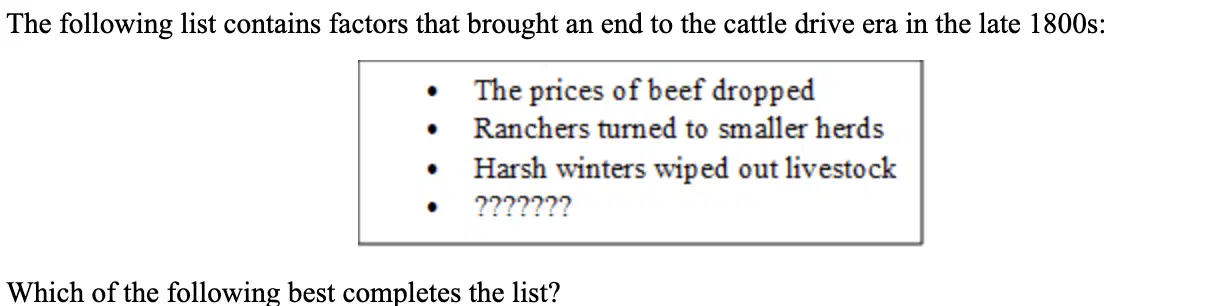
18.
a)
The U.S. government began regulating the cattle industry.
b)
Eastern slaughterhouses were shut down due to unsanitary conditions.
c)
There was a low demand for beef in the eastern cities.
d)
Ranchers fenced in their land with barbed wire.
19.
19. During the post-Reconstruction period (1877-1900), the Supreme Court declared that
a)
African Americans were beings of “inferior order”, and were not entitled to citizenship.
b)
The 15th Amendment was unconstitutional because voting rights were a state issue.
c)
Separate schools for African Americans were unconstitutional and inherently unfair.
d)
Segregation was acceptable as long as the facilities for both races were of equal quality.
20.
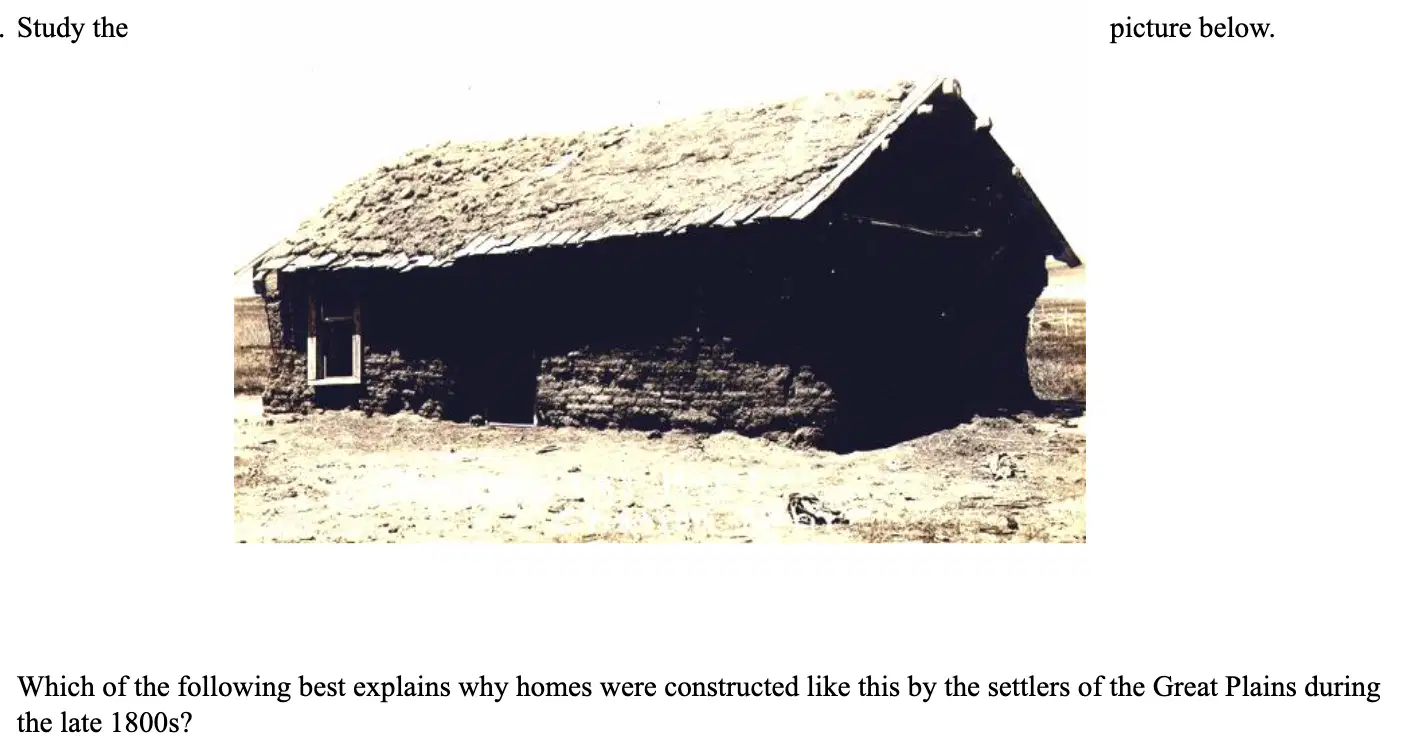
20.
a)
The Great Plains was a dry region with very few trees.
b)
Native Americans were less likely to raid these types of settlements.
c)
Settlers believed these homes could withstand harsh weather.
d)
Farmers were forced to live in poorer conditions due to economic hardships.
21.

21.
a)
Legal discrimination and the 14th Amendment
b)
Judicial review and the 5th Amendment
c)
Individual rights and the 13th Amendment
d)
States’ rights and the 10th Amendment
22.

22.
a)
Women’s suffrage became the most important part of the farmer’s movement.
b)
Farmers believed the government should encourage policies to help create deflation.
c)
Farmers endured great hardships in helping transform the Plains into the “breadbasket of the nation.”
d)
Women played a limited role in helping farmers in the Plains.
23.

23.
a)
Cattle ranching was an easy occupation in the American West.
b)
Cattle trails originated in the North to move cattle to southern Texas.
c)
Railroads played a minimum role in the cattle industry.
d)
Cattle were led north to rail towns and were then shipped east to be slaughtered for beef.
24.
24. Which of the following boomtowns emerged in western Nevada because of the Comstock Lode?
a)
Dodge City
b)
Deadwood
c)
Virginia City
d)
Sacramento
25.
25. Why did little of the free land offered by the Homestead Act end up being claimed by settlers?
a)
The land was too difficult to farm
b)
Few settlers wanted to move West at the time
c)
Most of it was taken by people seeking profits
d)
The government put too many restrictions on its use
100 %

