
 Worksheets
QUIZ 10
Total questions: 37
Worksheet time: 19mins
The duplication process of DNA is called
replication.
transcription.
translation.
nucleation.
The process by which an mRNA base sequence directs the amino acid sequence of a protein is called
replication.
transcription.
translation.
nucleation.
Which of the following is NOT an observed event in the flow of genetic information?
RNA --> DNA
DNA --> RNA
RNA --> RNA
Protein—>RNA
RNA --> Protein
In the original Central Dogma of biology, the ordinary flow of genetic information is:
DNA → RNA → Protein
RNA → DNA → Protein
Protein → RNA → DNA
DNA → Protein → RNA.
None of these
The famous Meselson and Stahl experiment showed:
DNA is replicated by a semi-conservative mechanism.
The direction of DNA synthesis proceeds 5' → 3'.
The isotope 15N is denser than 14N.
DNA replication is semi-conservative and 15N is denser than 14N.
All of these are correct.
All the following describe the general mechanism of DNA synthesis, except:
From the perspective of the DNA template strands, one strand is made 5' → 3' while the other strand is made 3' → 5'.
The strands become separated during synthesis.
Synthesis occurs in both directions from the starting site of synthesis.
Synthesis of DNA is a very accurate process.
All of these are correct.
How do origins of replication differ in eukaryotes and prokaryotes?
Eukaryotes have several origins, while prokaryotes typically have one.
Prokaryotes have several origins, while eukaryotes typically have one.
Only prokaryotes have origins of replication.
None of these.
DNA is synthesized from the 3’ end to the 5’ end in which of the following processes?
Replication of DNA
Replication of RNA
Transcription of RNA from DNA
none of these
Which of the following best describes the process of DNA replication in a prokaryote?
Replication begins at a unique site and proceeds in one direction all the way around a typically circular chromosome.
Replication begins at a unique site and proceeds in two directions, meeting about halfway around a typically circular chromosome.
Replication begins at multiple sites, spreading outward until the entire typically circular chromosome is replicated.
Replication begins at multiple sites, spreading outward until the entire typically linear chromosome is replicated.
Which of the following is not a function of DNA Polymerase III?
Polymerization.
Ligating the final products.
Proofreading.
Clamping on to the template.
None of these are functions of DNA Polymerase III
The universal features of DNA replication include all the following, except:
Release of PPi from a nucleoside triphosphate.
Synthesis from the 5' end to the 3' end.
Base pairing of A to T and G to C.
Use of a primer.
All of these describe DNA synthesis.
In E. coli,
the leading strand is synthesized in one piece while the lagging strand is synthesized discontinuously.
the leading strand is synthesized discontinuously while the lagging strand is synthesized in one piece.
both the leading and lagging strands are synthesized in one piece.
both the leading and lagging strands are synthesized discontinuously.
Which of the following activities does E. coli DNA polymerase III lack?
5' → 3' polymerase
5' → 3' exonuclease
3' → 5' exonuclease
E. coli DNA polymerase III has ALL of the above activities.
The energetic driving force for nucleic acid synthesis is
removal of pyrophosphate from the incoming nucleotide.
removal of pyrophosphate from the growing strand.
removal of inorganic phosphate from the incoming nucleotide.
removal of inorganic phosphate from the growing strand.
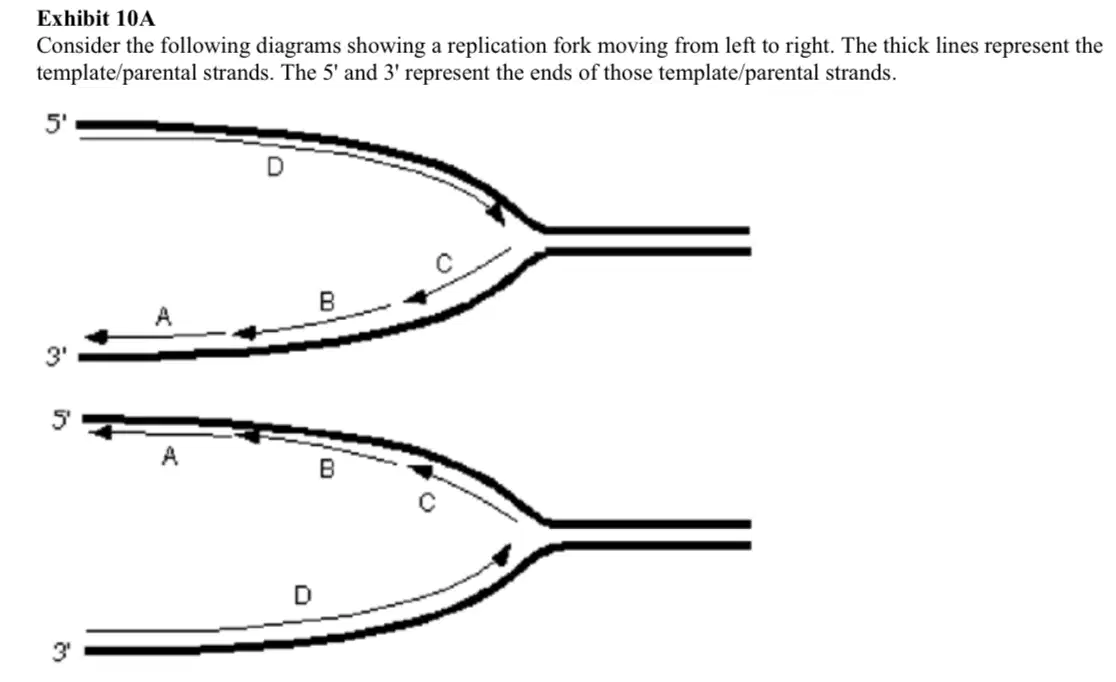
Refer to Exhibit 10A. Which Okazaki fragment was synthesized earliest?
A
B
C
D
DNA polymerase III from E. coli
is a large, multisubunit protein
has a sliding clamp portion that anchors it to DNA
has a polymerization site separate from the DNA binding site
all of these
The mechanism for all template-directed synthesis of any type of nucleic acid involves the following:
Nucleophilic attack of a 3' hydroxyl toward a nucleoside triphosphate, releasing PPi.
Nucleophilic attack of a 5' hydroxyl toward a nucleoside triphosphate, releasing PPi.
Nucleophilic attack of a 3' hydroxyl toward a nucleoside triphosphate, releasing Pi.
Nucleophilic attack of a 5' hydroxyl toward a nucleoside triphosphate, releasing Pi.
More than one of these would work, since the mechanism is not universal.
At the replisome of prokaryotic replication
there are only two DNA Polymerase III molecules
There are multiple copies of DNA Polymerase I
Two molecules of Polymerase III are dedicated to lagging strand synthesis while one is dedicated to leading strand synthesis
none of these
In the synthesis of DNA in Escherichia coli
a single-strand nick in the template DNA gives rise to a swivel point just in advance of the replication fork
Mn2+ is required
all enzymes involved are single polypeptide chains
neither the template DNA nor the daughter DNA molecules exhibit supercoiling
In Escherichia coli, the enzyme principally responsible for the synthesis of new DNA strands is
DNA polymerase I
DNA polymerase III
DNA ligase
primase
Which of the following characteristics is not associated with E. coli primase?
it synthesizes the RNA primer in DNA replication
it synthesizes a primer with a free 3'−OH end
it is essential for DNA replication
it is essential for RNA replication
Which of these proteins is used less for leading strand replication than for lagging strand replication?
DNA polymerase
DNA-binding protein
DNA ligase
DNA gyrase
Which of the activities of DNA Polymerase I is most important in its role of proofreading?
Polymerase activity.
Ability to nick intact double stranded DNA.
5' → 3' exonuclease.
3' → 5' exonuclease.
None of these is used for proofreading.
The enzyme that attaches the Okazaki fragments together is called
ligase.
primase.
DNA polymerase I
DNA polymerase III
Single strand binding proteins are important for this activity:
Prevent single-stranded DNA from rewinding.
Protect single-stranded DNA from enzymatic degradation.
Prevent double helical DNA from unwinding.
Prevent double helical DNA from becoming a triple helix.
Prevent single-stranded DNA from rewinding and protect it from degradation.
Which of the following repair mechanisms would most likely be used to repair a G in DNA damaged by oxidation?
Base Excision:
Nucleotide Excision
Pol III Proofreading
Mismatch Repair
Ultra-violet light principally causes which of the following damages to DNA?
mismatches between stands
breaks in the phosphodiester backbone of the DNA strand
thymine dimerization
methylation of specific bases
Which of the following enzymes is used to create AP sites?
primase
helicase
ligase
glycosylase
One of the most important ways in which DNA is modified after synthesis is
methylation of bases
covalent binding of proteins to the sugar moieties
splicing of RNA "leaders"
electrostatic binding of negatively charged counterions
Repair of DNA is usually carried out by
hydrolysis of the entire damaged DNA molecule and synthesis of new DNA
hydrolysis of one strand of the damaged DNA molecule and synthesis of a new strand
a cut-and patch process
introducing additional supercoiling in the molecule
How do the Okazaki fragments of eukaryotes and prokaryotes compare?
The Okazaki fragments are much longer in eukaryotes than in prokaryotes.
The Okazaki fragments are much shorter in eukaryotes than in prokaryotes.
The Okazaki fragments of eukaryotes are on the leading strand, rather than the lagging strand.
There is little to no difference between the Okazaki fragments of eukaryotes and prokaryotes.
One of the most important ways in which eukaryotic DNA differs from that of prokaryotes is
prokaryotic DNA is complexed to proteins whereas eukaryotic DNA is not
eukaryotic DNA is complexed to proteins whereas prokaryotic DNA is not
DNA synthesis in eukaryotes takes place in the opposite direction from that in prokaryotes
there is no requirement for a primer in the synthesis of eukaryotic DNA
Eukaryotes need more types of DNA polymerases than bacteria because
the DNA-containing organelles have their own DNA polymerases.
they have linear DNA , which is harder to replicate than circular DNA.
because they have more kinds of bases in their DNA than the four used by prokaryotes.
That's not true; eukaryotes do not have more types of DNA polymerases.
The DNA polymerases in eukaryotes have similar functions to those found in bacteria, but they are not identical.
True
False
Telomerase activity may decline with old age and this could explain why cells lose their ability to divide after many replications.
True
False
_____ is the enzyme that directs the synthesis of DNA on an RNA template.
Reverse transcriptase
Phosphokinase
Hydrolase
Acyl transferase
The last nucleotide added to a growing DNA chain has a _____ on the sugar.
5'-hydroxyl
5'-triphosphate
3'-hydroxyl
3'-triphosphate

