
Font size
 Worksheets
Unit 6 Protein Synthesis and Mutations Exam Review
Total questions: 70
Worksheet time: 1hrs 10mins
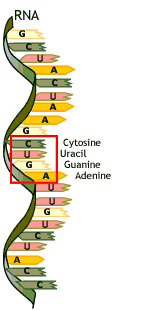
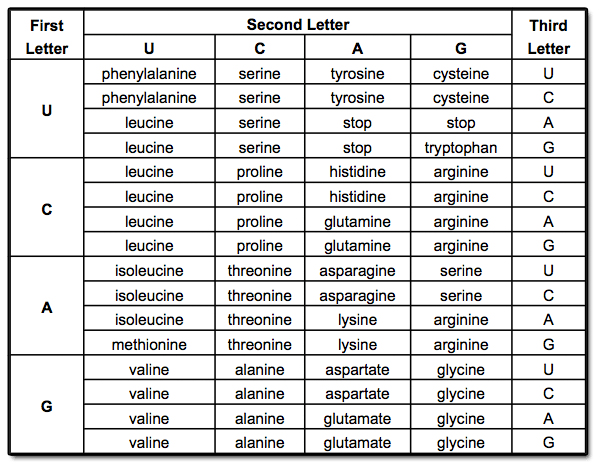
TGGCAAGTACGT
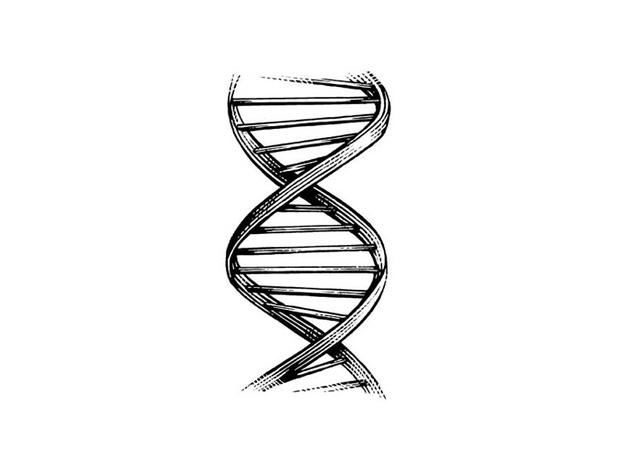
ATG GGA ACT CCA
enzyme that adds new RNA nucleotides to make mRNA
Helicase
RNA Polymerase
DNA Polymerase
Helicase Polymerase
Why must transcription occur where DNA can be found?
because DNA can't leave
because ribosomes are in the nucleus
because DNA polymerase is found there
because helicase unzips the DNA
Which of the following is a codon?

ATG
AUG
AUT
How many codons equals 1 amino acid?
1
2
3
4
How many nucleotides equal 1 amino acid?
1
2
3
4
On which molecule can an anticodon be found?
mRNA
DNA
tRNA
rRNA

Where is the anticodon located?
at the top of the molecule it's found on
at the bottom of the molecule it's found on
on the right of the molecule it's found on
on the left of the molecule it's found on
What is the purpose for anti-codons?
to ensure the correct amino acid is dropped off
to match the strand of DNA
to decode a sequence of 4 nucleotides into an amino acid
to make me hate biology

A polypeptide is a sequence of ____________________ held together by a ______________ bond.
amino acids; peptide
fatty acids; ionic
proteins; hydrogen
fatty acids; covalent
Which two thing are found on a molecule of tRNA?
amino acids; anticodons
amino acids; codons
ribose sugar; proteins
deoxyribose sugar; codons
How do you know when to begin translating a strand of mRNA?
look for AUG
start at the beginning
look for ATG
when Ms. H tells me to
How do you know when to STOP translating a strand of mRNA?
look for STOP on the decoder
stop at the end of the strand
you don't
when Ms. H tells me to
TRANSCRIBE this DNA sequence: TACGTTACT
AUGCAAUGA
ATGCAATGA
AUGGATUGA
TACGTTACT
TRANSLATE this RNA sequence: AUGCAAUGA
Met-Glu-Stop
Met-His-Stop
Thr-Glu-Stop
Thr-Pro-Stop
Which of the following units are repeatedly joined together to form a strand of DNA? (This is the MONOMER of DNA.)
amino acids
nucleotides
fatty acids
polysaccharides
Match the following terms...

mRNA

tRNA

rRNA
Proteins are important for all of the following except...
building structures like mucsles
helping the immune system
speeding up reactions
coding for your traits

In Protein Synthesis,
(a) happens first.
(b) happens last.
mRNA
carrying instructions from DNA
tRNA
carries an amino acid
rRNA
the ribsome where proteins are made
The mRNA reads CCA: what amino acid will the tRNA be carrying?

The mRNA reads UAG, what will the tRNA carry?
(a)

What is the amino acid sequence for the following mRNA strand:
UGG-ACU-CGA
Write your answer like this: ___-___-___
(a)
What is the amino acid sequence for the following mRNA strand:
AUU-AAG-UGC
Write your answer like this: ___-___-___
(a)
What is the amino acid sequence for the following mRNA strand:
CCA-GAG-UAG
Write your answer like this: ___-___-___
(a)

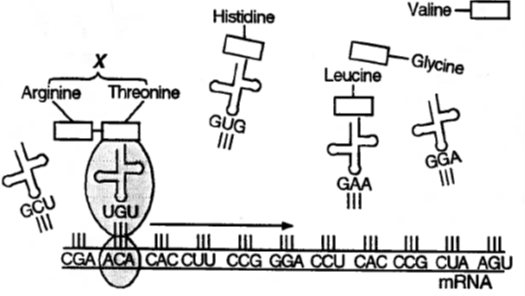
Label this image:
1= (a)
2= (b)
4= (c)
7= (d)
What mutation has occurred here?
T-G-A-C-C-A
T-G-A-G-C-A
Substitution
Deletion
Insertion
Frameshift
Which of the following would result in a frameshift mutation?
Insertions only
Substitution only
Deletion only
Insertions and Deletions
DNA molecule segment is : TTACGCAAG
The mutated DNA segment is TTCGCAAG. This is an example of ___ mutation.
Substitution
Deletion
Insertion
Inversion
A mutation is defined as:
A change in the cell's structure
Anything that changes in an embryo
Any change in the physical features of a human
A change in the DNA sequence
ATTTGAGCC- Original
ATTGAGCC - Mutated
The example above is an example of a
Insertion- Frameshift
Deletion- Substitution
Deletion -Frameshift
All of the above
What mutation has occurred here?
T-G-A-C-C-A
T-G-A-G-C-A
Substitution
Deletion
Insertion
Frameshift
Why are insertion and deletion (frameshift) mutations so harmful?
They change all of the codons from the mutation on down the line, which changes the amino acid sequence
They insert things that an organism doesn't need.
They often delete things that organisms need.
Insertion and deletions are not any more harmful than substitution mutations.
Identify the DELETION mutation form the following:
ATG CCA AAT
ATG TCA AAT
ATG CCT AAA T
ATC CA AT
ATG CCA AAT

What type of mutation involves substituting a DNA base with a different base?
point mutation
frameshift mutation
silent mutation
chromosomal mutation

What type of mutation involves substituting a DNA base with a different base but still forms the same protein?
point mutation
frameshift mutation
silent mutation
chromosomal mutation
What type of mutation involves adding or deleting bases from the DNA, which results in new codons (a shift in the reading of the codons)?
point mutation
frameshift mutation
silent mutation
chromosomal mutation
Original DNA = TAC GAC TTG AAT
Mutated DNA = TAC GAC TCG AAT
What type of mutation has occurred?
Chromosomal mutation
Point mutation
Frameshift mutation
No mutation occurred
Original DNA = TAC GAC TTG AAT
Mutated DNA = TAC GTA CTT GAA T
What type of mutation has occurred?
Chromosomal mutation
Point mutation
Frameshift mutation due to adding extra base
Frameshift mutation due to deletion of base
Original DNA = TAC GAC TTG AAT
Mutated DNA = TAC GAC TTG AAT
What type of mutation has occurred?
Chromosomal mutation
Point mutation
Frameshift mutation
No mutation occurred

What type of chromosomal mutation occurred?
chromosomal insertion/duplication
chromosomal deletion
chromosomal inversion
chromosomal translocation

What type of chromosomal mutation occurred?
chromosomal insertion/duplication
chromosomal deletion
chromosomal inversion
chromosomal translocation

What are considered "negative" mutations?
mutations in the DNA sequence that changes the resulting protein and harms the organism
mutations in the DNA sequence that changes the resulting protein and benefits the organism
mutations in the DNA sequence that produces the same protein
all mutations are considered bad and harm the organisms
What are considered "positive" mutations?
mutations in the DNA sequence that changes the resulting protein and harms the organism
mutations in the DNA sequence that changes the resulting protein and benefits the organism
mutations in the DNA sequence that produces the same protein
all mutations are considered bad and harm the organisms

What are considered neutral mutations?
mutations in the DNA sequence that changes the resulting protein and harms the organism
mutations in the DNA sequence that changes the resulting protein and benefits the organism
mutations in the DNA sequence that produces the same protein
all mutations are considered bad and harm the organisms
Mutation
a change in the DNA sequence
Point mutation
a type of mutation where one to few bases are substituted with different bases
Frameshift mutation
a type of mutation caused by adding or deleting bases, affecting all the codons after the change
Silent mutation
a type of mutation that doesn't result in a change in the amino acid sequence (same protein)
Chromosomal mutation
a type of mutation where large sections of the chromosome are affected
If the original amino acids produced were Gly, Ser, His and the amino acids produced from the mutated DNA were Gly, Glu, His this would be a
silent mutation
missense mutation
nonsense mutation
frameshift mutation
If the original amino acids produced were Gly, Ser, His and the amino acids produced from the mutated DNA were Gly, Glu, stop this would be a
silent mutation
missense mutation
nonsense mutation
chromosomal mutation


