
 Worksheets
arterial: duplex imaging
Total questions: 192
Worksheet time: 2hrs 57mins
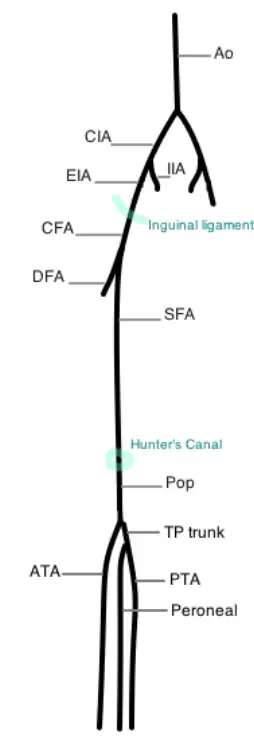
What does the Aorta terminate into at the branches of Common Iliac?
CIA (Common Iliac Artery)
Femoral Artery
Renal Artery
Subclavian Artery
during an organ transplant the TRAM flap( transverse rectus abdominus myocutnaeous flap) , the epigastric artery and _______ are harvested to reconstruct the breast
section of tissue in anterior abdomen
section of tissue in posterior thigh
section of tissue in lateral abomen
section of tissue in anterior thigh
during a properative mapping, _____ artery is used as a coronary artery bypass graft or hemodylasis access. must perform allen test to eval patency of planar arch. must have normal Doppler signals free of abnormalies and atleast 2mm
A. radial
B. ulnar
C. brachial
A and C
What is a common complication of an arteriovenous fistula that is close to the heart and large?
Increased risk of stroke
Increased risk of CHF (Congestive Heart Failure)
Increased risk of hypertension
Increased risk of diabetes
What is an arteriovenous fistula?
A communication between artery and vein
A blockage in the vein
A narrowing of the artery
A rupture in the capillary
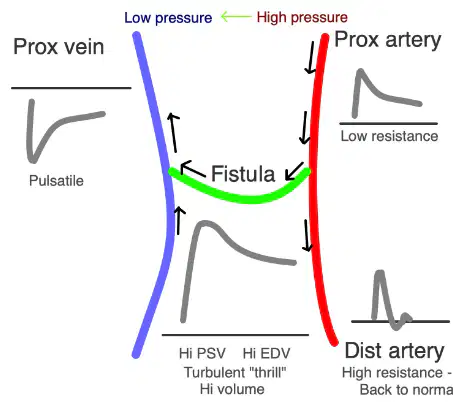
What is the hemodynamic characteristic of a proximal artery to an arteriovenous fistula (AVF)?
Decreased diastolic flow
Increased diastolic flow
Normal diastolic flow
Turbulent low velocity
What is the hemodynamic characteristic of a distal artery to an arteriovenous fistula (AVF)?
Decreased diastolic flow
Increased diastolic flow
Normal diastolic flow
Turbulent low velocity
What is the hemodynamic characteristic the fistula in an arteriovenous fistula (AVF)?
Decreased diastolic flow
Increased diastolic flow
Normal diastolic flow
Turbulent low velocity
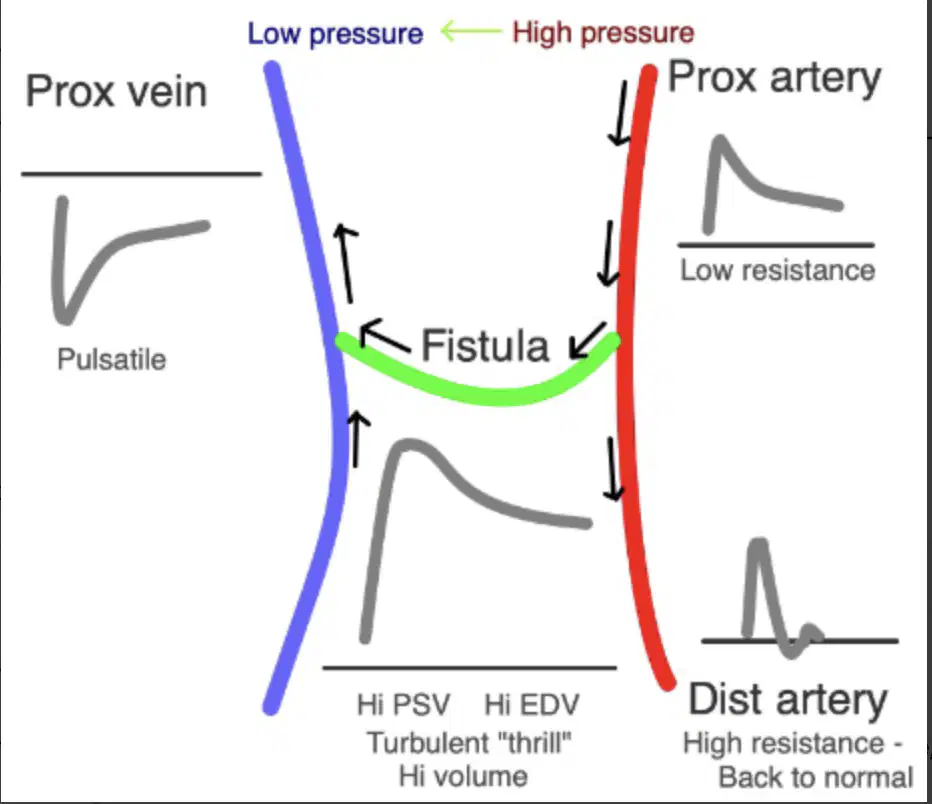
What is the hemodynamic characteristic of the proximal vein in an arteriovenous fistula (AVF)?
Decreased diastolic flow
Increased diastolic flow
Normal diastolic flow
Turbulent low velocity
pulsatile
Which artery is used as a recipient site for TRAM flap in breast reconstruction?
Epigastric artery
Internal mammary artery
Radial artery
Femoral artery
_____ are the superficial veins are used in grafts for bypass (coronary/arterial or hemodialysis), the diameter should also be at a minimum of 2mm
Only GSV, SSV, cephalic, or basilic
Only femoral and jugular veins
Only hepatic and portal veins
Only renal and iliac veins
Normal transplants should have normal organ flow patterns, which is characterized by ______ resistance in the artery.
low
high
variable
moderate
how would you know if there is liver transplant rejection
pv thrombosis
hepatofugal flow
hepatopetal flow
low RI hepatic artery
high RI hepatic artery
how would you know if there is renal transplant rejection
Low RI renal artery
high RI renal artery
renal vein thrombosis
monophasic or low resistive waveform
What is a sign of rejection in organ transplants according to the interpretation section?
Feeding artery HIGH resistance (decrease or loss of EDV)
Increased hepatopedal flow
increase organ size
thrombosis of vein
altered echogenicity and fluid
Which arteries are assessed in the technique for kidney perfusion?
Segmental artery
Interlobar artery
Arcuate artery
All of the above
What is the renal disease that affects kidney perfusion?
Kidney stones
Nephrosclerosis
Glomerulonephritis
Pyelonephritis
What symptom is NOT associated with anterior compartment syndrome?
Paresthesia
Muscle weakness
Increased arterial perfusion
Foot drop
What is the result of blunt force or penetrating trauma in terms of vascular injury?
Intimal injury(flap) leading to dissection and thrombosis
Immediate healing of the vessel
Decreased risk of arterial occlusion
Increased blood flow
What is the treatment for compartment syndromes?
Fasciotomy
Angioplasty
Bypass surgery
Thrombectomy
swelling within fascial compartments causing compression and increased pressure to capillary vascular beds. tibial artery is compressed.
compartment syndromes
trauma
avf
graft
Fill in the blank: Normal kidney perfusion is indicated by low resistance, EDR end diastolic ratio > ____, and RI (Poucelot’s resistivity index) < 0.7.
0.2
0.5
0.7
1.0
Increased resistance in kidney perfusion is associated with nephrosclerosis.
True
False
Which vessels are referred to as 'splanchnic vessels' in the technique for mesenteric ischemia?
Renal artery
Celiac, SMA, IMA
Femoral artery
Pulmonary artery
what are some symptoms of mesenteric ischemia?
abdominal pain 15-30mins after eating
cramping 15-30mins after eating
malnourished
underweight
all of the above
what is the proper technique for a mesenteric ischemic duplex exam ?
high frequency curvilinear (5-6MHz)
fasting
prandial
post prandial
high frequency linear (5-6MHz)
Match the following waveform characteristics with the correct vessel:
Celiac - Low resistance, High EDV
Celiac - Low resistance, High EDV
SMA - Fasting: High resistance, Low EDV; Post-prandial: Low resistance, Increased/doubled EDV
SMA - Fasting: High resistance, Low EDV;

IMA - Not easily seen; if imaged and hig
What is the PSV (Peak Systolic Velocity) threshold for the celiac artery indicating abnormality?
≥100cm/s
≥200cm/s
≥275cm/s
≥70cm/s
What is the PSV (Peak Systolic Velocity) threshold for the SMA indicating abnormality?
≥100cm/s
≥200cm/s
≥275cm/s
≥70cm/s
Fill in the blank: 2 out of 3 abnormal findings in waveform interpretation indicate ________ Mesenteric Ischemia.
Chronic
Acute
Transient
Reversible
Celiac band syndrome
MOST COMMON: young athletic women
only compressed during EXPIRATION, normalizing w/ inspiration.
due to compression of celiac by median arcuate ligament of the diaphragm
True
False
Which vessels are involved in liver and renal organ transplant techniques?
A) Hepatic artery, portal vein, hepatic veins for liver; Renal artery and vein for renal
B) Femoral artery for liver; Jugular vein for renal
C) Hepatic artery for renal; Portal vein for liver
D) Renal artery for liver; Hepatic vein for renal
low resistance in kidney perfusion is associated with nephrosclerosis.
true
false
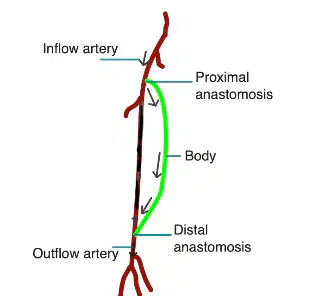
match the proper areas that should be evaluated in a bypass graft
which of these areas should NOT be evaluated during a bypass graft duplex study
inflow/outflow artery
proximal anastamosis
graft body
distal anastomosis
native. veing proximal to native artery
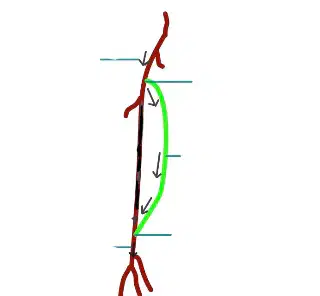
Which of the following is NOT an important area to be evaluated in a bypass graft?
inflow artery
proximal anastomosis
graft body
distal anastomosis
pulmonary vein
Fill in the blank: The technique for a bypass graft involves connecting artery to artery to reroute blood flow in presence of significant extensive arterial _________.
obstruction
dilation
infection
calcification
Which type of arterial bypass graft uses PTFE and requires evaluation of anastomosis sites for possible leakage?
Synthetic
In situ saphenous vein graft
Reversed saphenous vein graft
In situ saphenous vein graft (autologous) requires the vein to be removed from the venous system and flipped upside down.
true
false
Fill in the blank: In reversed saphenous vein graft (autologous), the vein is removed and ______ upside down.
flipped
twisted
stretched
compressed
Match the following types of arterial bypass grafts with their key evaluation concern:
anastamosis sites for possible leakage
synthetic
body due to risk of AVF from branches or stenosis from residual valves
in situ saphenous vein graft
prox anastomosis due to small size
Reversed saphenous vein graft
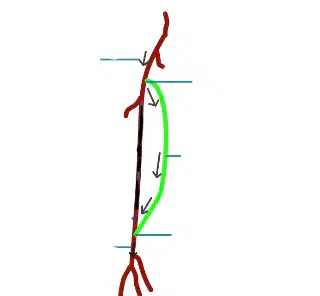
all successful bypasses must start ______ , _______ and end ____
above disease(patent flow)
1
patent conduit (graft)
2
after any disease (patent outflow)
3
the capabilities and limitations of duplex lower extremities include evaluation of location & severity of _____
stenosis
occlusion
%DR
aneursym
bypass graft & stent surveillance
_______ is included for a duplex of the lower extremities.
native arteries
prox arteries
distal arteries
mid arteries
B-mode, color, dopppler
in regards to duplex lower extremities, one of its techniques is a
_____ graft : connect artery to artery to reroute blood Flow in presence of significant extensive arterial obstruction.
fistula
stent
anastamosis
bypass
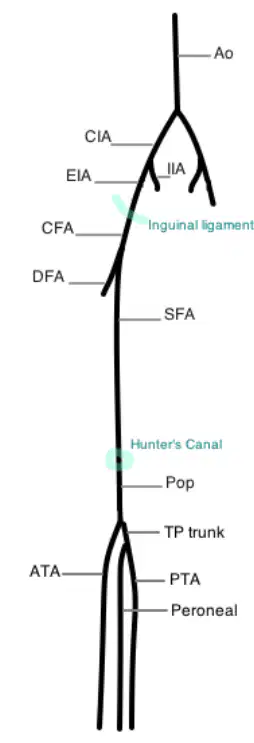
Which artery provides blood to the lower extremities and terminates at the inguinal ligament?
EIA (External Iliac Artery)
CIA (Common Iliac Artery)
SFA (Superficial Femoral Artery)
PFA (Profunda Femoris Artery)
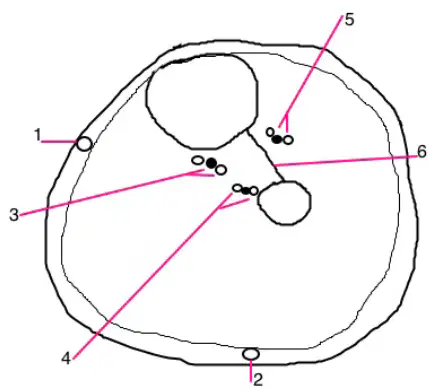
In the cross-section diagram, what does label 1 represent?
GSV (Great Saphenous Vein)
Femoral Artery
Popliteal Vein
Tibial Nerve
What does 'Anterior' mean in relational anatomy?
A) Closer to the back
B) Closer to the front of body AKA superficial
C) Towards the feet
D) Towards the head
What does 'Posterior' mean in relational anatomy?
Closer to the back AKA deep
Closer to the front of body
Towards the head
Towards the feet
What does 'Superior' mean in relational anatomy?
Towards the feet
Closer to the middle
Towards the head AKA Cephalad
Closer to the side
in regards of abnormal findings in a fistula graft, Perigraft fluid is a sign of ______, with clinical signs including red, warm, and tender.
infection
ischemia
thrombosis
hematoma
In regards of abnormal findings in a fistula graft, Steal syndrome is defined as reversal of flow in the ______ artery.
distal
radial
ulnar
brachial
What does 'Inferior' mean in relational anatomy?
Towards the feet AKA Caudal
Closer to the heart
Closer to the back
Towards the head
What does 'Medial' mean in relational anatomy?
Closer to the middle
Closer to the side
Closer to the heart
Away from the heart
What does 'Lateral' mean in relational anatomy?
A) Closer to the middle
B) Towards the side
C) Towards the feet
D) Closer to the heart
What does 'Proximal' mean in relational anatomy?
Closer to the heart, flow comes from
Away from the heart, flows goes to
Towards the feet
Closer to the back
What does 'Distal' mean in relational anatomy?
Closer to the heart, flow comes from
Away from the heart, flows goes to
Towards the head
Closer to the middle

What is the sequence of blood flow in the vascular system?
Arteries >> Arterioles >> Capillaries >> Venules >> Veins
Veins >> Venules >> Capillaries >> Arterioles >> Arteries
Capillaries >> Arterioles >> Arteries >> Veins >> Venules
Venules >> Veins >> Arteries >> Arterioles >> Capillaries

Which vessels are known as the smallest arteries and are vessels of resistance?
Arterioles
Venules
Capillaries
Aorta
The scanning plane for aorta must be along axis or perpendicular to aorta, and outer to outer measurement equals true lumen.
True
False

What is the most vital part of the circulatory system?
Heart
Arteries
Veins
Capillaries
Hemodialysis Access Graft is also known as Surgical AVF (fistula graft).
True
False
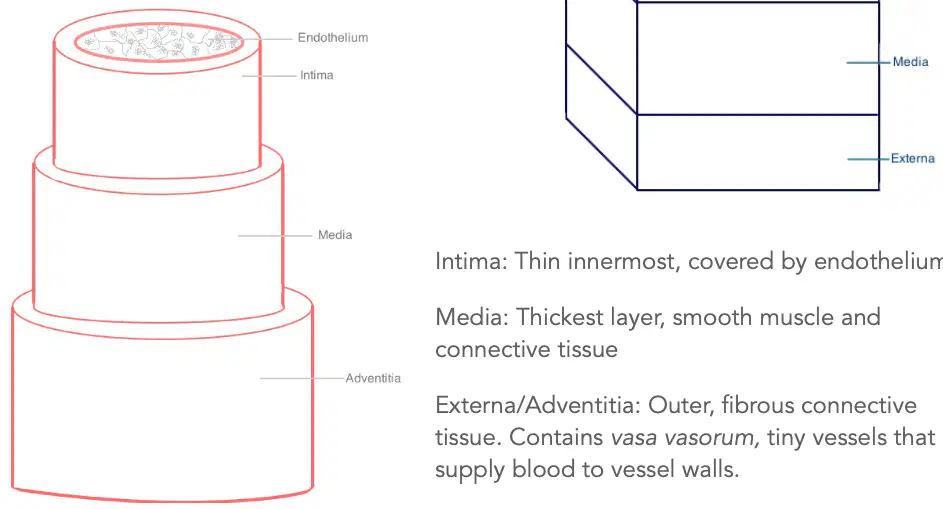
The structure of the intima layer in blood vessels is described as:
A single layer of endothelial cells
Multiple layers of smooth muscle cells
A thick layer of connective tissue
A layer of nerve fibers
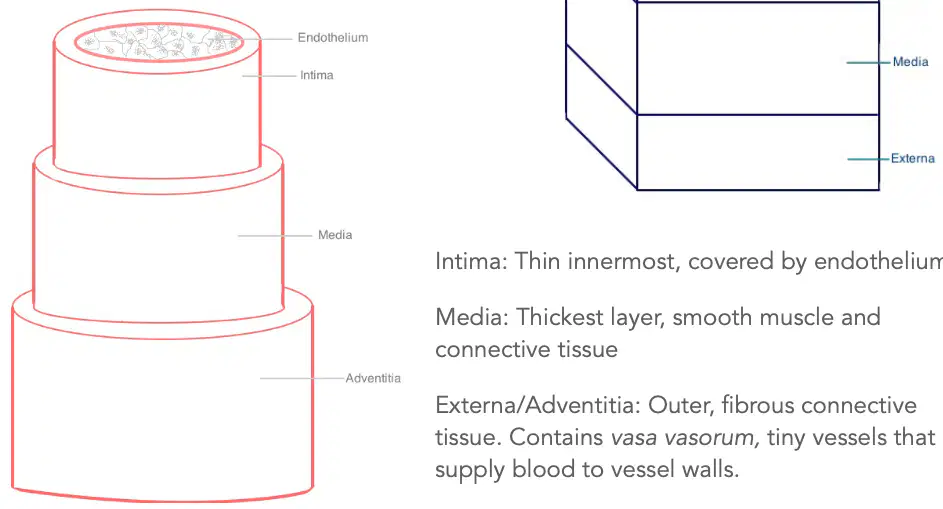
The function of the vasa vasorum is to:
supply blood to the walls of large blood vessels
transport oxygen to the brain
regulate blood pressure
filter waste from the blood
What is one of the capabilities of duplex upper extremities?
hemodialysis access graft surveillance
localize stenosis
localize occlusion
localize anuerysm
Retrograde flow in native artery at distal anastomosis is NORMAL.
true
false
What are the capabilities and limitations of Duplex Upper Extremities?
Localize stenosis/occlusion/aneurysm
Hemodialysis access graft surveillance
Both A and B
None of the above
An aneurysm is defined as an increase in diameter greater than ____%. peripherally most likely seen in pop.
50
25
75
100
Pseudoaneurysm is most likely to occur post procedure. What must be documented?
Connecting channel or neck
Diameter reduction
Platelet aggregation
None of the above
to and fro flow (bidirectional)
Fill in the blank: Dissection is identified by visualization of ______ flap in the aorta.
intimal
adventitial
muscular
serosal
(hypertension)
Which of the following is the correct order for the clinical progression of renal artery stenosis?
Renal artery stenosis > renin > renal ischemia > angiotensinogen > angiotensin
Renal artery stenosis > renal ischemia > renin > angiotensinogen > angiotensin
Renal artery stenosis > angiotensinogen > renin > renal ischemia > angiotensin
Renal artery stenosis > angiotensin > renin > renal ischemia > angiotensinogen
which arteries should be interogated during a renal duplex exam?
aorta
ivc
renal artery
prox , mid, list, renal artery
segmental arteries
f the aorta velocity is <40cm/s or >90cm/s, can you use Renal/Aorta ratio (RAR) for diagnosis?
yes
no
Fill in the blank: Renal/Aorta ratio ≥ ______ is considered ≥60% diameter reduction (DR).
3.5
2.0
4.0
2.5

Tardus Parvus distally is indicative of segmental artery disease.
True
False
Intraoperative US (12-15MHz): Which of the following is NOT a main focus during intraoperative ultrasound?
A) Patency of anastomosis sites
B) Intimal flaps
C) Platelet aggregation
D) Blood pressure measurement
Intraoperative US (12-15MHz): Which of the following IS a main focus during intraoperative ultrasound?
A) Patency of anastomosis sites
B) Intimal flaps
C) Platelet aggregation
D) Blood pressure measurement
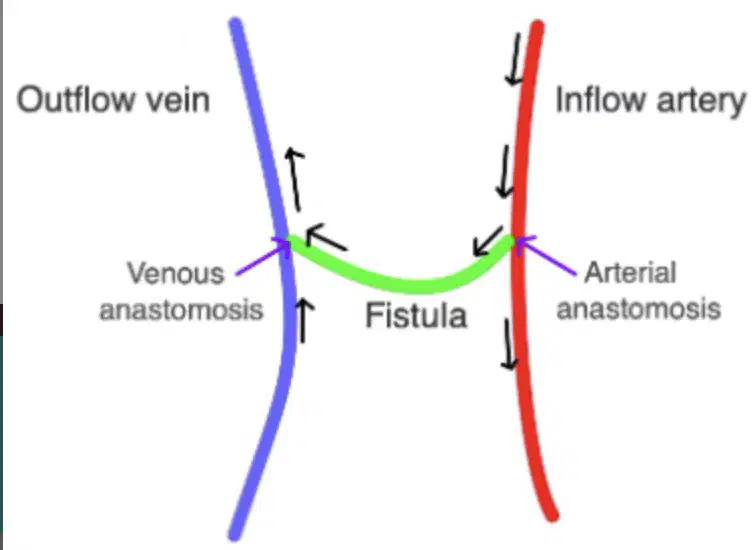
what is the proper technique for a duplex graft/fistula?
A. 7-9Mhz linear array transducer
B. arm extended laterally & 45degr. to body = pledge body
C. check for thrill = high velocity = patent hemo access
A and B
all of these
What is the recommended transducer frequency for abdominal imaging in patients with deeper or large body habitus?
3-5 MHz
7-10 MHz
1-2 MHz
10-15 MHz
Fill in the blank: In abdominal imaging, superficial/thinner patients require ______ frequency transducers compared to deeper/large body habitus.
higher
lower
equal
variable
What is the connection between in a hemodialysis access graft?
Connection between artery and vein
Connection between two veins
Connection between two arteries
Connection between artery and capillary
Fill in the blank: The connection between artery and vein in a hemodialysis access graft allows for greater _______ flow as needed with hemodialysis.
volume
pressure
oxygen
nutrient
What type of hemodialysis access graft is described as 'Brescia-Cimino. Radial a to Cephalic v'?
Autologous
Synthetic
Temporary
Permanent
Which of the following is an autologous type of hemodialysis access graft?
A. Brescia-Cimino (Radial a to Cephalic v)
B. Synthetic (straight or looped)
Both A and B
None of the above
In the technique for duplex upper extremities, what position should the arm be extended to?
45 deg to body = pledge position
90 deg to body = T position
180 deg to body = straight position
0 deg to body = resting position
What is the normal resistance pattern for native arteries?
Triphasic or biphasic
Monophasic
Quadriphasic
Flatline
Which of the following is a sign of graft or preocclusion occlusion?
Low resistance in prox artery
Thumping high resistance in prox artery
Low velocity dampened, continuous flow
Focal elevated velocity
What does focal elevated velocity indicate in a fistula graft?
Graft stenosis
Normal flow
Infection
Thrombosis
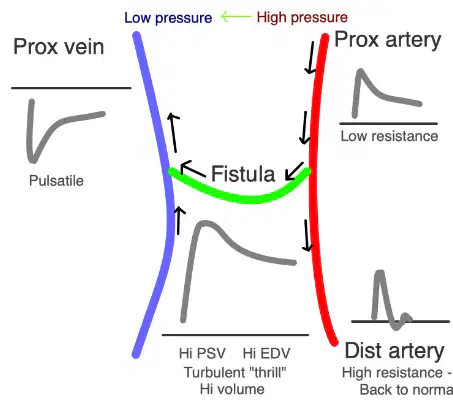
The normal flow in a graft is described as:
a continuous and unobstructed flow of blood through the graft.
an intermittent flow with occasional blockages.
a reverse flow from the graft to the artery.
a turbulent flow causing vibrations in the graft.
What is steal syndrome in the context of fistula grafts?
Reversal of flow in the distal artery
Increased blood flow to the distal artery
Blockage in the fistula graft
Infection at the graft site
Fill in the blank: All successful bypasses must start above disease (patent inflow), have a patent conduit (graft), and end after any disease (patent ________).
outflow
inflow
conduit
artery
Which of the following is a type of arterial bypass graft?
Synthetic
In situ saphenous vein graft
Reversed saphenous vein graft
All of the above
In a reversed saphenous vein graft, why are valves kept in place?
To prevent leakage
To allow blood to move in the right direction
To increase blood pressure
To reduce stenosis
What is the normal waveform pattern in vascular interpretation?
Normal - triphasic or biphasic.
Abnormal - monophasic.
Normal - quadriphasic.
Abnormal - biphasic.
Fill in the blank: Native arteries with normal high resistance are described as ______ or biphasic.
triphasic
monophasic
quadriphasic
polyphasic
According to the stenosis velocity criteria, what is the diameter reduction for a 2:1 ratio?
≥50% diameter reduction, PSV doubles at stenosis
<50% diameter reduction, PSV quadruples at stenosis
≥70% diameter reduction
No diameter reduction
≥75% diameter reduction, PSV quadruples at stenosis
What is the minimum diameter for an abdominal aortic aneurysm (AAA) according to the interpretation criteria?
>2cm
>3cm
>4cm
>5cm
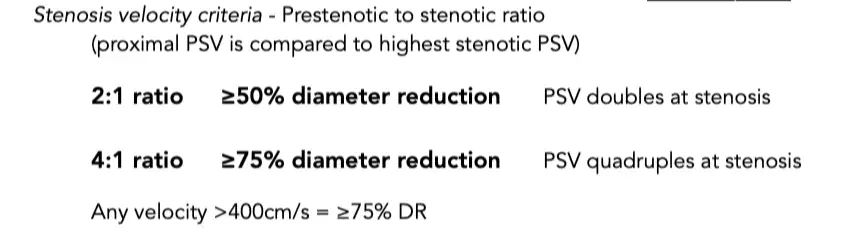
This criteria applies to both NATIVE arteries and ________.
BYPASSES
VEINS
CAPILLARIES
VALVES
According to the stenosis velocity criteria, what is the diameter reduction for a 4:1 ratio?
≥50% diameter reduction, PSV doubles at stenosis
<50% diameter reduction, PSV quadruples at stenosis
≥70% diameter reduction
No diameter reduction
≥75% diameter reduction, PSV quadruples at stenosis
Which of the following is NOT a criteria for stenosis in native arteries?
Velocity criteria
Qualitative profile
Knowledge of normal vs obstructive waveform contours
Focally elevated VEL and PST
What is the significance of a velocity greater than 400cm/s in stenosis velocity criteria?
≥75% diameter reduction
<50% diameter reduction
50-69% diameter reduction
70-99% diameter reduction
Any velocity greater than ____ cm/s is considered to be ≥75% diameter reduction (DR).
400
200
300
500
Additional bypass surveillance criteria: Which of the following is NOT a change to look for from past study?
Decrease of 30cm/s in the same graft segment
Increase in ABI >0.15
Change or deterioration in waveform quality
Decrease in ABI >0.15
Additional bypass surveillance criteria: Which of the following IS a change to look for from past study?
Answer choices
Decrease of 30cm/s in the same graft segment
Increase in ABI >0.15
Change or deterioration in waveform quality
Decrease in ABI >0.15
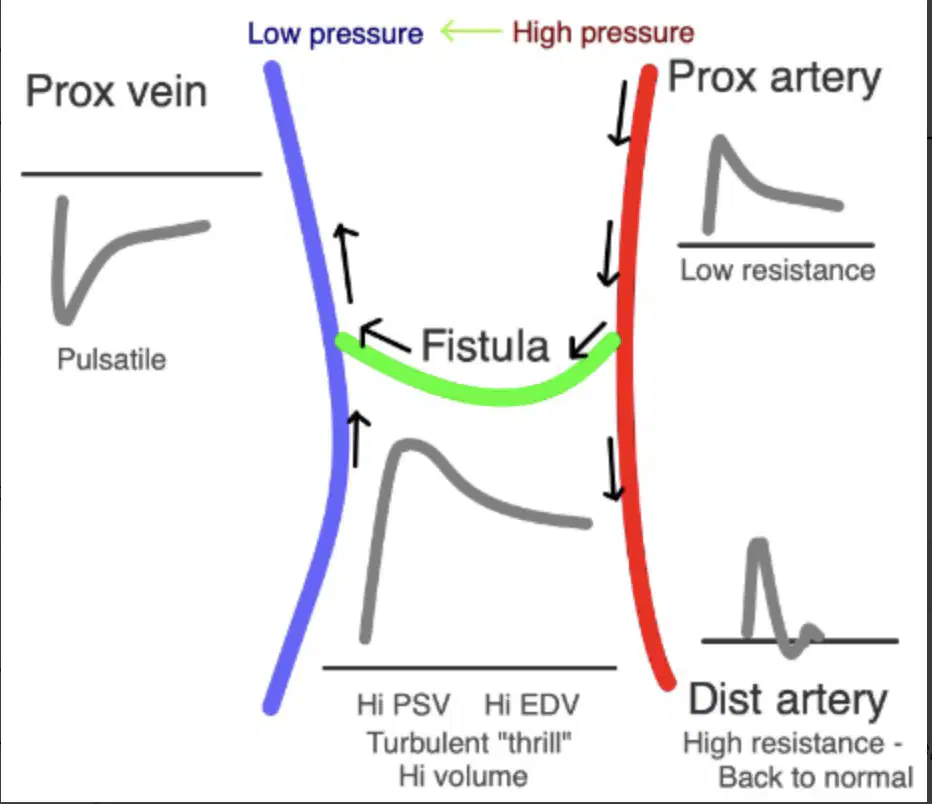
According to the normal hemodialysis waveforms in a fistula/graft a prox vein(outflow) will have ____
pulsatile flow
triphasic flow
high resistance flow
variable flow
T/F
normal flow in graft is high velocity & turbeulent
true
false
Match the abnormal findings for fistula graft
Thumping high resistance in prox artery or graft
graft occlusion
Focal elevated velocity
graft stenosis:mostly loc. outflow vein
Low velocity dampened, continuous flow
proximal inflow problem
Which of the following is an abnormal finding for a fistula graft?
Thumping high resistance in prox artery or graft
Low velocity dampened, continuous flow
Focal elevated velocity
All of the above
List one additional bypass surveillance criterion.
Criterion A
Criterion B
Criterion C
Criterion D
The main focus of intraoperative ultrasound (12-15MHz) is:
diagnosing heart conditions
guiding surgical procedures
monitoring fetal development
detecting bone fractures
What is the condition associated with abdominal aortic aneurysm or aortoiliac stenosis?
Abdominal aortic aneurysm / aortoiliac stenosis
Hypertension
Coronary artery disease
Peripheral artery disease
Which of the following is a technique for scanning the aorta?
Measure in transverse view
Measure in sagittal view
Measure in coronal view
Measure in oblique view
What is the clinical significance of renal artery stenosis?
Hypertension
Diabetes
Asthma
Arthritis
What is the interpretation if the Renal/Aorta ratio is greater than or equal to 3.5?
≥60% DR
<30% DR
40-50% DR
No significant DR
The significance of Tardus Parvus distally in renal artery interpretation is:
It indicates proximal renal artery stenosis.
It suggests normal renal artery function.
It shows increased blood flow velocity.
It implies distal renal artery occlusion.
Which arteries are involved in the technique for kidney perfusion?
Segmental artery, Interlobar artery, Arcuate artery
Renal artery, Hepatic artery, Splenic artery
Coronary artery, Pulmonary artery, Aorta
Femoral artery, Brachial artery, Radial artery
Which of the following is an indication for Duplex Abdomen?
Abdominal aortic aneurysm / aortoiliac stenosis
Renal artery stenosis and kidney perfusion
Mesenteric ischemia
Organ transplants
Pulmonary embolism
Which of the following is NOT an indication for Duplex Abdomen?
Abdominal aortic aneurysm / aortoiliac stenosis
Renal artery stenosis and kidney perfusion
Mesenteric ischemia
Organ transplants
Pulmonary embolism
What is the EDR end diastolic ratio for normal kidney perfusion?
Greater than 0.2
Less than 0.2
Equal to 0.2
Approximately 0.5
What clinical symptoms are associated with mesenteric ischemia?
Abdominal pain and cramping 15-30 min after eating, malnourished, underweight
Frequent headaches and dizziness
Joint pain and swelling
Skin rashes and itching
What is the condition called when there is compression of the celiac by the median arcuate ligament of the diaphragm?
Celiac band syndrome
Irritable bowel syndrome
Peptic ulcer disease
Gastroesophageal reflux disease
What are the vessels involved in liver organ transplants?
Hepatic artery, portal vein, hepatic veins
Renal artery, renal vein, ureter
Coronary artery, aorta, vena cava
Pulmonary artery, pulmonary vein, trachea
Which artery is used in the TRAM flap for breast reconstruction?
Epigastric artery
Femoral artery
Brachial artery
Carotid artery
What is the minimum diameter required for the internal mammary artery when used as a recipient site for TRAM flap?
2mm
1mm
3mm
4mm
Which test must be performed to evaluate the patency of the palmar arch before using the radial artery for coronary artery bypass graft?
Modified Allen test
Doppler ultrasound
Ankle-brachial index
Treadmill test
What are the superficial veins used in grafts for bypass?
GSV, SSV, cephalic, or basilic
Femoral, popliteal, or tibial
Radial, ulnar, or brachial
Iliac, renal, or hepatic
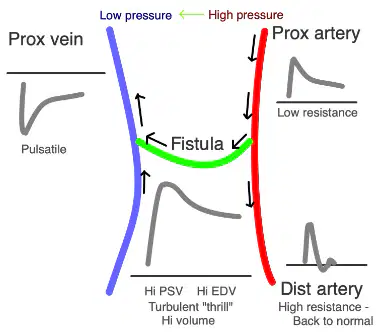
What is an arteriovenous fistula?
A communication between artery and vein
A type of heart disease
A form of cancer
A type of blood clot
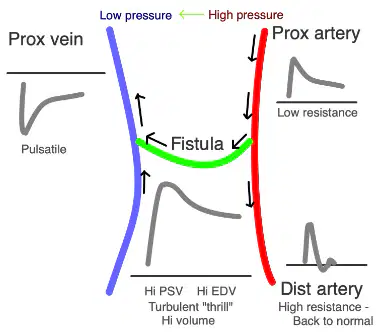
Fill in the blank: Proximal artery to AVF results in ______ diastolic flow.
Increased
Decreased
Unchanged
Variable
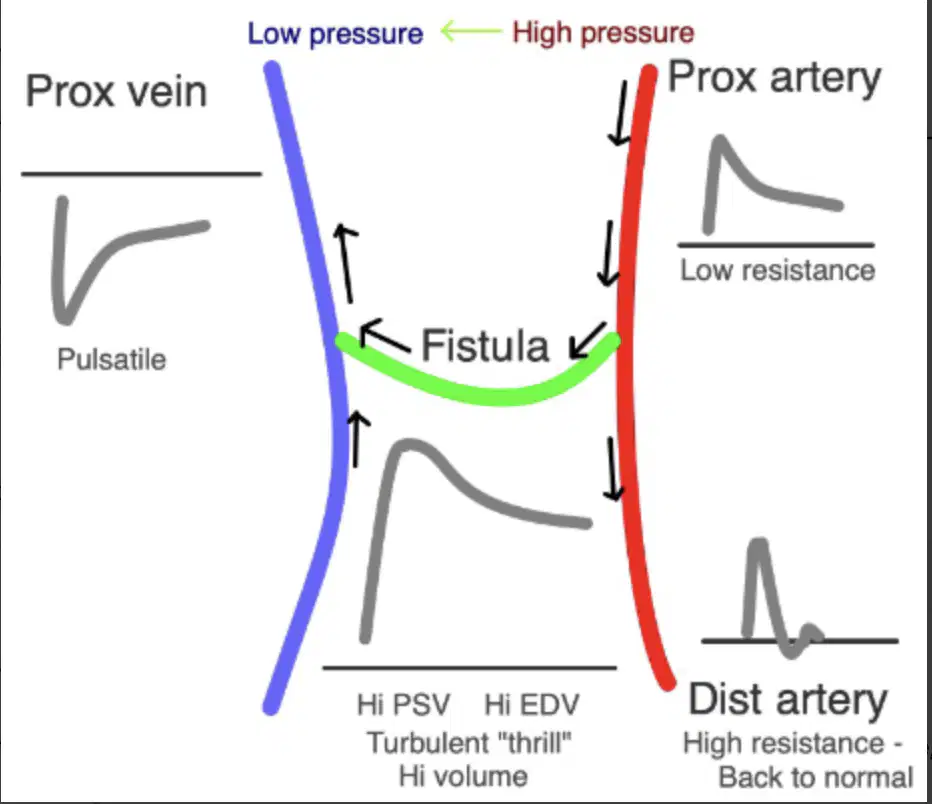
Fill in the blank: distal artery goes back to____ resistance during normal hemodialysis waveform
high
low
variable
pulsatile
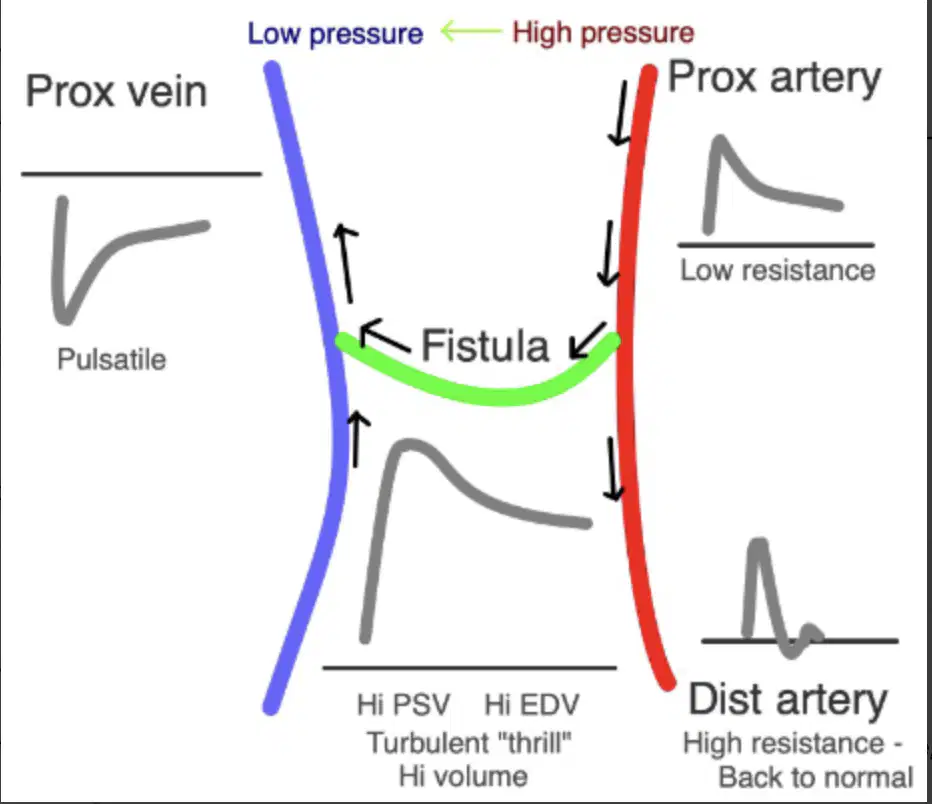
Fill in the blank: the fistula part of a normal hemodialysis waveform is ____ resistance/or _____ PSV ____ EDV
Low
variable
pulsatile
high
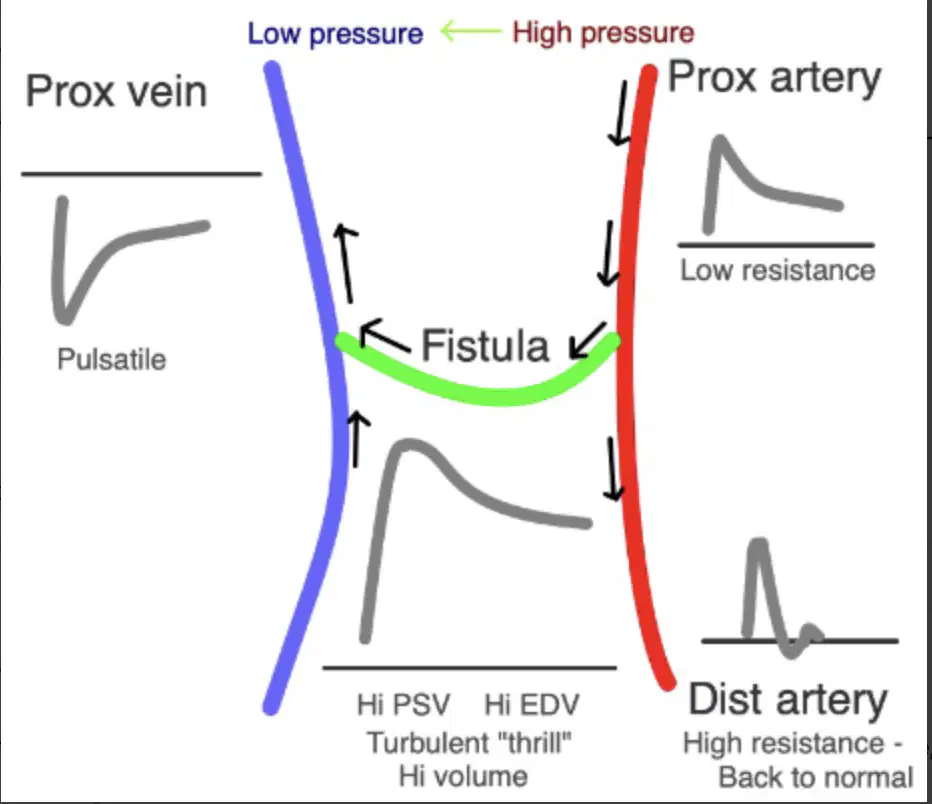
Fill in the blank: In a normal hemodialysis waveform, the fistula has low resistance, high PSV, and high ______.
EDV
MAP
CVP
SVR
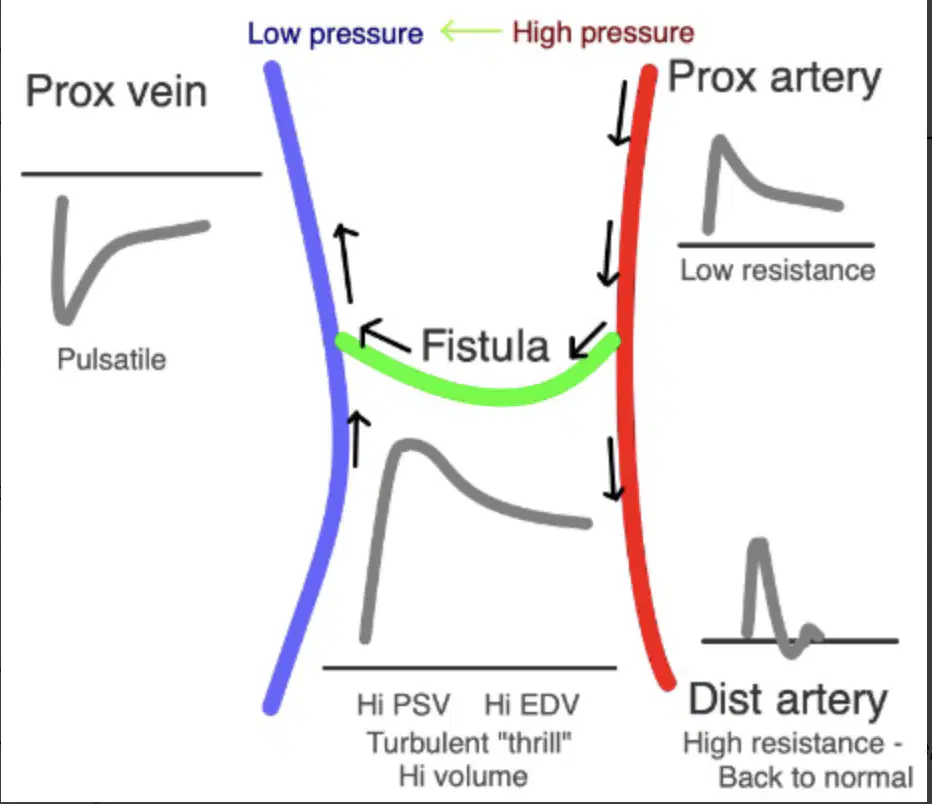
Fill in the blank: Proximal artery (inflow) in normal hemodialysis waveform has ______ resistance and increased EDV.
low
high
moderate
variable
Duplex upper extremities uses PW doppler. What does PW stand for in this context?
Pulsed Wave
Power Wave
Phase Wave
Pressure Wave
What is the treatment for compartment syndromes?
Medication
Surgery
Faciotomy
Physical therapy
T/F
the measurements should be perpendicular to the aorta
true
false

this is an image of
aortic aneurysm
thrombus
aortic aneurysm w/ thrombus
atherosclerosis

what occurs when there is a smaller lumen?
higher velocity & more thrombus
low velocity & more thrombus
higher velocity & less thrombus
low velocity & small thrombus

what occurs when there is a larger lumen?
higher velocity & more thrombus
low velocity & more thrombus
higher velocity & less thrombus
low velocity & less thrombus
a reverse saphenous vein graft is attached to the artery how?
ligation/removal of branches
1
reversed before anastomosis
2
small end of vein - prox artery
large end of vein to dist artery
3
once vein is connected vein dilates equally
4
valves remain in place since flow is going that direction
5
in-situ vein graft of the GSV consist of
removal of the valves and branches
only branches are removed
only valves are removed
neither are removed/ligated
where should you evaluate a PTFE aka synthetic graft?
proximal anastamosis only
distal anastamosis only
mid graft only
both anastamotic sites due to possible creation of pseudoanerusyms

the ultrasonic image is representing what?
proximal anastamosis pseudoaneurysm of bypass graft aka anastomotic aneurysm
distal anastamosis pseudoaneurysm of bypass graft aka anastomotic aneurysm
mid bypass graft pseudoaneurysm
none of these
what place within the graft should be evaluated in a in-situ bypass graft due to risk of AVF
patent branches
valve residuels creating obstruction
prox anastamosis
distal anastamosis
Match the following

long stenosis: ^ turbulent , 100cm/s-300

veloc. quadrupled: >75% or equal to sten

>50%hemodynamic signif. stenosis,Postste

rounded peak, prox disease , tardus parv

abn 265cm/s, no spec broad:smooth steno
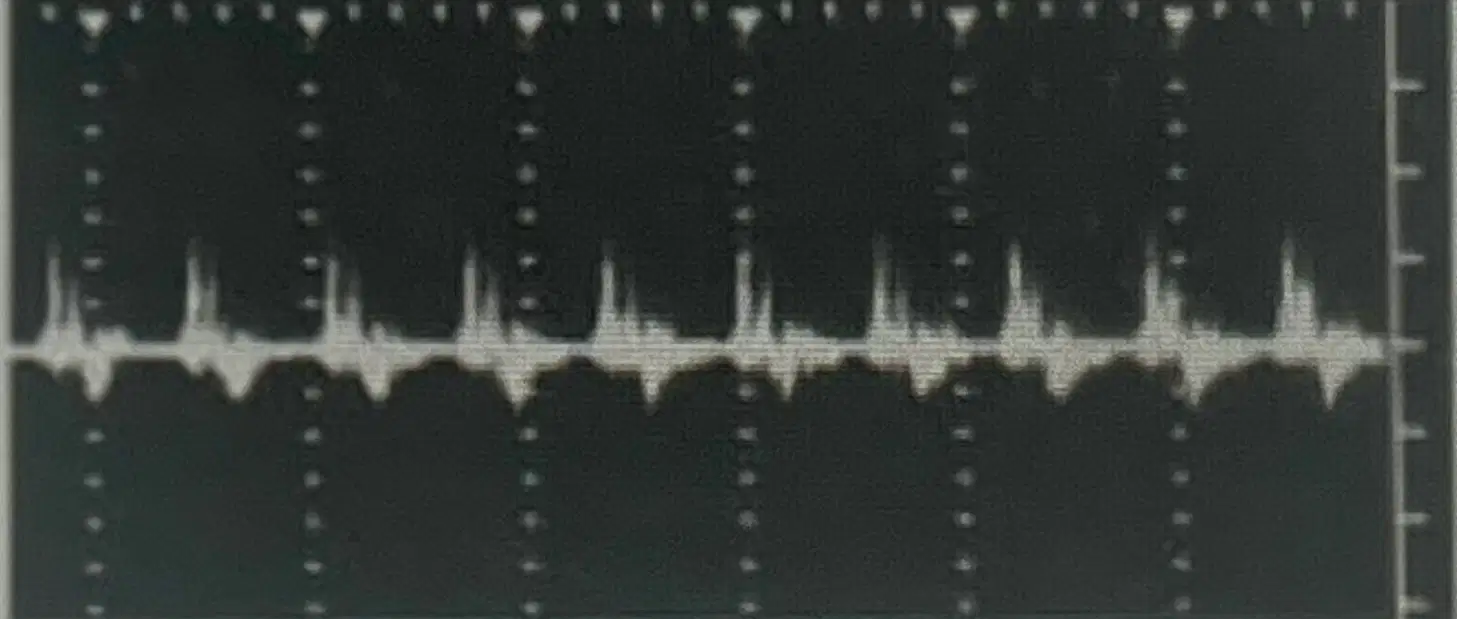
this image represents
proximal to an occlusion
distal to an occlusion
at occluson
proximal to mild stenosis

an increase in velocity from prestenosis to the actual stenosis area of >100% suggest a ratio of
2.1 or ≥ 50% diameter reduction
4:1 ratio or ≥ 75% diameter reduction
>400cm/s = 75% diameter reduction
none of these

an increase in velocity from prestenosis to the actual stenosis area of ≥ 400% suggest a
2:1 ratio or ≥50% diameter reduction
4:1 ratio or ≥75% diameter reduction
>400cm/s = 75% diameter reduction
none of these
significant stenosis and occlusions are cmmon in
adductors canal
distal superficial femoral artery
prox popliteal artery
mid femoral artery
a decrease in a graft of 30cm/s PSV indicates
stenosis
occlusion
blockage
AVF

this is an image of
popliteal aneurysm
pseudonauersym of the aorta
bakers cyst
atherosclerosis
an aneurysm is characterized as an increase of _____ in diameter greater than the native artery
50%
25%
30%
80%
match the following vessels to its location
match the following u/s structures
MATCH THESE
match
the cause of dampened waveforms distal to an occlusion/stenosis could be due to
collateralization
loss in vessel diameter
increase in velocities
none of these
a change in _____ , ____ & _____ upon assessing bypass graft indicates occlusion or stenosis or any abnormality.
decrease in velocity >30cm /s
triphasic - biphasic change
biphasic - monophasic change
triphasic - monophonic change
decrease in ABI >0.15
a normal finding upon assessing the distal artery in a vein bypass graft is:
PSV of >45cm/s
PSV<45cm/s
PSV of <30cm/s
high resistance
low resistance
abnormal findings in a intraoperative(During SURGERY) assessment of a bypass graft includes revision if
PSV >180cm/s
velocity ratio >2.5
platelet/thrombus formation w/ PSV >300cm/s
Low PSV : assess inflow
the most frequent complication of a an aneurysm includes
rupture
embolization
narrowing
enlargment
Match the following occurences in order upon narrowing of the renal artery it reduces blood flow which causes ____ , ____ ,___ , ____ , _____
renin
1
angiotensinogen
2
angiotensin II
3
sodium
4
fluid retention
5

this image represents
AVF
traumatic AVF bypass
duplicate renal veins
duplicate renal arteries
match the following normal renal arterial perfusion flow

normal renal A flow
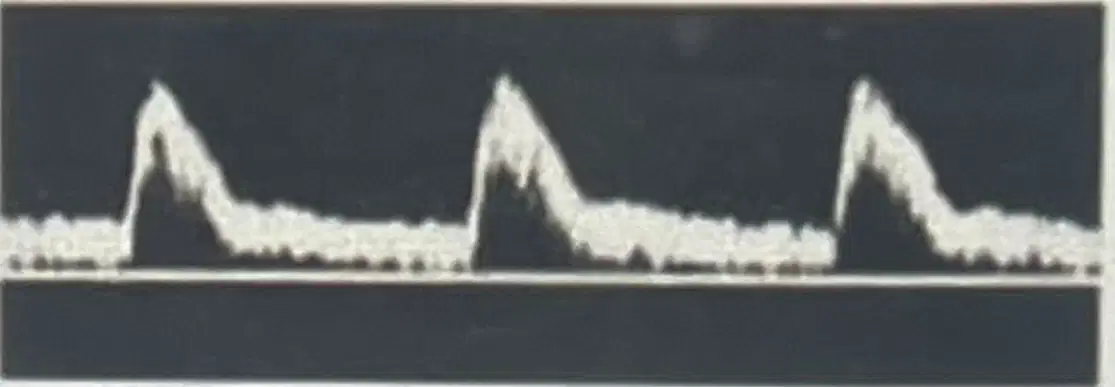
aortic normal pre renal branch flow
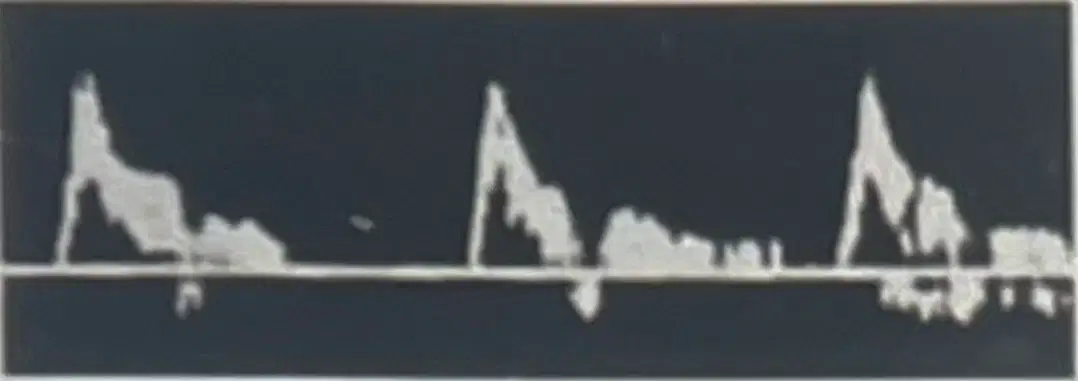
aortic normal post renal branch flow
aortic flow is usually high resistant unless
obtained pre renal branch area
obtained post renal branch area
obtained within iliac area
obtained within the brachiocephalic and aortic arch area
how do you obtain the renal aortic ratio (RAR)
renal artery PSV / aortic PSV
aortic PSV / renal artery PSV
distal aortic PSV / renal artery EDV
none of these
normal renal aortic ratio (RAR) :
>3.5
<3.5
<40
>90-100
RAR(renal aortic ratio) cannot be accurate in the presence of ____ or when PSV of the aorta are
aneurysm
atherosclerosis
<40cm/s
>90-100cm/s
>40
what is the normal kidney size ?
8-12cm
6-12cm
5-12cm
12-13cm
a normal EDR/PRR of the kidney is ≥ 0.2 anything less is abnormal & it is obtained by:
PSV - PSV / mean
EDV / PSV
EDV - EDV / mean
PSV - EDV / PSV
another way of identifying normal kidney resistance is by using pourcelots ratio/ resistive index which normally is <0.7 anything greater is ABNORMAL you obtain it by ______
PSV - EDV / PSV
PSV - PSV / mean
EDV / PSV
PSV - PSV / EDV
pourcelots resistive index of the kidney is normal when greater than or equal to 0.7
true
false
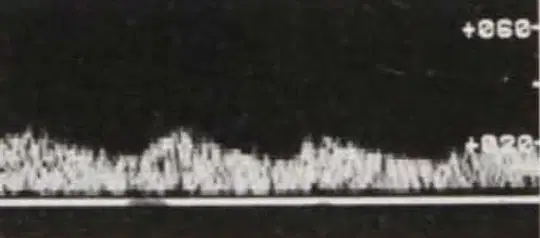
a kidney ___ of ≥ 100msec indicates ≥ 60% stenosis proximal stenosis
acceleration time
EDR
RAR
RI
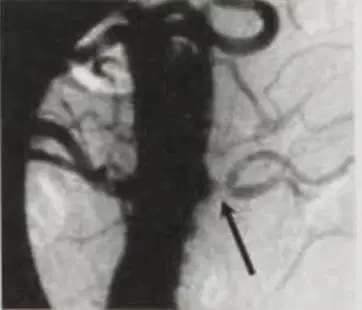
this is an image of
renal artery occlusion
FMD
stenosis
coarctation
a ___ is the slope of the doppler velocity waveform . and is calculated between the onset of systole and the systolic peak divided by acceleration time.
EDR
RI
RAR
AI
a ≥____ cm/sec AI is considered a >60% diameter reduction in the kidneys perfusion or arterial flow
≥291cm/sec
≥3.5cm/sec
≥0.7cm/sec
≤0.2cm/sec
mesenteric ischemia is also known as ______
mesenteric necrosis
mesenteric angina
mesenteric gangrene
mesenteric death
MATCH THE MESENTERIC VESSELS
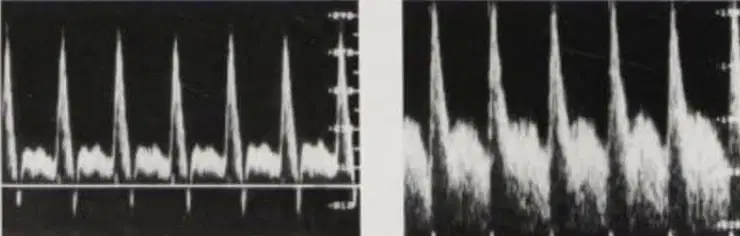
In a fasting state the ____ is high resistant , after eating(post prandial) the flow changes to low resistant and the PSV elevates and the EDV doubles
SMA
celiac
internal iliac arteries
external iliac arteries
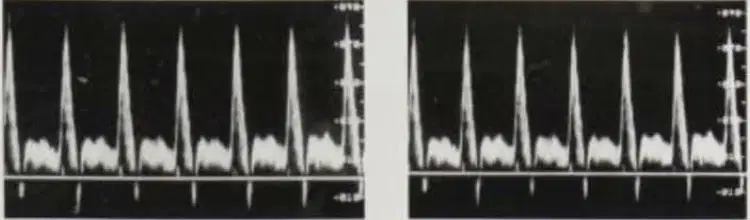
these images were taken of the SMA & IMA A(preprandial) and B(Postprandial) describe the images to the best of your knowledge
abnormal , due to remaining high resistant which indicates proximal ischemia disease
abnormal , due to remaining high resistant which indicates disal ischemia disease
normal due to high resistance which indicates patent flow
normal due to doubling of the end diastolic velocity and elevated peak systolic velocity
the celiac artery _____ post prandial
remains the same
has elevated PSV and EDV
has elevated PSV with doubling of the EDV
Has higher resistance
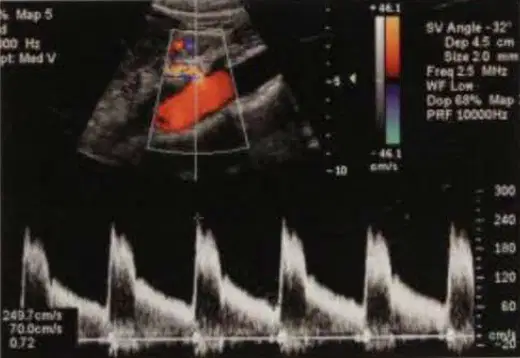
this image represents
normal celiac artery
70% stenosis of the celiac artery
stenosis of the SMA
normal inferior mesenteric artery
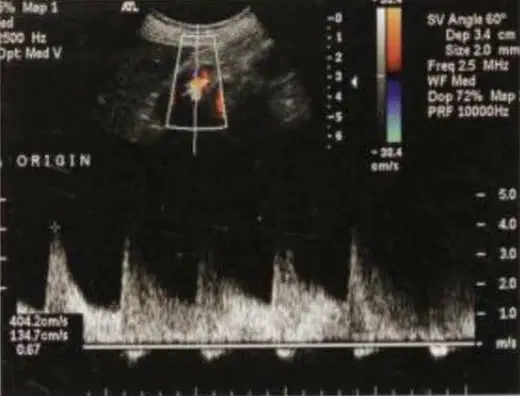
this image represents what mesenteric presence in a fasting patient?
sma ischemia , >70% stenosis
celiac ischemia >70% stenosis
aortic ischemia >70% stenosis
normal limits
a normal celiac artery velocity is
>200cm/s
>275cm/s
110-177cm/s
50-160cm/s
is flow reversal in the SMA normal in a fasting patient?
yes
no
is flow reversal in the SMA of a postprandial patient normal?
yes
no
does celiac artery have flow reversal at any point?
no
yes
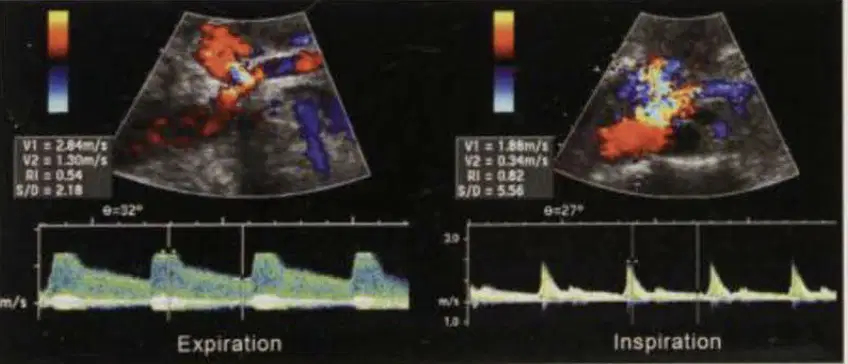
During celiac band syndrome/ reversal celiac artery stenosis: there is an audible auscultating ____ and can also be seen on color doppler as a color ____
bruit
swirl
trill
turbulence
normal portal vein size should be
1-1.5cm
2-2.5mm
3-3.35cm
1-1.9cm
postoperative complications of organ transplants ALSO include allograft rejection and pseudoaneurysms
true
false
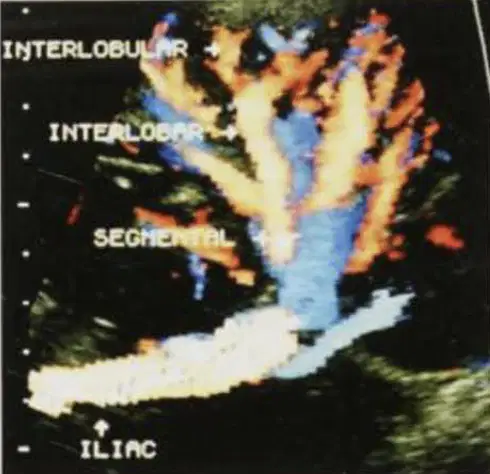
during renal transplants (allograft) match the anastamosis connections
end to end anastamosis
artery - internal iliac artery
end to side anastamosis
artery - external iliac artery
donor ureter
directly into bladder
renal venous anastamosis
external iliac vein
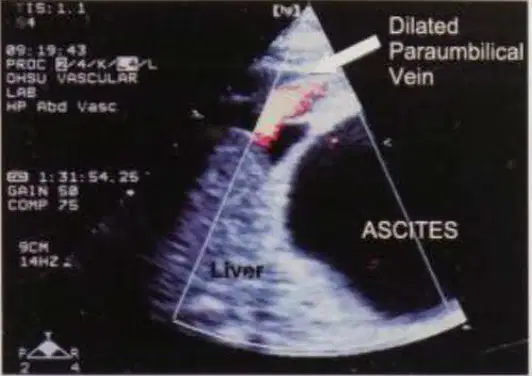
this occurs due to
fatty liver
renal transplant failure
portal hypertension
hepatic artery thrombosis
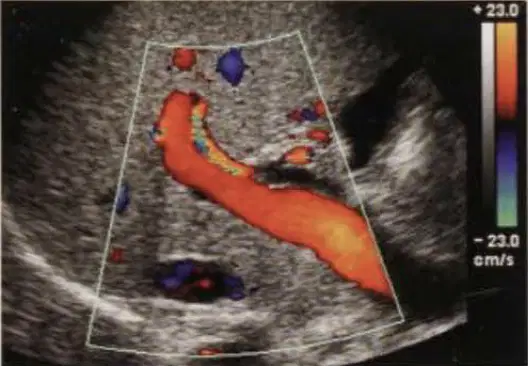
this is an image of
portal hypertension
portal stenosis
portal thrombosis
aliasing portal vein w/ flow reversal
normal flow

