wayground logo

Free Printable Worksheets

Font size

S
M
L
XL
Worksheets

Review Units 3 & 4

Total questions: 69

Worksheet time: 35mins
Name
Class
Date
1.
When bonds are broken,
a)
energy is released.
b)
energy is supplied
c)
a phase change is occurring.
d)
a physical change is occurring.
2.
Activation energy is...
a)
the energy required to break a chemical bond
b)
the energy required to make a chemical bond
c)
all of the above
d)
none of the above
3.
An ion is
a)
an atom with equal number of protons and electrons.
b)
an atom with equal number of protons and neutrons.
c)
an atom with unequal number of protons and neutrons.
d)
an atom with unequal number of protons and electrons.
4.
Ionization energy is
a)
an atoms ability to hold onto core electrons
b)
an atoms ability to hold onto valance electrons
c)
an atoms ability to steal onto core electrons
d)
an atoms ability to steal onto valance electrons
5.
Electronegativity is
a)
an atoms ability to hold onto core electrons
b)
an atoms ability to hold onto valance electrons
c)
an atoms ability to steal onto core electrons
d)
an atoms ability to steal onto valance electrons
6.
In general, as you move down a group,
a)
atomic radius increases.
b)
electronegativity decreases.
c)
ionization energy decreases.
d)
all of the above.
7.
Which of the following elements has the greatest atomic radius?
a)
Be
b)
Mg
c)
Ca
d)
Sr
8.
Which of the following elements has the greatest atomic radius?
a)
Be
b)
B
c)
C
d)
N
9.
Cations are,
a)
neutrally charged atoms.
b)
positively charged ions.
c)
negatively charged ions.
d)
none of the above.
10.
Anions are,
a)
neutrally charged atoms.
b)
positively charged ions.
c)
negatively charged ions.
d)
none of the above.
11.
A type of chemical bond that is formed from the attraction of an atom that has lost an electron and an atom that has gained an electron is called a(n)
a)
covalent bond.
b)
ionic bond.
c)
metallic bond
d)
hydrogen bond
12.
An ionic bond forms between,
a)
Metals and metals.
b)
Nonmetals and nonmetals
c)
Protons and neutrons
d)
Nonmetals and metals
13.
Metals tend to
a)
Gain electrons
b)
Lose electrons
c)
Form anions
d)
Dissolve
14.
Nonmetals tend to
a)
Gain electrons
b)
Lose electrons
c)
Form cations
d)
Dissolve
15.
Metals tend to form
a)
Cations
b)
Anions
c)
Electrons
d)
neutrons
16.
Nonmetals tend to form
a)
Cations
b)
Anions
c)
Electrons
d)
Neutrons
17.
A negatively charged ion attracts a(n)
a)
anion
b)
cation
c)
neutral atom
d)
element
18.
A characteristic of metals is that,
a)
They are more likely to steal electrons.
b)
They are more likely to give up protons
c)
They are more likely to give up electrons.
d)
They are more likely to steal protons
19.
Where are metals located on the periodic table?
a)
Left side
b)
Right side
c)
Everywhere
d)
Nowhere
20.
Where are nonmetals located on the periodic table?
a)
Left side
b)
Right side
c)
Everywhere
d)
Nowhere
21.
Atomic radius is,
a)
The distance from the nucleus of an atom to the neutrons
b)
The distance from the nucleus of an atom to the valence electrons
c)
The distance from the valence electrons of an atom to another atoms valence electrons.
d)
The distance from protons to neutrons in an atom.
22.
Think about the reactivity lab, (Calcium and magnesium reactivity). In general, metals become _______________ reactive as you move down a group.
a)
More
b)
Less
c)
None of the above
23.
Rows on the periodic table are called
a)
Groups/families
b)
Periods
c)
Sections
d)
Elements
24.
Columns on the periodic table are called
a)
Groups/families
b)
Periods
c)
Sections
d)
Elements
e)
Funny Names
25.
Atoms can be identified by the number of _______________.
a)
protons
b)
neutrons
c)
electrons
d)
electron configuration
26.
An atomic number tells us the number of ___________ an atom has.
a)
protons
b)
neutrons
c)
electrons
d)
electron configuration
27.
A covalent bond is formed between a
a)
metal and metal
b)
nonmetal and nonmetal
c)
metal and nonmetal
d)
none of the above
28.
Which atom has the greatest ionization energy?
a)
Mg
b)
S
c)
Sr
d)
Ba
29.
Which atom is most reactive?
a)
Sn
b)
Fe
c)
Mg
d)
Ba
30.
Which atom is most reactive?
a)
I
b)
Se
c)
P
d)
O
31.
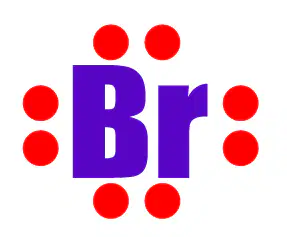
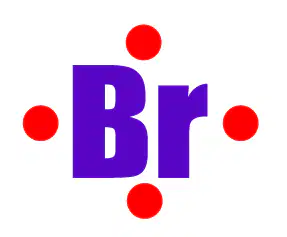
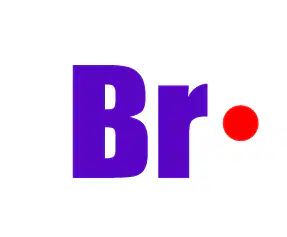
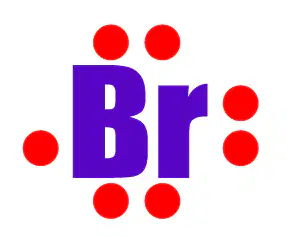
What is the correct Electron Dot Diagram for a neutral atom of BROMINE?
a)
'
b)
.
c)
,
d)
`
32.
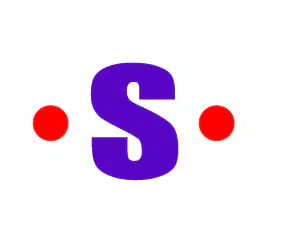
What is the correct Electron Dot Diagram for a neutral atom of SULFUR?
a)
`
b)
'
c)
,
d)
.
33.

What is the prefix that means "3"

(a)  

34.

Which atom has the greatest ionization energy on the periodic table?

(a)  

35.

Which atom has the greatest electronegativity on the Periodic Table?

(a)  

36.

Which atom has the greatest atomic radius on the Periodic Table?

(a)  

37.
A proton is
a)
A positively charged particle located in energy levels
b)
A positively charged particle located in nucleus
c)
A negatively charged particle located in nucleus
d)
A negatively charged particle located in energy levels
38.
An electron is
a)
A positively charged particle located in energy levels
b)
A negatively charged particle located in energy levels
c)
A negatively charged particle located in nucleus
d)
A positively charged particle located in nucleus
39.
The atomic number tells us,
a)
How many protons there are in an atom
b)
How many neutrons there are in an atom
c)
The amount of protons and neutrons there are in an atom
d)
The shape of an atom
40.
The mass number of an atom represents,
a)
The shape of an atom
b)
How many neutrons there are in an atom
c)
How many protons there are in an atom
d)
The amount of protons and neutrons there are in an atom
41.
An atom that has more protons than electrons has a
a)
negative charge
b)
neutral charge
c)
no charge
d)
positive charge
42.
An atom that has more electrons than protons has a
a)
negative charge
b)
neutral charge
c)
no charge
d)
positive charge
43.
Most of the mass of an atom comes from (Choose all that apply)
a)
electrons
b)
protons
c)
neutrons
d)
antineutrino
44.
A neutral atom has
a)
The same number of protons and electrons
b)
The same number of protons, neutrons and electrons.
c)
The same number of neutrons and electrons
d)
The same number of protons and neutrons
45.
Isotopes are,
a)
Two atoms of the same element that have the different masses.
b)
Two atoms of the same element that have the same masses.
c)
Two atoms of the different element that have the same masses.
d)
Two atoms of different elements that have different masses.
46.
If you have one atom with 4 protons, 3 neutrons and 4 electrons and another atom with 3 protons 3 neutrons and 4 electrons you have
a)
the same element.
b)
isotopes of the same element.
c)
different elements
d)
none of the above.
47.
What element is located at period two group 13?
a)
Si
b)
Al
c)
C
d)
B
48.
Which of the following are located on the periodic table? (choose all that apply)
a)
average atomic mass
b)
atomic number
c)
mass number
d)
pressure
e)
symbol number
49.
12C and 13C are...
a)
Isotopes
b)
Same Atom, Not Isotopes of Each Other
c)
Different Elements
d)
None of the above
50.
You have the following elements.... An atom with 13 protons and 13 neutrons. Another atom with 14 protons and 13 neutrons. Choose the correct statement.
a)
The two atoms are isotopes.
b)
The two atoms are the same element and not isotopes.
c)
The two atoms are different elements.
d)
none of the above.
51.

Identify the number of PROTONS for the elements located at... Period 1, group 1 =

(a)  

52.

Identify the number of PROTONS for the elements located at... Period 2, group 2 =

(a)  

53.

Identify the number of PROTONS for the elements located at... Period 4, group 12 =

(a)  

54.

Identify the number of PROTONS for the elements located at... Period 5, group 14 =

(a)  

55.
Carbon-20 is most likely
a)
stable
b)
unstable
c)
not enough information is provided to appropriately answer this question
56.
An oxygen atom with eight neutrons is most likely
a)
stable
b)
unstable
c)
there is not enough information available to answer this question
57.

There are a total of (a)   periods on the periodic table (insert a number)
58.

There are a total of (a)   groups on the periodic table (insert a number)

59.
Radioactivity is...
a)
the process in which an unstable electron cloud emits particles and energy
b)
the process in which an unstable electron cloud blows up.
c)
the process in which an unstable atomic nucleus emits particles and energy
d)
the process in which an unstable atomic nucleus blows up.
60.
Radioisotopes contain...
a)
unstable electron clouds.
b)
stable electron clouds
c)
unstable nucleus
d)
stable nucleus
61.
Half life is
a)
the time required for one half of a sample of radioisotope to decay.
b)
half the time it takes for 25% of a nuclear reaction to react.
c)
the amount of time it takes for a radioisotope to become unstable.
d)
the amount of time it takes for a sample to become radioactive
62.
Which type of nuclear process powers most of the nuclear power plants?
a)
alpha decay
b)
Nuclear Fusion
c)
gamma radiation
d)
beta decay
e)
Nuclear Fission
63.

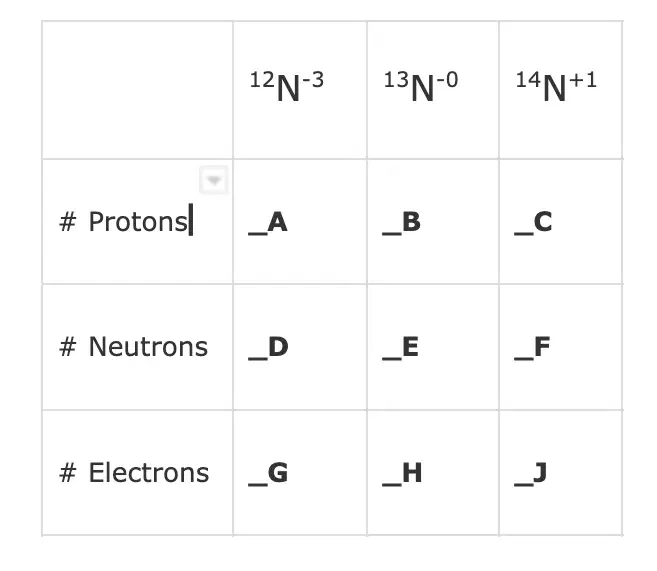
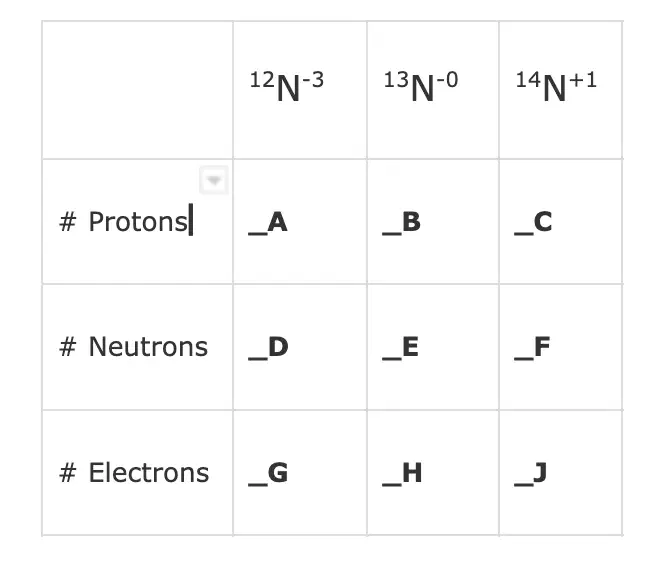
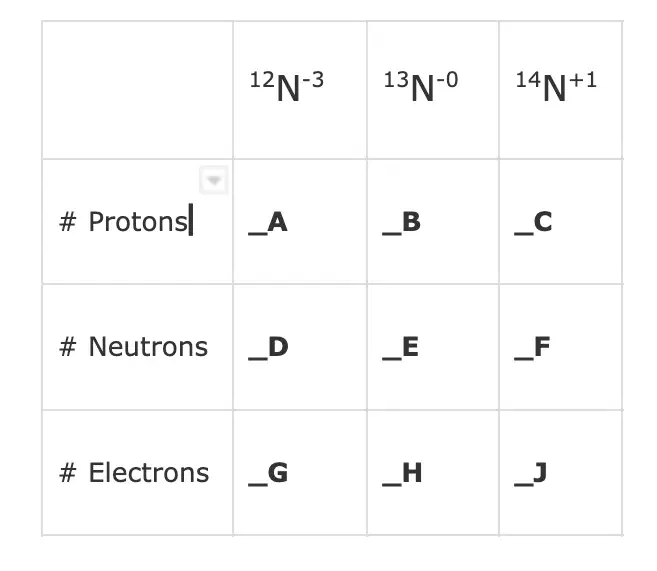
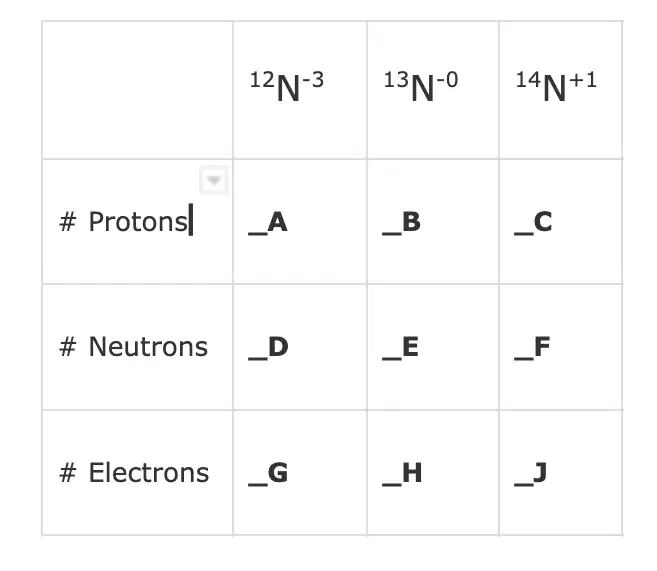
Complete the table: What is "B"

(a)  

64.

Complete the table: What is "D"

(a)  

65.

Complete the table: What is "F"

(a)  

66.

Complete the table: What is "G"

(a)  

67.

Complete the table: What is "J"

(a)  

68.
adding salt to water depresses or lowers the freezing point below zero
a)
depresses or lowers the freezing point below zero Fahrenheit.
b)
elevates or increases the freezing point above zero Celsius.
c)
depresses or lowers the freezing point below zero Celsius.
d)
elevates or increases the freezing point above zero Fahrenheit.
69.
Generally speaking, as kinetic energy of molecules increase in a system,
a)
pressure increases.
b)
temperature increases.
c)
all of the above.
d)
none of the above.