
 Worksheets
Unit 3.1 Test
Total questions: 64
Worksheet time: 34mins
Name
Class
Date
1.
What systems are we studying?
a)
Arterioneural; circulatory and nervous
b)
cardiopulmonary; circulatory and respiration
c)
Pneumocardio; lungs and heart
d)
Solar System
2.
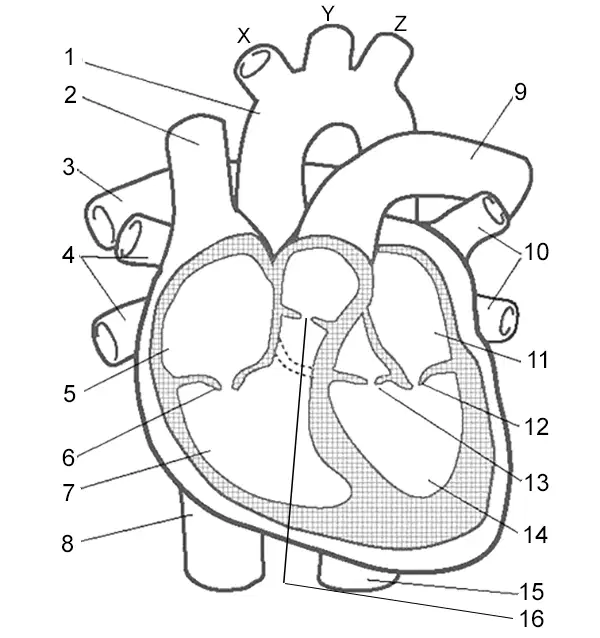
What is #12?
a)
Mitral valve
b)
Tricuspid valve
c)
Ventricle
d)
Aortic Valve
3.
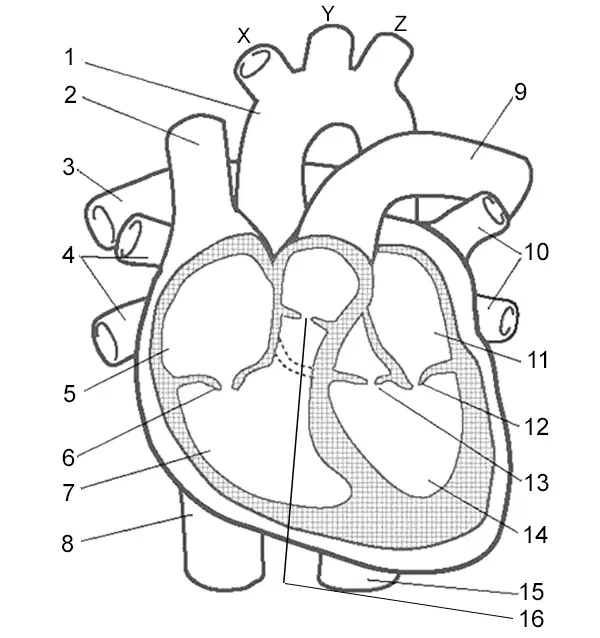
What is #5?
a)
Left Ventricle
b)
Right Atria
c)
Right Ventricle
d)
Left Atria
4.
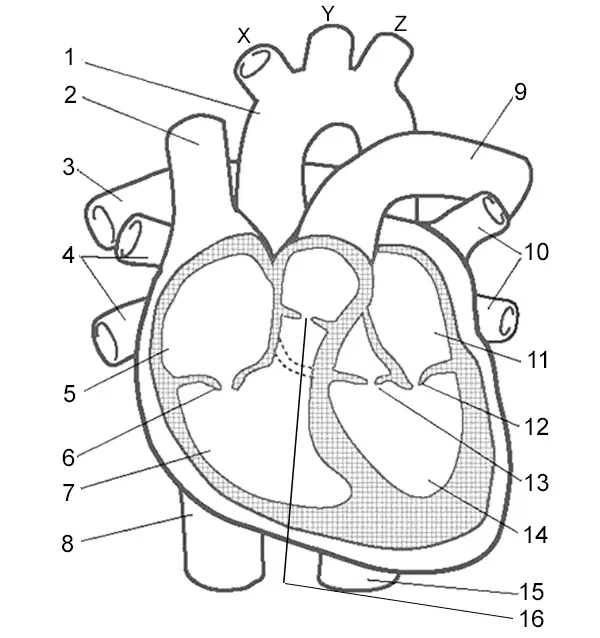
What is #14?
a)
Left Ventricle
b)
Right Atria
c)
Right Ventricle
d)
Left Atria
5.

What is #7?
a)
Left Ventricle
b)
Right Atria
c)
Right Ventricle
d)
Left Atria
6.
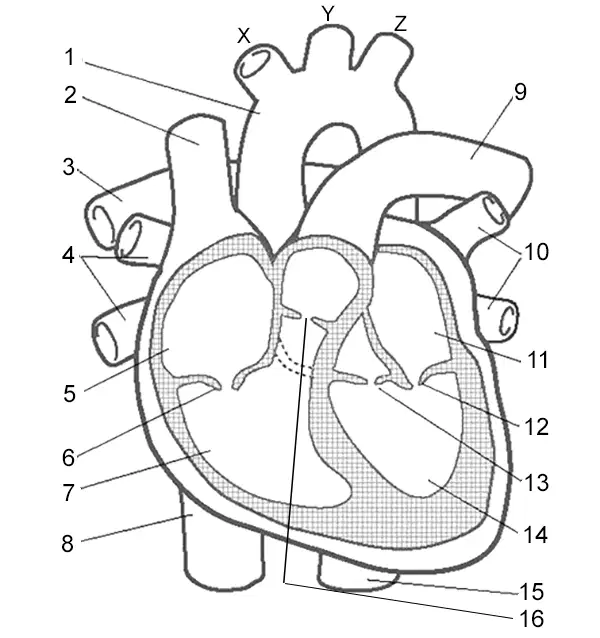
What is #11?
a)
Left Ventricle
b)
Right Atria
c)
Right Ventricle
d)
Left Atria
7.
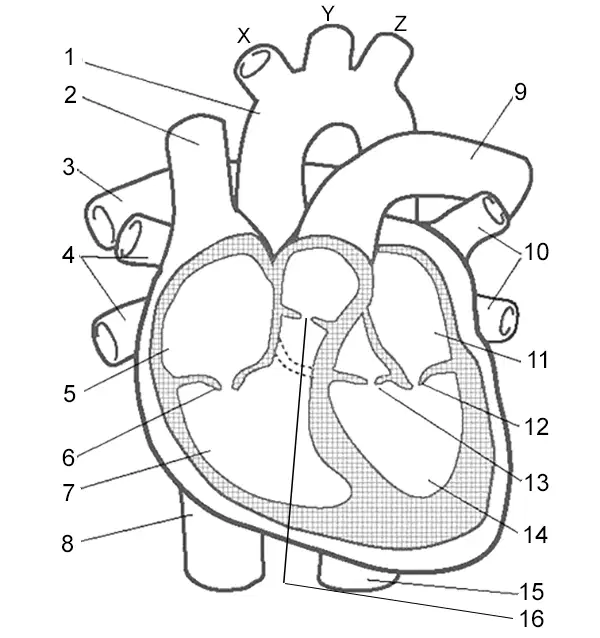
What is #1?
a)
Left Ventricle
b)
Inferior Vena Cava
c)
Superior Vena Cava
d)
Aorta
8.

What is #2?
a)
Pulmonary Artery
b)
Inferior Vena Cava
c)
Superior Vena Cava
d)
Aorta
9.
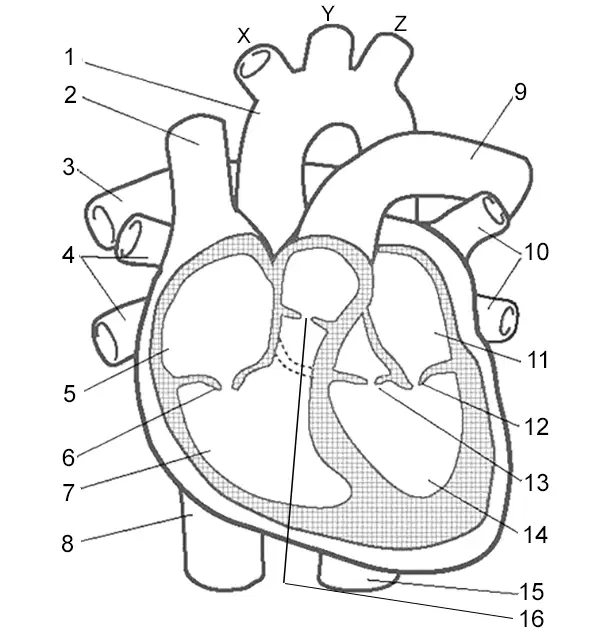
What is #8?
a)
Pulmonary Artery
b)
Inferior Vena Cava
c)
Superior Vena Cava
d)
Aorta
10.
How are arteries and veins different?
a)
Arteries have thicker walls, and carry blood away from the heart
b)
Veins have thicker walls, and carry blood away from the heart
c)
Arteries have thinner walls, and carry blood away from the heart
d)
Veins have thinner walls, and carry blood to the heart
11.
How many liters of air are left in your lungs that you can not exhale? Use labels.
(a)
12.
All deoxygenated blood enters the heart through what two vessels?
a)
Left and Right Pulmonary Arteries
b)
Left and Right Pulmonary Veins
13.
The lower left and right chambers of the heart are known as the _____?
a)
Atria
b)
Ventricles
c)
Arteries
d)
veins
14.
True or False: Veins contain valves which prevent blood from flowing in the opposite direction (away from the heart) due to the force of gravity
a)
True
b)
False
15.
A strong, elastic vessel that carries blood away from the heart under high pressure is known as a(n)...?
a)
Artery
b)
Vein
c)
Capillary
d)
lumen
16.
What is the largest (and strongest) artery of the whole body?
a)
Superior Vena Cava
b)
Inferior Vena Cava
c)
Aorta
d)
Pulmonary
17.
True or False: Gas exchange occurs between the capillaries and the alveoli.
a)
True
b)
False
18.
True or False: High blood pressure is also known as atherosclerosis.
a)
True
b)
False
19.
True or False: When calculating an ABI value, the closer you are to a 1.0 value, the better your blood flow.
a)
True
b)
False
20.
True or False: Calculating an ABI value helps us to determine if a person has peripheral artery disease (PAD).
a)
True
b)
False
21.
Which of the following is a function of the respiratory system?
a)
Obtaining oxygen
b)
removing Carbon dioxide
c)
Filtering incoming air
d)
all of these are functions
22.
Which of the following is the correct sequence of air movement during inhalation?
1. Bronchioles
2. Alveoli
3. Trachea
4. Bronchi
a)
4 3 1 2
b)
1 3 4 2
c)
3 4 1 2
d)
3 2 4 1
23.
What disease or medical condition could affect lung capacity?
a)
Asthma
b)
Emphysema
c)
Common cold
d)
All of these
24.
Total lung capacity (TLC) is calculated by adding…?
a)
VC + TV
b)
VC+RV
c)
TV+RV
d)
TV + MV
25.
Approximately how long can you survive without oxygen?
a)
3 seconds
b)
3 minutes
c)
3 hours
d)
3 days
26.
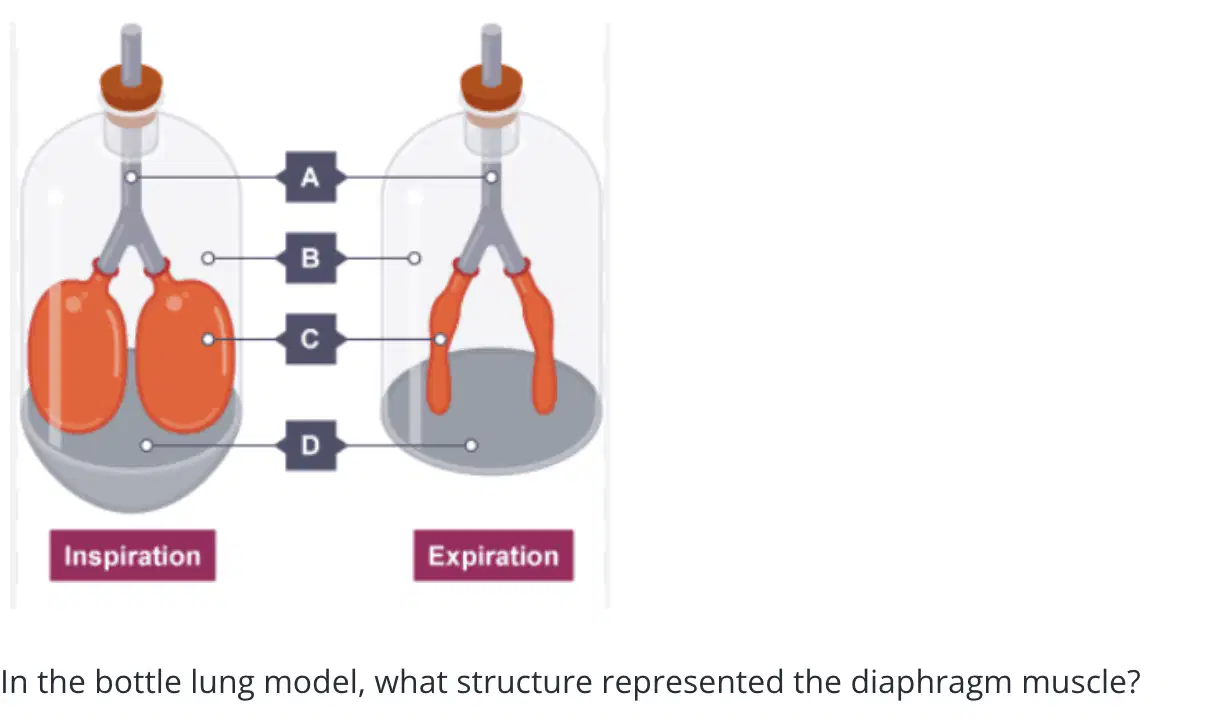
a)
A
b)
B
c)
C
d)
D
27.
True or False: A normal and healthy pulse ox reading is anything 80% and above.
a)
True
b)
False
28.
True or False: A normal resting heart rate is anywhere from 40-70 beats per minute.
a)
True
b)
False
29.
What is the air that is leftover in your lungs called?
4 lines
30.

Which letter is the Inspiratory Reserve Volume?
a)
E
b)
A
c)
B
d)
D
31.
These are tiny air sacs found in the lungs.
a)
alveoli
b)
bronchi
c)
bronchioles
d)
trachea
e)
larynx
32.
This muscle sits under the lungs. It contracts and relaxes, causing your lungs to pull air in and out.
a)
Diaphragm
b)
Alveoli
c)
Pharynx
d)
Larynx
33.
These are where oxygen and carbon dioxide are exchanged.
a)
Alveoli
b)
Diaphragm
c)
Bronchial Tree
d)
Trachea
34.
Check which of the following are characteristics of arteries (could be more than one)
a)
Thick multicellular walls; delivers blood from the heart to the body
b)
Returns oxygen rich blood from the lungs back to the heart
c)
Has valves to push blood from extremities back to the heart
d)
Involved in gas exchange and nutrient/waste exchange
e)
Single cell layer thick
35.
Check which of the following are characteristics of veins (could be more than one)
a)
Returns oxygen rich blood from the lungs back to the heart
b)
Has valves to push blood from extremities back to the heart
c)
Thin, flabby walls with a wider diameter
d)
Thick multicellular walls; delivers blood from the heart to the body
e)
Involved in gas exchange and nutrient/waste exchange
36.
Check which of the following are characteristics of capillaries (could be more than one)
a)
Involved in gas exchange and nutrient/waste exchange
b)
Single cell layer thick
c)
Thick multicellular walls; delivers blood from the heart to the body
d)
Returns oxygen rich blood from the lungs back to the heart
e)
Has valves to push blood from extremities back to the heart
37.
Match the Blood Vessel with the Region of the Body: Thigh Region of the Leg
a)
Femoral Artery
b)
Brachial Artery
c)
Popliteal Artery
d)
Digital Artery
e)
Subclavian Artery
38.
Match the Blood Vessel with the Region of the Body: Underneath the Collar Bone
a)
Subclavian Artery
b)
Brachial Artery
c)
Popliteal Artery
d)
Digital Artery
e)
Femoral Artery
39.
Match the Blood Vessel with the Region of the Body: Back of the knee
a)
Popliteal Artery
b)
Brachial Artery
c)
Digital Artery
d)
Subclavian Artery
e)
Femoral Artery
40.
Match the Blood Vessel with the Region of the Body: Upper arm or humerus area
a)
Brachial Artery
b)
Popliteal Artery
c)
Digital Artery
d)
Subclavian Artery
e)
Femoral Artery
41.
Match the Blood Vessel with the Region of the Body: Each finger of the hands
a)
Digital Artery
b)
Brachial Artery
c)
Popliteal Artery
d)
Subclavian Artery
e)
Femoral Artery
42.
Match the Blood Vessel with the Region of the Body: Thumb side of the lower arm
a)
Radial Artery
b)
Brachial Artery
c)
Popliteal Artery
d)
Digital Artery
e)
Subclavian Artery
43.
Instrument used to measure Blood Pressure
a)
Sphygmomanometer
b)
Pulse Oximeter
c)
Spirometer
d)
Fetal Doppler
44.
Instrument used to measure ABI (ankle brachial index)
a)
Sphygmomanometer
b)
Pulse Oximeter
c)
Spirometer
d)
Fetal Doppler
45.
Instrument used to oxygen in the blood
a)
Sphygmomanometer
b)
Pulse Oximeter (Thumb thingy)
c)
Spirometer
d)
Fetal Doppler
46.
Instrument used to lung capacity
a)
Sphygmomanometer
b)
Pulse Oximeter
c)
Spirometer
d)
Fetal Doppler
47.
A client of yours has a blood pressure reading of 140 / 90. Your client has:
a)
Normal blood pressure
b)
Prehypertension
c)
Cardiac diastole
d)
Hypertension
48.
A client of yours has a blood pressure reading of 120/80. Your client has:
a)
Normal blood pressure
b)
Prehypertension
c)
Cardiac diastole
d)
Hypertension
49.
Which one refers to the pulmonary vein?
a)
Returns oxygen rich blood from the lungs back to the heart
b)
Thick multicellular walls; delivers blood from the heart to the body
c)
Has valves to push blood from extremities back to the heart
d)
Involved in gas exchange and nutrient/waste exchange
e)
Single cell layer thick
50.
Filters and warms air
a)
Nose
b)
Trachae
c)
Bronchial tree
d)
Alveoli
51.

Which letter is the larynx, or voicebox?
a)
A
b)
B
c)
C
d)
D
e)
E
52.
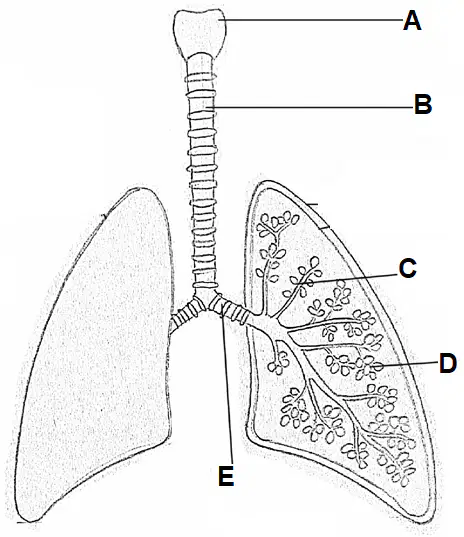
Which letter is a bronchus/bronchi?
a)
C
b)
A
c)
B
d)
E
53.
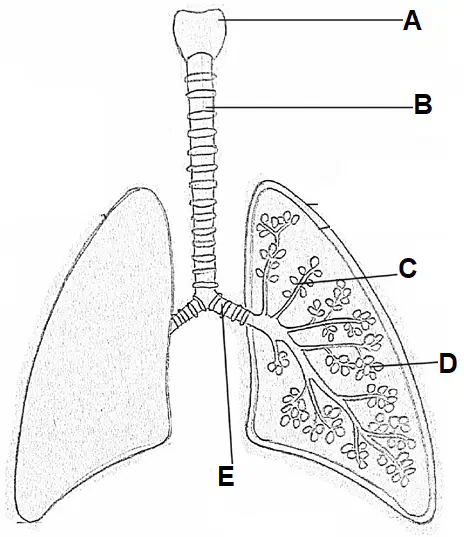
Which letter is a Trachea?
a)
C
b)
A
c)
B
d)
E
54.
Where does gas exchange from the alveoli happen?
a)
Capillaries
b)
Veins
c)
Arteries
55.

Which letter is the Tidal Volume?
a)
D
b)
A
c)
B
d)
E
56.
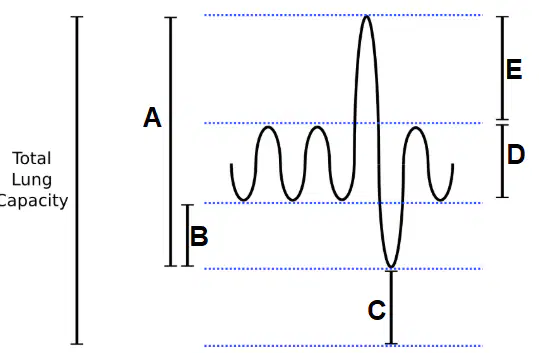
What is the expiratory volume?
a)
B
b)
A
c)
C
d)
D
e)
E
57.
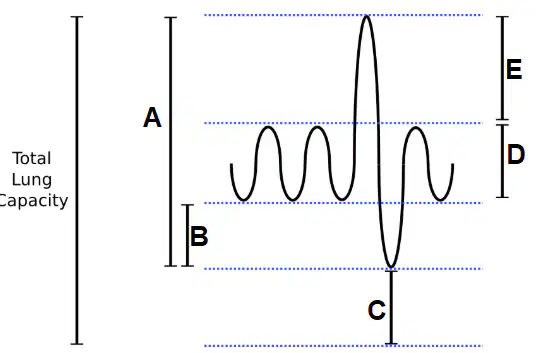
What makes up vital capacity?
a)
A B C
b)
B D E
c)
B C
d)
D E
58.
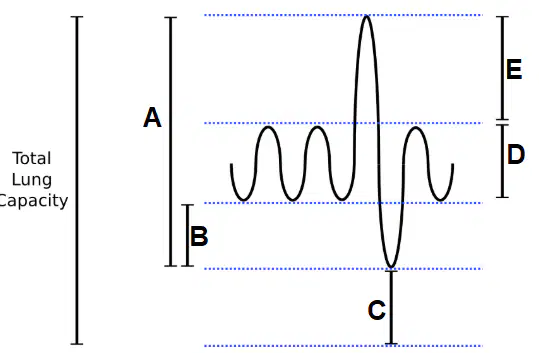
What letters make up Total Lung Capacity? (two potential answers)
a)
E D B C
b)
A C
c)
E D B
d)
A
59.
Where does deoxygenated blood return to the heart?
a)
Through superior and inferior vena cavas
b)
Through the aorta
c)
Through the coronary artery
d)
Through the pulmonary vein
60.

Which system pumps blood through your body?
a)
circulatory
b)
digestive
c)
respiratory
d)
muscular
61.

Arteries carry blood with oxygen away from the heart.
a)
True
b)
False
62.

Which blood cells carry oxygen from the lungs to all body cells?
a)
red blood cells
b)
white blood cells
c)
platelets
d)
all of the above
63.

When you breathe in air, you inhale oxygen into your lungs and exhale ____.
a)
carbon dioxide
b)
oxygen
c)
nitrogen
d)
carbon monoxide
64.
This chamber of the heart RECEIVES blood returning from the body
a)
Right Atrium
b)
Right Ventricle
c)
Left Atrium
d)
Left Ventricle
100 %

