
 Worksheets
C1,2,3 Exercises
Total questions: 23
Worksheet time: 19mins
Which statement is NOT TRUE?
Rate = k[A][B]²[C]
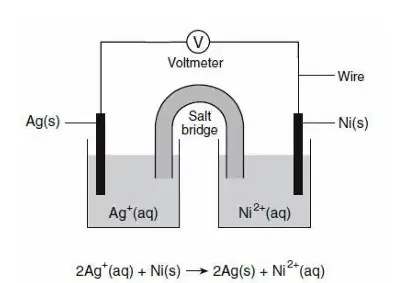
By referring to the figure and overall equation below, which reaction occurs at the cathode?
Standard conditions for measuring enthalpies are as follows EXCEPT:
24 degrees celcius
Choose the correct definition of electrode potential.
The following statements are true regarding electrolytic cells EXCEPT
The reactions taking place are non spontaneous.
A salt bridge is not being used to set up this cell.
It converts electrical energy to chemical energy.
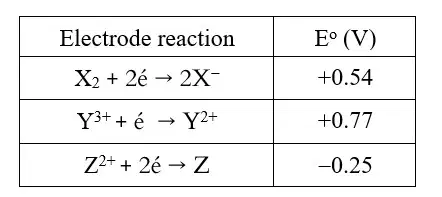
Given their standard reduction potentials, which of the species is going to be oxidized?
Cu2+/Cu = 0.34V
Zn2+/Zn = -0.76V
Cu
ZnSO4
CuSO4
Zn

In a redox reaction, the species that loses electrons
is called the cathode
is oxidized
gains mass at the electrode
decreases in oxidation number
In voltaic cells, the salt bridge _______ .
is not necessary in order for the cell to work
allows charge balance to be maintained in the cell
drives free electrons from one half-cell to the other
is tightly plugged with firm agar gel through which ions cannot pass
In the standard notation for a voltaic cell, the double vertical line "||" represents:
a phase boundary
gas electrode
a wire (metal) connection
a salt bridge
In the following reaction
Sn2+ + 2Fe3+ → Sn4+ + 2Fe2+
the oxidizing agent is....
Sn4+
Sn2+
Fe3+
Fe2+
What reaction occurs at the anode?
Ag+/Ag = 0.80V
Ni2+/Ni = -0.25V
Ni2+ + 2e- → Ni
Ag+ + e- →Ag
Ag → Ag+ + e-
Ni → Ni2+ + 2e-
Q= m c ∆T
The units for specific heat are:
The reaction A + 2B → products was found to have the rate law, k = k[A][B]2. Predict by what factor the rate of reaction will increase when the concentration of B is doubled and the concentration of A remained uncanged
2
4
6
8
The catalyst alters the rate of a chemical reaction by,
providing an alternative pathway with a lower Ea
changing the products formed in the direction of the reaction
providing a surface on which the molecules react
increasing the frequencies of collisions between molecules
What happened to the rate of reaction, if concentration of reactant is 'zero order'.
rate of reaction will become double
rate of reaction will become triple
rate of reaction will become quadrapel
No affect to the rate of reaction
What is meant by rate of reaction?
Decrease in the quantity of a reactant or product during a chemical reaction
Change in the quantity of a reactant or product over time
Change in the quantity of a reactant or product during a chemical reaction
Change in the quantity of a reactant or product per unit time

