
 Worksheets
Alkenes & Alkanes
Total questions: 35
Worksheet time: 19mins
A homologous series is a family of organic compounds with
similar chemical properties and same general formula
similar chemical properties and different general formula
different chemical properties and same general formula
similar physical properties and same general formula
A homologous series is a family of organic compounds with
similar chemical properties and same general formula
similar chemical properties and different general formula
different chemical properties and same general formula
similar physical properties and same general formula
Each member of a homologous series differs from the next by a
–CH2 group
–CH group
–CO2 group
–CH4 group
Which of the following can be used to distinguish between alkanes and alkenes?
add a few drops of aqueous bromine
add a few drops of Universal indicator
add a piece of blue litmus paper
add a piece of red litmus paper
Which of the following statement is correct?
Alkenes can turn aqueous bromine from reddish-brown to colourless.
Alkenes can turn aqueous bromine from colourless to reddish-brown.
Alkanes can turn aqueous bromine from reddish-brown to colourless.
Alkanes can turn aqueous bromine from colourless to reddish-brown.
State the general formula for alkane
CnH2n+2
CnH2n
CnH2n+1
CnH2n-2
State the general formula for alkene
CnH2n+2
CnH2n
CnH2n+1
CnH2n-2
Which are the following are all alkanes?
methane, ethane, propane
methane, ethene, propene
methene, ethene, propene
ethene, propene, butene
Which are the following are all alkenes?
methane, ethane, propane
methane, ethene, propene
methene, ethene, propene
ethene, propene, butene
The formula for ethene is
C2H4
C2H6
CH4
C3H6
The formula for propane is
C2H4
C2H6
C3H8
C3H6
Alkanes react with excess oxygen to form
carbon dioxide and water vapour
salt and water
carbon monoxide and soot
metal hydroxide and hydrogen
Both alkanes and alkenes are
hydrocarbons
alcohols
saturated
unsaturated
An alkane is
polyunsaturated
polysaturated
saturated
unsaturated
Alkanes undergo substitution by chlorine only in the presence of
UV light
oxygen
water
aqueous bromine
What are the conditions for cracking?
solid catalyst of aluminium oxide and silicon dioxide, at 600oC
nickel catalyst at 200oC
nickel catalyst at 600oC
solid catalyst of aluminium oxide and silicon dioxide, at 200oC
Which of the following statements about cracking is not true?
Cracking is the breakdown of large alkane molecules into small molecules.
Cracking is used to produce fuel for motor vehicles.
Cracking is used to produce H2 and alkenes.
Cracking takes place in the presence of sunlight.
Polyunsaturated means having many
C=C bonds
C-C bonds
C=O bonds
C-O bonds
Which of the following shows the structure of ethene?


Which of the following shows the structure of propene?
Which of the following shows the structure of ethane?
What is the name of 4 carbons alkane?
Butane
Butyne
Butene

What type of reaction is shown?
Polymerisation
Hydrogenation
Hydration
Bromination
When an alkane is added to bromine water it remains orange. Why?
Bromine only reacts with saturated compounds
Bromine only reacts with unsaturated compounds
What is used to test for saturation/ unsaturation?
Bromine acid
Potassium permanganate
Iodine solution
Bromine water
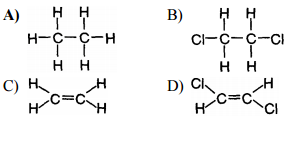
Unsaturated molecules contain...
A carbon to carbon double bond
Only single bonds between carbon atoms
A water molecule
A hydroxyl group

Cracking is the breaking down of long-chain hydrocarbons into (a) molecules.
It produces alkenes, smaller alkanes or hydrogen.
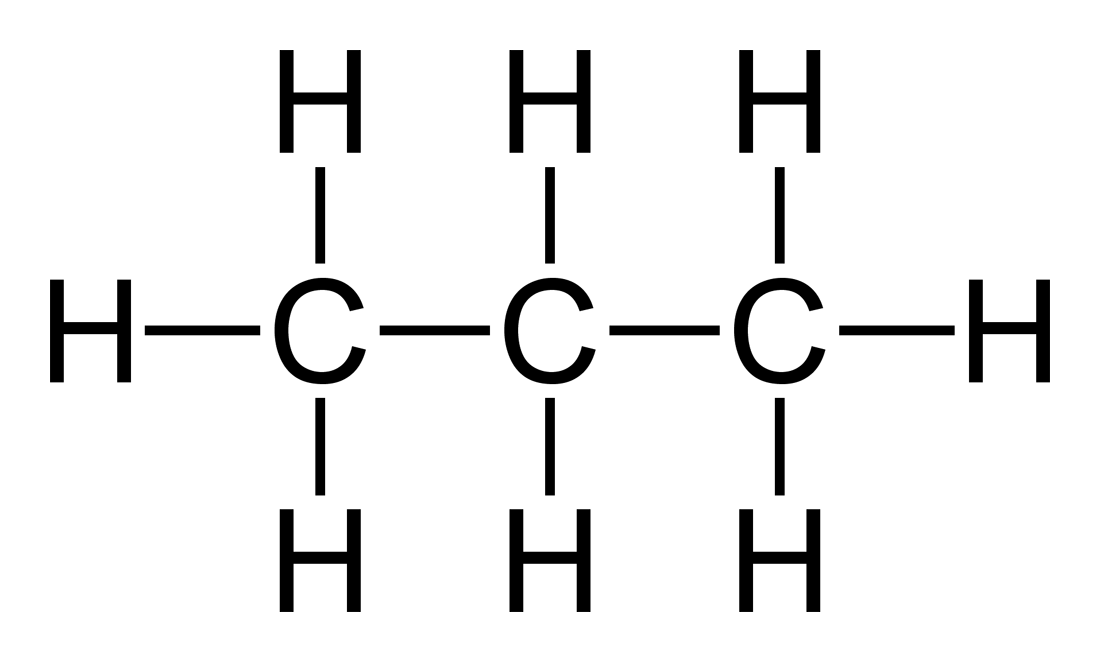
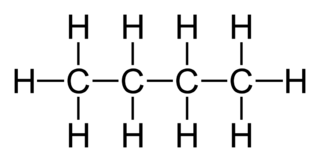

What chemical is this? (C5H10)
Pentene
Pentane
Hexane
Heptene
Polyunsaturated fats and oils contain ______ carbon-carbon double bonds.
Hydrogenation is used to convert _______ _______ to _________.
(a)

