
 Worksheets
RLM Graphs of Functions Quiz
Total questions: 128
Worksheet time: 6hrs 27mins

Find the equation of the transformed graph
y=x2+3
y=(x+3)2
y= x2−3
y=(x−3)2

Find the equation of the transformed graph
y=x2+3
y=(x+3)2
y= x2−3
y=(x−3)2

y= ∣x∣ − 1
y= − ∣x∣
y= ∣x∣
y= ∣x−1∣

y= ∣x∣ + 3
y= ∣x∣− 3
y= ∣x+3∣
y= ∣x−3∣

y= ∣x∣ + 3
y= ∣x∣− 3
y= ∣x+3∣
y= ∣x−3∣
y=3∣x∣
Which graph represents this transformed function


y=−2∣x∣
Which graph represents this transformed function


y = g(x) to y = - g(x + 6) - 10
Shifted down 10 units
Shifted left 6 units
Shifted up 10 units
Shifted left 6 units
Shifted up 10 units
Shifted right 6 units
Shifted down 10 units
Shifted left 6 units

If the blue is f(x)=x2, then the red must be

Identify the y-intercept
(0, -3)
(0, 1)
(0, 3)
(2, 1)


What variable represents the domain?
x
y
d
r
What variable represents the domain?
x
y
d
r
What variable represents the range?
x
y
d
r

What is the Domain of this exponential function?
y=1
x=0
All Real Numbers
x>0

What is the Range of this function?
y > 0
x> 0
All Real Numbers
y > 1
What is the Range of this function?
y > 0
x> 0
All Real Numbers
y > 1

What is the range of the exponential function?
all real numbers
y > -1
y < -1
x > -1

What is the range of the exponential function?
all real numbers
y > 3
y < 3
x > 3
What is the domain of the exponential function?
all real numbers
y > 3
y < 3
x > 3

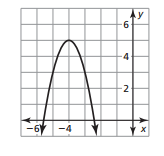
Which of the following transformations are present (select all that apply)?
-2f(2(x - 1)) + 2
reflection over horizontal axis
reflection over vertical axis
horizontal compression
vertical shift
Rotation about origin
Describe the transformation:
Shift 3 units up
Shift 3 units down
Shift 3 units left
Shift 3 units right
Describe the transformation:
Shift 7 units down
Shift 7 units up
Shift 7 units left
Shift 7 units right
Describe the transformation: (click on two answers)
Shift 1 unit left
Shift 1 unit right
Shift 5 units up
Shift 5 units down
Describe the transformation: (click on two answers)
Reflection over the x-axis
Reflection over the y-axis
Shift 7 units up
Shift 7 units down


The graph shows the function f(x)=x2 in blue and another function g(x) in red. Which could be the equation for g(x)?
A. g(x)=3x2
B. g(x)=-3x2
C. g(x) = x2 - 3
D. g(x) = (x-3)2


Identify the transformation from the graph of f(x)=x2 to the graph g(x)= -(x+5)2
shifted up five units
reflection in x-axis
shifted down five units
reflection in x-axis
shifted left 5 units
reflection x-axis
shifted right 5 units
reflection x-axis
Left 3
Right 3
Left 3
Right 3
y= ∣x∣ + 3
y= ∣x∣− 3
y= ∣x+3∣
y= ∣x−3∣
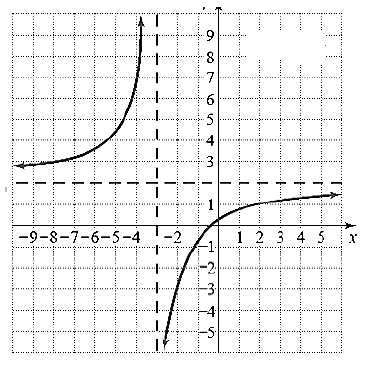
Which of the following represents the graph below?
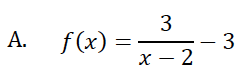
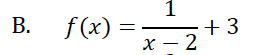
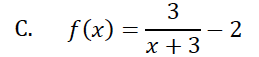
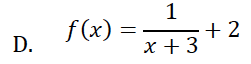

Which of the following represent the graph?


What is the vertical asymptote of the following function?
x = -2
x = 2
y = -3
y = 3

Describe the transformation of the function.
shift left 3 units
shift right 3 units
shift up 3 units
shift down 3 units

Describe the transformations of the function.
Shifted right by 4 units
Shifted down by 7 units
Stretched Vertically
Shifted right by 4 units
Shifted up by 7 units
Stretched Vertically
Shifted right by 4 units
Shifted down by 7 units
Compressed Vertically
Shifted left by 4 units
Shifted down by 7 units
Compressed Vertically

What is this function called?
Quadratic
Reciprocal
Polynomial
Exponential
What is the equation of the Vertical Asymptote of y=x−43+2
x=2
y=2
x=4
y=4
No Vertical Asymptote

Which is the graph of the rational equation:


The given graphed function would have a horizontal asymptote at
x = 0
y = 0
x = 2
y = 2

What is the domain for the following function?
All real numbers except 2.
All real number except -2.
All real numbers except 4.
All real numbers.

What is the range for the following function?
All real numbers.
All real numbers except for -2.
All real numbers except for 2.
All real numbers exceptt for 4.
What is the vertical asymptote of the following function?
x = -2
x = 2
y = -3
y = 3
Describe the transformations of the function.
Shifted right by 4 units
Shifted down by 7 units
Stretched Vertically
Shifted right by 4 units
Shifted up by 7 units
Stretched Vertically
Shifted right by 4 units
Shifted down by 7 units
Compressed Vertically
Shifted left by 4 units
Shifted down by 7 units
Compressed Vertically

Describe the transformation of the function.
Shift left by 2 units
Compressed vertically
Shift right by 2 units
Stretched vertically
Shift right by 2 units
Compressed vertically
Shift down by 2 units
Compressed vertically

What is the vertical asymptote of the function?
x = 2
x = -2
x = 0
x = 1

What is the horizontal asymptote of the function?
x =1
x = -2
x = 2
y = 0
Given the function y = 3/x what is the domain
R except x = 0
R except x = 3
R except y = 0
R except x = 1

What is the equation of the graphed function?
y = (1 / x) + 2
y = (1 / x) - 2
y = 1 / (x + 2)
y = 1 / (x - 2)


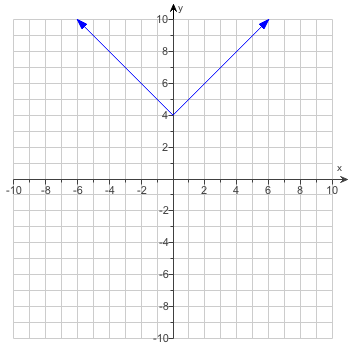


The blue graphs is the parent function f(x)=|x|, the red must be

What is the equation of this graph?
y=2|x-3|+1
y=2|x-1|+3
y=-2|x+1|+3
y=-2|x-1|+3
y=4|x+3|-2
Use Narrow, wide, or same to compare the width of this graph to the parent function.
y= 1/2 |x-1|+2
Narrow
Wide
Same

What is the axis of symmetry for the following graph?
y=3
x=3
x=2
y=2
y=0

What is the axis of symmetry for the following graph?
y=-4
x=-4
x=-3
y=-3
x=3

What is the vertex of the graph below? You can click the picture to zoom in!
(-2, 0)
(2, 4)
(4, 2)
(0, 2)


What is the asymptote of y = 2x - 3
y = 0
y = -3
x = 0
x = -3


What equation matches the graph?
f(x) = 3x
f(x) = (⅓)x
f(x) = -3x
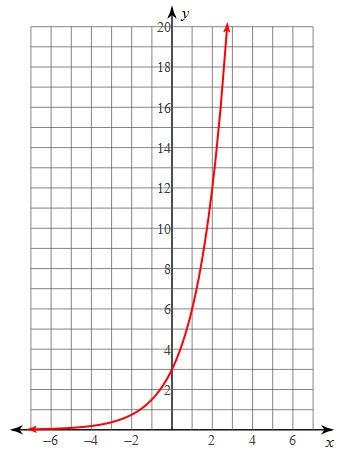
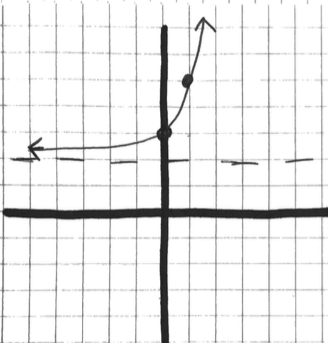
Write the equation of the graph.
f(x)=(31)x+2
f(x) = 3x - 2
f(x) = 3x + 2
f(x)=(31)x−2

What is the asymptote of y = 2x-3 ?
y = 0
y = -3
x = 0
x = -3

Which equation matches the graph?
y = 4x + 3
y = 4x - 3
y = 4x + 3
y = 4x - 3

Which equation matches the graph?
y = 4x + 3
y = 4x - 3
y = 4x + 3
y = 4x - 3

Which equation matches the graph?
y = 4x - 6 - 3
y = 4x + 6 - 3
y = 4x - 6 + 3
y = 4x + 6 + 3
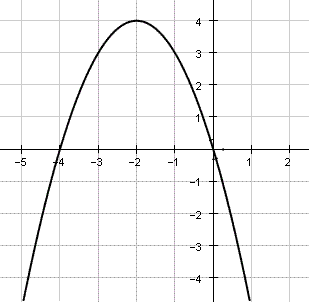
What is the vertex of this quadratic equation?
y = - (x + 2)2 + 4
(-2, 4)
(2, 4)
(4,-2)
(-4,-2)
What is the vertex of this quadratic equation?
y = 2(x - 2)2 + 4
(-2, 4)
(2, 4)
(4, 4)
(2, -4)
The graph of a quadratic will always be ...
a line
a V
a parabola
a squiggle
What is the vertex of the parabola: y=2(x-3)2+4
(3,4)
(-3,4)
(3, -4)
(-3,-4)
What is the vertex of the parabola:
y=2(x + 3)2+4
(3,4)
(-3,4)
(-6, 4)
(-6,-4)

What is the vertex of this parabola?
y = x2 + 5
(5, 0)
(-5, 0)
(0, 5)
(0, 0)
What is the vertex of this parabola?
y = (x+7)2
(49, 0)
(-7, 0)
(0, 7)
(0, -7)
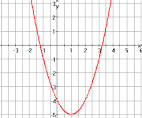
Where is the axis of symmetry?

Find the vertex:
y = -5(x + 1)2 - 8
(-1, -8)
(1, -8)
(-1. 8)
(1, 8)
Find the axis of symmetry:
y = ½(x + 3)2 + 4
x = -3
x = 3
x = 4
x = -4
Find the y-intercept of:
y=2(x - 3)2 + 4
22
10
-14
13
Find the y-intercept:
y = -5(x + 1)2 - 8
-13
13
3
12
What is the vertex, axis of symmetry, does the graph opens up or down, domain and range of the given parabola:
y=6(x-4)2-1?
Vertex: (4,-1)
Axis of Symmetry: x=4
Graph opens: up
Domain: all real numbers
Range: y≥-1
Vertex: (4,-1)
Axis of Symmetry: x = 4
Graph opens: up
Domain: x≥-1
Range: all real numbers
Vertex: (-4,1)
Axis of symmetry: y=-1
Graph opens: up
Domain: all real numbers
Range: y ≤-1
Vertex: (-4,1)
Axis of symmetry: x=-4
Graph opens: up
Domain: x≤-1
Range: all real numbers

Describe the transformation below: −(x+3)2+6
reflect over the x-axis
reflect over the x-axis, left: 3, up: 6
stretch, left: 3, down: 6
left: 3, down: 6
Describe the transformation below: −3(x+4)2−1
stretch by 3, right: 4, down: 1
reflect over the x-axis, right: 4, down: 1
reflect over the x-axis, stretch by 3, left: 4, down: 1
stretch by 4, down: 3, left: 1
Determine if the following function will be narrow (stretch) or wider (shrink): 4(x−3)2+4 (a)
Determine if the following is narrow or wider: 32(x+3)2+6 (a)
What is a quadratic funtion in the form of f(x)=a(x−h)2+k called? (a)
What is the vertex of f(x)=(x+4)2
(0,4)
(4,0)
(-4,0)
(0,-4)
f(x)=−(x−4)2+1 Choose the correct graph of the equation.


Which describes the transformation of the graph f(x) = x2 to the graph of g(x) = 5x2 ?


Which equation is graphed above?
y=−(x−1)2+4
y=(x−1)2+4
y=−(x−4)2+1
y=(x−4)2+1
Explain the transformation of
y=(x+3)2 - 1
right 3 , down 1
Left 3, down 1
left 1, Down 3
Right 1, UP 3
What is this quadratic equation called ?
y = x2
Mom and Pop
Home base
the Goal
the Parent function
What is the only transformation of this equation
y= - x2
up 1
down 1
reflected ( flipped)
wider ( shrink)

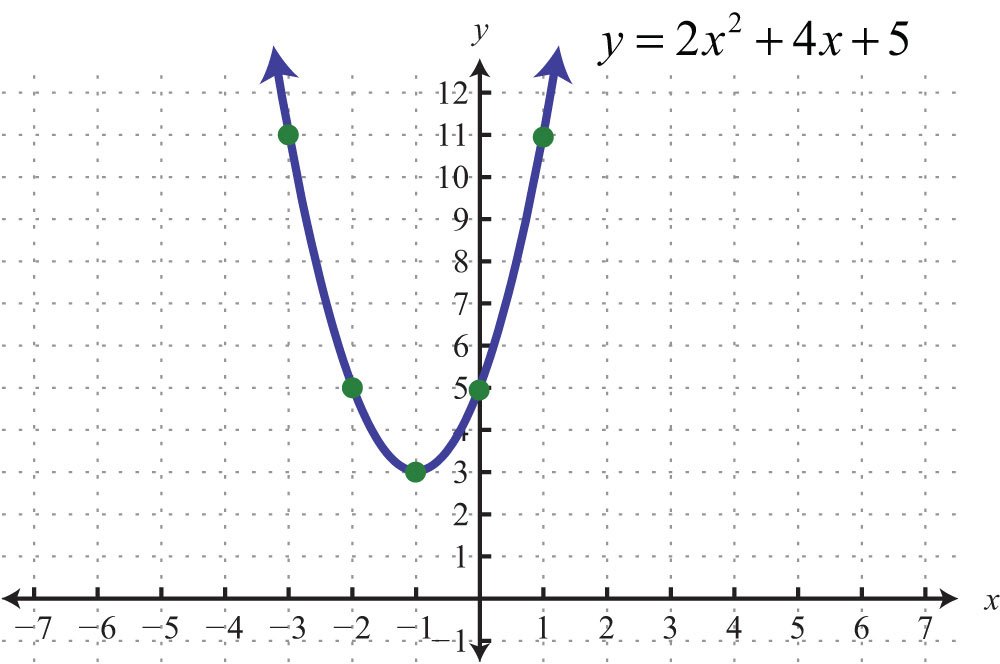

Use the graph to determine the x-intercepts.
-1 and -3
1 and -3
1 and 3
-1 and 3
Which of the following describes the transformations done to the quadratic parent function of f(x) = x2 to obtain g(x) = 2x2 + 4 ?
Vertical Stretch by a factor of 2 and vertical shift up 4 units
Vertical Compress by a factor 2 and vertical shift up 4
Vertical Stretch by a factor of 2 and horizontal shift left 4 units
Vertical Compress by a factor of 2 and horizontal shift right 4 units
What is the equation of the quadratic function obtained from vertically compressing the parent function by 3/5 and then shifted up 8 units?
f(x)= 3/5(x-8)2
f(x)=3/5x2+8
f(x)=x2
f(x)=3/5x2-8
What is the equation of the quadratic function obtained from vertically compressing the parent function by a factor of 0.5 and then reflecting across the x-axis?
f(x)= 0.5x2
f(x)= -0.5x2
f(x)= -(x-0.5)2
f(x)= x2+0.5

f(x) = x2
then the red must be...

