
 Worksheets
Unit 10A - Describing Circuits with Words
Total questions: 35
Worksheet time: 12mins

This image is an example of a parallel circuit
true
false
Voltage does not depend on the devices within a circuit... i.e. adding a lamp.
True
False
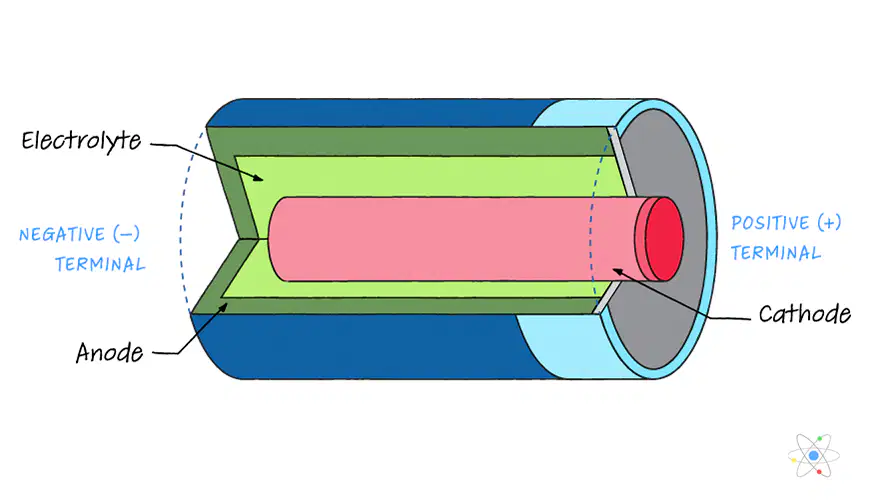
Energy storage device that provides a constant potential difference between 2 locations called terminals
Battery
Conductor
Capacitor
Cell
The net movement of electrons through a conductor; measured with an ammeter
current
static electricity
electric discharge

Look at the diagram. What is the term for "A"?
Conductor
Switch
Transformer
Source
What is an electrical insulator?
a material that allows electrons to flow freely between its atoms/nuclei
a material that somewhat allows electrons to flow between its atoms/nuclei
a property of matter that can be either positive or negative
a material that blocks electrons from flowing freely between its atoms/nuclei
What is an electrical semiconductor?
a material that allows electrons to flow freely between its atoms/nuclei
a material that somewhat allows electrons to flow between its atoms/nuclei
a property of matter that can be either positive or negative
a material that blocks electrons from flowing freely between its atoms/nuclei
How do aligned batteries affect voltage?
More volts means less power
More volts means more power
The positive terminal on a battery is called the
anode
collector
cathode
electrolyte

Look at the diagram. What is the term for "C"?
Conductor
Switch
Transformer
Source
What is an electrical conductor?
a material that allows electrons to flow freely between its atoms/nuclei
a material that somewhat allows electrons to flow between its atoms/nuclei
a property of matter that can be either positive or negative
a material that blocks electrons from flowing freely between its atoms/nuclei
Cloth Rag
Plastic Bottle
Gold Ring
Wooden Spoon

Look at the diagram. What is the term for "B"?
Conductor
Switch
Transformer
Source

A PATH along which electricity can flow is a ___________________?
light bulb
switch
insulator
circuit
What is an electrical charge?
a material that allows electrons to flow freely between its atoms/nuclei
a material that somewhat allows electrons to flow between its atoms/nuclei
a property of matter that can be either positive or negative
a material that blocks electrons from flowing freely between its atoms/nuclei
The negative terminal on a battery is called the
anode
cathode
collector
electrolyte
Voltage is measured as joules of kinetic energy per coulomb of positive charge.
True
False
TRUE / FALSE: A battery does not generate electricity, it converts it from chemical potential energy.
TRUE
FALSE
A device containing an electric cell (or a series of electric cells) storing energy that can be converted into electric power
capacitor
battery
resisitor
ammeter
What is an open circuit?
an electric circuit that has only one possible path through which electric charge can flow
an electric circuit that has more than one path or branch through which electric charge can flow
a circuit with a break in it, which prevents the flow of electric charge
a circuit with no breaks in it, which allows the flow of electric charge
What is a closed circuit?
an electric circuit that has only one possible path through which electric charge can flow
an electric circuit that has more than one path or branch through which electric charge can flow
a circuit with a break in it, which prevents the flow of electric charge
a circuit with no breaks in it, which allows the flow of electric charge
What is a series circuit?
an electric circuit that has only one possible path through which electric charge can flow
an electric circuit that has more than one path or branch through which electric charge can flow
a circuit with a break in it, which prevents the flow of electric charge
a circuit with no breaks in it, which allows the flow of electric charge
What is a parallel circuit?
an electric circuit that has only one possible path through which electric charge can flow
an electric circuit that has more than one path or branch through which electric charge can flow
a circuit with a break in it, which prevents the flow of electric charge
a circuit with no breaks in it, which allows the flow of electric charge
Part of an Alkaline battery that electrons can flow more freely in.
negative terminal
outer casing
positive terminal
brass pin
A ____ circuit has more than one path available for electrons to flow through, so if one portion of the circuit is not functioning, the whole circuit does not shut down
series
parallel
incomplete
complete
A ____ circuit has only one path for electrons to flow and therefore, when one portion of the circuit is disrupted, the whole circuit shuts down.
series
complete
incomplete
parallel

Look at the diagram. What is the term for "D"?
Conductor
Switch
Transformer
Source
What is a battery?
switch
power source
insulator

Which type of Circuit is shown
series circuit
parallel circuit

