Wayground logo

Free Printable Worksheets

Font size

S
M
L
XL
Worksheets

Cell Cycle, DNA Replication, Mitosis

Total questions: 37

Worksheet time: 31mins

Name
Class
Date
1.
During which phase of the cell cycle does the cell spend the most time?
a)
Mitosis
b)
Cytokinesis
c)
Interphase
2.
During which part of the cell cycle does the cell divide?
a)
Interphase
b)
Mitosis
c)
S phase
3.
During which part of the cell cycle is DNA copied?
a)
Mitosis
b)
Cytokinesis
c)
S phase
4.
During which parts of the cell cycle does the cell grow?
a)
G1 and G2
b)
G1 and S
c)
M phase and cytokinesis
5.
Which phase of mitosis is shown in the picture?
a)
Prophase
b)
Anaphase
c)
Telophase
6.
Which phase of mitosis is shown in the picture?
a)
Interphase
b)
Metaphase
c)
Telophase
7.
Which phase of mitosis is shown in the picture?
a)
Prophase
b)
Metaphase
c)
Anaphase
8.
Which phase of mitosis is shown in the picture?
a)
Prophase
b)
Telophase
c)
Metaphase
9.
What is shown in the picture?
a)
Mitosis
b)
Interphase
c)
Cytokinesis
10.
What is the purpose of the cell cycle?
a)
To create new daughter cells
b)
To prevent cancer from developing
c)
To help the body fight viruses and bacteria
11.

Uncontrolled cell division which usually leads to tumors and disease is called:

a)

Metaphase

b)

Cytokinesis

c)

Cancer

d)

Diabetes

12.

Match the image to the correct answer

a)

1.

Prophase

b)

2.

Metaphase

c)

3.

Anaphase

d)

4.

Telophase

e)

5.

Cytokinesis

13.

Mitosis is the division of the​ (a)  

Choose from the below words
nucleus
cytoplasm
14.

Cytokinesis is the division of the ​ (a)  

Choose from the below words
cytoplasm
nucleus
15.

Match each phase with its correct description

a)

Cell grows rapidly while carrying out normal functions.

1.

G1 Phase

b)

Cells must replicate their DNA before cell division to ensure that identical genetic information is passed to  the next generation.

2.

S Phase

c)
  • FINISHES GROWING

  • Errors in DNA replication are checked- if something is wrong, cell needs to fix its errors before it divides!

3.

G2 Phase

16.

What happens during G1 phase

a)

Cell grows rapidly

b)

DNA replication

c)

Checks for errors in DNA

d)

Cell divides

17.

What happens during G2 phase

a)

Cell grows rapidly

b)

DNA replication

c)

Checks for errors in DNA

d)

Cell divides

18.

What is the result of the cell cycle?

a)

Three cells

b)

Four daughter cells

c)

2 identical cells

d)

1 clone cell

19.
Which 2 molecules form the sides (backbone) of the DNA ladder?
a)
deoxyribose sugar and adenine
b)
deoxyribose sugar and a hydrogen bond
c)
deoxyribose sugar and the nucleus
d)
deoxyribose sugar and phosphate
20.
Which organelle is DNA usually found in?
a)
cell membrane
b)
vacuole
c)
chloroplast
d)
nucleus
21.
Nitrogenous bases are joined by which type of bond?
a)
polar bonds
b)
ionic bonds
c)
covalent bonds
d)
hydrogen bonds
22.
The enzyme that unzips the DNA to prepare for replication
a)
helicase
b)
replicase
c)
polymerase
d)
synthase
23.
DNA replication results in two DNA molecules,
a)
each one with two original strands
b)
each one with two new strands
c)
each one with one new strand and one original strand
d)
one with two new strands and the other with two original strands
24.
order of replication
a)
3, 2, 1, 4
b)
2, 1, 4, 3
c)
2, 3, 1, 4
d)
3, 4, 1, 2
25.
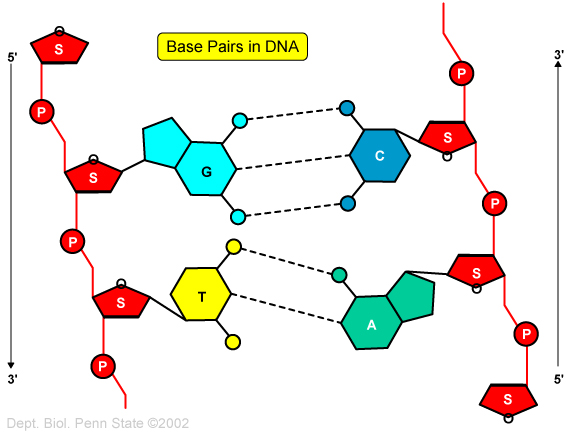
Diagram represents a portion of DNA molecule. The letters represent different types of
a)
sugar molecules
b)
molecular bases
c)
enzymes
d)
proteins
26.

Which of the following units are repeatedly joined together to form a strand of DNA?

a)

Amino Acids

b)

Nucleotides

c)

Fatty Acids

d)

Polysaccharides

27.

Why is DNA important?

a)

it is very small and very complicated

b)

it's in everything

c)

it serves as the blueprint for traits of all living things

d)

because we eat it every day for energy

28.

What does DNA stand for?

a)

Deoxyribonucleic acid

b)

Denitrogenous acid

c)

Deribonucleic acid

d)

Diribonucleic acid

29.

What is needed for DNA replication to unzip at the hydrogen bonds?

a)

phosphates

b)

enzymes

c)

deoxyribose (sugar)

d)

hydrogen

30.

What is a mutation?

a)

Adenine

b)

a change/mistake in DNA

c)

a copy of the original DNA

d)

Guanine

31.

This is an example of -

THE DOG HID THE TOY (ORIGINAL)

THE DOH IDT HET OY? (NEW)

a)

addition

b)

substitution

c)

deletion

32.

This is an example of -

THE DOG HID THE TOY (ORIGINAL)

THE DOG SHI DTH ETO Y??

a)

addition

b)

deletion

c)

substitution

33.

This is an example of -

THE DOG HID THE TOY (ORIGINAL)

THE DOG HIM THE TOY (NEW)

a)

addition

b)

deletion

c)

substitution

34.

Point mutations result from -

a)

none of these

b)

substitutions

c)

additions

d)

deletions

35.
Are all mutations bad?
a)
Yes
b)
No
36.
What mutation has occurred here? 
T-G-A-C-C-A
T-G-A-G-C-A
a)
Substitution
b)
Deletion
c)
Insertion
d)
Frameshift 
37.
Identify the DELETION mutation from the following DNA sequence: 
ATG CCA AAT
a)
ATG TCA AAT
b)
ATG CCT AAA T
c)
ATC CA  AT
d)
ATG CCA AAT