
 Worksheets
Industrial Automation Quiz
Total questions: 21
Worksheet time: 11mins
What is industrial automation primarily used for?
To increase manual labor
To reduce human intervention and improve efficiency
To replace computers with manual processes
To decrease the use of technology in industries
When did industrial automation start gaining significant traction?
During the 20th Century
During the 18th Century
During the 19th Century
During the 21st Century
What marked a significant advancement in automation technology in the 1960s?
Development of artificial intelligence
Introduction of machine learning
Development of programmable logic controllers (PLCs)
Invention of the steam engine
Which technologies are involved in modern industrial automation?
Robotics, artificial intelligence, and machine learning
Steam engines and manual tools
Typewriters and telegraphs
Handcrafted machinery and manual labor
What is a potential challenge of industrial automation?
Decrease in production efficiency
High initial cost and fear of job losses
Increase in manual labor
Reduction in technological advancements
What is the role of control systems in industrial automation?
To perform repetitive tasks
To manage and regulate industrial processes
To provide real-time data
To integrate various systems
Which aspect of industrial automation involves using robots to perform tasks?
Data Analysis
Sensors
Robotics
Integration
How do sensors contribute to industrial automation?
By assembling products
By providing real-time data and enabling feedback loops
By managing inventory
By regulating chemical processes
What is an example of industrial automation in warehouse operations?
Managing inventory
Welding parts
Moving materials with automated guided vehicles
Regulating chemical processes
In which area of industrial automation are automated control systems used to monitor and regulate chemical processes?
Manufacturing
Supply Chain
Warehouse Operations
Process Industries
What does "magazining" refer to in industrial automation?
The process of loading and unloading components into a machine's magazine
The process of publishing industrial magazines
The process of designing machine parts
The process of painting industrial equipment
Which of the following is an example of a machine that uses magazining?
CNC machines
Washing machines
Printing presses
Textile looms
What does CNC Stand for?
(a)
What is the role of a conveyor in industrial automation?
To facilitate the movement of materials
To design new machinery
To paint industrial equipment
To publish industrial magazines
How is "conveying" different from "conveyor" in the context of material handling?
Conveying is the action, while a conveyor is the equipment
Conveying is the equipment, while a conveyor is the action
Both are the same and interchangeable
Conveying is a type of conveyor
What is the primary function of a sensor?
To store data
To detect and respond to physical inputs
To generate electricity
To display images
Which type of sensor is used to measure heat and cold?
Light sensor
Motion sensor
Temperature sensor
Sound sensor
What do proximity sensors detect?
Light intensity
Chemical concentrations
Presence of objects without physical contact
Sound levels
Which sensor is used to monitor pressure in liquids or gases?
Magnetic sensor
Pressure sensor
Motion sensor
Chemical sensor
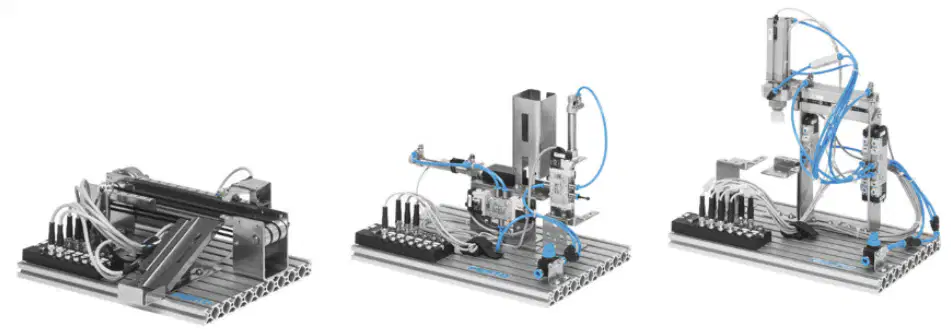
What is the primary purpose of MecLab learning stations?
To provide insights into automation and production technology
To simulate circuit diagrams in pneumatics
To connect devices to a PC
To override automated systems
What does the manufacturing process primarily involve?
Converting services into products
Converting raw materials into finished goods
Assembling people into industrial processes
Developing new technologies

