
 Worksheets
Evolution Review
Total questions: 41
Worksheet time: 35mins
Name
Class
Date
1.
In Biology, what is evolution?
a)
This is when individuals change their adaptations.
b)
This is how natural selection occurs.
c)
This is the variety of species that live on Earth.
d)
This is the gradual change of heritable traits of living things over time.
2.
TRUE OR FALSE: Evolution states that all living organisms descended from a single common ancestor.
a)
True
b)
False
3.
While on the Galapagos islands, Darwin observed variety in one type of animal that was later used to help him form his theory of natural selection. Which type of animal was this?
a)
Finches
b)
Lizards
c)
Lemurs
d)
Bananas
4.
Natural selection can also be described as "Survival of the ____________". What is the missing word?
a)
Bravest
b)
Fittest
c)
Oldest
d)
Youngest
5.
A characteristic that enables an organism to survive in its environment is called a/an _______________".
a)
Speciation
b)
Adaptation
c)
Gift
d)
Trait
6.
Another example of genetic drift is when a large proportion of the population is lost, e.g. through natural disaster. The surviving population may not be representative of the original population. This is known as the "__________" effect.
a)
Bottleneck
b)
Founder
c)
Gene Flow
d)
Natural Selection
7.
Which name is given to the preserved remains or traces of dead organisms?
a)
Extinctions
b)
Fossils
c)
Mutations
d)
Variations
8.
What do we call structures that no longer have a function in an organism? Example: Coccyx (tailbone)
a)
Vestigial
b)
Homologous
c)
Analogous
d)
Deleterious
9.
What do we call structures found in different species that have shared ancestry?
a)
Vestigial
b)
Homologous
c)
Analogous
d)
Deleterious
10.

Which layer of rock is the oldest?
The image below shows fossils found in rock.
a)
A
b)
B
c)
C
11.
What is speciation?
a)
The process of a species becoming extinct
b)
The process by which new species form
c)
The evolution of all species over time
d)
The rapid accumulation of mutations in a species
12.
Two populations of a bird species develop different courtship songs. Over time, they stop interbreeding, due to different preferences in songs, and become two separate species. Which type of isolation caused this speciation?
a)
Behavioral Isolation
b)
Gametic Isolation
c)
Habitat Isolation
d)
Barrier Isolation
13.
A plains zebra crossed with a donkey forms a hybrid called a zonkey. The zebra has 44 chromosomes, while the donkey has 62 chromosomes. How many chromosomes would you expect a zonkey to have?
a)
106
b)
53
c)
84
d)
75
14.
Which of these is NOT a factor that can cause extinction?
a)
New predators
b)
New, more successful competitors
c)
A beneficial mutation
d)
A catastrophic event
15.
What is classification in biology?
a)
Deciding which species have the best features
b)
Determining class systems for groups of animals
c)
The process of sorting of species into groups
d)
The splitting all species into the animal or plant kingdom
16.
What is the gradual change in species over time called?
a)
Adaptations
b)
Natural Selection
c)
Evolution
d)
Nucleotide
17.
What is it called when species adjust to a changing environment?
a)
mutation
b)
adapt
c)
create
d)
move
18.
Another word for adapt is.......
a)
create
b)
change
c)
move
d)
transform
19.
Which term refers to the process by which individuals that are better suited to the environment survive and reproduce therefore passing down their genes to their offspring?
a)
variation
b)
natural selection
c)
evolution
d)
adaptation
20.
What is it called when an organism completely dies out?
a)
mutation
b)
fossilization
c)
extinction
d)
adaptation
21.
Genetic differences between organisms of the same species is known as......
a)
variation
b)
environment
c)
adaptation
d)
behavior
22.
The Theory of Evolution was proposed by what scientist?
a)
Albert Einstein
b)
Charles Darwin
c)
Isaac Newton
d)
Steven Hawking
23.

The trees these moths used to live on were white, but have been covered in black soot from coal factories. Which moth will be more successful in this environment?
a)
Light moth
b)
Both will be equally successful
c)
Dark moth
d)
Neither will be more successful
24.
What is a relative who lived in the past called?
a)
Ancestor
b)
Descendant
c)
Charles Darwin
d)
Speciation
25.
An original species from which all other species evolved is known as....
a)
Descendant
b)
Common Ancestor
c)
Fossil
d)
Family Member
26.

The gradual change in species over time is...
a)
Evolution
b)
Nucleotide
c)
Adaptation
d)
Natural Selection
27.

To adjust to a changing environment
a)
Mutation
b)
Adapt
28.

Another word for adapt is ____________.
a)
change
b)
create
29.
Which term refers to the process by which individuals that are better suited to the environment survive and reproduce therefore passing down their genes to their offspring?
a)
Evolution
b)
Variation
c)
Adaptation
d)
Natural Selection
30.
When an organism completely dies out, it is called.....
a)
Adaption
b)
Extinction
c)
Fossilization
d)
Mutation
31.
The white feathers of a snowy owl allow it to blend in with its environment during the winter months (snow). This is an example of ________________
a)
Species
b)
Environmental Change
c)
Adaptation
d)
Variation
32.
Genetic differences between organisms of the same species
a)
Variation
b)
Adaptation
c)
Behavior
d)
Environment
33.
Remains of ancient organisms are called
a)
Extinctions
b)
Fossils
c)
Mutations
d)
Variations
34.
Definition: fossil record
a)
remains of dead organisms
b)
related organisms have the same bone makeup
c)
in the early stages of development dogs, pigs, and humans resemble one another
35.
The Theory of Evolution was proposed by what scientist?
a)
Charles Darwin
b)
Albert Einstein
c)
Steven Hawking
d)
Isaac Newton
36.
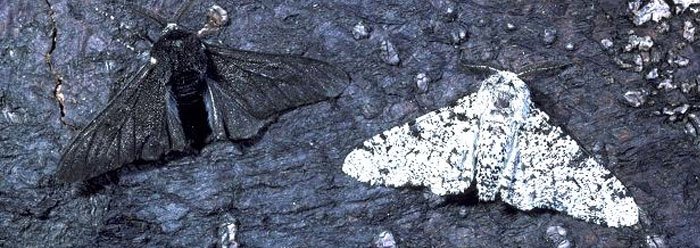
The trees these moths used to live on were white, but have been covered in soot from coal factories. Which moth will be more successful in this environment?
a)
Dark moth
b)
Light moth
c)
Both will be equally successful
d)
Neither will be successful
37.

A relative who lived in the past.
a)
Charles Darwin
b)
Speciation
c)
Ancestor
d)
Descendant
38.

An original species from which all other species evolved.
a)
Fossil
b)
Natural Selection
c)
Descendant
d)
Common Ancestor
39.

A term that typically describes a species that no longer has any known living individuals
a)
Generation Time
b)
Fossil Record
c)
Extinct
d)Speciation
40.

The information provided by fossils about the Earth's history.
a)
Fossil Record
b)
Extinction
c)
Evolution
d)
Genetic Variation
41.
What is an organism that has similar characteristics and can reproduce?
a)
species
b)
organism
c)
embryology
d)
vestigial
100 %

