
 Worksheets
Plate Tectonics
Total questions: 49
Worksheet time: 25mins

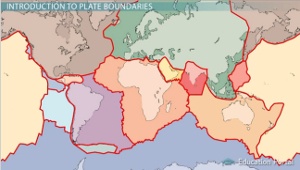
Plate Boundary
The place where two plates meet; most volcanoes and earthquakes occur here.
The location where the food falls onto the table.
Where one country ends and another begins.
The edge of your patella.

Seafloor spreading

The place where two plates meet.
plate boundary
tectonic plate
asthenosphere
crust

Forms at a convergent boundary
Who came up with the idea that all the continents were once joined together?
Albert Einstein
Alfred Wegener
Charles Darwin
What is Pangaea?
an ice sheet which covered several continents
the fossil of a fern found on different continents
a mountain belt linking two continents
a supercontinent that contained all the continents
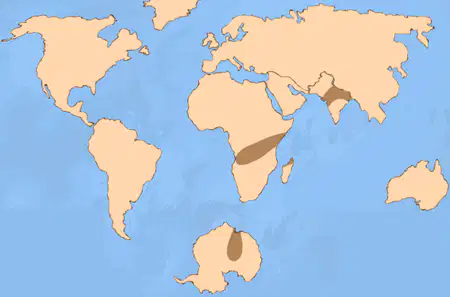
Lystrosaurus was a slow-moving, plant-eating reptile that lived over 250 million years ago. Fossils of Lystrosaurus have been found in the brown areas shown below. How is this explained by the existence of Pangaea?
Lystrosaurus swam across the oceans from one continent to another.
Lystrosaurus drifted on rafts of vegetation from one continent to another.
Land bridges once crossed oceans to connect Africa, Antarctica, and India.
Africa, Antarctica, and India used to be joined together into a single landmass.
What is the theory of continental drift?
The continents move slowly over Earth's surface.
The continents moved millions of years ago, but now they are fixed in one place.
The continents were fixed in one place, but recently they have begun to move.
What clue supported the continental drift hypothesis?
Fossils of animals have been found on continents separated by oceans
Similar coal beds and rock structures have been found on different continents
A puzzle-like fit of all the continents
All answers are correct
What is the source of most of the information scientists have about Earth's interior?
deep wells drilled in the ground
satellite imaging
analysis of earthquake waves
studies of landforms
Which layer of the Earth is made up of tectonic plates?
the core
the asthenosphere
the lithosphere
the mantle
What defines the mechanical layers of the Earth?
how the layers move and behave due to their strength and the pressure that they are under
how the layers are separated due to their different densities
Which mechanical layer of the Earth is made up of solid rock that is so hot it has the quality of plastic, or is soft enough to flow?
lithosphere
asthenosphere
lower mantle
outer core
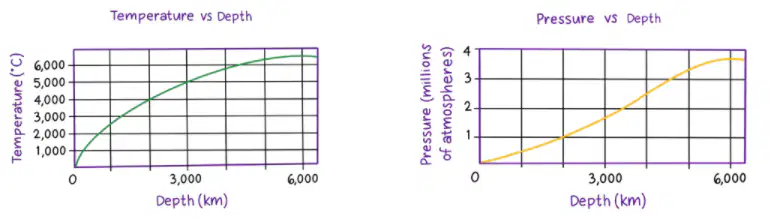
As scientists explore deeper and deeper into Earth's crust, what have they noticed about temperature and pressure?
both temperature and pressure decrease
both temperature and pressure increase
pressure increases while temperature decreases
temperature increases while pressure decreases
Which of the following is true about "S" waves?
They travel twice as fast as "P" waves.
They cannot travel through liquid.
The motion of the wave is parallel to the direction that the wave transfers energy.
Which of the following is the best definition of density?
the amount of space an object takes up
the amount of stuff that fits into a space
the amount of space that fits into a container
Why is Earth's interior layered?
when the Earth was formed, the inner core was formed first and then each layer formed one by one on top of the inner core
the inner core is magnetic so the more magnetism that a layer has, the closer that it gets to the inner core
each of Earth's layers has a different density and the most dense layer sinks farthest into the planet while the least dense layer 'floats' on top
By which method is heat from deep in Earth's interior transferred to its crust?
Subduction at mid-ocean ridges
Conduction in the ocean
Convection in the mantle
Which of the following is true about how heat affects fluids?
heat makes fluid less dense so it rises up
heat makes fluid more dense so it sinks
heat does not affect fluids
How are island chains like the Hawaiian and Galapagos archipelagos formed?
They are pieces that broke off of Pangaea
A tectonic plate moves over top of a hot spot, which vents to form each island one at a time
The islands were already there and changes in sea level made them rise up to the surface

Mount Everest sits at the plate boundary where the Indian Plate is crashing into the Eurasian Plate. What type of plate boundary is making Mount Everest taller and taller every year?
divergent boundary
convergent boundary
transform boundary

You can SCUBA dive between the North American and Eurasian tectonic plates in the Silfra Lake of Iceland. What type of plate boundary would you be diving in?
divergent boundary
convergent boundary
transform boundary
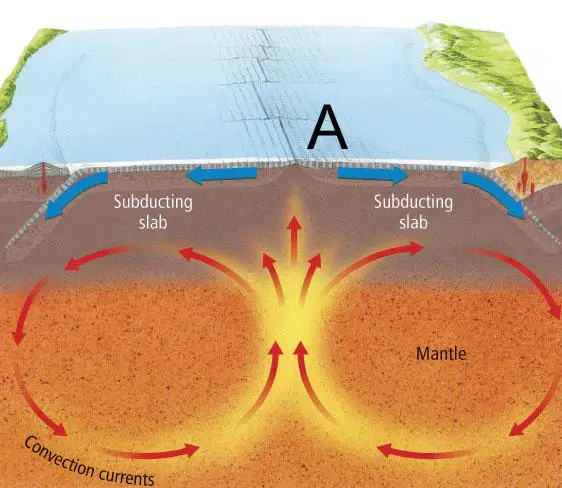
What is occurring at Letter A on the figure?
a mid-ocean ridge is forming
the sea floor is sinking
heat is melting the oceanic crust
What happens as the seafloor spreads apart?
The older oceanic crust folds into the mid-ocean ridge.
The newer oceanic crust is pushed under the mid-ocean ridge.
The older oceanic crust moves away from the mid-ocean ridge.
What do scientists believe is the force that drives plate tectonics?
the magnetic field
gravity
convection currents
Why might one plate be subducted (sink) under another plate at a convergent boundary?
Both plates are made of the same material.
One plate is denser than the other and will sink when the plates collide.
One plate is thicker than the other and will slide over the other plate.
One plate is moving faster than the other.
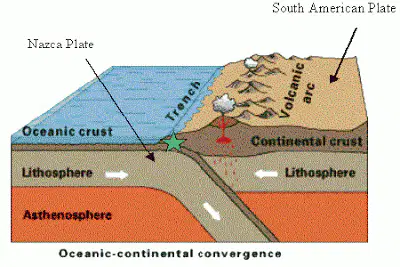
Which plate interaction has caused the tallest chain of volcanic mountains in the world, the Andes Mountains? (the Andes Mountains are located on the South American Plate)
the collision of the Nazca Plate and the South American Plate
the subduction of the Nazca Plate under the South American Plate
the diversion of the Nazca Plate and the South American Plate
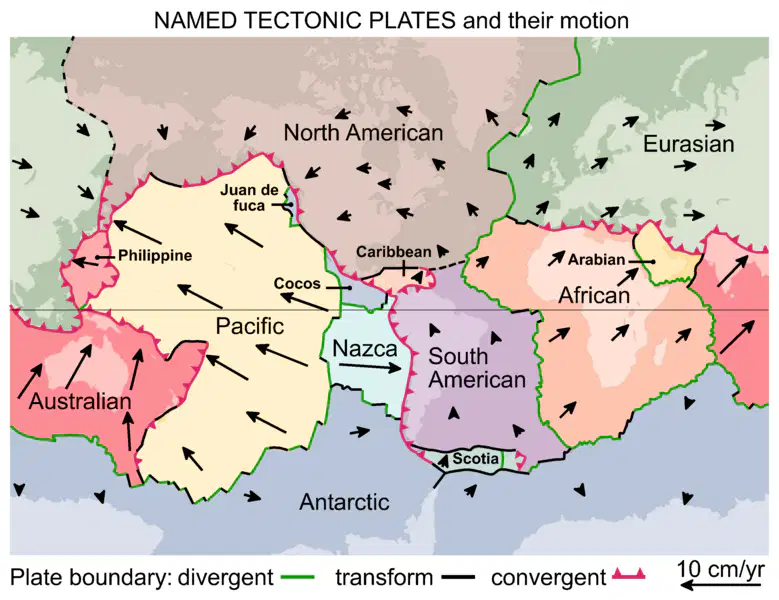
What type of natural disasters can be caused by the Australian Plate slamming into the Pacific Plate?
volcanic eruptions
earthquakes
tsunamis
all of these
Why doesn't the Earth's size get larger as new seafloor is created at mid-ocean ridges?
the Earth does actually get larger over geologic time
because seafloor is also destroyed by subduction at convergent plate boundaries
because the Earth's gravity keeps the Earth from getting larger

