
 Worksheets
U3L2a HW Econ: Supply
Total questions: 28
Worksheet time: 7hrs 0mins
The law of supply states that, all else being equal, an increase in price results in an increase in what?
Demand
Supply
Equilibrium
Cost
Differentiate between a change in quantity supplied and a change in supply.
A change in quantity supplied refers to a movement along the supply curve due to a change in price, while a change in supply refers to a shift of the entire supply curve due to factors other than price.
A change in quantity supplied refers to a shift of the entire supply curve due to factors other than price, while a change in supply refers to a movement along the supply curve due to a change in price.
Both a change in quantity supplied and a change in supply refer to a movement along the supply curve due to a change in price.
Both a change in quantity supplied and a change in supply refer to a shift of the entire supply curve due to factors other than price.
Explain how producers respond to changes in the price of resources.
Producers increase production when resource prices fall and decrease production when resource prices rise.
Producers decrease production when resource prices fall and increase production when resource prices rise.
Producers do not change production regardless of resource price changes.
Producers always increase production regardless of resource price changes.
Define subsidy.
A financial aid provided by the government to support a specific economic sector.
A tax imposed by the government on imported goods.
A regulation set by the government to control prices.
A loan given by banks to small businesses.
Which of the following is one of the five shifters (determinants) of supply?
Income of consumers
Prices of related goods
Tastes and preferences
Price of the good itself
Number of sellers
What influences the decisions of sellers? Choose the best answer
Market trends
Personal preferences
Government regulations
All of the above
What affects the ability of a business to produce? Choose the best answer
Market demand
Production technology
Availability of resources
All of the above

What is the definition of 'Supply'?
The total amount of a product available for purchase at any specified price.
The desire of consumers to purchase goods and services.
The difference between the highest and lowest prices of a product.
The cost of producing one additional unit of a product.
The Law of Supply states that, all else being equal, an increase in price results in an increase in what?
Demand
Supply
Equilibrium
Scarcity
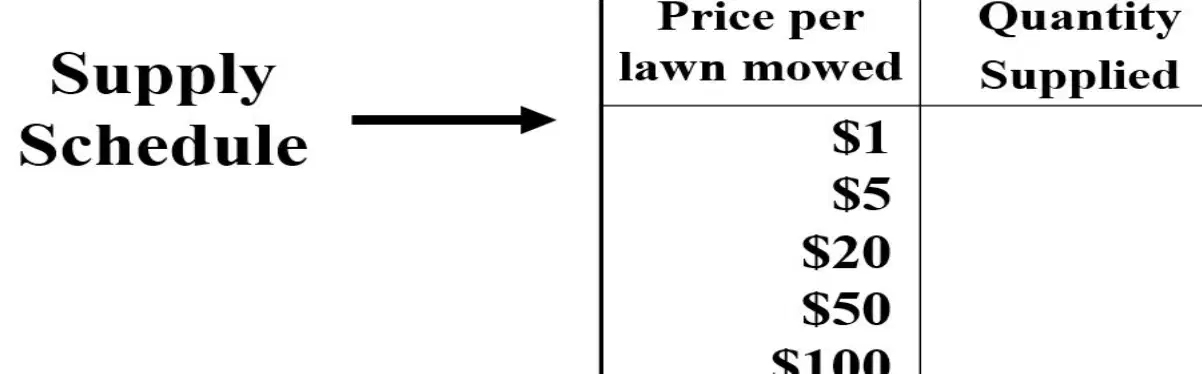
You own a lawn mower and you are willing to mow lawns. How many lawns will you mow at the price of $50 per lawn mowed?
0 lawns
1 lawn
2 lawns
3 lawns
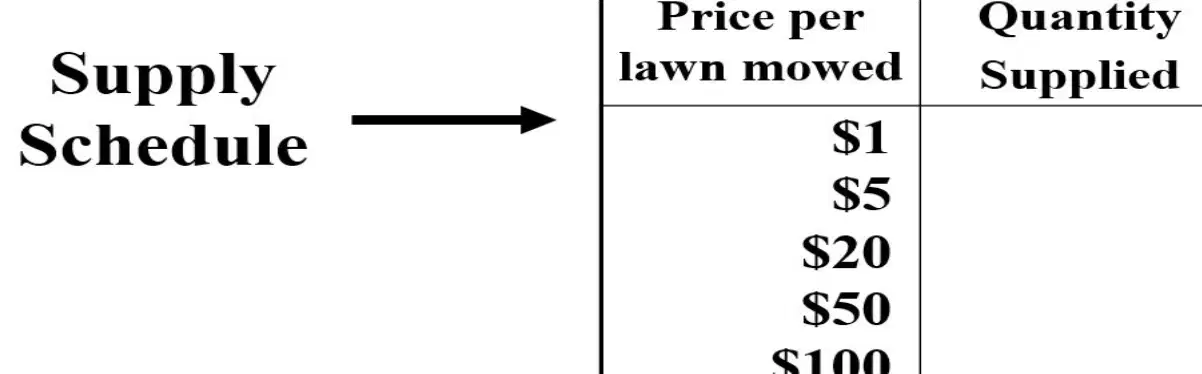
You own a lawn mower and you are willing to mow lawns. How many lawns will you mow at the price of $100 per lawn mowed?
The answer is not provided in the image.
One lawn
Two lawns
Three lawns
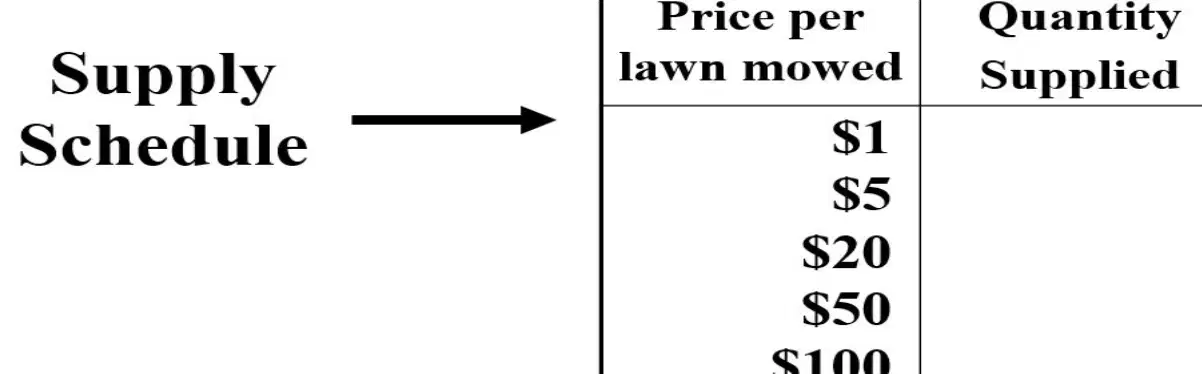
You own a lawn mower and you are willing to mow lawns. How many lawns will you mow at the price of $1000 per lawn mowed?
The answer is not provided in the image.
10 lawns
5 lawns
20 lawns
What is one of the determinants of supply?
Prices/Availability of inputs
Number of Buyers
Consumer Preferences
Income Levels
What does a subsidy do to the supply of a good?
Decreases it
Increases it
Has no effect
Eliminates it
Fill in the blank: A change in ______ doesn’t shift the curve. It only causes a movement along the curve.
PRICE
DEMAND
SUPPLY
QUANTITY
Which government action is a determinant of supply?
Taxes & Subsidies
Consumer Preferences
Income Levels
Number of Buyers
Fill in the blank: Expectations of future ______ is a determinant of supply.
Profit
Demand
Cost
Revenue
What is a government payment to a business or market that causes the supply of a good to increase?
Tax
Subsidy
Tariff
Quota

What is the quantity supplied when the price of milk is $5?
50
30
40
60

What is the price of milk when the quantity supplied is 30?
$3
$2
$4
$5
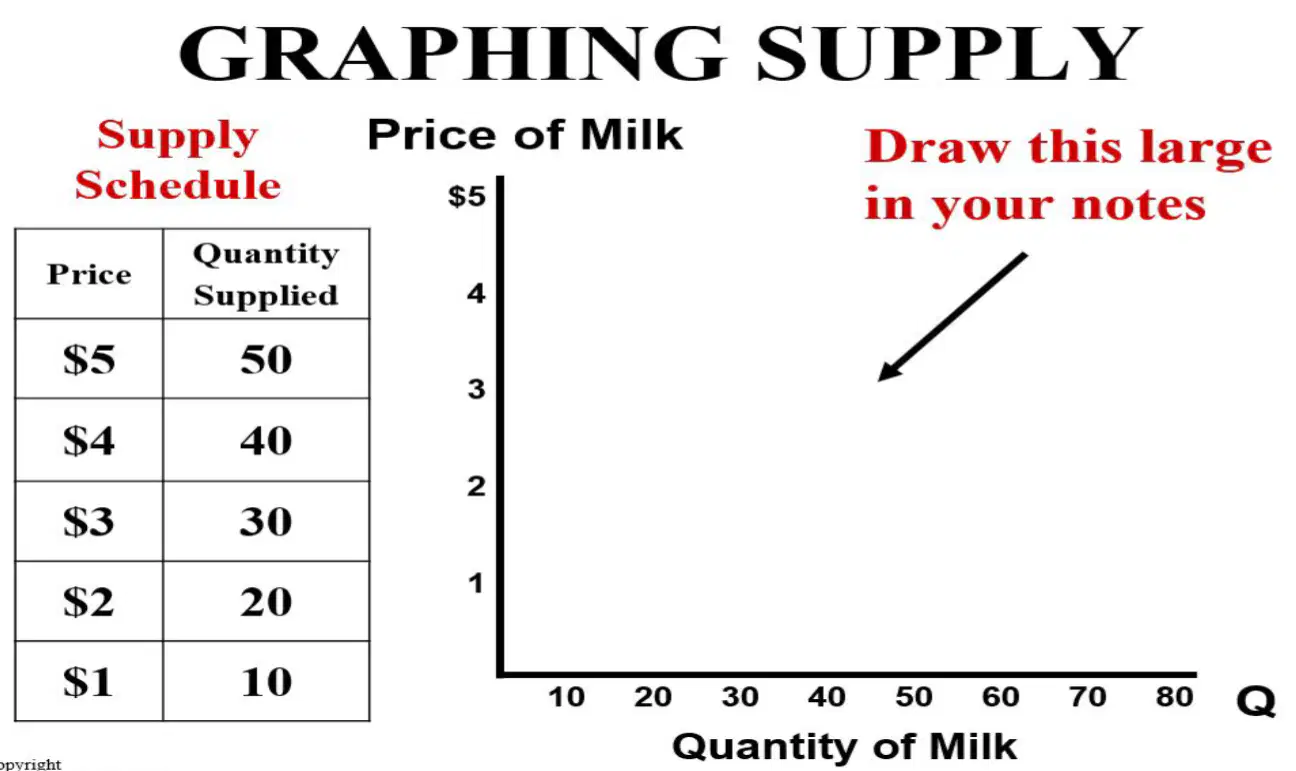
Which of the following is the correct quantity supplied when the price of milk is $2?
10
20
30
40

At what price is the quantity supplied 40?
$1
$2
$3
$4
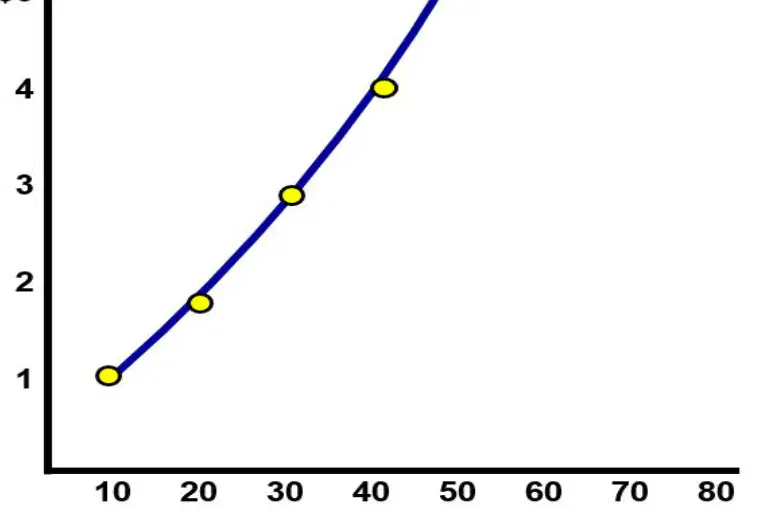
At what price is the quantity supplied 50 units?
$5
$10
$15
$20

Which of the following is true based on the supply schedule?
At $1, the quantity supplied is 10.
At $2, the quantity supplied is 30.
At $4, the quantity supplied is 50.
At $5, the quantity supplied is 20.
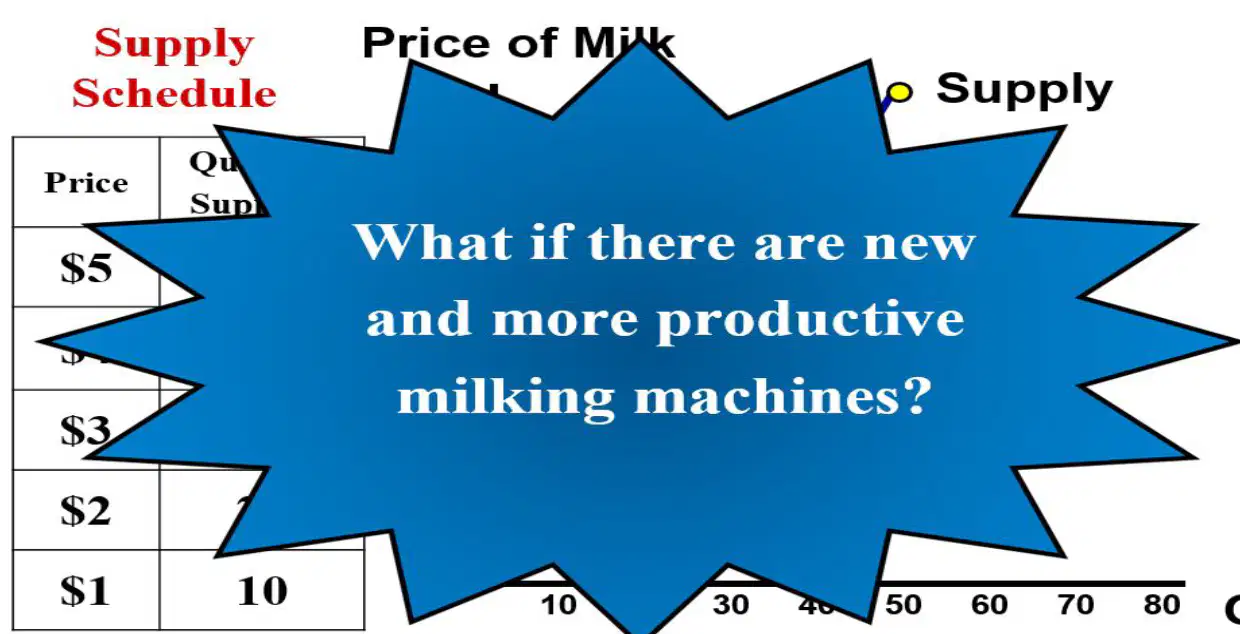
What if there are new and more productive milking machines?
It would increase milk production efficiency.
It would decrease milk production efficiency.
It would have no effect on milk production efficiency.
It would make milking machines obsolete.

What is the quantity supplied when the price of milk is $5 according to the supply schedule?
70
50
60
80
According to the graph from the slide deck, what happens to the price and supply when there is an increase in supply?
A) Prices increase
B) Prices decrease
C) Prices remain the same but more milk is produced
D) Prices remain the same and less milk is produced

Fill in the blank: When the price of milk is $3, the quantity supplied is ____.
50
40
60
70

