
Font size
 Worksheets
Common Ancestry and Cladograms TCAP Review
Total questions: 30
Worksheet time: 13mins
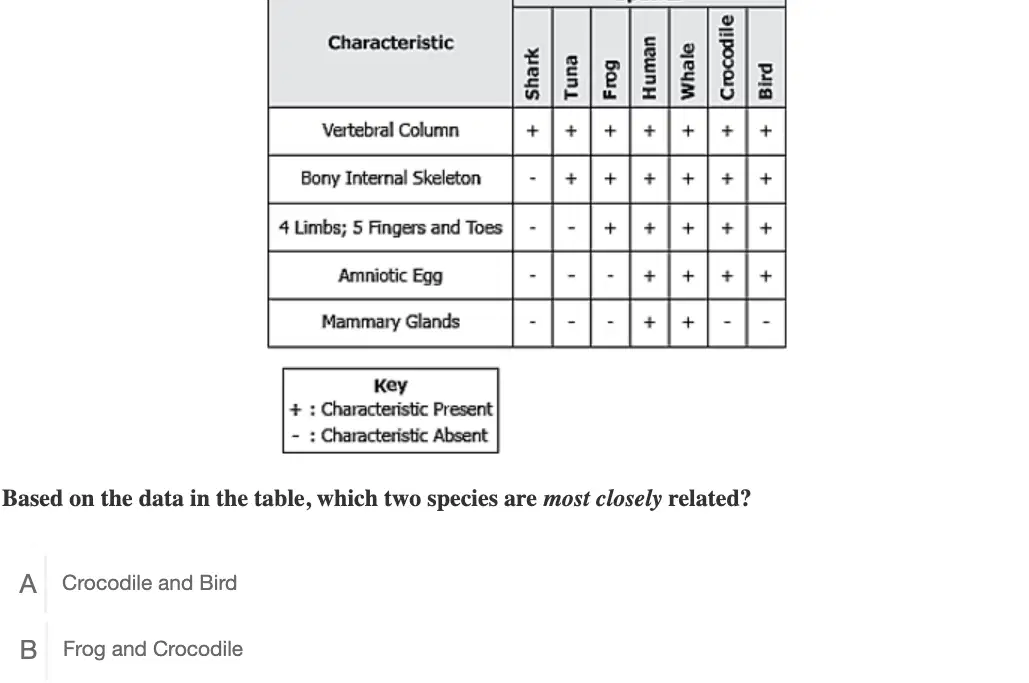
Based on the data in the table, which two species are most closely related?
Crocodile and Bird
Frog and Crocodile
Tuna and Whale
Whale and Shark
How does comparing the anatomies of living species with those from the fossil record help biologists to understand life on Earth better?
It helps reconstruct the evolutionary history of various species
It helps determine the habitat most suitable for various species.
It helps predict the time when various species will become extinct.
It helps modify various species for future environmental conditions.
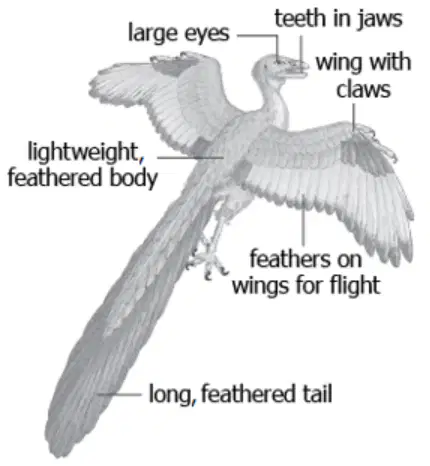
What can be inferred about the Archaeopteryx?
The Archaeopteryx may have been an ancestor of modern-day birds.
The Archaeopteryx could not fly very high.
The Archaeopteryx was an omnivorous animal.
The Archaeopteryx used to build its nest in trees.
Scientists believe that the Archaeopteryx is an ancestor of modern-day birds. How can the relationship between the Archaeopteryx and modern-day birds be established?
by studying the geologic conditions modern-day birds experience and the geologic conditions that existed during the time that the Archaeopteryx lived on Earth
by studying the fossils of modern-day birds and the animals that lived at the same time as the Archaeopteryx
by studying the anatomical similarities between modern-day birds and the fossils of the Archaeopteryx
by studying the climatic conditions modern-day birds experience and the climatic conditions that existed during the time that the Archaeopteryx lived on Earth
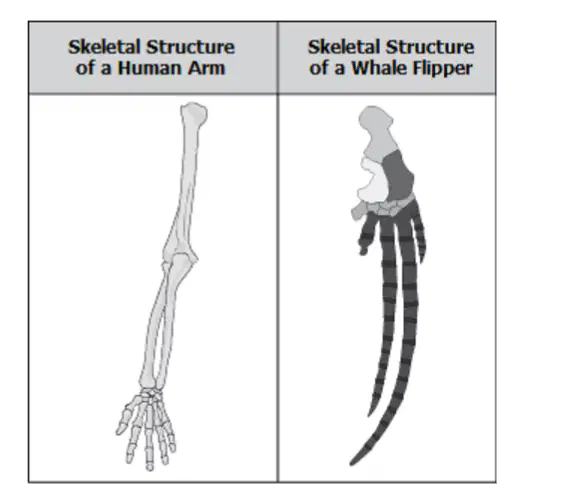
The image shows the skeletal structures of a human arm and whale flipper. Comparing the images, a student infers that both humans and whales evolved from a common ancestor. What evidence does the image provide to support the student’s conclusion?
The shape of bones in both skeletal structures is similar.
The length of bones in both skeletal structures is the same.
The function of bones in both skeletal structures is the same.
The arrangement of bones in both skeletal structures is similar.
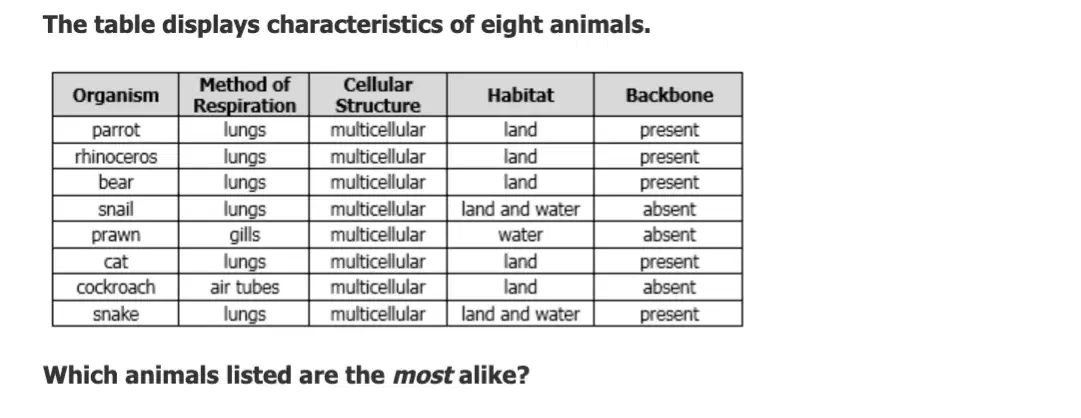
Which animals listed are the most alike?
snail, snake, and cat
cat, parrot, and rhinoceros
rhinoceros, parrot, and cockroach
bear, cat, and prawn
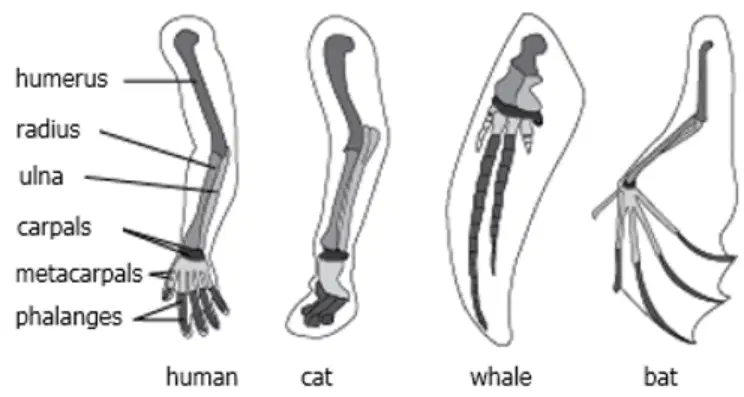
Use the image that shows the forelimbs of four different animals to answer the question. The image shows labeled bones (humerus, radius, ulna, carpals, metacarpals, phalanges) in the forelimbs of a human, cat, whale, and bat. How can the similarities among the animals best be described?
homologous structures
analogous structures
embryological structures
vestigial structures
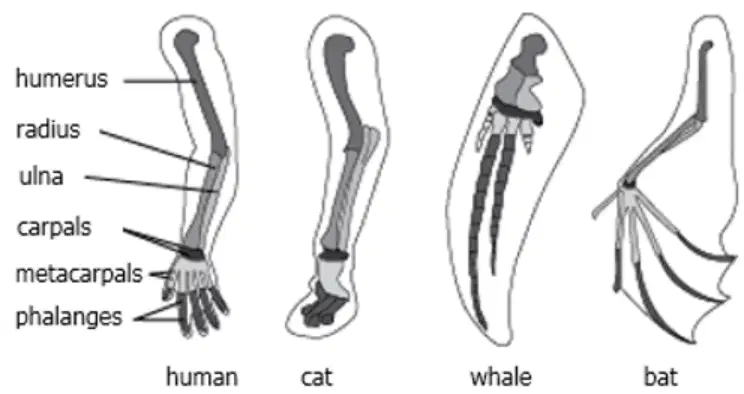
What evolutionary relationship do these organisms share?
They originated in the same geographical region.
They have similar methods of locomotion.
They have similar feeding methods.
They share a common ancestry.
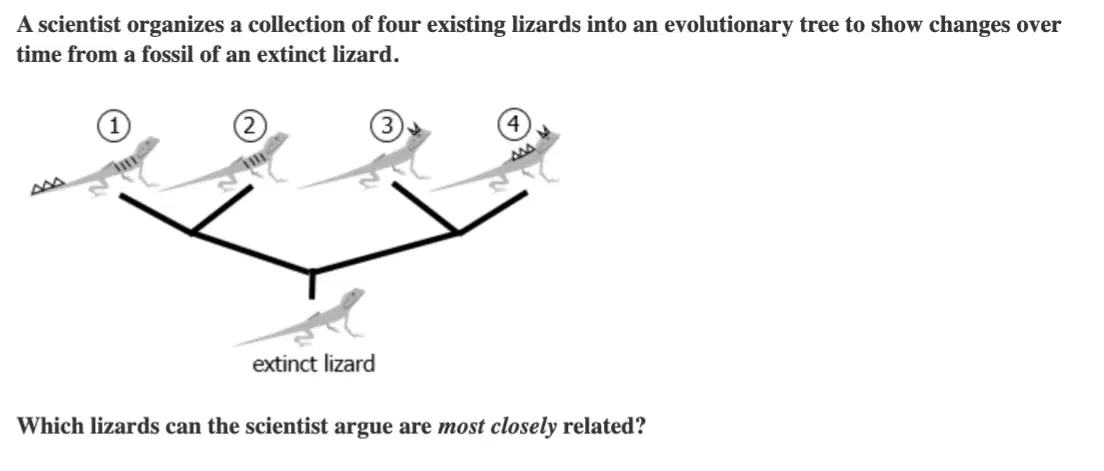
A scientist organizes a collection of four existing lizards into an evolutionary tree to show changes over time from a fossil of an extinct lizard. Which lizards can the scientist argue are most closely related?
lizards 1 and 4
lizards 1 and 2
lizards 2 and 3
lizards 2 and 4
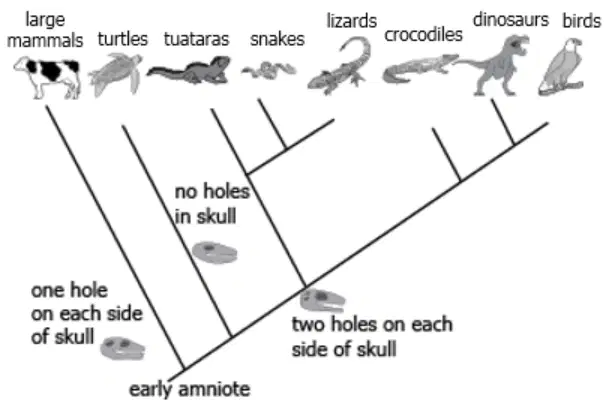
Which statement accurately describes a relationship between the organisms shown in the cladogram?
Snakes are most closely related to crocodiles.
Birds are most closely related to dinosaurs.
Large mammals have evolved from turtles.
Turtles have evolved from crocodiles.

How can the skeletons be used to determine evolutionary relationships among the three organisms?
Organisms that have similar bone structures share a common ancestor.
Organisms that have homologous structures do not share a common ancestor.
Organisms that have the ability to fly share a common ancestor.
Organisms that have backbones do not share a common ancestor.
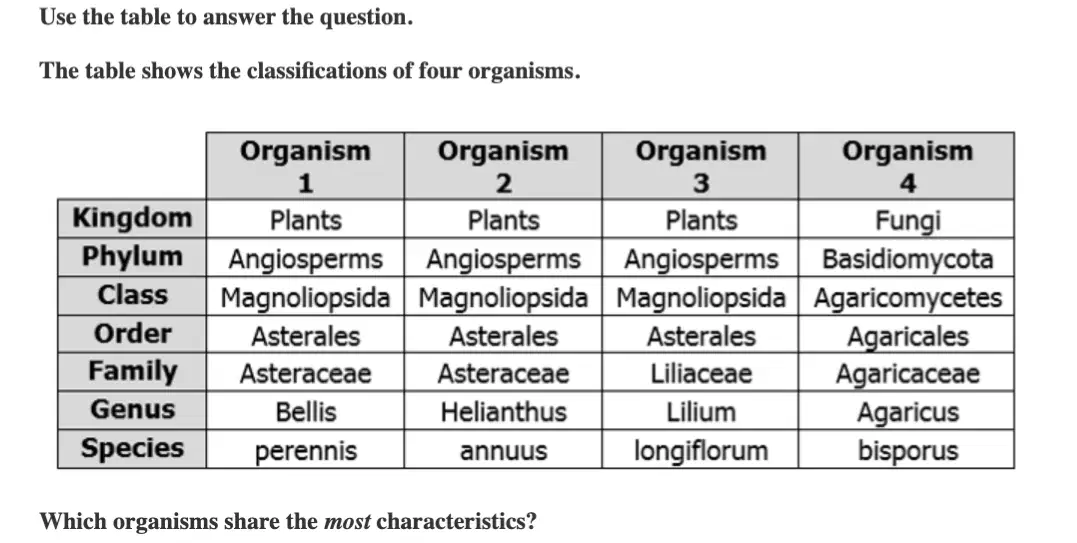
Which organisms share the most characteristics?
1 and 2
2 and 3
1 and 3
2 and 4
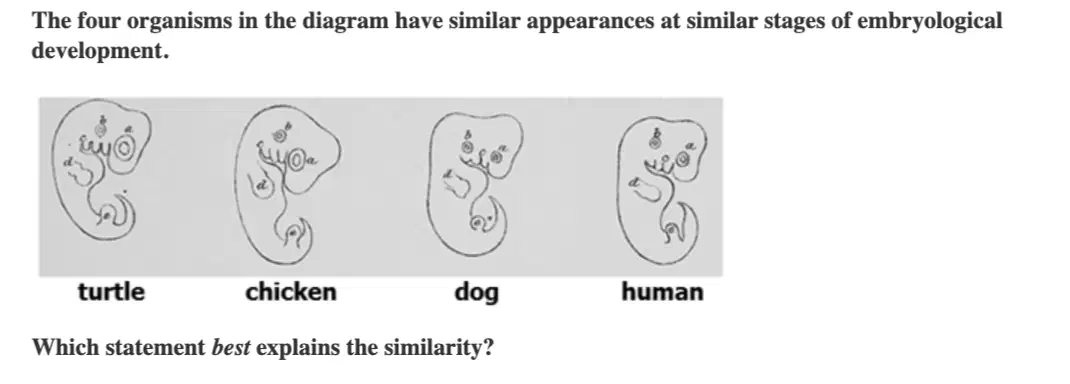
The four organisms in the diagram have similar appearances at similar stages of embryological development. Which statement best explains the similarity?
The embryos have tails as each adult body structure of the organisms has a tail.
The embryos have similar structures as each organism is part of the same species.
The embryos have similar structures due to random chance, and differences between the organisms come from a common ancestor.
The embryos have similar structures due to a common ancestor, and differences between the organisms come from adaptations.
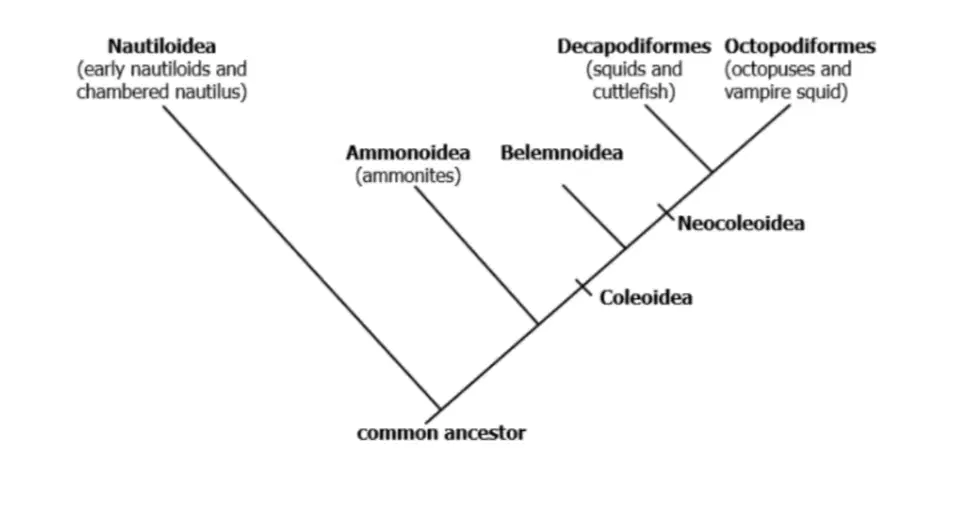
Refer to the diagram showing evolutionary relationships among cephalopod groups. Which two groups of organisms would be expected to have the most common features in embryonic development with the Decapodiformes?
Ammonoidea
Belemnoidea
Nautiloidea
Neocoleoidea
Octopodiforms
Bird wings and butterfly wings are an example of
homologous structure
mimicry
analogous structure
camouflage
Analogous structures show common ancestry.
True
False

Which organism has claws?
salamander
lizard
hagfish
perch
Organisms that are further apart on a cladogram are more closely related.
True
False

Which organisms have fur?
Chimp and Pigeon
Mouse and Pigeon
Mouse and Chimp
Pigeon and Perch
Humans, birds, whales, and lizards all have similar arm bones. What is the reason for this?
They may have a common ancestor.
They live in similar environments.
Function is the same in all animals.
All organisms resemble humans.

Which organism is more closely related to the lizard?
hagfish
chimp
perch
salamander
Structures that are inherited from a common ancestor are homologous.
True
False
Is a branch of embryology that compares and contrasts embryos of different organisms.
homologous structures
analogous structures
embryology
comparative embryology
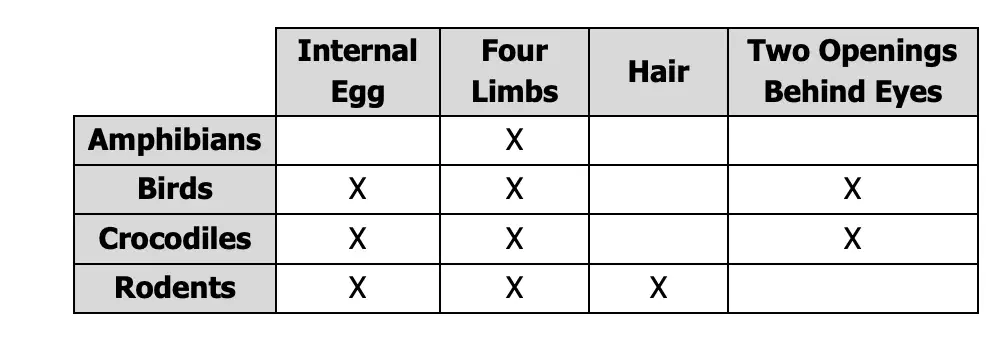
The table shows characteristics of different animals. Which cladogram correctly uses the information to relate the animals?

A

B

C

D

What conclusion can be made about these four organisms?
The four organisms have similar bones because they live in similar environments
The four organisms have different ancestors since they live in different environments.
The four organism have no connection to each other because they live in different ecosystems
The four organisms have a common ancestor since they have the same number of bones in the same positions.

Which pair of animals is most closely related?
R&S
R &U
S&T
S&U


What best describes the relationships among the organisms shown?
embryological similarities
superposition similarities

