Worksheets
Chemistry Unit Final - Unit Final Test
Total questions: 38
Worksheet time: 1hrs 25mins
Which of the following best describes the Law of Conservation of Matter?
The law of conservation of matter states that matter can neither be created nor destroyed. The total mass remains the same, even if substances change form or are rearranged.
The law of conservation of matter states that matter can neither be created nor destroyed. The total mass of a system can increase, but never decreases.
The law of conservation of matter states that matter can neither be created nor destroyed, but the number of atoms can change, resulting in mass loss.
The law of conservation of matter states that matter never changes and stays the same forever, regardless of physical or chemical processes.

Will the properties of the two samples likely be the same or different? (Examples of properties include smell, color, and melting point.)
The properties will likely be different because the two samples have different repeating groups of atoms.
The properties will likely be the same because the repeating groups of atoms in both samples have the same number of atoms.

If two substances react to form a new substance with completely different properties, what does this most likely indicate?
A physical change has occurred.
A new substance with a different atomic number has formed.
A chemical reaction has taken place.
The temperature changed but no atoms rearranged

What are three subatomic particles commonly found in atoms?
neutrinos, mosquitos, and electricity
protons, ampons, and electrons
Electrons, protons, and neutrons
Proton and neutrons

Determine the number of neutrons in this element: (Element: Gold, Symbol: Au, Atomic Number: 79, Atomic Mass: 197)
(a)
What coefficient(s) would you need to add to balance this chemical equation? ___ Al + ___ Fe3N2 → ___ AlN + ___ Fe
A two in front of the Fe3N2 and a three in front of Fe
A two in front of AlN, A two in front of Al, and a three in front of Fe
A one in front of Al and a two in front of Fe
None of the above

Delia loves school—especially science tests! She’s learned that each pattern represents a different element from the periodic table. Below is a diagram showing the repeating groups of atoms that make up two different samples. (Each pattern—such as stripes, dots, waves, or checks—represents a different element.) Based on the structure of the repeating atom groups, will the two samples likely have the same or different properties? (Properties include things like smell, color, melting point, and how a substance reacts.) Mark only one oval.
The properties will likely be different because the repeating groups of atoms in each sample are made of different elements.
The properties will likely be different because there are more repeating groups of atoms in Sample 1.
The properties will likely be the same because both samples have one element pattern in common.

Explain how two substances can change into three other substances.
chemical reaction takes place and the atoms between the first two substances change place.
A chemical reaction takes place.
A chemical reaction takes place and the atoms rearrange to form new substances
The atoms change into other types of atoms

Two substances look alike but react differently with acid. What can you conclude?
They are the same substance.
One is just less reactive.
They are different substances with different properties.
Properties don’t matter in chemical reactions.

How did we define a substance in this unit? Mark only one oval.
something that is made of all the same atoms or groups of atoms
something that is made of at least two different repeating groups of atoms
something that can be observed about a substance, such as color, smell, or boiling point
a group of atoms joined together in a particular way

Are all atoms on the reactant side of a chemical equation also on the product side?
Yes
No
It depends if a chemical reaction took place.
Impossible to tell. Ask again later.

Is a phase change a chemical reaction? Mark only one oval.
Yes
No
Which of the following is the best evidence that a chemical reaction occurred?
A change in temperature
A change in color
The formation of a new substance with different properties
A change in state (solid to liquid)
Mark only one oval.
The mixture changed color and produced a gas.
The solid melted into a liquid.
The mixture was stirred.
The container got cold when left alone.

What must be true about the number of atoms on each side of a balanced chemical equation?
There are always more atoms on the product side.
There are fewer atoms on the reactant side due to energy loss.
The number and type of atoms are the same on both sides.
There can be leftover atoms if it’s an exothermic reaction.

At a cat café in Tokyo, Cosmo decided to test a new ingredient called "color-shift syrup," which turns blue in hot coffee. However, when he added it to iced tea, there was no visible change. What can Cosmo infer from this experiment?
The syrup is defective.
No chemical reaction took place.
The iced tea caused a slow reaction.
A color change occurred too quickly to notice.
During halftime at a foggy rugby match in the Northumberland Alchemy League, Elric—team captain and part-time potion enthusiast—added a powdered metal to a mysterious sports drink called “Echowater.” The liquid turned black, made a loud popping noise, and began to vibrate in his hands—without any increase in temperature. What should Elric conclude about the reaction?
The vibration came from sound waves only.
It's just a temperature trick.
A chemical reaction occurred due to color, sound, and energy change.
The Echowater was haunted by a rival team’s spell.

Idril the Apprentice, who lives under a singing waterfall, analyzes a neutral atom with 11 protons and 10 electrons. What is the most can Idril conclude about the atom?
It is a positively charged ion.
It is a negatively charged ion.
It is a stable isotope.
It is a sodium ion with a +1 charge.

The basic units from which all things are made are ______.
atoms
equations
compounds
mixtures
____________ is anything that has mass and takes up space.
solution
water
matter
compound
The single kind of matter that has a specific makeup is a
solute
solvent
substance
mixture
_______ are substances made of only one type of atom.
Compounds
Elements
Mixtures
Solutions
A group of two or more atoms chemically bonded together is
an element.
a solution.
a compound.
A change that alters the appearance without chemically changing a substance.
chemical change
physical change
If you have 15 grams of Baking Soda and 20 grams of Vinegar as products, what would you expect the mass of your reactants to be?
15 grams
20 grams
5 grams
35 grams

How many Carbons are on EACH side of the chemical reaction?
1
3
4
5
What is a substance produced during a chemical reaction?
product
reactant
law of conservation of mass
chemical reaction
What type of change is a firework going off?
chemical
physical
A chemical bond that forms when one atom loses and electron and one atom gains an electron (like NaCl/Sodium Chloride) is called a/an _____________ bond.
metallic
covalent
ionic
polar
A chemical bond that forms when electrons are shared between atoms is called a/an _______________ bond.
metallic
covalent
ionic
polar
What elements and how many of element are present in the compound: NH3
Sodium = 3, Helium = 3
Nitrogen = 3, Hydrogen = 3
Nitrogen = 1, Hydrogen = 3
Nitrogen = 3, Hydrogen = 1
How would you balance the following Chemical Equation?
Mg + O2 ---------> MgO
It is already balanced.
Add a Coefficient 2 in front of Mg on the reactant side.
Remove the subscript on O2.
Add a Coefficient 2 in front of Mg on the reactant side and a Coefficient 2 in front of MgO on the product side.
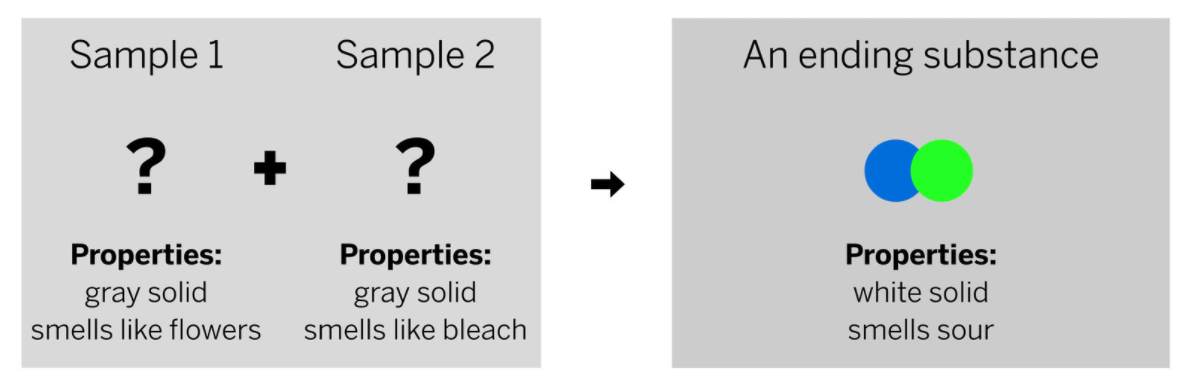
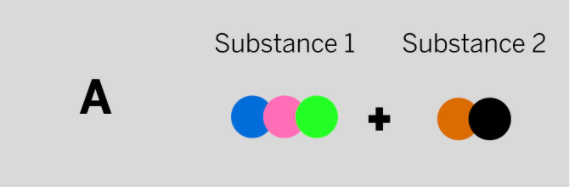
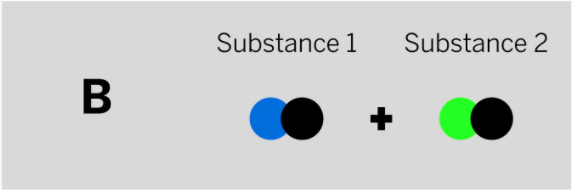
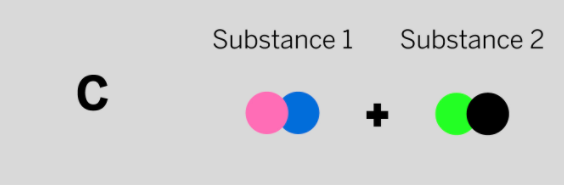
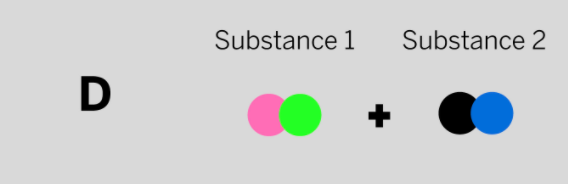
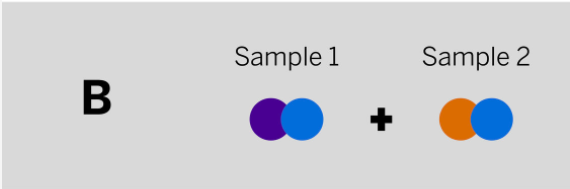
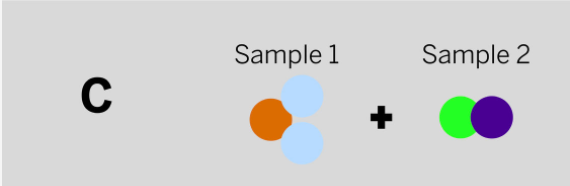
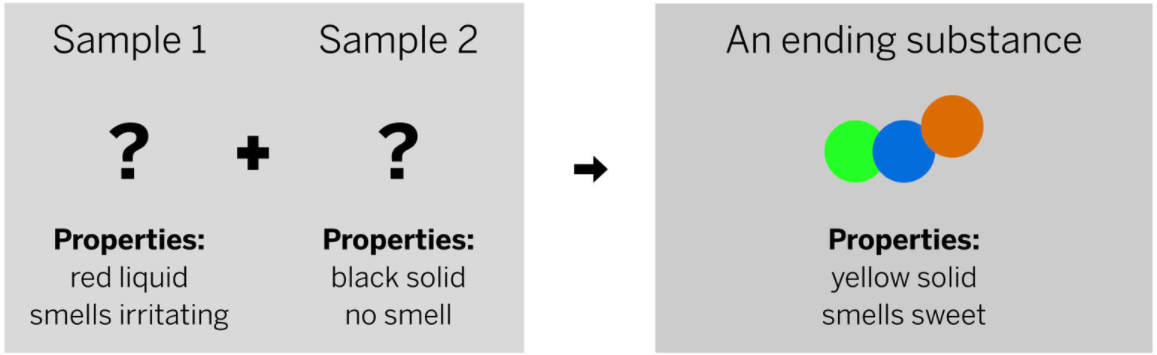
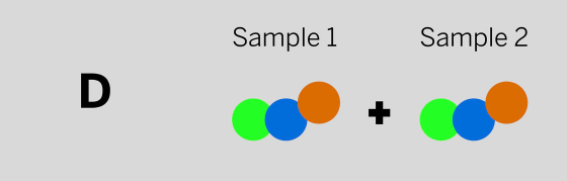
Serena mixed two samples together: a gray solid that smells like flowers and a gray solid that smells like bleach. She analyzed the results and found two ending substances. One of the ending substances was a white solid. This ending substance is made up of the repeating group of atoms shown above. Which of the diagrams to the left shows the repeating groups of atoms that make up the samples Serena mixed together?


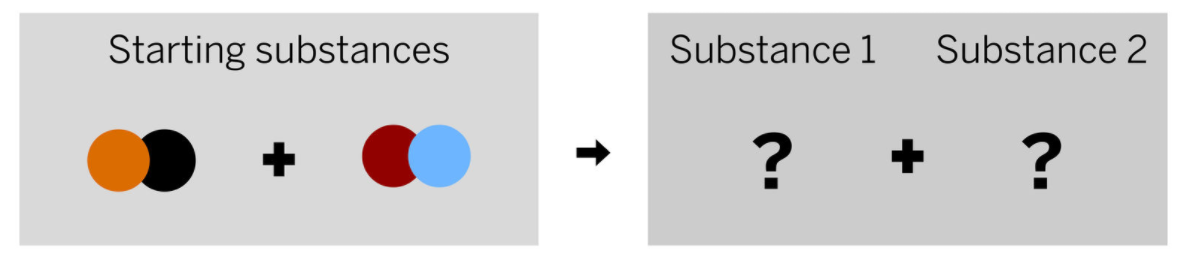
Tiana is a chemist who is making a chemical to add to swimming pools in order to make the water safer. She mixed two solid substances together in a sealed container. The diagram above shows the repeating groups of atoms that make up the two starting substances.
After mixing, Tiana found two liquid substances in the sealed container. (Nothing had escaped.) Which of the diagrams to the left shows the repeating groups of atoms that make up the ending substances?
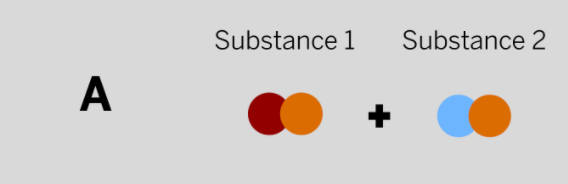
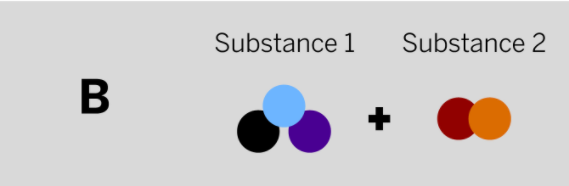
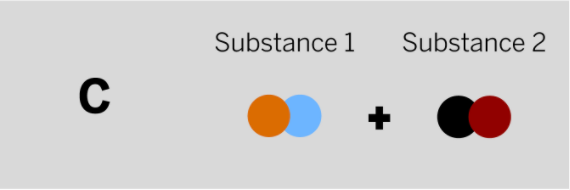
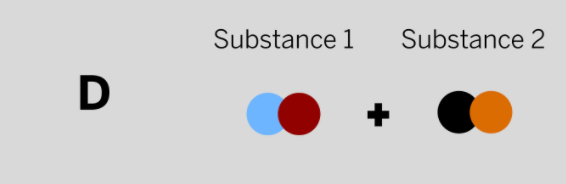



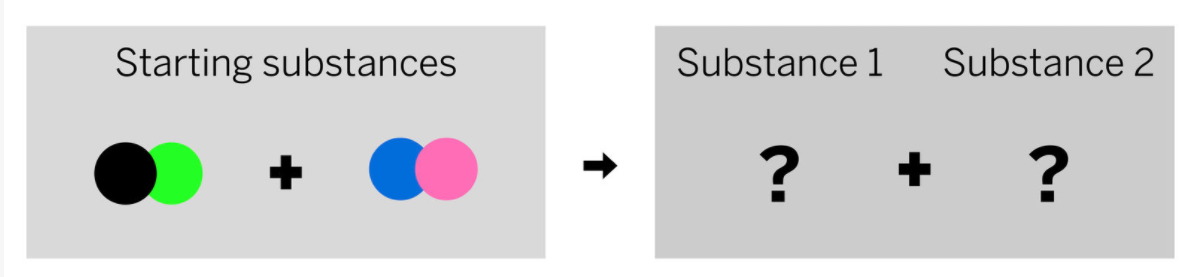
Santiago is a chemist working to make a new kind of antacid, which is a medicine that helps with stomach pain. He mixed two powdery solid substances together in a sealed container. The diagram above shows the repeating groups of atoms that make up the two starting substances.
After mixing, Santiago found two liquid substances in the sealed container. (Nothing had escaped.) Which of the diagrams to the left shows the repeating groups of atoms that make up the ending substances?