
Font size
 Worksheets
mechanical osilation and sound waves
Total questions: 88
Worksheet time: 1hrs 6mins
Select the example of an electromagnetic wave.
sound
x-rays
seismic (earthquake)
ocean waves
Which wave can NOT travel through a vacuum like outer space?
Electromagnetic
Mechanical
Select the example of a mechanical wave.
sound
x-rays
UV rays
gamma rays
Why do sound waves travel fastest through a solid?
Molecules in a solid are closer together and sound can move from one to another quicker.
Molecules in a solid are farther apart and sound can move from one to another quicker.
What are solids, liquids, and gasses
Energy
Waves
Vibrations
Media
What type of wave is an X ray?
Electromagnetic
Mechanical
Which of the following waves do you think are emitted by the sun?
X ray, gamma ray, and sound wave
UV ray, sound wave, and infrared ray
UV ray, infrared ray, and microwaves
light waves, infrared waves, sound waves
Which type of wave is an ocean wave?
Electromagnetic
Mechanical
Which type of wave has to have mass in order to travel?
Electromagnetic
Mechanical
Both Electromagnetic and Mechanical
Which type of wave can travel through mass and a vacuum?
Electromagnetic
Mechanical
Electromagnetic and Mechanical
What type of wave is sound?
Electromagnetic
Mechanical
Both Electromagnetic and Mechanical

Sonar and echolocation use ----- to detect objects under water.
Refraction
Reflection
Sound waves that are beyond the range of human ear are known as ----
Infrasonic waves
Ultrasonic waves
Sound waves travel the fastest through ---
Liquids
Gases
Solids
The speed of sound depends on these two things:
The type of medium and the temperature of the medium
Speed of the medium and temperature of the medium
Temperature of the medium and sound of the medium
None of the above
The Tacoma Narrows Bridge, musical instruments, and crystal stemware are examples of -----
Frequency
Resonance
Interference
Speed
A wave that can travel through matter and empty space is a:
electromagnetic wave
longitudinal wavy
transverse wave
What does a wave carry from place to place?
energy
matter
people


Which distance represents the amplitude?
W
X
Y
Z
What do radio waves, microwaves, X-rays, and gamma rays all have in common?
They all have the same wavelength.
They are electromagnetic waves.
They are detected in the same way.
They store the same amount of energy.
(a) refers to the change in
observed frequency during the relative
motion between a wave source and its
observer.
What is two factors that influence sound intensity?
node and antinode
amplitude and distance
Transverse wave Is defined as a wave in which the direction of vibrations of the particle is (a) to the direction of the wave propagation (wave speed)
What is Node?
Zero displacement
Back and forth displacement
Maximum displacement
Linear displacement
Water waves and waves on a string is a type of...
Transverse wave
Longitudinal wave
Both of the waves

Mechanical wave is defined as the waves produced by a disturbance in a
medium causes the vibration of particles in the medium to ________________________________
transfer the electromagnetic
transfer the energy.
transfer the heat
What is a rarefaction in a longitudinal wave?
The region in a longitudinal wave where the particles are closest together.
The entire wave.
The region in a longitudinal wave where the particles are furthest apart.
Identify the mechanical wave that the particles vibrate with and up-and-down motion.
transverse
longitudinal
An example of a combined wave...
sound waves
water waves
What is the relationship between frequency and sound?
Frequency affects a sound's volume.
Frequency affects a sound's amplitude.
Frequency affects a sound's loudness.
Frequency affects a sound's pitch.
The matter (solid, liquid, or gas) through which mechanical waves travel.
medium
vibration
disturbance
energy
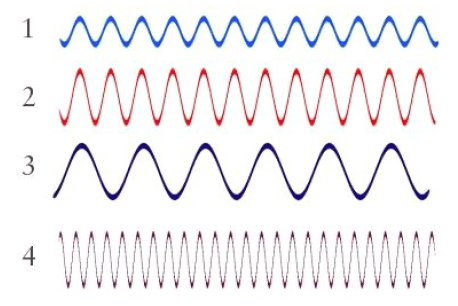

The distance between two corresponding parts of a wave is the ____.
crest
trough
amplitude
wavelength
A low point of a wave is known as a
downside
well
trough
flop
A high point of a wave is known as a
upside
crest
peak
flip
Sound wave A has a lower frequency than sound wave B, but both waves have the same amplitude. What must also be true of these two waves?
Wave A has a lower pitch.
Wave A has a higher pitch.
Wave A is louder.
Wave A is softer.
A student blows a whistle. In which direction do the air particles vibrate with respect to the direction the sound wave travels?
parallel to
perpendicular to
At an unpredictable angle
At a 45° angle to
Which action could a student take to produce a longitudinal wave with a large amplitude?
Drop a pebble in a pond.
Light a candle.
Bang on a drum.
Which phrase describes the way that air particles vibrate with respect to the way a sound wave travels?
parallel to
perpendicular to
equal to
opposite to
When a wave travels through a medium, it causes the medium to vibrate.
True
False
Waves that require a medium are known as
Medium waves
Mechanical waves
Air waves
Heat waves
The material through which a wave travels is?
a rope
water wave
snaves
medium
In science, the ability to do work is defined as
sleep
micronuclearism
energy
synergy
A disturbance involving the transfer of energy
ocean
wavelength
wave
snapes
A wave that vibrates medium at right angles
longitudinal
crest
trough
transverse


The material through which a wave travels
Mechanical Wave
Medium
Crest
Trough
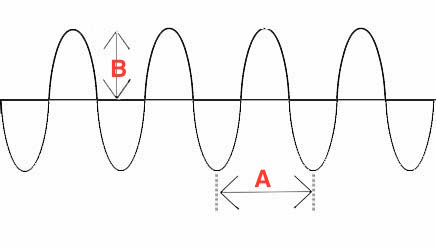
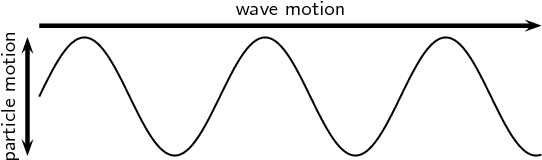
Sonar can make use of
the Doppler effect
ultrasound
infrasound
resonance
The highest-frequency sound human ears can usually hear is about
20 Hz
10,000 Hz
20,000 Hz
30,000 Hz
A large speaker is better than a small speaker for producing sounds with
low frequency
high frequency
low intensity
high intensity
When two waves interfere, the displacement where two troughs meet is
positive
negative
zero
a crest
When a wave bends around an obstacle, it is called
reflection
refraction
diffraction
interference
When a wave is reflected, its speed
increases
increases or deacreses
decreases
is unchanged
For waves moving at a constant speed, if wavelenght is doubled, the frequency is
doubled
halved
unchanged
quadrupled
The height of a wave crest is called
wavelenght
frequency
amplitude
energy
In a transverse wave, the medium vibrates:
at right angles to the wave direction
in the same direction as the wave
in a direction opposite that of the wave
at a 45° angle to the wave direction
Which of the following is NOT true about mechanical waves?
They carry energy
They transfer matter
They can be longitudinal
They require a medium

