
 Worksheets
Unit 4: 7.7A-C
Total questions: 81
Worksheet time: 3hrs 44mins
What is the measure of the distance an object travels in a given amount of time?
Speed
Velocity
Acceleration
Distance
What term describes the speed and direction of a moving object?
Speed
Velocity
Acceleration
Distance
What is a graph that shows the comparison of distance over time called?
Bar graph
Line graph
Distance-time graph
Pie chart
What is the definition of speed?
The change in an object’s direction over time
The rate at which an object covers distance
The total displacement of an object
The time taken for an object to stop
What is the formula for calculating speed?
Speed = Distance × Time
Speed = Displacement ÷ Time
Speed = Distance ÷ Time
Speed = Time ÷ Distance
What is the tendency for objects in motion to resist change to their direction and speed?
Inertia
Momentum
Friction
Gravity
What is the process of changing position called?
Motion
Movement
Transition
Shift
What term describes an object's distance and direction from a reference point?
Position
Location
Displacement
Orientation
What does a distance-time graph show?
Comparison of speed over time
Comparison of distance over time
Comparison of force over time
Comparison of velocity over time
What is the definition of velocity?
The rate of change of distance over time
The rate of change of displacement in a specific direction
The total time traveled by an object
The total distance covered by an object
What is the entire length of an object's path from point A to B?
Displacement
Distance
Position
Slope
What is the difference between the initial or starting position and the final position of an object?
Distance
Displacement
Position
Slope
What is the process of changing position called?
Speed
Motion
Velocity
Inertia
How does displacement differ from distance?
Distance is a straight line, while displacement includes curves.
Displacement only considers the total path traveled, while distance includes direction.
Distance is the total path traveled, while displacement is the straight-line measurement from start to finish.
Distance and displacement are the same measurement.

Velocity is speed with __________________________.
a unicycle helmet
direction
fight

A dog running at 3 m/s
A deer sprinting at 4 m/s
A migrating bird headed south for the winter at 3 m/s
A person not moving at all
When an object's speed increases, its kinetic energy:
Decreases
Remains the same
Increases
Becomes zero
Which axis on a distance-time graph represents distance?
x-axis
y-axis
z-axis
t-axis
If a line on a distance-time graph is steep, what does it indicate about the object's speed?
It is moving slowly
It is moving fast
It is not moving
It is moving backward

What does a horizontal line on a distance-time graph represent?
The object is accelerating
The object is moving at a constant speed
The object is stationary
The object is moving backward

Which of the following describes a scenario where the line on a distance-time graph is a straight diagonal?
Constant speed
Increasing speed
Decreasing speed
Stationary
What is the primary purpose of a distance-time graph?
To show the color of an object
To measure the weight of an object
To illustrate the motion of an object over time
To calculate the temperature changes
Displacement is different from distance because displacement considers:
Only the path traveled.
Both the path and the total time taken.
Only the starting and ending points and direction.
Only the total time taken.

A Car traveled 240 Km in 5 Hours

A Motorcycle traveled 368 Km in 8 Hours

A truck traveled 208 Km in 4 Hours

A bus traveled 98 Km in 2 Hours
A boy jogs 250 meters in 110 seconds. What is his average speed in m/s?
227 m/s
22.7 m/s
2.27 m/s
You arrive in my class 45 seconds after leaving math, which is 90 meters away, How fast did you travel?
3 m/s
2 m/s
4 m/s
It takes a freight train 2.3 seconds to move 26 meters. Calculate its average speed.
11.3 m/s
1.13 m/s
22 m/s
Calculate the average speed of a car that travels 60 km in 2 hours.
12 km/h
30 km/h
25 km/h
35 km/h
If Steve throws the football 50 meters in 3 seconds, what is the average speed of the football?
16.7 m/s
15.5 m/s
25.3 m/s
22 m/s
A car travels 60 kilometers in 2 hours. What is the average speed of the car?
20 km/h
30 km/h
40 km/h
50 km/h
Which of the following distance-time graphs represents an object moving at a constant speed?
A straight line with a positive slope
A curved line
A horizontal line
A straight line with a negative slope
If a cyclist travels 15 km in 1 hour and then 30 km in the next 2 hours, what is the total distance covered by the cyclist?
30 km
35 km
40 km
45 km
A runner's distance-time graph shows a line that becomes steeper over time. What does this indicate about the runner's motion?
The runner is slowing down.
The runner is speeding up.
The runner is moving at a constant speed.
The runner has stopped.
A car travels at a constant speed of 50 km/h for 3 hours. How far does the car travel?
100 km
150 km
200 km
250 km
A distance-time graph shows a horizontal line. What does this tell you about the object's motion?
The object is moving at a constant speed.
The object is accelerating.
The object is decelerating.
The object is stationary.
A student records the motion of a toy car and plots the data on a distance-time graph. The graph shows a line that curves upwards. What does this suggest about the toy car's motion?
The toy car is moving at a constant speed.
The toy car is accelerating.
The toy car is decelerating.
The toy car has stopped.
If a train travels 120 km in 2 hours and then 180 km in the next 3 hours, what is the average speed of the train for the entire journey?
50 km/h
60 km/h
70 km/h
80 km/h
A distance-time graph shows a line that slopes downward. What does this indicate about the object's motion?
The object is moving forward.
The object is moving backward.
The object is stationary.
The object is accelerating.
A cyclist's distance-time graph shows a line that becomes less steep over time. What does this indicate about the cyclist's motion?
The cyclist is speeding up.
The cyclist is slowing down.
The cyclist is moving at a constant speed.
The cyclist has stopped.
A car travels 100 km in 2 hours and then 150 km in the next 3 hours. What is the total time taken for the journey?
3 hours
4 hours
5 hours
6 hours
Which of the following scenarios would result in a distance-time graph with a curved line?
A car moving at a constant speed
A car accelerating
A car decelerating
Both B and C
A runner completes a 10 km race in 50 minutes. What is the runner's average speed in km/h?
10 km/h
12 km/h
15 km/h
20 km/h
A distance-time graph shows a line that starts steep and then becomes flat. What does this indicate about the object's motion?
The object is accelerating.
The object is decelerating.
The object has stopped.
The object is moving at a constant speed.
A car travels at a speed of 60 km/h for 1.5 hours. How far does the car travel?
60 km
75 km
90 km
100 km

How far did the bicyclist travel from 9:00 to 12:00?
40 km
120 km
0 km
60 km

A child went for a walk with their grandparents. How many seconds did the child stop to pick flowers on their walk?
20 sec
15 sec
10 sec
60 sec

Three objects are thrown and their speeds graphed. Which of the following answer choices correctly labels Object A’s path?
Getting faster
Fast, constant speed
Constant speed, at rest, return to start
No motion

Three runners ran a 200-meter dash, and data was collected. Which runner’s race includes a portion that was of constant speed?
Runner A
Runner B
Runner C
Runners A and B

A rocket travels 450 km in 60 seconds. Which distance-time graph below correctly shows the motion of the rocket?
Graph A
Graph B
Graph C
Graph D
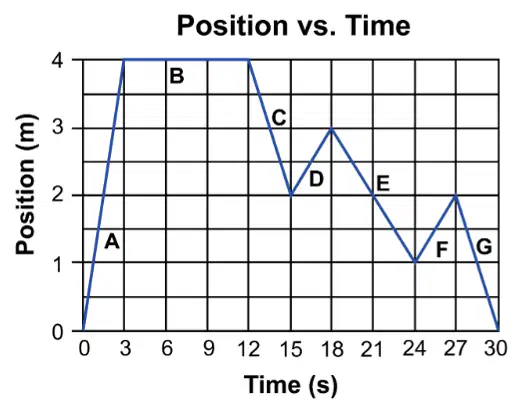
Which two of the following line segments shows the greatest speeds?
Line segment A
Line segment C
Line segment D
Line segment F

The graph provided here shows the motion of an object. At two points, the object is at rest.
At which points on the graph is the object at rest?
Points 1 and 4
Points 2 and 3
Points 2 and 4
Points 4 and 5

Which answer correctly identifies the period of time the object in the graph above is at rest?
Line segment DE is five minutes long and shows a distance of zero.
Line segment DE is ten minutes long and shows a distance of zero.
Line segment CD is five minutes long and shows a distance of zero.
Line segment CE is ten minutes long and shows a distance of zero.
Which statement is true?
A vertical line shows that time is passing but no distance is traveled.
A vertical line shows that distance is increasing but no time is passing.
A horizontal line shows that distance is increasing but no time is passing.
A horizontal line shows that time is passing but no distance is traveled.

What is the distance traveled in the first 60 seconds shown on the distance-time graph?
100 meters
120 meters
80 meters
140 meters

What does the graph titled "Family Walk" represent?
The speed of a car over time
The distance a family walked over time
The temperature change over time
The growth of a plant over time

What was the maximum distance the family walked from their starting point?
800 m
400 m
1600 m
55 m

What was the distance covered by the family at 20 minutes?
200 meters
400 meters
600 meters
800 meters
What was the distance covered by the family at 40 minutes?
200 meters
400 meters
600 meters
800 meters
Where was the family at 55 minutes?
800 m away
1600 m away
Back at their starting point
400 m

Which answer choice best describes the movement of the object between the times of 0 and 6 seconds on the graph?
Moving at a constant speed
Moving toward the north
Accelerating
Stopped
What is the purpose of using distance-time graphs in measuring motion?
To record and interpret an object's motion
To measure temperature changes
To calculate the weight of an object
To determine the color of an object


speed of an object in a particular direction
motion
velocity
speed
acceleration
total distance traveled divided by total time taken to travel that distance
velocity
motion
acceleration
average speed
At what speed would a car have to move in order to travel 20 kilometers in 2 hours.
5 km/hr
10 km/hr
20 km/hr
40 km/hr
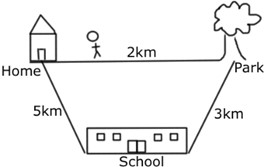
Jerry walked from home to school, then from the school to the park. What is his total displacement?
2 km
5 km
8 km
10 km
Jerry walked from home to school, then from the school to the park. What is his total distance?
2 km
5 km
8 km
10 km
What is the speed of the International Space Station if it travels 300 miles in 60 seconds?
5 miles/second
0.2 miles/second
5 seconds/mile
18,000 miles/second
35 m/s would describe
distance
displacement
speed
velocity
5 m/s west would describe
distance
displacement
speed
velocity

Joe rides his bike from point A to point B and then on to point C. What is the total distance traveled?
12 m
43 m
7 m
12 m

Joe rides from point A to B to C. What is the displacement?
7 m
12 m
5 m
2 m
What is distance?
The difference between an object's final position and its starting position
The rate at which an object is moving
How far an object travels
The speed of an object

