
 Worksheets
Weather & Matter
Total questions: 50
Worksheet time: 30mins
The analysis of scientific data to predict future weather conditions.
Meteorology
Weather Forecasting
Weather Map
none of the above
Scientist who study Meteorology are called
Meteorologist
Physicist
Anthropologist
Astronaut

Which town is experiencing the most severe weather?
Sterling
Peru
Clinton
Rockford

What type of front is shown on the surface weather map?
Cold Front
Warm Front
Both A and B
None of the above
Weather forecasts that make predictions about the weather 0-3 days into the future.
Short-Range Weather Forecasts
Medium-Range Weather Forecasts
Long-Range Weather Forecasts

On what days will there be rain?
Monday
Tuesday
Wendesday
Thursday

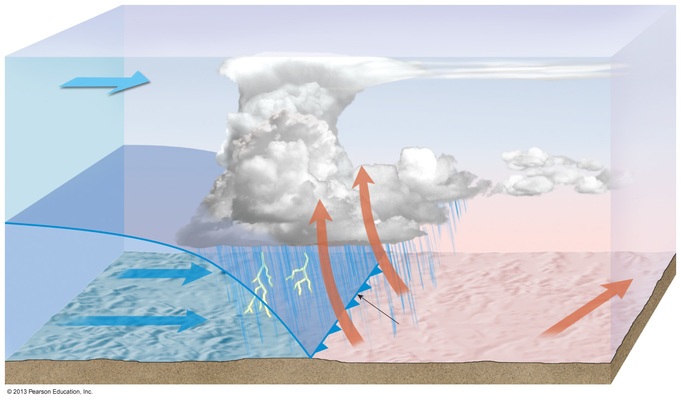


Air in a LOW PRESSURE system usually
sinks because it's cold and dense
rises because it's warm and low density
sinks because it's low density
rises because it's high density

What type of front is shown here?
warm front
occluded front
stationary front
cold front

In what direction is this front moving?
North
South
West
East

This is a
cold front
warm front
occluded front
stationary front

In what direction is this front moving?
north
south
east
west
What kind of pressure system is light and rises bringing wet, cloudy weather
High pressure system
Low pressure system
What type of air mass is warm, forms in the tropics, and has low air pressure?
Tropical
Polar
Maritime
Continental
What type of air mass is cold, forms over the poles, and has high air pressure?
Tropical
Polar
Maritime
Continental
What type of air mass is warm, humid, and forms over oceans?
Maritime Tropical
Maritime Polar
Continental Tropical
Continental Polar
What type of air mass has cool, dry air and forms over land?
Maritime Tropical
Maritime Polar
Continental Tropical
Continental Polar
Maritime air masses will contain more moisture than continental air masses?
True
False

Which scenario would BEST explain the phase change shown in the picture?
A pot of water boils and forms steam.
Pond water freezes on a cold winter day.
Water droplets form on grass on a cool morning.
Snowman melts on a sunny day.
Which state of matter is described below?
1. Particles are packed closely together
2. Particles vibrate
3. Strong molecular attraction between particles
solid
liquid
gas
plasma
Which state of matter is described below?
1. Particles are less densely packed
2. Particles slide around past each other
3. Not a strong molecular attraction between particles
solid
liquid
gas
plasma
Which state of matter is described below?
1. Particles move freely
2. High energy
3. Very weak molecular attraction between particles
solid
liquid
gas
plasma
The windows in your home are made of glass. Which of the following statements describes the motion of particles that make up the glass?
The particles of the glass are always vibrating.
The particles of the glass move only when the window is being opened or closed.
The particles of the glass move only when the sun warms the window.
The particles of the glass are never moving.
A hot air balloon rises because its ___.
particles are less attracted by gravity when heated
particles move slower and closer together when heated
particles move faster and farther apart when heated
particles become charged and repel each other when heated
The three states of matter are different. However, liquids and gases do have some things in common. One of these is ____.
the liquids and gases are both more dense than solids
the liquids and gases both take the shape of their container
that liquids and gases have the same densities as solids
that liquids and gases do not take the shape of their container

Consider the diagrams representing particle arrangements. Which correctly matches the diagrams with the three phases of matter?
A, gas; B, liquid; C, solid
A, gas; B, solid; C, liquid
A, solid; B, liquid; C, gas
D, solid; B, gas; C, liquid

Which letter represents the point at which a solid changes to a liquid?
C
B
A
D
When ice melts, the temperature increases. Which of the following describes what happens to the arrangement of the water molecules as the temperature increases?
Water molecules lose all contact with one another and intermolecular forces are non-existent.
Water molecules become less orderly and they spread out.
The kinetic energy of the water molecules decreases proportionally to the temperature change.
Water molecules separate into hydrogen and oxygen atoms.
The particles in which state (phase) of matter has the most energy?
water
ice
steam
There is no difference in particle energy.
How does plasma, the fourth state of matter, differ from a gas?
Plasma has indefinite shape and volume; gas does not.
Plasma has definite shape and volume; gas does not.
Plasma cannot conduct electricity; gas can.
Plasma has electrically charged particles like the Northern Lights; gas does not.

