
 Worksheets
Unit 12: South Asia Test Review
Total questions: 39
Worksheet time: 31mins
Your First Name
Your Last Name
Your Class Period
3rd
5th
6th
8th
One downside of outsourcing is that:
Building factories in other countries often results in the loss of domestic jobs.
Establishing factories abroad generally increases production expenses.
Opening factories overseas usually lowers the standard of living in that country.
Setting up factories internationally usually increases employment in the home country.
During the 1947 Partition of India, how did cultural and religious divisions influence migration?
Many people moved to places with better farming and weather.
Many individuals relocated to areas where their religion or culture was the majority.
The British government forced people to move in order to preserve cultural diversity.
People migrated mainly to avoid higher taxes under new rulers.

Based on the HDI chart, which Asian nation has the lowest level of economic development?
Thailand
India
Japan
Bangladesh
How do the monsoon wind patterns affect farming in South Asia?
Dry northern winds in summer limit the need for irrigation.
Winter monsoons bring heavy rain from the ocean to support rice cultivation.
Summer monsoon winds bring heavy rains critical for growing crops.
Winter monsoon rains allow farmers to avoid using irrigation year-round.
A man in Bangalore, India, works for a U.S. company’s customer service center. Which development best explains this opportunity?
Improvements in handling data
New barriers to global trade
Advances in communication technology
Cheaper overseas transportation costs
What is the most common reason a company would outsource?
To enhance the quality of goods and services
To hire more highly educated workers
To let companies concentrate on key business areas
To reduce/cut the costs.
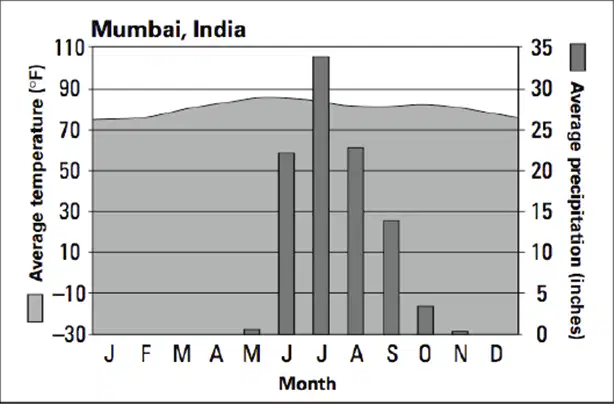
What best explains Mumbai's heavy summer rainfall pattern shown in the climograph?
Monsoon winds from the Indian Ocean bring large amounts of rain during summer.
Mumbai’s desert climate leads to year-round dry conditions.
Higher winter temperatures increase rainfall through evaporation.
Mumbai has steady rainfall all year due to its proximity to the equator.

What contributed most to the spread of Buddhism across Asia?
Expansion of European colonial rule
The movement of merchants, missionaries, and travelers along trade routes.
Military forces forcing people to convert
India’s isolation encouraging cultural independence
What is the Indian social caste system?
The caste system is a hereditary social structure that made it difficult for individuals to change their social status.
The Brahmins mainly worked in manual labor.
Dalits were treated equally among the main castes.
The Kshatriyas were considered the lowest social group.
How can a YOUNGER population affect a country’s development?
It helps by expanding the labor force.
It hurts by raising unemployment levels.
It has no impact on growth.
It helps by decreasing the number of dependents.
British control over India is an example of:
Educated workers moving abroad (brain drain)
Tourism focused on natural conservation (ecotourism)
Using resources responsibly for future generations (sustainable development)
A foreign power ruling politically and economically (imperialism)

These homes built in Dhaka, Bangladesh show that:
Literacy rates have greatly improved.
People have adapted to frequent flooding and severe weather.
Forest fires are a major regional issue.
War has caused mass migrations out of the area.
Match each characteristic to the correct South Asian religion:
- Belief in Reincarnation
- Oldest Religion
- Structured by the Caste System
- Polytheistic
Hinduism
- Believe in the Eightfold Path
- Four Noble Truths
- Believe in Enlightenment
Buddhism
- Founded in Northern India
- Belief in reincarnation
- Monotheistic
- Combination of Hindu and Islamic beliefs
Sikhism
Which religion is a polytheistic?
Hinduism
Buddhism
Sikhism
Christianity
Which religion is a combination of Hindu and Islamic beliefs?
Hinduism
Buddhism
Sikhism
Christianity
Which religion follows the Eightfold Path?
Hinduism
Buddhism
Sikhism
Christianity
Which religion was introduced in India by the Europeans?
Hinduism
Buddhism
Sikhism
Christianity
Which two nations are most involved in the Kashmir territorial dispute? (Select 2)
India
Nepal
Bangladesh
Pakistan
Bhutan
What is the main reason India and Pakistan are in conflict over Kashmir?
Religious differences
Competition for limited water resources
Disputes over ancient monuments
Land claims and national identity issues
Why is the Indus River Valley historically significant?
It contains major oil reserves.
It was the birthplace of Buddhism.
It was home to one of the earliest civilizations.
It is South Asia’s primary trade route.
What are two effects of India's dense population on the South Asian region? (Select 2)
Increased competition for natural resources
Growth of environmental problems like air and water pollution
Major redesign of regional architecture
No real effect on resource usage
Reduced agricultural demand
The Ganges River is (a) to the (b) religion and as a result millions of people bathe in the river daily.
Why has bathing in the Ganges River become a health concern?
The river dries up during the summer season.
The river is believed to be cursed by ancient myths.
The river contains high levels of pollution from human activity.
The river flows too rapidly for safe bathing.

What was the primary purpose of the stepwells built in India?
To serve as temples for religious ceremonies
To store water during the dry season
To trap fish for food
To protect crops from monsoon floods

Which region in India is known for having the highest population density?
The Thar Desert in the west
The Himalayan mountain range in the north
The Ganges River Plain in the north
The Deccan Plateau in the south
Who was the most influential figure who led India's independence movement?
Jawaharlal Nehru
Mahatma Gandhi
Sardar Vallabhbhai Patel
Subhas Chandra Bose
How did Mahatma Gandhi contribute to India’s independence?
He organized a violent revolution against the British.
He promoted nonviolent protests and economic boycotts.
He signed an agreement giving Britain partial control.
He worked to increase British colonial investments.
What event caused the partition of India?
Differences in political leadership styles
Conflicts over natural resources like oil
Religious differences between Hindus and Muslims
Disagreements over trade policies with Britain
What two countries resulted from the Partition of India?
India
Pakistan
Sri Lanka
Nepal
Bhutan
How is India’s political system best described?
A constitutional monarchy
A communist state
The world’s largest democracy
A military dictatorship
The region of the (a) in South Asia is becoming a popular destination for (b) , where visitors can climb the mountain and explore the cultural heritage of the area while conserving the local environment
What are some of the British legacies in India? (SELECT 3 ANSWERS)
Sports: Cricket and Rugby
Infrastructure: railroads and education
The establishment of a Constitutional Monarchy.
The establishment of a caste system
The introduction of democracy and a parliamentary system
The British Raj is an example of -
imperialism
Sovereignty
Nationalism
Federalism
Match the vocabulary terms to its definitions:
The division of British India in 1947 into two independent nations, India and Pakistan, primarily due to religious differences between Hindus and Muslims.
Partition of India
A method of achieving political or social change through peaceful means, such as boycotts or demonstrations, as led by Mahatma Gandhi in India’s independence movement.
Nonviolent Protests
The period of British colonial rule over India from 1858 to 1947, leaving a legacy of infrastructure, governance, and cultural influences.
British Raj
A region in South Asia, significant as the cradle of one of the earliest known civilizations (Harappan Civilization), supporting early agriculture and urban development.
Indus River Valley
A territorial conflict between India and Pakistan over the Kashmir region, driven by differences in religious beliefs, national identity, and territorial claims.
Kashmir Dispute
Match the vocabulary terms to the definitions.
A religious belief, central to Hinduism and Sikhism, that an individual’s soul is reborn into a new body after death.
Reincarnation
Tourism focused on experiencing natural environments while minimizing environmental impact and supporting conservation efforts.
Ecotourism
A policy or practice where a country extends its power and influence over another region, often through political and economic control.
Imperialism
A hereditary social hierarchy in India that divides people into rigid social classes, historically limiting social mobility.
Caste System
Seasonal wind patterns in South Asia that bring heavy rainfall during the summer and dry conditions during the winter, significantly influencing agriculture.
Monsoon
Match the vocabulary terms to the definitions.
The practice of a company hiring or contracting work to an external organization, often in another country, to reduce costs or focus on core business needs.
Outsourcing
A composite statistic that uses life expectancy, education (literacy rate), and per capita income indicators to rank countries' levels of development.
Human Development Index (HDI)
Traditional water storage systems in India, designed to collect and store rainwater during the wet monsoon season for use in dry periods.
Stepwells
Region of South Asia that has the highest population density.
Gangetic Plain

