
NEW
Font size
 Worksheets
Exam 5 Information Quiz
Total questions: 61
Worksheet time: 31mins
What is the lapse rate?
The rate of temperature increase with height
The rate of temperature decrease with height
The rate of pressure increase with height
The rate of humidity increase with height
What is the dry adiabatic lapse rate approximately equal to?
5 °C km⁻¹
7 °C km⁻¹
10 °C km⁻¹
12 °C km⁻¹
The dry adiabatic lapse rate applies to which type of air parcel?
Saturated
Unsaturated
Humid
Condensed
What happens when a rising air parcel becomes saturated?
Condensation occurs
Evaporation occurs
The air parcel expands
The air parcel contracts
What is the effect of condensation on a rising air parcel?
It cools the air parcel
It warms the air parcel
It has no effect
It causes the air parcel to fall
What is the source of energy that warms the air parcel during condensation?
Kinetic energy
Latent heat
Potential energy
Solar radiation
What is the cooling rate for a lifted saturated air parcel called?
Dry adiabatic lapse rate
Moist adiabatic lapse rate
Standard lapse rate
Environmental lapse rate

What does the moist adiabatic lapse rate describe?
Increase of temperature with height for dry air
Decrease of temperature with height for saturated air
Constant temperature with height for all air
Increase of temperature with height for saturated air

What does Ts represent
Saturated air lapse rate
Dry air lapse rate
Solid lapse rate
Damp air lapse rate

What does Td represent
Dry air lapse rate
Saturated air lapse rate
Damp air lapse rate
Solid air lapse rate

What does this entire thing represent
Solid air lapse rate is greater than damp lapse rate
Saturated air lapse rate is less than dry air lapse rate
Saturated air lapse rate is greater than damp air lapse rate
Dry air lapse rate is greater than Damp air lapse rate
Why is the saturated air lapse rate always less than the dry air lapse rate?
Because of the absorption of latent heat
Because of the release of latent heat
Because of the increase in air pressure
Because of the decrease in air pressure
What is the condensation level (CL or LCL)?
The height where temperature and dew point become equal, and RH=100%
The point where only temperature becomes equal
The height where only dew point becomes equal
The level where RH is less than 50%
What should you do to find the condensation level (CL)?
Lift the temperature and dew point on their respective lines until they intersect
Use the moist adiabatic line immediately
Only lift the temperature line
Only lift the dew point line
After reaching the CL, which line should you follow to continue lifting?
Moist adiabatic (solid red) line
Dry adiabatic line
Mixing ratio line
Temperature line
At 10 pm, the temperature for the air parcel is 30°C and the dew point temperature is 25°C. At 11:30 pm, the temperature drops to 15°C. What is the new dew point temperature at 11:30 pm?
10°C
15°C
20°C
25°C
For the dry adiabatic process, the actual water mixing ratio ______.
increases
decreases
keeps constant
fluctuates
If the environmental temperature is 20°C at the surface and 5°C at 1 km, the atmosphere ______.
is absolutely stable
is absolutely unstable
is conditionally stable
is neutrally stable
What is the stability of a parcel when its temperature is greater than the temperature of its environment?
Stable
Unstable
Neutral
Indeterminate
How is the stability of a parcel described when its temperature is less than the temperature of its environment?
Unstable
Neutral
Stable
Variable
What is the stability condition when the temperature of a parcel equals the temperature of its environment?
Unstable
Stable
Neutral
Fluctuating
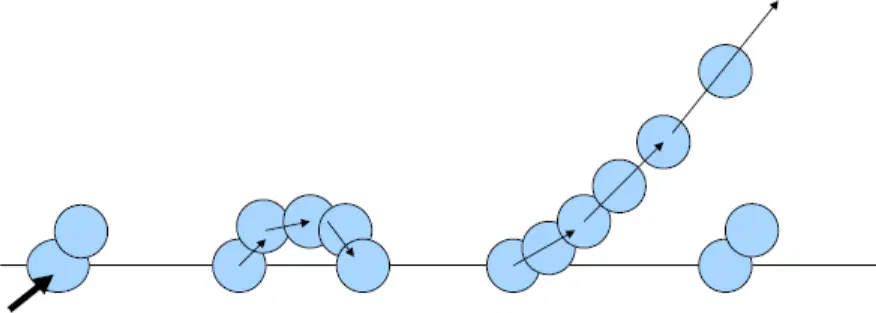
What happens to an air parcel in a stable atmosphere when it is displaced from its original height?
It returns to its original height.
It accelerates upward.
It stays at the displaced position.
It moves downward indefinitely.
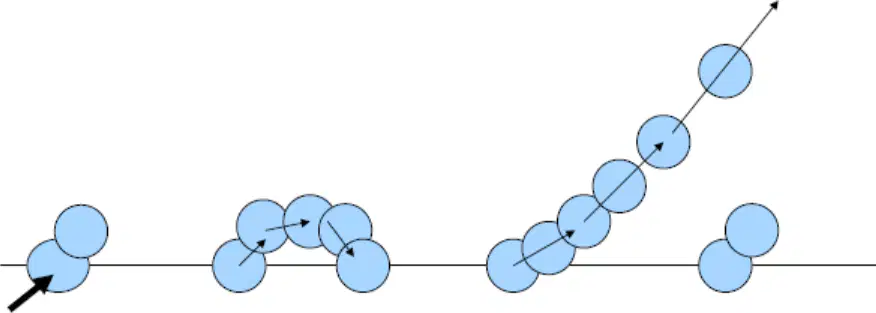
In an unstable atmosphere, what is the behavior of an air parcel when displaced?
It returns to its original height.
It accelerates upward.
It stays at the displaced position.
It moves downward indefinitely.
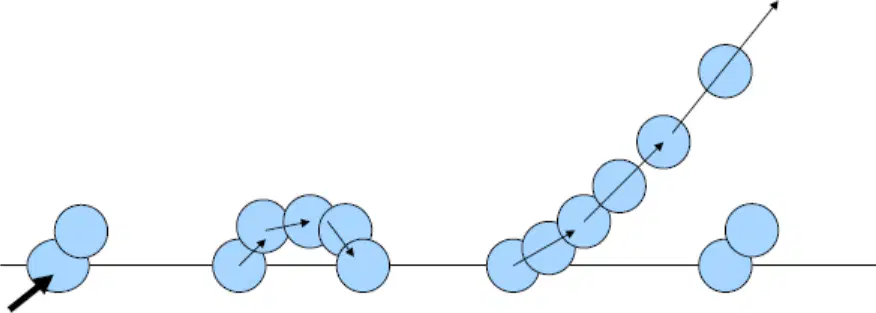
What is the characteristic of an air parcel in a neutral atmosphere when displaced?
It returns to its original height.
It accelerates upward.
It stays at the displaced position.
It moves downward indefinitely.
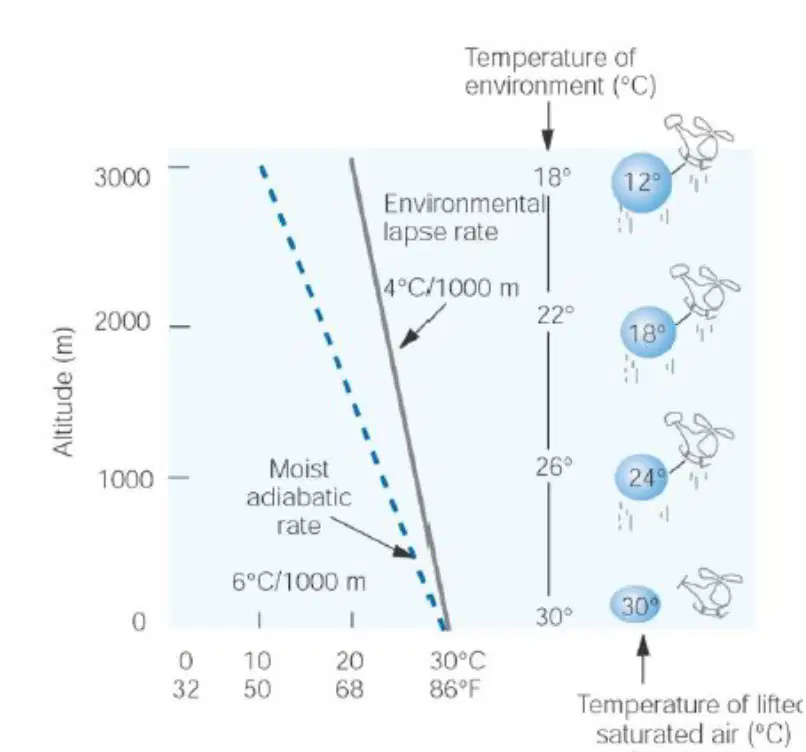
What is the relationship between the environmental lapse rate and the moist lapse rate in an absolutely stable atmosphere?
Environmental lapse rate is greater than the moist lapse rate.
Environmental lapse rate is equal to the moist lapse rate.
Environmental lapse rate is less than the moist lapse rate.
Environmental lapse rate is unrelated to the moist lapse rate.
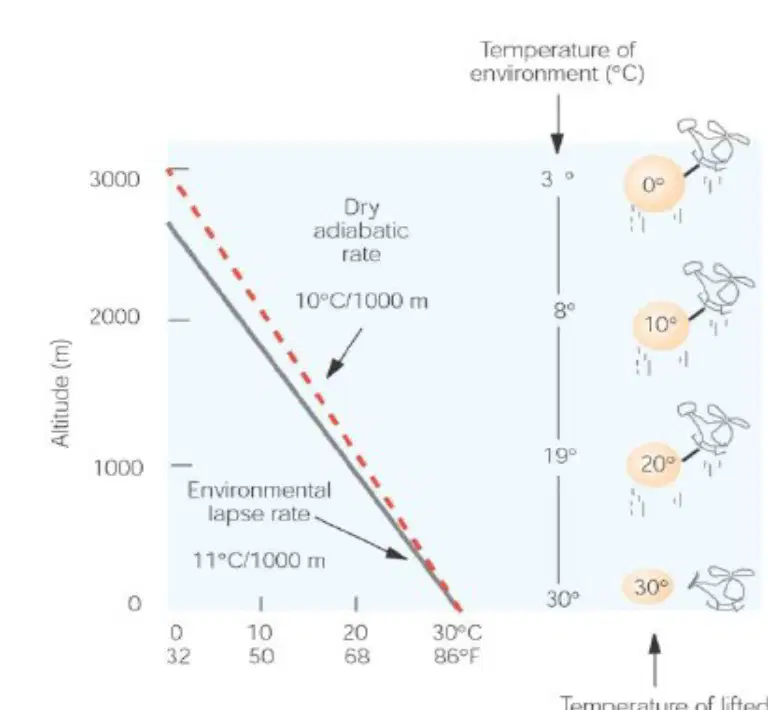
What is the condition for an absolutely unstable atmosphere?
Environmental lapse rate is smaller than the dry lapse rate.
Environmental lapse rate is equal to the dry lapse rate.
Environmental lapse rate is larger than the dry lapse rate.
Environmental lapse rate is equal to the moist lapse rate.
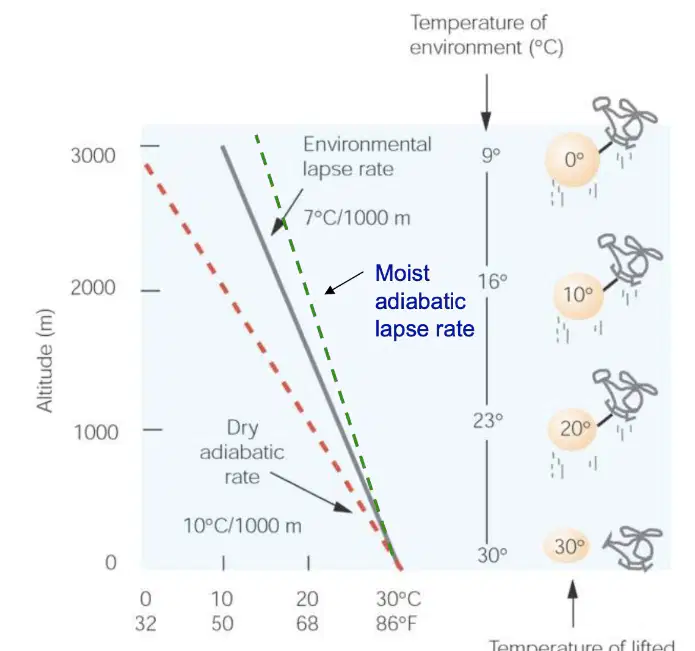
What is the environmental lapse rate in a conditionally unstable atmosphere?
It is higher than both dry and moist lapse rates.
It sits between the dry and moist lapse rates.
It is lower than both dry and moist lapse rates.
It is equal to the dry lapse rate.
If the environmental temperature is 25°C at the surface and 5°C at 1 km, what is the state of the atmosphere?
Absolutely stable
Conditionally stable
Absolutely unstable
Conditionally unstable
What is the formula for calculating the pressure gradient force?
Change in pressure divided by change in distance
Change in distance divided by change in pressure
Change in pressure multiplied by air density
Change in distance multiplied by air density
In which direction does the pressure gradient force always point?
From low to high pressure
From high to low pressure
From east to west
From west to east
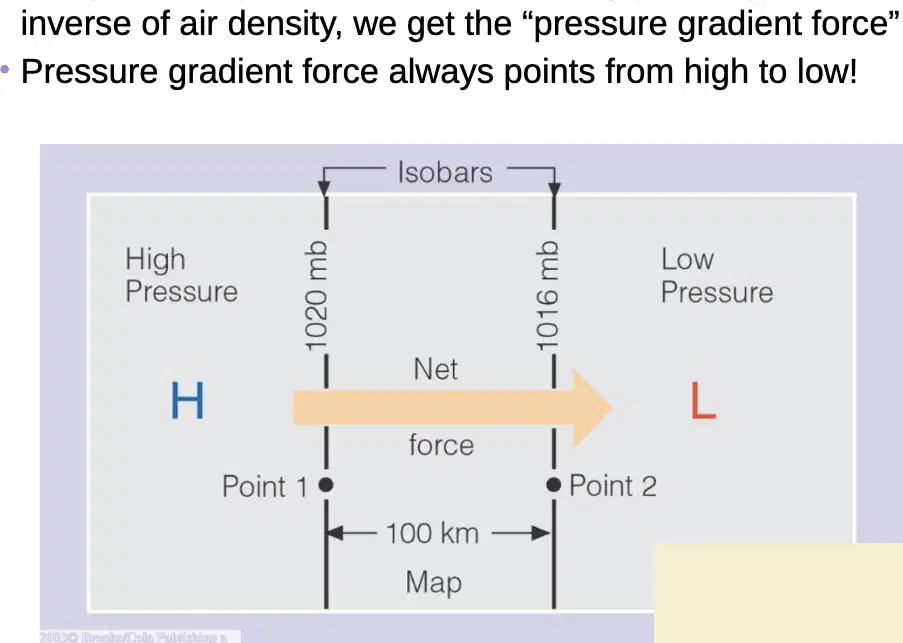
If the pressure difference between two stations is 500 Pa and the distance between them is 10,000 m, what is the pressure gradient force per mass? Assume the air density is 1 kg/m³.
0.05 N/kg
0.5 N/kg
5 N/kg
50 N/kg
What is the formula for calculating the Coriolis force?
Coriolis force = f * V
Coriolis force = V / f
Coriolis force = f + V
Coriolis force = f - V
What does the variable 'V' represent in the Coriolis force formula?
Velocity of light
Volume of air
Wind speed
Viscosity
How is the Coriolis parameter 'f' calculated?
f = 2 * Earth's rotational rate * sin(latitude)
f = Earth's rotational rate / sin(latitude)
f = 2 + Earth's rotational rate + sin(latitude)
f = Earth's rotational rate - sin(latitude)
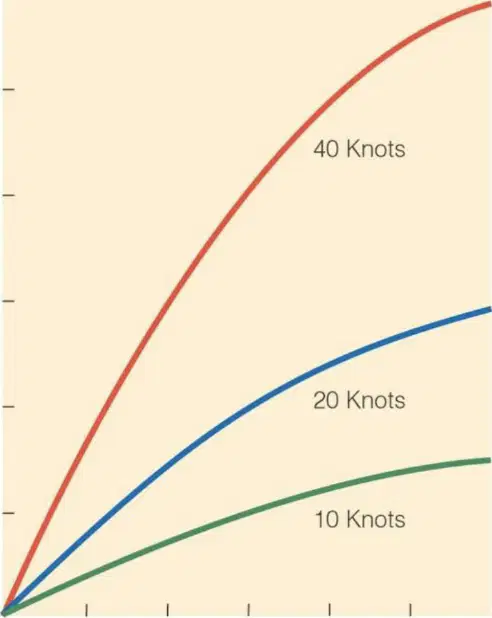
What is the Earth's rotational rate used in calculating the Coriolis parameter?
7.3 e-5 radians/sec
7.3 e-4 radians/sec
7.3 e-6 radians/sec
7.3 e-3 radians/sec
What is the Coriolis force?
A real force due to the Earth's gravity
An apparent force due to the rotation of the Earth
A force that affects the Earth's magnetic field
A force that influences ocean currents
How does the Coriolis force affect air parcels in the Northern Hemisphere?
Deflects them to the left
Deflects them to the right
Increases their speed
Decreases their speed
Where is the Coriolis force zero?
At the poles
At the equator
At mid-latitudes
In the Southern Hemisphere
What does the Coriolis force influence?
Wind speed
Wind direction
Temperature
Humidity
What is the formula for calculating centrifugal force?
CENTF = mV/R
CENTF = mV²/R
CENTF = mR²/V
CENTF = Rm/V²
In the formula CENTF = mV²/R, what does 'R' represent?
Radius of the Earth
Radius of curvature of the curved path
Radius of a circle
Radius of a sphere
Which direction does the centrifugal force point?
Towards the center of the curve
Away from the center of the curve
Parallel to the curve
Perpendicular to the curve
What happens to the centrifugal force if the speed increases and the curve of the path becomes tighter?
The centrifugal force decreases
The centrifugal force remains the same
The centrifugal force increases
The centrifugal force becomes zero
What is the formula for the frictional force (FF) that slows wind down?
FF = kV
FF = -kV
FF = k/V
FF = V/k
Which factors determine the magnitude of the frictional force on wind?
Temperature and humidity
Speed of the air parcel and roughness of the Earth's surface
Altitude and pressure
Density and volume
In which direction does the frictional force act relative to the movement of the air parcel?
In the same direction
Opposite to the movement
Perpendicular to the movement
At a 45-degree angle
In which layer of the atmosphere is the frictional force most important?
Stratosphere
Mesosphere
Friction layer (planetary boundary layer)
Thermosphere
What effect does the frictional force have on wind?
Changes wind direction
Increases wind speed
Slows wind down
Has no effect on wind
The Coriolis force _______ the wind speed.
increases
decreases
does not influence
stabilizes
In the southern hemisphere, the Coriolis force causes the air parcel to deflect to the ____ of the air parcel’s intended path.
right
left
center
top
The faster the speed and the tighter the curve of the path traveled, the ______ the centrifugal force.
smaller
larger
weaker
constant
Direction for the centrifugal force is always pointing ______ from the center of the curve.
towards
away
parallel
above
The friction force ______ on the speed of the air parcel.
increases
decreases
depends
stabilizes
The friction force is ______ the movement of the air parcel.
in line with
opposite to
parallel to
above
Geostrophic wind is ______ the constant pressure lines (isobars).
perpendicular to
parallel to
opposite to
above
The wavelength for the peak radiation emitted by the Earth is ______.
10 µm
5 µm
15 µm
20 µm
What is the dominant source of the Earth/atmosphere system’s energy?
Solar energy
Wind energy
Geothermal energy
Nuclear energy
If the temperature is lower, the saturation vapor pressure ______.
is lower
is higher
remains constant
doubles
Moist adiabatic lapse rate is always ______ the dry adiabatic lapse rate.
less than
greater than
equal to
double
The direction for the pressure gradient force is always pointing ____________.
from high pressure to low pressure
from low pressure to high pressure
parallel to the isobars
perpendicular to the isobars
During El Nino, the Southern Oscillation Index is ______.
negative
positive
zero
undefined

