Wayground logo

Free Printable Worksheets

Font size

S
M
L
XL
Worksheets

Energy and Natural Resources Test

Total questions: 30

Worksheet time: 15mins
Name
Class
Date
1.
What is the key difference between renewable and non-renewable resources?
a)
All non-renewable resources pollute the environment; renewable resources don't.
b)
Non-renewable resources must be refined before humans can use them; renewable resources don't.
c)
Non-renewable resources exist in unlimited quantities; renewable resources exist in limited quantities.
d)
Non-renewable resources cannot be regenerated in a human lifetime; renewable resources can.
2.
Which of the following is/are true of a synthetic resource?
a)
They are man-made
b)
They are always non-renewable
c)
They are not found in nature
d)
They are always made from petroleum
e)
They can be made from plant and animal materials
3.
How does recycling conserve natural resources?
a)
It allows us to re-use products instead of manufacturing new ones.
b)
It prevents garbage from being burned.
c)
It saves on the amount of fuel used by garbage trucks.
d)
It saves on the amount of plastic used to manufacture garbage bags.
4.
Why does fresh-squeezed orange juice have a more sustainable product life cycle than bottled orange juice?
a)
because bottled-juice oranges are harvested in Florida and shipped to Kentucky
b)
because anything fresh is always healthier than anything man-made
c)
because there are a fewer number of steps from the production to the disposal of the materials to make it
d)
because bottled orange juice is not alive anymore
5.
Which type of energy production relies on hot water from the earth to produce electricity?
a)
Solar energy
b)
Hydroelectric power
c)
Biomass energy
d)
Geothermal energy
6.
Which of the following is a disadvantage of using wind energy?
a)
There is potential for impact on bird populations
b)
A turbine only captures about 60% of total wind energy
c)
Turbines can disrupt natural scenery
d)
Wind energy can be intermittent and difficult to integrate into electrical grids
e)
All of these are disadvantages
7.
Which negative human environmental influence is matched to the positive influence that has helped to correct it?
a)
A. overhunting – pollution controls
b)
B. disposal problems – species preservation
c)
C. importation of organisms – energy conservation
d)
D. pesticide use – biological control of insects
8.
Water from nearby rivers or lakes is usually used to cool down the reactors in nuclear power plants. The release of this heated water back into the river or lake would most likely result in
a)
A. an increase in the sewage content in the water
b)
B. a change in the biodiversity in the water
c)
C. a change in the number of mutations in plants growing near the water
d)
D. a decrease in the amount of sunlight necessary for photosynthesis in the water
9.
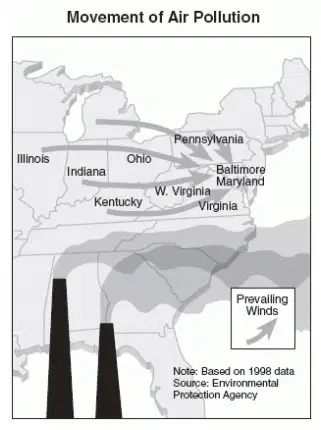
The map below shows the movement of some air pollution across part of the United States. Which statement is a correct inference that can be drawn from this information?
a)
A. Illinois produces more air pollution than the other states shown.
b)
B. The air pollution problem in Baltimore is increased by the addition of pollution from other areas.
c)
C. There are no air pollution problems in southern states.
d)
D. The air pollution problems in Virginia clear up quickly as the air moves toward the sea.
10.
Which human activity would most likely deplete finite resources?
a)
A. use of natural enemies to eliminate insect pests
b)
B. development of wildlife refuges
c)
C. governmental restriction of industrial pollution
d)
D. uncontrolled population growth
11.
Which of the following is an advantage of using solar energy?
a)
less energy is produced on cloudy days
b)
no energy is produced at night
c)
greenhouse gases are not produced
d)
solar cells come with a high cost
e)
a large surface area is required
12.
What is a large group of wind turbines used to capture wind energy called?
a)
wind farms
b)
high wind areas
c)
migration paths
13.
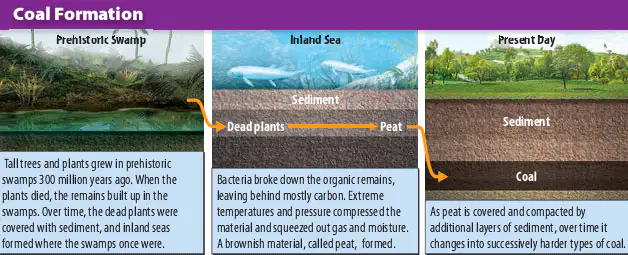
What situation in this figure showing the formation of coal would make it considered a non-renewable resource when it originally comes from biomass?
a)
The biomass that formed coal can only be found today in tropical rainforests.
b)
Coal formation took place 3 million years ago, so it is not practically renewable.
c)
There is not enough carbon dioxide in the atmosphere at this time to promote enough plant growth.
d)
There are no dinosaurs on earth today to form coal.
14.
Which of the following describes where oil comes from?
a)
gooey liquid from inside ancient volcanoes is pumped from deep in the ground
b)
it is from the blubber of ancient whales that lived millions of years ago
c)
microorganisms from prehistoric swamps undergo intense heat and pressure over millions of years
d)
the remains of dinosaurs are pressed into oil over millions of years
15.
How are synthetic products made from petroleum different from synthetic products made from plants and animals?
a)
Synthetic products made from petroleum are made from renewable resources whereas synthetic products made from plants and animals are made from non-renewable resources.
b)
Synthetic products made from petroleum are made from a non-renewable resource whereas synthetic products made from plants and animals are made from renewable resources.
c)
Synthetic products made from plants and animals are mined from the Earth while synthetic products made from petroleum are created in factories.
d)
Products made from plants and animals are never synthetic.
16.
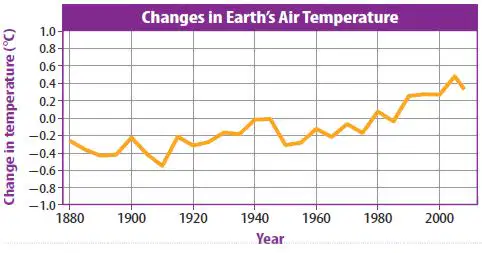
How has Earth's air temperature changed since 1880?
a)
It has remained constant.
b)
It has gotten warmer with some fluctuation.
c)
It has gotten constantly warmer.
d)
It has gotten cooler with some fluctuation.
17.
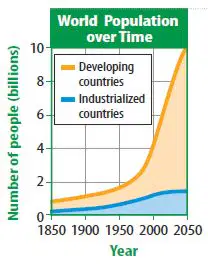
Why is the predicted change in human population a concern for climate change?
a)
Fewer resources will be used as the population increases.
b)
Earth will cool down as more resources are used.
c)
Greenhouse gases are likely to be depleted from the atmosphere as more resources are used.
d)
More greenhouse gases are likely to be added to the atmosphere as more resources are used.
18.
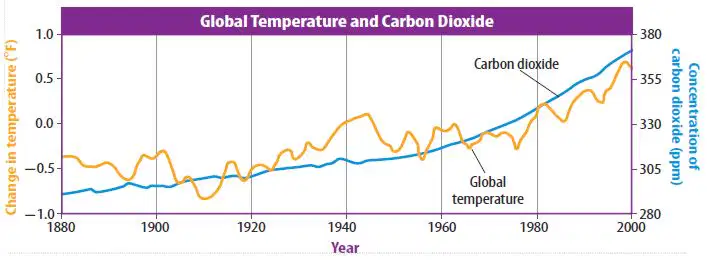
What does this graph illustrate?
a)
that temperature and concentration of carbon dioxide are correlated
b)
that temperature and concentration of carbon dioxide are not correlated
c)
that temperature increases when the concentration of carbon dioxide decreases
d)
that the concentration of carbon dioxide increases when temperature decreases
19.
What is a carbon footprint?
a)
How much carbon dioxide you breathe out over the course of one year.
b)
The amount of carbon dioxide that your lifestyle adds to the atmosphere each year.
c)
The amount of greenhouse gasses that your car generates each year.
20.

What is the primary reason for the increase in global sea levels?

a)

Increased volcanic activity

b)

Melting of polar ice caps and glaciers

c)

Decreased rainfall

d)

Expansion of ocean water due to cooling

21.

Which of the following is a consequence of deforestation?

a)

Increase in biodiversity

b)

Decrease in atmospheric carbon dioxide

c)

Loss of habitat for many species

d)

Increase in soil fertility

22.

What is the main component of natural gas?

a)

Methane

b)

Oxygen

c)

Carbon dioxide

d)

Nitrogen

23.

Which of the following is a potential consequence of ocean acidification?

a)

D. Enhanced growth of marine plants

b)

C. Decreased levels of atmospheric carbon dioxide

c)

B. Coral bleaching

d)

A. Increased fish populations

24.

What is the primary source of energy for the water cycle?

a)

C. Geothermal energy

b)

D. Tidal energy

c)

B. Solar energy

d)

A. Wind energy

25.

Which of the following is a benefit of using hydroelectric power?

a)

A. It produces greenhouse gases

b)

B. It relies on non-renewable resources

c)

D. It requires large amounts of fossil fuels

d)

C. It provides a consistent energy supply

26.

What is a major disadvantage of using fossil fuels for energy?

a)

B. They produce greenhouse gases

b)

D. They have no impact on the environment

c)

A. They are renewable resources

d)

C. They are abundant and easy to access

27.

Which of the following is a benefit of using wind energy?

a)

D. It requires a large amount of water

b)

C. It reduces dependency on fossil fuels

c)

B. It is a non-renewable resource

d)

A. It produces a large amount of waste

28.

What is a major environmental benefit of using electric vehicles?

a)

They require more fossil fuels.

b)

They increase air pollution.

c)

They emit fewer greenhouse gases.

d)

They produce more noise pollution.

29.

How does composting help reduce waste?

a)

It produces more greenhouse gases.

b)

It turns organic waste into a useful product.

c)

It increases the amount of landfill space needed.

d)

It requires more energy than traditional waste disposal.

30.

What is a primary benefit of using biofuels over fossil fuels?

a)

Biofuels can be produced from renewable resources

b)

Biofuels produce more greenhouse gases

c)

Biofuels are derived from non-renewable resources

d)

Biofuels are more energy-dense than fossil fuels