
 Worksheets
Semester Exam
Total questions: 50
Worksheet time: 29mins

Arnold takes a bus after school to a recreation center. If the trip takes 12 minutes, what is the average velocity of the bus?
0.5 miles/min
0.5 miles/min southeast
2 miles/min
2 miles/min southeast
Franklin wants to know how fast he runs different distances. He uses a stopwatch to measure the time it takes him to complete a 50-meter, 100-meter, and 200-meter race. How can he calculate his speed for each race?
Add the distances and the times.
Divide the distances by the times.
Multiply the distances by the time.
Subtract the distances from the times.

A ladybug traveled from Point 1 to Point 2 as shown in the picture. It took the ladybug 5 seconds (s) to travel 0.10 meters (m). At what speed was the ladybug traveling from Point 1 to Point 2?
0.02 m/s
0.10 m/s
0.5 m/s
50.0 m/s
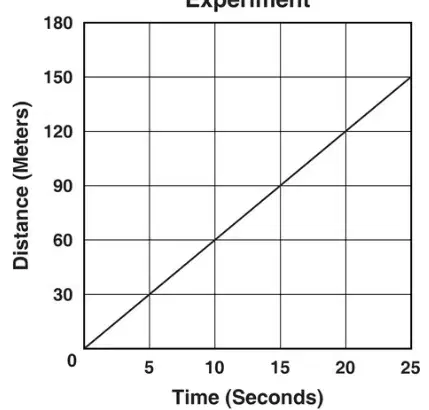
What was Terrell’s speed during the experiment?
5 m/s
6 m/s
30 m/s
150 m/s
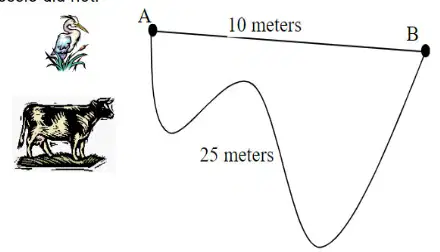
Bessie the cow and Sally the bird both traveled from point "A" to point "B." Sally traveled in a straight line and Bessie did not. What is the displacement of Bessie the cow?
25 meters
10 meters
35 meters
15 meters
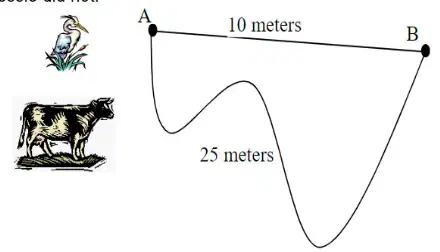
What distance does Sally the bird travel?
25 meters
10 meters
35 meters
15 meters
A car traveled at 55 mph east of the town. What is being described in this case?
distance
velocity
displacement
speed
When measuring volume, the unit that you use is
grams
milliliters
meters
None of the above
When measuring length, the unit that you should use is
meters
liters
grams
None of the above
When measuring mass, the unit that you should use is ________
liters
meters
grams
None of the above
A moving object has this type of energy
chemical potential energy
potential energy
kinetic energy
gravitational potential
Energy that is due to the gravitational force between objects
chemical potential energy
potential energy
kinetic energy
gravitational potential
Camille pushed a box with a force of 10 N. If it moved 55 meters, how much work did she do on the box?
350 J
400 J
450 J
550 J
A cow is given a growth hormone and then compared to another cow that was not given a growth hormone. Each cow was given the same amount of food and water and at the same time daily. Both cows’ weight is measured in 2 years. What is the dependent variable?
Each cow was given the same amount of food and water and at the same time daily.
A cow is given a growth hormone and then compared to another cow that was not given a growth hormone.
A cow not given growth hormones.
Both cows’ weight is measured in 2 years.
On 10 people, mosquito repellent is sprayed on one arm and the other arm is not sprayed. Each person was sprayed the same amount of repellent. The number of mosquito bites is counted after 2 hours. What is the independent variable?
The number of mosquito bites is counted after 2 hours.
On 10 people, mosquito repellent is sprayed on one arm and the other arm is not sprayed.
Each person was sprayed the same amount of repellent.
The arm not sprayed with mosquito repellent.
You want to test the blood pressure levels of a soldier. Every 30 minutes for an hour, you record the blood pressure while he is resting. You then record his blood pressure every 30 minutes for an hour when the soldier is exposed to a stressful environment. What is constant?
Test the blood pressure levels of a soldier.
time
Blood pressure while resting.
the environment
A couch is pulled on the left side with 10 N of force and on the right side, it’s pushed with 3 N of force. The net force acting on the couch is:
7 N to the left
13 N to the left
7 N to the right
13 N to the right
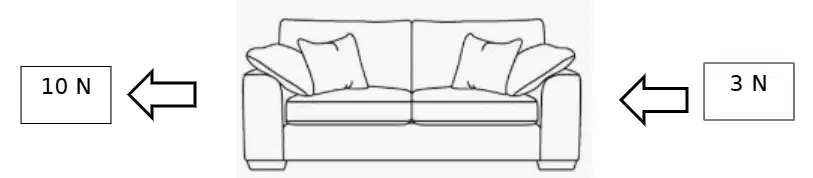
A couch is shown with two forces acting on it: 10 N to the left and 3 N to the right.
The couch will not move due to the force being equal or balanced.
The couch will move to the left due to an unbalanced force. The net force will be 13 N.
The couch will move to the left due to an unbalanced force. The net force will be 7 N.
The couch will move to the right due to a balanced force. The net force will be -7.
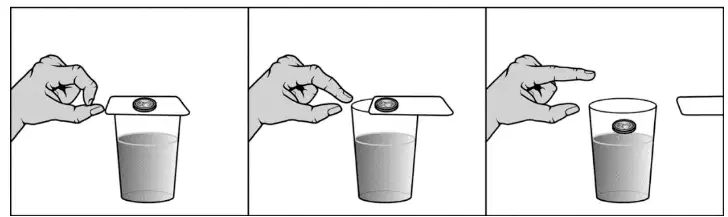
A smooth card is placed over a drinking glass. A penny is placed in the middle of the card. When the card is hit with the index finger, the card moves away, and the penny drops into the glass. Which statement best explains why the penny does not move in the same direction as the card?
There is an absence of friction between the penny and the card.
The penny has more inertia than the card.
The card exerts too much force on the penny.
There is a little gravity between the card and the penny.
What are electromagnetic waves?
Waves created by vibrating electric charges that can travel through a vacuum or through matter.
The process by which an object is made to vibrate by absorbing energy at natural frequencies.
A point in a standing wave at which the interfering waves always cancel.
A wave pattern that forms when waves of equal wavelength and amplitude, but traveling in opposite directions, continuously interfere with each other.
Microwaves are:
a type of sound wave
a type of electromagnetic wave
a type of mechanical wave
a type of gravitational wave
What are gamma rays?
They have the longest wavelength with the lowest frequency and have the least energy. They carry television, radio, & cell phone signals.
These waves will cook your popcorn in just a few minutes, but they're also used by astronomers to learn about the structure of nearby galaxies.
Used in remote controls to change the channel on your television. All warm bodies give off these waves. Used in night vision goggles. They can be used for seeing people in the dark.
Doctors use these waves to see inside your body. These are the shortest waves with the highest frequency and have the most amount of energy. They are used on some foods to kill bacteria that make food spoil quickly.
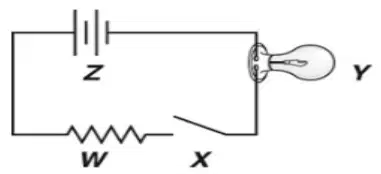
Refer to the diagram of the electric circuit with components labeled W, X, Y, and Z. What is the function of component X?
Causes resistance to electric current
Opens and closes the circuit.
Provides an energy source for the circuit.
Allows a path for the current to flow.
Electric circuits provide energy for lightbulbs. Which of these prevents the flow of electrons?
a circuit that is closed
a series circuit
a circuit that is open
a parallel circuit
What happens when you turn off a light switch?
The circuit opens, and the electrons stop flowing.
The circuit opens, and the electrons keeps flowing.
The circuit closes, and the electrons stop flowing.
The circuit closes, and the electrons keeps flowing.
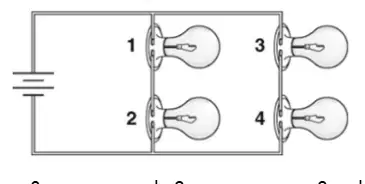
If Bulb 1 burns out, which other bulb(s) will also stop emitting light?
2
3
3 and 4
2, 3, and 4
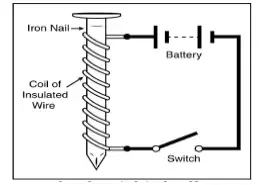
What will most likely happen when the switch is closed while the nail acts as a bar magnet?
A magnetic field will be produced.
The iron in the nail will break down.
The battery’s charge will be depleted.
Rusting will be immediately observed.

Velocity is speed with __________________________.
a unicycle helmet
direction
fight
What is energy?
The ability to do work
A force
Electricity
The ability to transform work

Pancho's hands are cold. Which is the best way for Pancho to warm his hands?
Hold them above his head.
Shake them in the air.
Spread his fingers far apart.
Rub them together.
How do the particles behave when heat is being added?
They stay in place
they gain a lot of energy and bounce all over
they join together to solidify
Mechanical waves that travel through a medium moving back and forth in the same direction the wave travels
Longitudinal wave
Transverse wave
Surface wave
A substance (like solid, liquid or gas) that the energy of a wave can travel through
amplitude
compression
medium
frequency
The top of something; sometimes called a "peak"
trough
amplitude
compression
crest
The state of being squeezed or pressed together.
compression
trough
amplitude
wavelength
Mechanical waves that travel through a medium moving perpendicular to the motion of the wave.
Transverse wave
Surface wave
Longitudinal wave
medium
The area around the lowest point of a wave.
medium
crest
amplitude
trough
The area of a longitudinal wave where the particles are crowded together.
compression
crest
transverse
medium

Longitudinal Wave
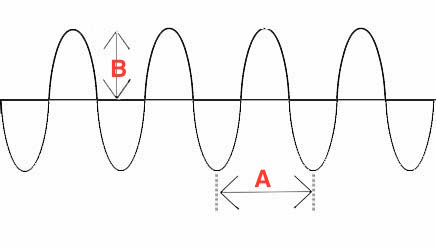
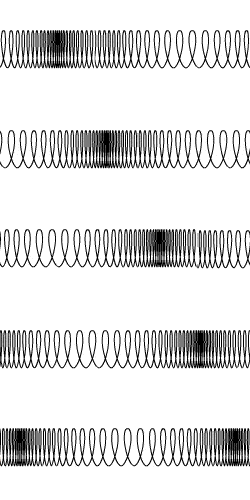
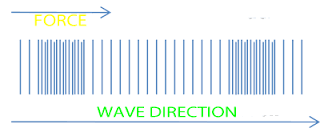
What type of waves have compressions?
Which electromagnetic waves have the longest wavelengths and lowest frequencies?
infrared waves
radio waves
gamma rays
ultraviolet rays
The electromagnetic waves with the highest frequencies are called
radio waves.
gamma rays.
X-rays.
visible light.
The range of electromagnetic waves placed in a certain order is called the
electromagnetic spectrum.
electromagnetic wavelength.
electromagnetic frequency.
electromagnetic field.
Radio waves carry information from a broadcasting station to your radio or television.
True
False
Global Positioning System signals can tell you....
what television station you are tuned to.
your exact location on Earth.
how many satellites are in orbit.
who is sending a message to your pager.

What does this image show?
Parallel circuit
Series circuit
Magnet
Electromagnet

