
NEW
Font size
 Worksheets
Nitrogen Cycle, Soil Triangle, Soil Horizons
Total questions: 15
Worksheet time: 8mins
1. This process converts nitrogen gas (N₂) from the atmosphere into ammonia (NH₃) or ammonium (NH₄⁺), which can be used by plants.
Nitrification
Nitrogen Fixation
Assimilation
Denitrification
2. Which process involves the conversion of ammonia (NH₃) into nitrite (NO₂⁻) and then into nitrate (NO₃⁻)?
Assimilation
Nitrification
Nitrogen Fixation
Denitrification
3. What is the process by which plants absorb nitrates from the soil and incorporate them into plant proteins?
Assimilation
Nitrogen Fixation
Nitrification
Denitrification
4. Which process reduces nitrates back into nitrogen gas (N₂), releasing it into the atmosphere?
Assimilation
Nitrification
Nitrogen Fixation
Denitrification
This process occurs when decomposers break down organic nitrogen compounds from dead organisms and waste, converting them into ammonia (NH₃) or ammonium (NH₄⁺).
This topmost soil layer is rich in organic material like decomposed leaves and plant matter, often dark and loose in texture. Known as the organic layer.
O
A
B
C
This layer, just beneath the organic-rich surface, is where most plant roots grow and biological activity occurs; it contains a mix of decomposed organic material (humus) and minerals. Also known as the topsoil.
O
A
B
C
This layer accumulates materials like clay, iron, and minerals that leach down from the layers above. It has very little organic material. Also known as the subsoil.
O
A
B
C
This deepest layer consists mostly of weathered parent rock and has little to no organic material; it's the foundation for soil development. Sometimes called bedrock.
O
A
B
C
Which of the following is the correct order of soil particles in order of increasing particle size?
clay-sand-silt
sand-clay-silt
silt-clay-sand
clay-silt-sand
Which of the following has the least permeability?
Clay
Loam
Sand
Silt
Which soil component has the least capacity for holding water?
Silt
Sand
Clay
Humus
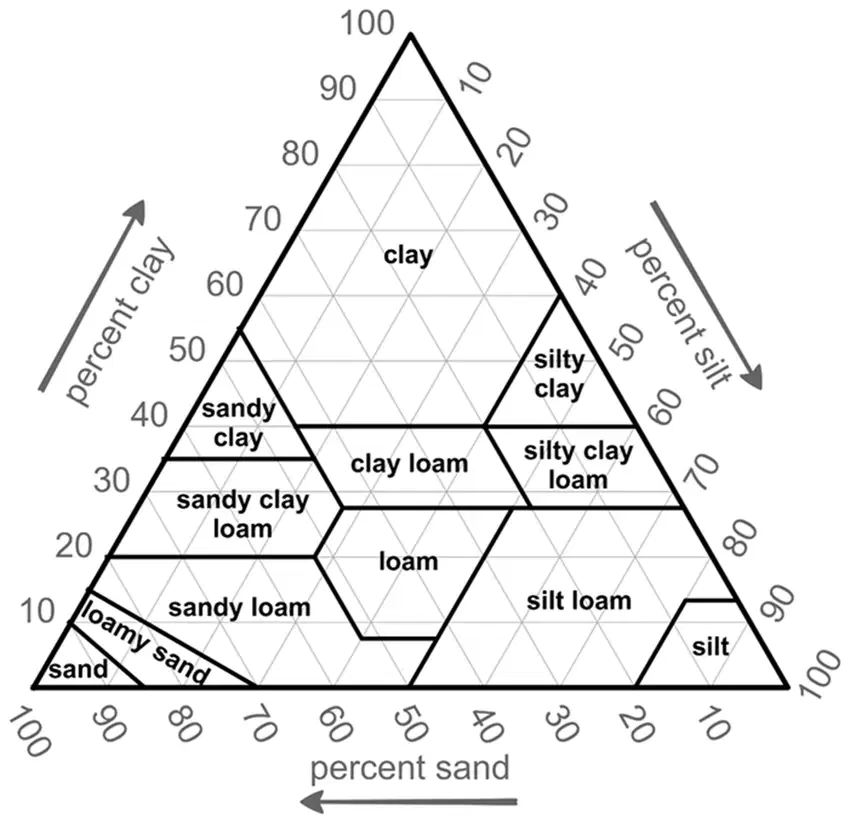
Which soil has 40% sand, 30% silt, and 30% clay?
Loam
Sandy Clay Loam
Clay Loam
Clay
What type of soil contains 40% sand, 50% silt, and 10% clay?
Clay
Sandy Loam
Silt Loam
Clay Loam
Soils that hold water well typically have a lot of?
clay
silt
sand
loam

