
 Worksheets
Sanitation 2
Total questions: 50
Worksheet time: 28mins
Urinals are fitted in non-domestic buildings such as schools, cinemas, pubs, and offices. Which of the following is NOT a basic design of urinals?
Bowl
Trough
Slab
Sink
Urinals are found in three basic designs: ________, Trough, and Slab.
Bowl
Panel
Column
Tube
List the three basic designs of urinals mentioned in the passage.
Bowl, Trough, Slab
Bowl, Sink, Pan
Trough, Sink, Basin
Slab, Pan, Basin
According to the passage, why is the bowl urinal very common?
It is cheap
It is easy to install
It is waterless
It is large
The bowl lip is set at around ______ high for an adult urinal.
600mm
450mm
750mm
900mm
The bowl lip is set at around ______ high for junior urinals.
500mm
300mm
700mm
900mm
Privacy dividers are placed in between each bowl in bowl urinals.
True
False
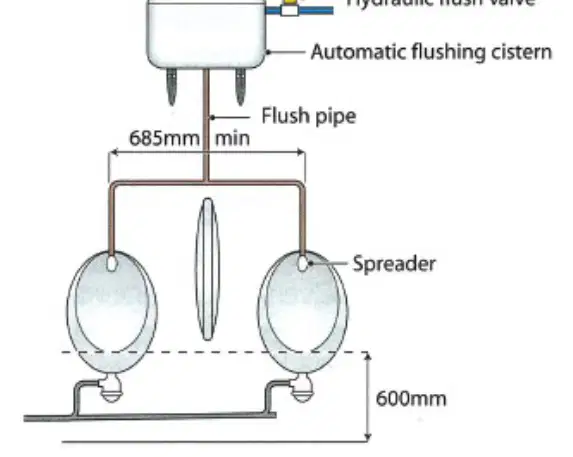
According to the diagram, what is the minimum distance between the two urinals?
500mm
600mm
685mm
700mm
What material are trough urinals generally made from?
Stainless steel
Plastic
Wood
Ceramic
Why are trough urinals installed in certain locations?
For decoration
Where there could be a risk of vandalism
To save water
For privacy
How are trough urinals sized?
According to the number of users
According to the height of the wall
According to the color of tiles
According to the type of flush used
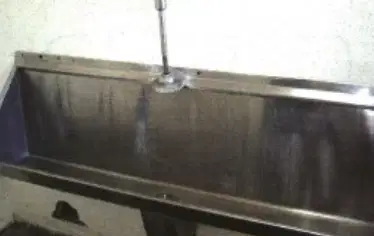
How many waste connections does the trough have?
(a)
What material are slab urinals manufactured from?
Plastic
Fire clay
Metal
Glass
The base channel of a slab urinal has a slight fall towards the ________, which is connected directly to the drain via a gulley trap.
waste
floor
ceiling
vent
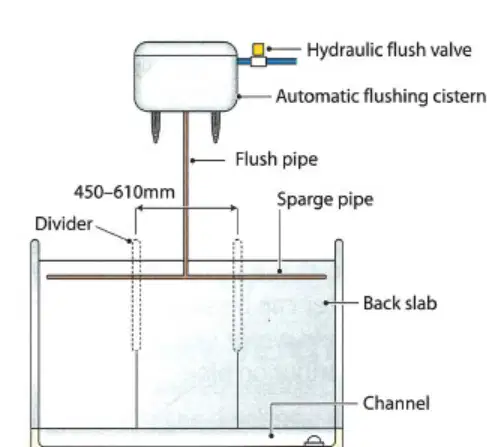
What is the function of the sparge pipe in a slab urinal?
To divide the slabs
To wash the face of the slab
To collect waste
To support the back slab
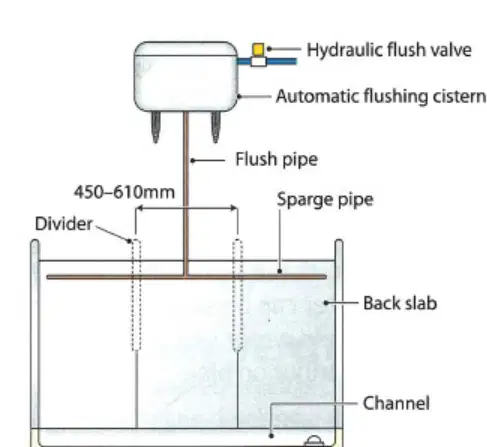
Part of the flush pipe is mounted on the face of the slab and has a number of holes to wash the face of the slab. This is called the ________.
sparge pipe
vent pipe
soil pipe
waste pipe
According to the Water Regulations, how can a urinal be flushed?
Only manually
Only automatically
Either manually or automatically
Only with a flushing valve
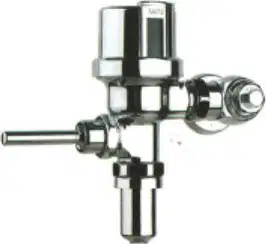
What is the function of a flushing valve in a urinal?
It delivers 1.5 litres of water to an individual bowl when the lever is pressed or the infrared sensor is activated.
It heats the water in the urinal.
It adds soap to the water.
It removes waste from the urinal automatically.
What allows siphonic action to start in an automatic flushing cistern?
A reduction in pressure in the main housing.
An increase in water temperature.
The presence of air bubbles in the siphon tube.
A blockage in the outlet pipe.
When does siphonic action stop in an automatic flushing cistern?
When air is introduced.
When water is added.
When the handle is pressed.
When the outlet is closed.
According to the Water Regulations, what is the flushing volume from an automatic flushing cistern for a single bowl or stall?
5 litres/hour
10 litres/hour
7.5 litres/hour
15 litres/hour
According to the Water Regulations, what is the flushing volume from an automatic flushing cistern for each position if multiple urinals are installed?
10 litres/hour
5 litres/hour
7.5 litres/hour
12 litres/hour
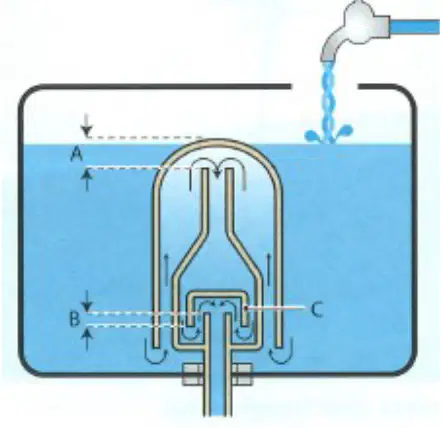
What happens when the water level reaches the top of the dome in an automatic flushing cistern?
The water stops flowing
The head of water at point A becomes greater than the pressure at point B, starting the siphonic action
The urinal overflows
The trap at point C closes
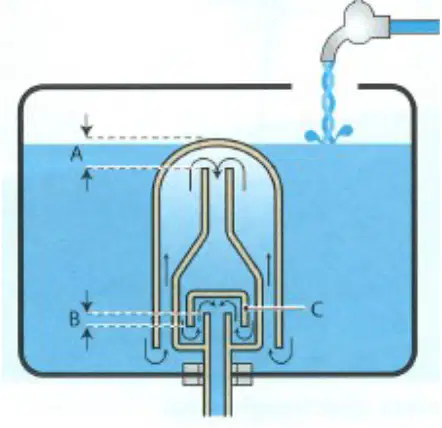
The trap is pushed out at which point?
Point A
Point B
Point C
Point D
How many types of urinals are there?
Three types
One type
Two types
Four types
Bowl and trough urinals are connected to a soil stack via what?
A trap and discharge branch
A vent pipe
A rainwater pipe
A waste pipe
What is the minimum waste size for urinals?
32mm
25mm
40mm
50mm
Do urinals have an overflow?
True
False
What type of waste is used for urinals?
Raise and unslotted waste
Slotted waste
Bottle trap waste
Floor trap waste
What is the feed size to the cistern for urinals?
(a)
What are bidets often described as?
sit-on wash basin
hand dryer
toilet paper holder
soap dispenser
What material are bidets made of?
vitreous china
plastic
wood
stainless steel
Which of the following is NOT a way bidets can be mounted?
Floor-mounted
Wall hung
Ceiling mounted
Back to wall
If a bidet is wall hung, what may it require?
Additional support brackets
Extra water filters
Heated seat covers
Automatic air fresheners
Which of the following are the two designs of bidets supplied?
Over the rim bidet and Ascending spray bidet
Floor-mounted and Wall hung
Sit-on wash basin and WC pan
Vitreous china and Porcelain
Over the rim bidets are installed the same way as a ________.
basin
toilet
bathtub
shower
Over the rim bidets present less of a water contamination risk compared to other types of bidets.
True
False
What must be maintained when connecting an over the rim bidet to a mains fed system?
AUK2 air gap
Double check valve
Flexible hose connector
Non-return valve
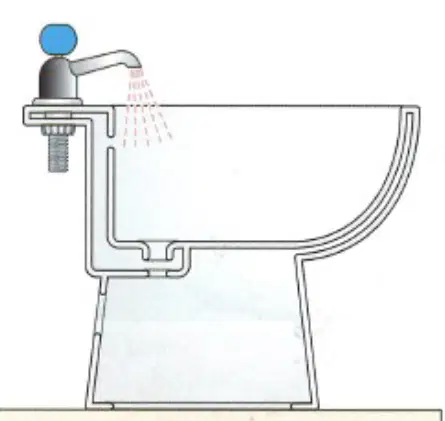
Over the rim bidets: Why is it important to maintain the AUK2 air gap between the spill over level of the sanitary appliance and the outlet of the tap?
To prevent water wastage
To maintain hygiene and prevent contamination
To increase water pressure
To reduce noise
What is a characteristic of ascending spray bidets?
They are very common in the UK
They use a special mixer tap to spray upwards from the base of the bowl
They do not require any special installation considerations
They can be connected to mains fed systems
Ascending spray bidets are as common in the UK as in other countries.
True
False
Why can ascending spray bidets not be connected to mains fed systems?
Because of the risk of contamination of the mains water supply
Because they require a higher water pressure
Because they are not compatible with modern plumbing
Because they are too expensive to install
As there is no air gap present between the spillover level of the appliance and the outlet of the spray, these appliances cannot be connected to ________.
Why do ascending spray bidets require a feed from the cold water storage cistern?
Because they have an air gap
Because they cannot be connected to mains fed systems
Because they use hot water only
Because they are electric
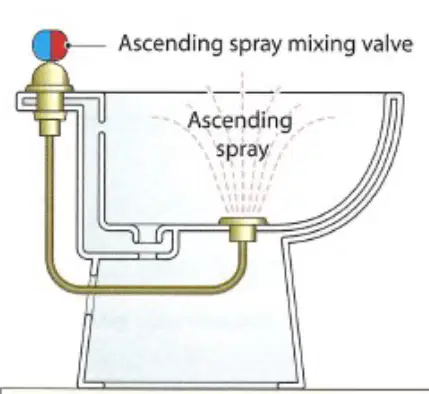
The function of the ascending spray mixing valve in the diagram of the ascending spray bidet is to:
Control the direction of the spray
Mix hot and cold water for the spray
Regulate the water pressure
Filter impurities from the water
What is a potential risk associated with bidets?
Risk of contamination
Improved hygiene
Reduced water usage
Enhanced comfort
Which type of spray is associated with cistern fed bidets?
Ascending spray
Descending spray
Rotary spray
Mist spray
Do bidets have an integral overflow?
True
False
What is the minimum waste size required for bidets?
32mm
25mm
40mm
50mm
How are bidets connected to a soil stack?
Via a trap and discharge branch
Directly without a trap
Using only a vent pipe
By connecting to the rainwater downpipe

